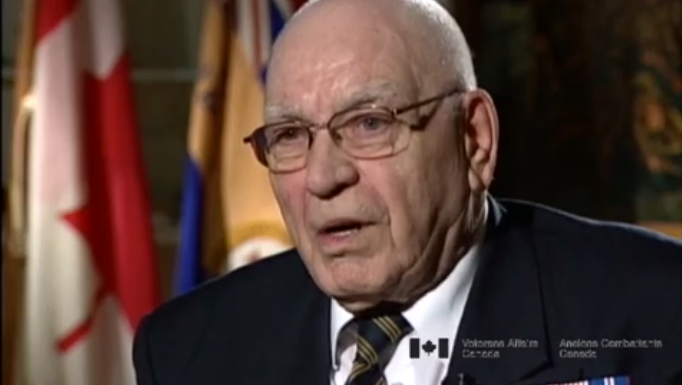
Description
Mr. Yarnell recalls that the instructors and the training were both excellent. He also recalls a story about one of his students freezing up at the controls and spinning at 10,000 feet.
Cyrill St. Clair (Cy) Yarnell
M. Yarnell est né le 9 août 1920 à Carlow, en Irlande. Il a déménagé au Canada à l'âge de 8 ans. Il s'est enrôlé dans l'Aviation royale du Canada (ARC) en 1940 à l'âge de 20 ans. Il a suivi la formation initiale de pilote à Victoriaville (Québec), où il a appris à piloter le Fleet Finch pour enfin maîtriser le Harvard. Il a suivi la formation d'instructeur de vol à Trenton et formé des pilotes d'un grand nombre de pays. Après avoir été instructeur pendant un an, M. Yarnell a été envoyé outre-mer. Il a effectué des missions aériennes au-dessus de l'Afrique du Nord, de l'Italie et de l'Allemagne et participé aux batailles de la vallée du Liri et de Monte Cassino. Après la guerre, il est demeuré dans l'Aviation royale du Canada (ARC). Lorsqu'il a pris sa retraite de l'ARC en 1975, M. Yarnell avait le grade de colonel. Il est membre de l'Association des Forces aériennes du Canada et participe activement aux activités du musée de l'Aviation de Trenton. M. Yarnell et son épouse, Phyllis, ont trois enfants, sept petits-enfants et un arrière-petit-enfant.
Transcription
Thank goodness the training I received was excellent, the instructors I had were excellent. One of the students I had was a big American fellow from Texas, I won’t tell you his name, but he was a huge man and he looked not unlike a gorilla. His arms were so long he could scratch his ankles without bending over. He was a big man. I had him in the front seat and I was teaching him to spin the aircraft and to spin the aircraft there is a routine for recovery. He froze on the controls, he actually froze in the spin position which was full right rudder and I was not powerful enough to overcome his strength and we started spinning at about 10,000 feet. (Interviewer: It’s a spin like a corkscrew? ) Yeah, going down in a spin. And at 8,000 I’m saying you know, “Release, release.” And he kept going, I said, “I have control, I have control.” He kept going and finally I realized when I had passed through about 5,000 feet, I realized I had to do something here or we’re gonna go straight in. So what I did was I immediately dropped the under cart of the aircraft and dropped the flaps and that was enough to lurch the aircraft and disengage him from the controls and I was able to recover. And so we did. And we went back up and did it again and did it again until he overcome this initial fright. Oh yes, and he was great.
Oh all the boys, all the fellows will tell you stories like this, who were instructors, ground looping on landing, incidents in night flying, formation flying where you’re flying on another wing, with your wing a foot or two from another aircraft, oh yeah. But, but it really sounds more dangerous than it is, really is.