Attention!
Cette vidéo est disponible en anglais seulement.
Description
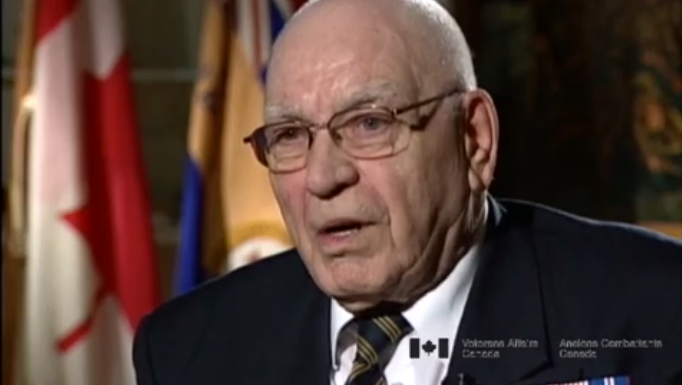
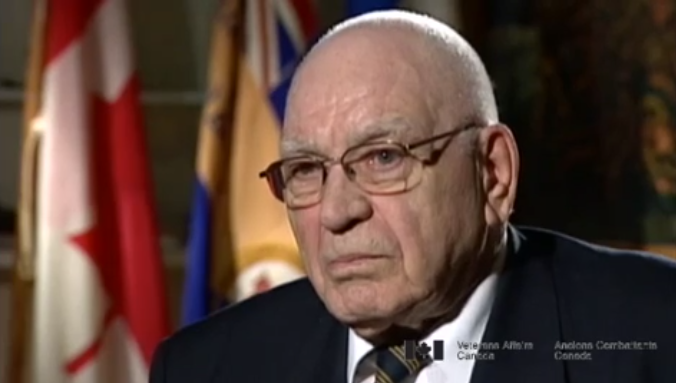
Mr. Rohmer discusses how their operations changed as D-Day approached. He also describes his involvement with a flying circus that was being used to educate the ground troops.
Transcription
As we approached D-Day, we were informed that we would know when D-Day was coming, we didn't know where it was going to happen. We would know when it was coming because we would be ordered to paint black and white stripes on our air planes in order to identify us visually to people on the ground or people in the air as Allied. And so the day before D-Day we were ordered to paint our air planes. So we knew that D-Day was about to happen. That night, the night of the 5th, June the 5th, our Group Captain Ernie Moncrief (sp) briefed us all saying "This is what's happening, tomorrow morning landing craft will be hitting the beaches at Normandy and our role is to be there to support them with reconnaissance, all the things that we have been trained to do." So we knew exactly at that point where the invasion was going to be. And we had painted the air planes with their black and white stripes around the fuselage at the tail and around the wing routes, very effective. But before D-Day, I think it was in April, the beginning of May, I had been sent to a place called Thorny Island, on the south coast of England, an airfield there to join a flying circus. And the flying circus was comprised of one fighter aircraft of each of the types we were going to use on D-Day. American, and British and Canadian. And the flying circus, its role was to overfly gatherings of troops gathered on the ground so that they would be able to see us, say "Ah, that is a Spitfire, I will not fire on it on D-Day or thereafter." Or "That's a Mustang" or "It's a P38, it's a Lighting" or "It's a Thunderbolt". We had a big gang. So we toured Southern England, over flying these gatherings of troops for about a week.
Catégories
The Flying Circus
Médium
Video
Propriétaire
Veterans Affairs Canada
Guerre ou mission
Seconde Guerre mondiale
Emplacement géographique
Europe
Campagne
La bataille de Normandie
Personne interviewée
Richard Heath Rohmer
Branche
Aviation
Unité ou navire
403<sup>e</sup> Escadron
Military Rank
Major général
Occupation
Pilote
Durée
02:38