Attention!
Cette vidéo est disponible en anglais seulement.
Description
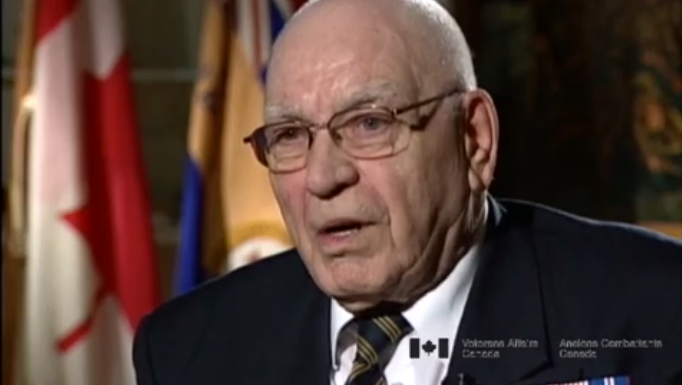
Mr. Smith and four others from the 4th Brigade were selected, to develop a system for crossing tidal estuaries along the coast of France.
Transcription
We, we were selected to be an assault division, or certainly 4th Brigade was, of a tidal, of an assault crossing of a tidal-estuary. So they sent us up to the Humber River, I think it was the Humber, a big tidal-estuary river, that had an enormous bed of silt and we practised doing assault crossings here. One of the things we had to do was get an observation party. The infantry would go across in K-pot boats. We had to get across in a low profile deal so, and get established on the other side so we could direct the fire to support them. So, we were left to invent our own system and what we did was, we, we marched the last couple of miles up to the river at night and we had a ten foot square tarp on and we took off our boots and our four rifles with a boot over each end of the rifle, laid them down in a square, put our signal sets and our reels of wire and all our personal kit, particularly our radios, in the centre of the square and then we laced the square up and that was our pontoon, then we swam across. In order to find our own boots each of us tied something different on the shoelaces. I think mine were little pieces of leather lace and everybody had a piece of rag or some damn thing, so in the dark you could find your own boots. Then we swam across, the four of us, pushing that ahead of us and that, we didn't make any wake or any noise and that was very effective. But by the time the 2nd division came to do actual assault river crossings with tidal-estuary, everybody was either dead or wounded of all those people that were trained. But that was the one special thing we were done. We think their tidal-estuaries along the French coast, were mostly crossed and eventually, farther up where it wasn't tidal anymore. Maybe they found it was just too damn hard.
Catégories
Crossing the Tidal Estuary
Médium
Video
Propriétaire
Veterans Affairs Canada
Guerre ou mission
Seconde Guerre mondiale
Personne interviewée
Arthur Britton “Britt” Smith
Branche
Armée
Unité ou navire
4<sup>e</sup> Régiment d'artillerie de campagne
Military Rank
Capitaine
Occupation
Gunnery Officer
Durée
02:13