Description
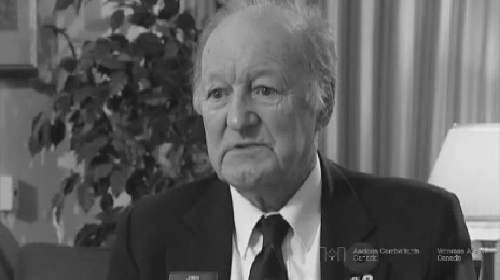
Mr. Raymond describes the Normandy landing, the atmosphere during the Channel crossing and the noise when they approached the beach.
Jacques Raymond
Né à Trois-Rivières, Jacques Raymond a perdu son père alors qu’il était très jeune. Il a été placé à l’orphelinat avec un de ses frères, sa mère ne pouvant s’occuper de ses sept enfants toute seule. À 17 ans, il revient à Trois-Rivières travailler à la Wabasso, une usine de coton. Lorsque la guerre éclate, il reçoit une lettre lui demandant de passer des examens à Longueuil. Il débute sa formation de deux mois à Valleyfield. Il passe six mois dans l’Ouest canadien, où il apprend l’anglais et où il poursuit sa formation. Il part d’Halifax au début de 1943 à bord du Nieuw Amsterdam vers Greenock, en Écosse, pour continuer sa formation. Il participe au débarquement de Normandie avec le Régiment de la Chaudière. Il participe aussi aux batailles de Carpiquet, de Falaise, de Caen et traverse la Belgique et la Hollande. Il se rend même jusqu’en Allemagne. Il est resté onze mois en Europe.
Transcription
The Normandy invasion…We saw convoys arriving every day. I was there about six weeks before D-Day. Every day, miles and miles of tank convoys were heading for the coast, in Glasgow, Southampton and everywhere to board ships for the invasion. And there were the thundering noises of everything involved in the invasion. I landed more or less with the second wave. Because when they say that they landed, there were ten of them that landed, they weren’t the only ones landing. There was a whole host of people landing—135,000 or 150,000. You couldn’t just land one wave. So I landed with another group and, again, I was lucky. The larger group ahead had fallen. Let’s say that the enemy resistance was weaker. I rejoined my battalion, on the other side, after having climbed the barricade, as others did, to regroup. My regiment, La Chaudière, in the first hour, or over the course of two or perhaps three or four hours in all, lost 113 men on that first day. Half were dead and half of them were wounded. That was one of the biggest losses. However, there were 2,000 Canadians in the group that we were in and, according to the experts, the losses were minimal, compared to what they thought it would take to land. But, all the same, on that day we lost 113. At least, there were some who were wounded more, some less, and others who returned to combat but . . . on that first day there were 58 dead. That’s official.Atmosphere on the beach before landing …We were so crammed together and so anxious to land that we weren’t thinking. All that we heard was a thundering noise. Everything that happened, the aircraft overhead and the boats that were firing over the top of us and the Germans who were returning fire. You had to have been there to know that it was almost unimaginable . . . it took nerves to get through that. But the only urgency for us was to land. We knew that we could not go back, we had to land. But, thinking back over it, there was so much noise, the thundering of the aircraft . . . It lasted . . . before we could land, from what I saw, with the noise, it’s true that crossing the Channel took perhaps about two or two-and-a-half hours, because it’s about 20 kilometres, but the final hour was hell because that’s when the troops were landing and you had to run like crazy to take cover. There was so much barbed wire as well as all kinds of . . . the Germans had set up an entire defensive system . . . but we could get by it. It was probably to stop the landing craft from getting closer. We were under such withering fire, but we didn’t think about it. All we thought about was getting across the sand and getting through the houses to take cover. It was complete chaos. Because of being nervous, nobody was talking. They were shouting and screaming. It was seven or eight hours after we landed on the beach and managed to climb the slope, before we started regrouping; there were those who had gone off and some who were lost all over the place . . . it was a mad rush, there were those who . . . who had gone off in the wrong direction. When you arrive somewhere and you don’t know the place . . . it’s not easy . . . you land on a cliff. Then there were those who stayed hidden, and with good reason, looking for their buddies, because you couldn’t advance when you knew the Germans were everywhere. At that time, they were everywhere. However, we eventually got reorganized. It took a few hours before we were back together, more or less, and we saw that there were some guys who were not there. We questioned each other. Such and such a person was not there; this other person was there; this person was not seen . . . It was what you would call the first big blow. But after that, we gradually got used to it. There’s nothing funny about it, but one day we would lose two guys and some days we didn’t lose any. There were some days when five, 10 or 15 were wounded and five were killed.