Description
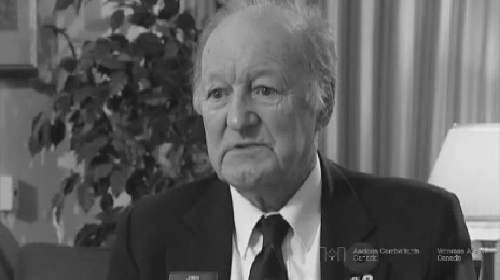
Mr. Raymond recounts the Battle of Carpiquet, France, where a dozen of his fellow soldiers were found hanged by the Germans, and the battle of Falaise, with Rommel’s Panzers.
Jacques Raymond
Né à Trois-Rivières, Jacques Raymond a perdu son père alors qu’il était très jeune. Il a été placé à l’orphelinat avec un de ses frères, sa mère ne pouvant s’occuper de ses sept enfants toute seule. À 17 ans, il revient à Trois-Rivières travailler à la Wabasso, une usine de coton. Lorsque la guerre éclate, il reçoit une lettre lui demandant de passer des examens à Longueuil. Il débute sa formation de deux mois à Valleyfield. Il passe six mois dans l’Ouest canadien, où il apprend l’anglais et où il poursuit sa formation. Il part d’Halifax au début de 1943 à bord du Nieuw Amsterdam vers Greenock, en Écosse, pour continuer sa formation. Il participe au débarquement de Normandie avec le Régiment de la Chaudière. Il participe aussi aux batailles de Carpiquet, de Falaise, de Caen et traverse la Belgique et la Hollande. Il se rend même jusqu’en Allemagne. Il est resté onze mois en Europe.
Transcription
Carpiquet and FalaiseWe— the Régiment de la Chaudière— were involved in the fighting in Caen, and the Battle of Carpiquet. Just last year, they put up a marker for us “l’enfer de Carpiquet “ [the Carpiquet inferno]. This was put up because it was an airfield and, while the Germans were in control of it, they used it to go on bombing raids, and the aircraft landed there. It was close. It took three weeks before we were able to take control of the airfield. We lost a lot of men in that battle. I think there were two full brigades fighting for it . . . the Germans had held fast. After that, it was convenient for our armies, because they could leave from England to land and then go on bombing raids in Germany. It was because it was an airfield . . . the Germans were well dug in and they were quite heavily armed with 88s, which were the best of their guns. There were some young guys, some men, as well as some SS, the notorious and well-trained SS, who were really out of their minds, fighters, who pushed . . . They fought, and there was some hand-to-hand fighting. I was not involved in it, but there was some hand-to-hand combat, because we kept getting closer and closer to the Germans. What we saw there forced us to become a bit more warlike. It was a bad situation. A dozen of our guys from La Chaudière had been taken prisoner and hanged. They were found hanging from trees. That’s war; they call it cruel and it’s not exactly what you usually see in books . . . but we retaliated in much the same way. Those are things that you really don’t see often in books. But when they did things like that, we did the same thing. They say, “That’s war.” But that tended to be what got to us and drove us on a bit further, giving us the killer instinct . . . we were successful, all the same, because with the tanks and the guns helping us, we managed to take the airfield. It took at least three weeks. After that, there was the Battle of Falaise. Falaise was easier, although it was mainly a battle of tanks or aircraft, because Rommel, with his army, was supposed to throw us back into the sea at that time. Hitler had ordered Rommel, his best commander, to . . . he arrived with his panzer division, as it was known, but what they didn’t consider was that, compared to other tanks, panzers had the biggest engines. The panzers weighed over 50 tons each, and when the aircraft started to machine-gun them, if they managed to stop the first ones and to hit the last ones, they would end up surrounded. The panzers tried to head off into the fields, because in Falaise there were huge fields and farmlands. But they got bogged down and that’s where they were destroyed and he lost his vaunted panzers. . . But when you saw those panzers, it was a shocking sight. However, it was at Falaise that we saw tanks getting knocked out, when they were targeted and fired on, and sometimes they exploded. You saw pieces of . . . heads, bodies hanging from trees, from branches, because they exploded. That’s why sometimes when I used to talk about it, I would say, “I’m just as happy to fight on the ground as in a tank, because when a tank is hit, or when they get their tracks hit, they are stuck and can’t move anymore. They become an easy target for aircraft. The herds of cows were another part of the war. At night, aircraft searched for everything that moved and they didn’t know if they were humans. Everything was bombed. Then you saw hundreds of bodies of cows that were bloated and they stank. It might have been weeks since they had been killed. There was a terrible smell from them. I used to be anxious to get away from them. Those were things that you saw and experienced . . . again, these were aspects of the war that we went through that you don’t see in books. They don’t talk about that.