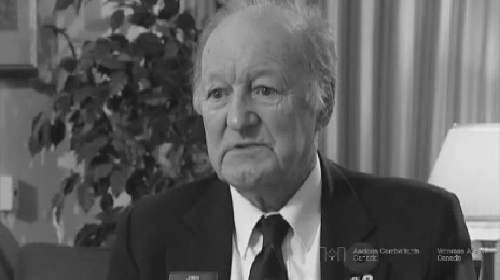
Description
The senses had special importance during the war for detecting the presence of the enemy and how far away they were. Sounds from allied weapons and aircraft were different from the enemy’s . . .
Jacques Raymond
Né à Trois-Rivières, Jacques Raymond a perdu son père alors qu’il était très jeune. Il a été placé à l’orphelinat avec un de ses frères, sa mère ne pouvant s’occuper de ses sept enfants toute seule. À 17 ans, il revient à Trois-Rivières travailler à la Wabasso, une usine de coton. Lorsque la guerre éclate, il reçoit une lettre lui demandant de passer des examens à Longueuil. Il débute sa formation de deux mois à Valleyfield. Il passe six mois dans l’Ouest canadien, où il apprend l’anglais et où il poursuit sa formation. Il part d’Halifax au début de 1943 à bord du Nieuw Amsterdam vers Greenock, en Écosse, pour continuer sa formation. Il participe au débarquement de Normandie avec le Régiment de la Chaudière. Il participe aussi aux batailles de Carpiquet, de Falaise, de Caen et traverse la Belgique et la Hollande. Il se rend même jusqu’en Allemagne. Il est resté onze mois en Europe.
Transcription
Importance of the sensesEchoes and noise. We became so accustomed to the noises of machine guns from the Germans. We were able to distinguish them from our machine guns. When a gun fired and you could hear the noise, it was not dangerous. When a gun fired and you could not hear the noise, that meant it was close. It’s strange to say that. When they passed overhead, they whined just like a strong wind. When there were a lot of guns firing over our heads, our rear guard sometimes fired forward when they heard that noise. That’s right. We heard the boom, fsss! Fsss! They made noises. But when the Germans fired and we heard nothing, that meant that they were close. They were closer than if you heard the noise. That’s one of the things we learned by instinct. We even became accustomed to the aircraft. The sounds from our aircraft were not the same as those from German aircraft. A German fighter, a Messerschmitt, that was flying by did not sound the same as a Spitfire or a . . . there were fewer and fewer of them because they had lost control of the air space. They had lost a lot of things, the Germans. They were spread a little too thin. However, they did not sound the same, anyway. When they passed overhead, we knew that it was a German. But those are things that we learned. We even had expressions, a German machine gun, we called that a “roteuse” [belcher]. That’s because the machine guns were so fast that they were hard on morale. We called them “roteuses” because they used wooden bullets. They would fire 20 or 25 bullets and would use one wooden bullet. You understand what I mean? Then at night, they had flares. They were called tracers. We saw them. When a tracer was set off, 25 bullets were fired. It’s true that they had had their weapons for a long time and, militarily, they had had a long time to accustom themselves to them. But what did they have in terms of weapons were superior to ours, but they didn’t have so many of them because, at any given time, we outnumbered them.Interviewer – Why did they have wooden bullets? Yes.Interviewer - Why? We were told that it was because at a certain point in time they did not have enough ammunition. Instead of using powder and everything, they used a wooden bullet, which did nothing but make noise. For that purpose, it was not very effective, just on morale. We used to use the expression a “belt of bullets.” You saw them with the tracers, over the lines, you know, when they fired. They weren’t very dangerous, but they were so annoying. But they were like tracers or flares. There were some things that we did not know, but they were experienced and had spent years getting ready to wage a war and they knew a lot of tricks that we didn’t.