Service militaire
Lieu de l’enterrement/commemoration
Fils de Joseph et Sara Montanelli, de Altopascio, Lucca, Italy. Enlisted Aug. 1914.
Galerie numérique de Soldat John Montanelli
Galerie numérique de
Soldat John Montanelli
The location of the battlefield burial site of Private John Montanelli is marked (orange star), to the rear of the front line trenches on the north side of Rue Petillon. The trench map coordinates are 36.N.3.c.4.0. The trench map was marked by the author of the article on the Battle of Bois Grenier (Richard Laughton) which shows the location of the Canadian Expeditionary Force during the battle in March 1915. The map was compiled using information from the War Diary of the 3rd Canadian Infantry Brigade, of which the 13th Infantry Battalion was a component.
Galerie numérique de
Soldat John Montanelli
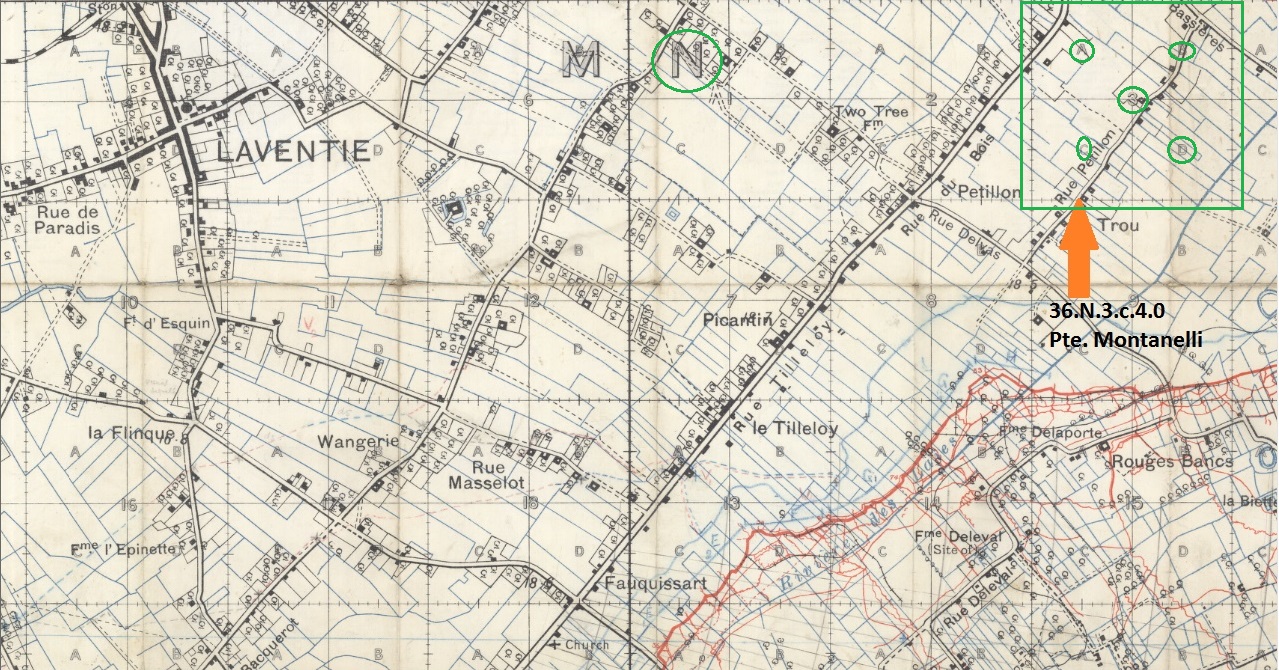
The location of the battlefield burial site of Private John Montanelli is marked (orange arrow), on a detailed period trench map. The remains were buried at the time of his death at location 36.N.3.c.4.0. The trench map is marked to show that the map shows Sector N (green circle) and Sub-Sector 3 (green square). That square is 1,000 yards by 1,000 yards. Within that green square (36.N.3) there are four (4) smaller squares shown as "a, b, c, and d". Each of those smaller squares are 500 yards by 500 yards. The body was buried at the time in the south east square (36.N.3.c). Each small lettered square is marked with ten (10) "hash lines", which are at 50 yard intervals. Pte. Montanelli was buried 200 yards to the east (4 x 50 yards) of the lower corner of the "c" square (36.N.3.c.4.0).
Galerie numérique de
Soldat John Montanelli
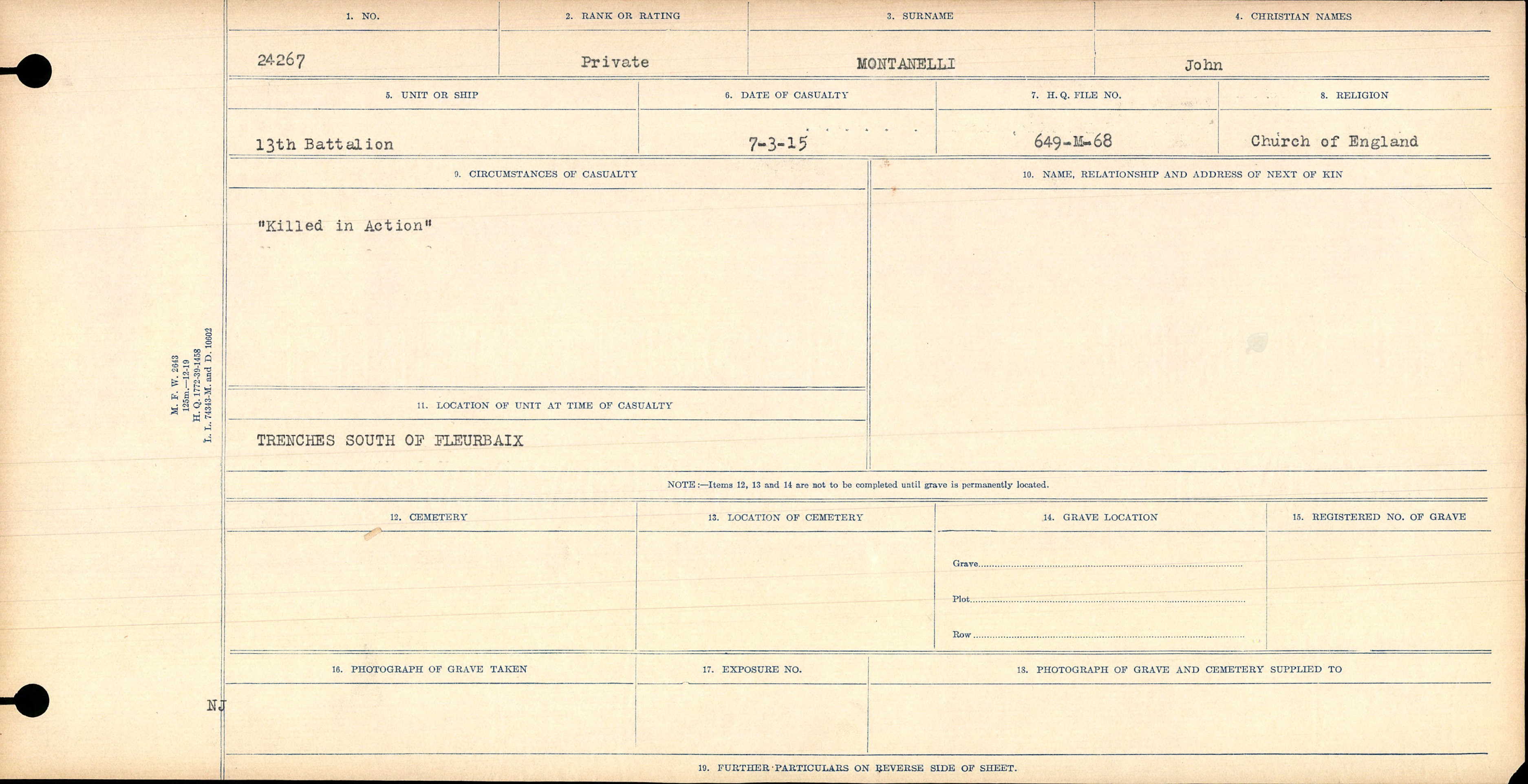
Private John Montanelli #24267 was reported "Killed in Action" in the "Trenches South of Fleurbaix". He was serving in the 13th Infantry Battalion, 3rd Infantry Brigade, 1st Canadian Division. He was killed during the often forgotten battle at Bois-Grenier, France in March 1915, an action designed to provide the initial experience to the Canadian Corps in trench warfare.
Galerie numérique de
Soldat John Montanelli
Galerie numérique de
Soldat John Montanelli
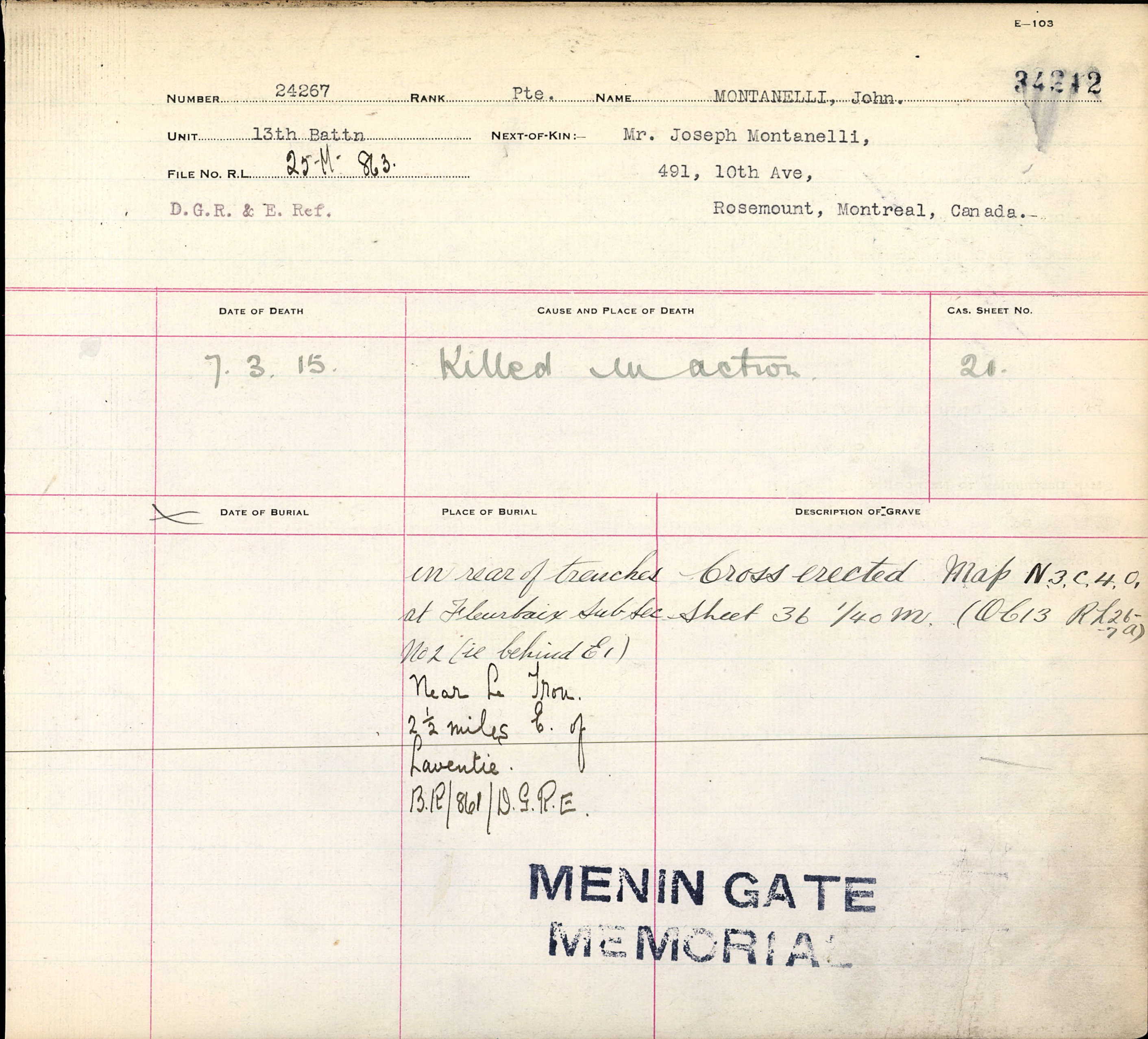
The E-103 "War Graves Register" confirms the information provided in the "Circumstance of Death" that the burial location was as marked on the trench map at coordinates 36.N.3.c.4.0. This form further states that the grave was in the rear of the trenches and that a cross was erected at that location. Application of modern technology to the trench map coordinates tells us that the location of his burial was at GPS coordinates 50.6260, 2.8293 (full GPS 50°37'33.60"N 2°49'45.48"E).
This form also indicates that the remains were not recovered by the Graves Registration Unit and his file was marked to note that his name was to be added to the Menin Gate Memorial in Ypres, Belgium. That process was completed and his name is listed on that memorial at this time (February 2018). This was an error on the part of the Imperial War Graves Commission at that time (now Commonwealth War Graves Commission), as his name should have gone on the Vimy Memorial, as he was killed in France not Belgium.
Galerie d'images
-
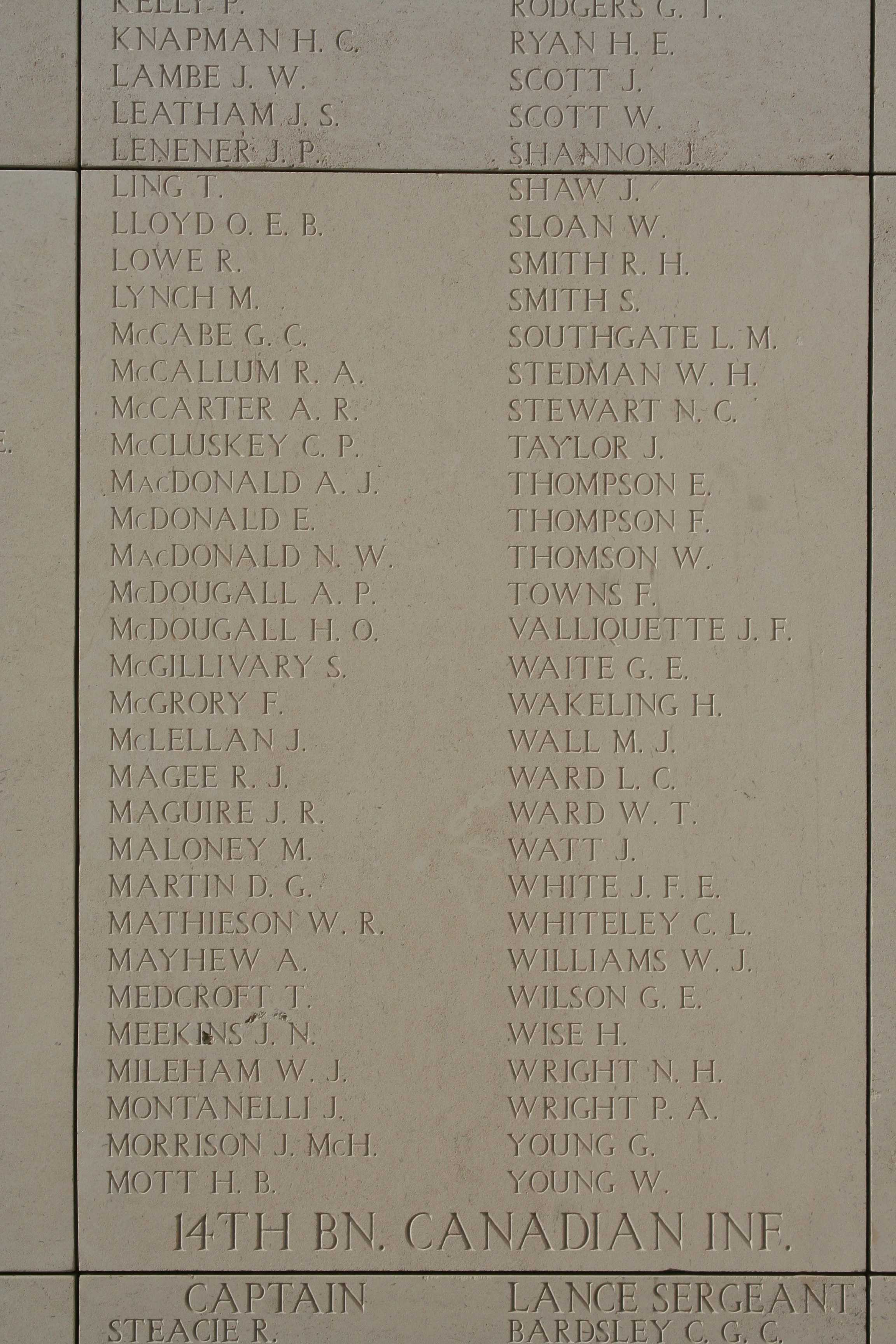
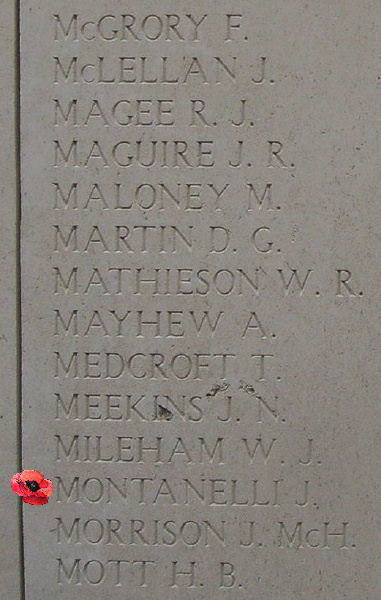
Extract of the Menin Gate Memorial Panel showing the name "Montanelli J".
-
The location of the battlefield burial site of Private John Montanelli is marked (orange star), to the rear of the front line trenches on the north side of Rue Petillon. The trench map coordinates are 36.N.3.c.4.0. The trench map was marked by the author of the article on the Battle of Bois Grenier (Richard Laughton) which shows the location of the Canadian Expeditionary Force during the battle in March 1915. The map was compiled using information from the War Diary of the 3rd Canadian Infantry Brigade, of which the 13th Infantry Battalion was a component.
-
The location of the battlefield burial site of Private John Montanelli is marked (orange arrow), on a detailed period trench map. The remains were buried at the time of his death at location 36.N.3.c.4.0. The trench map is marked to show that the map shows Sector N (green circle) and Sub-Sector 3 (green square). That square is 1,000 yards by 1,000 yards. Within that green square (36.N.3) there are four (4) smaller squares shown as "a, b, c, and d". Each of those smaller squares are 500 yards by 500 yards. The body was buried at the time in the south east square (36.N.3.c). Each small lettered square is marked with ten (10) "hash lines", which are at 50 yard intervals. Pte. Montanelli was buried 200 yards to the east (4 x 50 yards) of the lower corner of the "c" square (36.N.3.c.4.0).
-
Private John Montanelli #24267 was reported "Killed in Action" in the "Trenches South of Fleurbaix". He was serving in the 13th Infantry Battalion, 3rd Infantry Brigade, 1st Canadian Division. He was killed during the often forgotten battle at Bois-Grenier, France in March 1915, an action designed to provide the initial experience to the Canadian Corps in trench warfare.
-
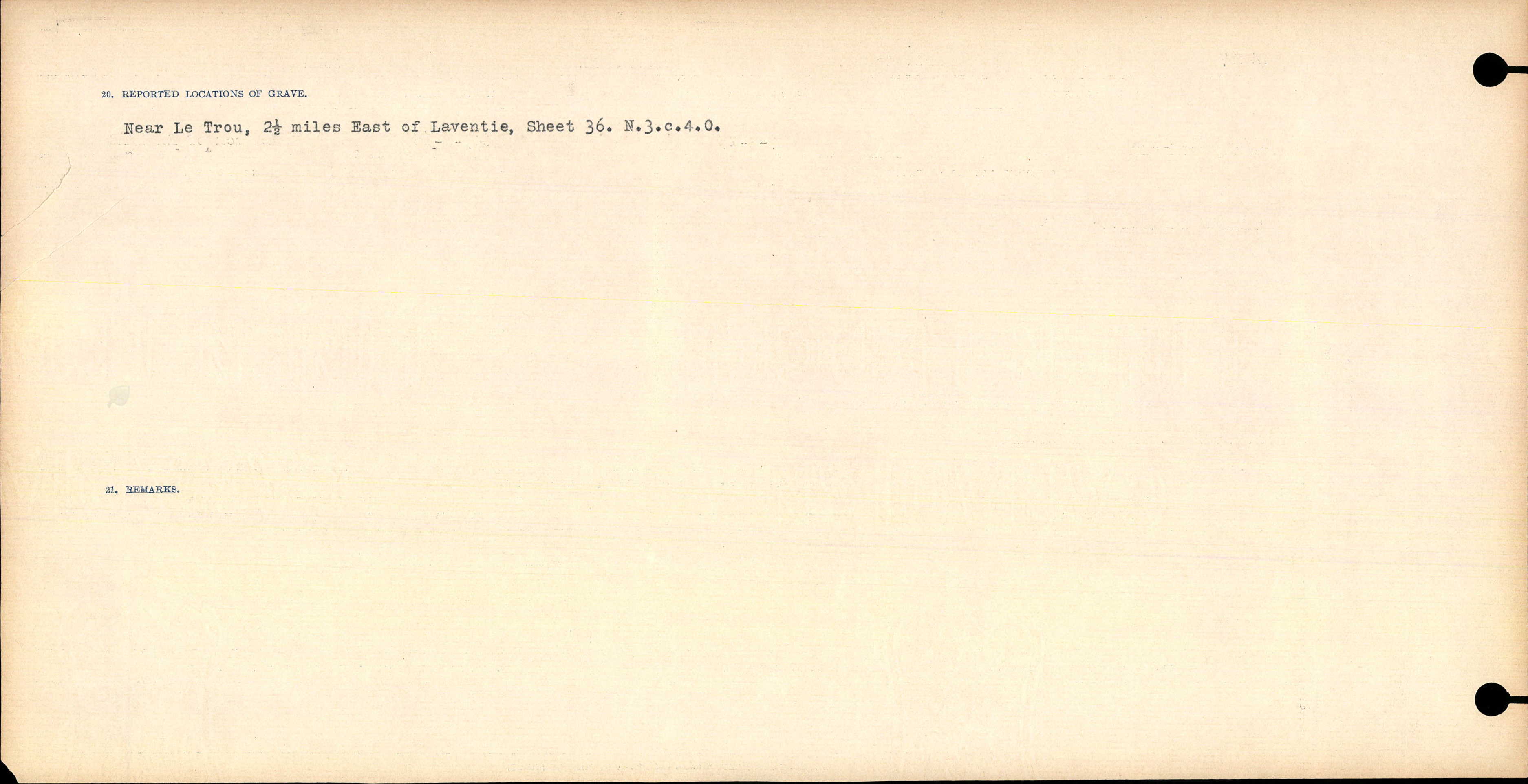
Private John Montanelli's "Circumstance of Death" register reports that he was buried in a battlefield grave near Le Trou (France), 2.5 miles east of Laventie, Sheet 36.N.3.c.4.0. These trench map coordinates enable us to show exactly where he was buried near the front line trenches.
-
The E-103 "War Graves Register" confirms the information provided in the "Circumstance of Death" that the burial location was as marked on the trench map at coordinates 36.N.3.c.4.0. This form further states that the grave was in the rear of the trenches and that a cross was erected at that location. Application of modern technology to the trench map coordinates tells us that the location of his burial was at GPS coordinates 50.6260, 2.8293 (full GPS 50°37'33.60"N 2°49'45.48"E). This form also indicates that the remains were not recovered by the Graves Registration Unit and his file was marked to note that his name was to be added to the Menin Gate Memorial in Ypres, Belgium. That process was completed and his name is listed on that memorial at this time (February 2018). This was an error on the part of the Imperial War Graves Commission at that time (now Commonwealth War Graves Commission), as his name should have gone on the Vimy Memorial, as he was killed in France not Belgium.
-
Private John Montanelli's name is on the 13th Canadian Infantry Battalion panel on the Menin Gate Memorial in Ypres, Belgium. His name should be on the Vimy Memorial in France, as he was not killed in action in Belgium.
-
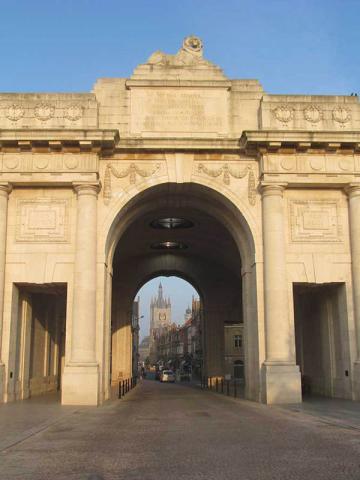
Inscription on the Menin Gate … photo courtesy of Marg Liessens
-
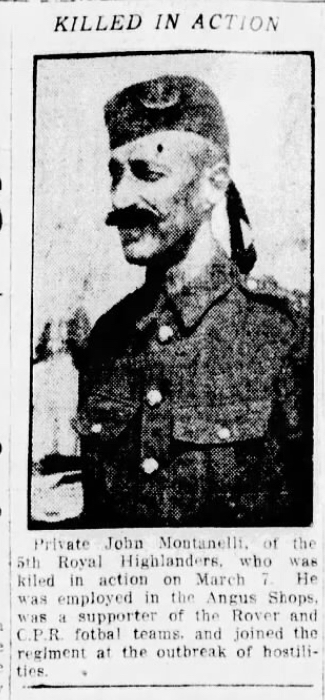
From the Montreal Star 1915. Submitted for the project Operation Picture Me
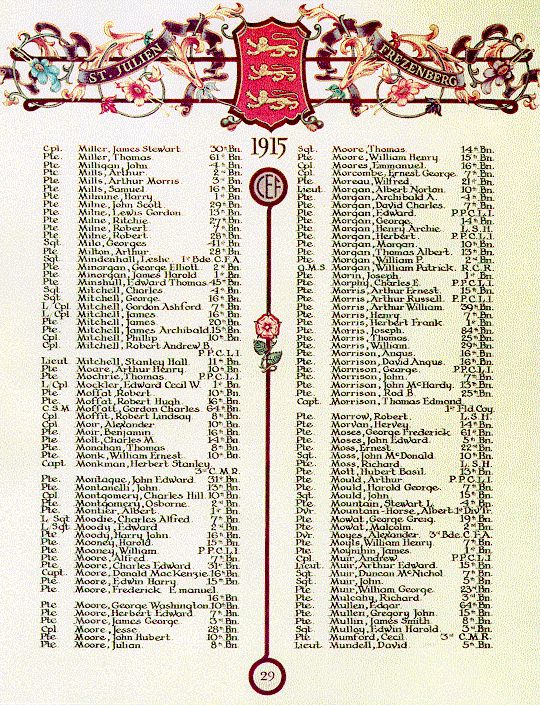
Dans les livres du souvenir
Inscription commémorative sur la :
Page 29 du Livre du Souvenir de la Première Guerre mondiale.
Commander cette page
Télécharger cette page
MÉMORIAL DE LA PORTE DE MENIN (YPRES) Belgique
Le Mémorial de la Porte de Menin (Ypres) est situé dans la partie est de la ville de Ypres (maintenant Ieper) dans la province de la Flandre-Occidentale, sur la route de Menin et de Courtrai. Il porte les noms de 55 000 hommes disparus sans laisser de traces lors de la défense du saillant d'Ypres durant la Première Guerre mondiale.
Dessiné par Sir Reginald Blomfield et érigé par la Commission des sépultures de guerre de l'Empire (maintenant du Commonwealth), ce Mémorial comprend une salle du Souvenir " longue de 36,6 mètres et large de 20,1 mètres. Au centre se trouve un large escalier conduisant aux remparts qui surplombent les douves et les loggias sur colonnes qui entourent le monument. Sur les murs intérieurs de la salle, du côté de l'escalier, ainsi que sur les murs des loggias, les noms des morts sont inscrits par régiments et par corps sur des panneaux en pierre de Portland.
Au-dessus de l'arche centrale on peut lire en anglais une inscription dont voici la traduction:
AUX ARMÉES DE L'EMPIRE BRITANNIQUE QUI COMBATTIRENT ICI DE 1914 À 1918 ET À LEURS MORTS DONT LA TOMBE EST INCONNUE.
Et, au-dessus de l'escalier qui conduit à la salle principale, on peut lire en anglais une inscription dont voici la traduction :
À LA PLUS GRANDE GLOIRE DE DIEU ICI SONT INSCRITS LES NOMS DES SOLDATS QUI SONT TOMBÉS DANS LE SAILLANT D'YPRES, MAIS QUE LES HASARDS DE LA GUERRE ONT EMPÊCHÉS D'AVOIR UNE IDENTITÉ ET UNE SÉPULTURE HONORABLE COMME LEURS CAMARADES DANS LA MORT.
Chaque jour à 20 h, une cérémonie toute simple rappelle encore aujourd'hui le souvenir des morts. Alors que la circulation est arrêtée à la barrière, deux clairons (quatre dans les grandes occasions) sonnent l'appel aux morts. Les deux trompettes d'argent utilisées durant la cérémonie ont été données au Comité de l'appel aux morts par un officier de l'Artillerie royale canadienne, qui servait dans la 10e batterie de St. Catharines (Ontario), à Ypres, en avril 1915."
Pour plus d’informations, visitez la Commission des sépultures de guerre du Commonwealth (site disponible en anglais seulement).
L’image du coquelicot est une marque déposée de la Légion royale canadienne (Direction nationale) et est utilisée avec sa permission. Cliquez ici pour en savoir plus sur le coquelicot.
Avons-nous oublié quelque chose ?
Contribuer à cette page commémorative
Avez-vous des photos, des informations ou une correction concernant la page commémorative de cet individu? Apprenez-en plus sur le MVGC et les informations que nous collectons.