Autre

City/Municipality
Edmonton
Memorial Number
48011-114
Type
Address
Croissant Somme
Location
Parc Lancaster
in Canada
Oui
GPS Coordinates
53.67067, -113.4871
Inscription

needs further research/recherche incomplète

War or Conflict Term
Province
!4v1717779993297!6m8!1m7!1s6sLm1ZhWr32wgCabaXxVOg!2m2!1d53.67069095986651!2d-113.4918601532885!3f103.3325690289033!4f2.294649321230338!5f0.7820865974627469
Body Content

Cette rue rend hommage aux soldats qui ont combattu à la bataille de la Somme pendant la Première Guerre mondiale.

City
Edmonton
Country
Type Description
Street
Memorial CF Legacy ID
12541
City/Municipality
Edmonton
Memorial Number
48011-113
Type
Address
Croissant Frezenberg
Location
Parc Lancaster
in Canada
Oui
GPS Coordinates
53.67074, -113.48961
Inscription

needs further research/recherche incomplète

War or Conflict Term
Province
!4v1717779993297!6m8!1m7!1s6sLm1ZhWr32wgCabaXxVOg!2m2!1d53.67069095986651!2d-113.4918601532885!3f103.3325690289033!4f2.294649321230338!5f0.7820865974627469
Body Content

Cette rue rend hommage aux soldats qui ont combattu à la bataille de Frezenberg pendant la Première Guerre mondiale.

L’honneur « Frezenberg » a été attribué à 66 unités britanniques et à un bataillon canadien, le Princess Patricia’s Canadian Light Infantry, pour avoir défendu les positions empêchant une attaque allemande de gagner du terrain à l’est d’Ypres. Après les batailles de Saint-Julien, le Corps expéditionnaire britannique sur le saillant d’Ypres se retire du 3 au 4 mai pour s’établir dans de meilleures positions permettant de défendre Ypres. The Princess Patricia’s Canadian Light Infantry (PPCLI), qui fait partie de la 80e Brigade de la 27e Division britannique, se déplace jusqu’à des positions le long de la crête de Bellewaarde à quelques centaines de mètres à l’ouest de Frezenberg.

Le 8 mai, un violent bombardement de la part des Allemands marque le début d’une attaque allemande entre Mouse Trap Farm, juste au nord de Wieltje, et Frezenberg. Six divisions allemandes attaquent la 27e Division et la 28e sur sa gauche. Les membres du PPCLI tiennent le flanc d’extrême gauche de la 27e Division et ils se trouvent les plus proches de la partie la plus intense de l’attaque allemande qui s’abat sur la 28e Division devant Frezenberg. La 28e Division réussit à repousser les deux assauts allemands avant qu’un troisième n’écrase ses défenses.

Le barrage allemand initial qui a ouvert l’attaque a fait plusieurs victimes parmi les membres du PPCLI, anéantissant bon nombre de leurs positions de mitrailleuses. Le bataillon fait appel à tous ses hommes, y compris les infirmiers, les ordonnances et les spécialistes des transmissions, pour aider à la défense. Le flanc gauche du PPCLI fait face à un assaut allemand qui vise à renverser le flanc de la Division. Les membres du PPCLI repoussent les assauts répétés des Allemands contre leurs positions en tirant au fusil. Après avoir subi près de 400 pertes au cours des combats menés ce jour-là, ils reçoivent des renforts des bataillons de réserve de la 80e et de la 81e Brigade à la fin de l’après-midi. Une fois le PPCLI entièrement relevéun peu avant minuit le même jour, son effectif ne compte plus que 4 officiers et 150 hommes.

City
Edmonton
Country
Type Description
Street
Memorial CF Legacy ID
12540
City/Municipality
Edmonton
Memorial Number
48011-112
Type
Address
Avenue Falaise
Location
Park Lancaster
in Canada
Oui
GPS Coordinates
53.6695419, -113.4918704
Inscription

needs further research/recherche incomplète

War or Conflict Term
Province
!4v1717779239089!6m8!1m7!1sCNJl0ktn2LkJS1FTOVjVoQ!2m2!1d53.66954190531339!2d-113.4918703528989!3f83.70414801366911!4f-7.928691226510011!5f1.8132661007876116
Body Content

Cette rue rend hommage aux soldats qui ont combattu à Falaise pendant la Seconde Guerre mondiale.

City
Edmonton
Country
Type Description
Street
Memorial CF Legacy ID
12539
City/Municipality
Edmonton
Memorial Number
48011-111
Type
Address
8424, avenue 95 Nord-Ouest
Location
Chapelle protestante St Luke
in Canada
Oui
GPS Coordinates
53.5317698, -113.4571763
Inscription

Commemorating
the
Rededication
of the
Regimental Windows
March 1994

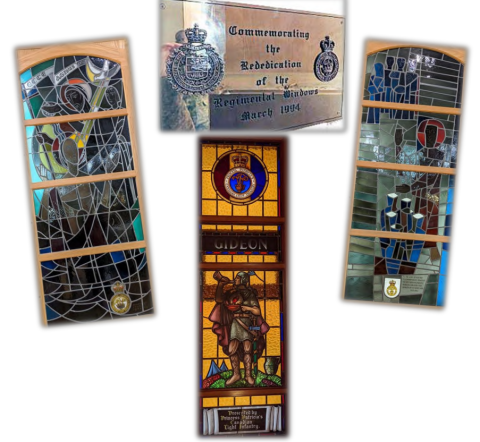
ECCE AGNUS DEI

PRINCESS PATRICIA'S CANADIAN LIGHT INFANTRY

GIDEON

Presented by
Princess Patricia's
Canadian
Light Infantry

Image
Légende
Princess Patricia Canadian Light Infantry Regimental Windows
Province
!4v1711374087427!6m8!1m7!1sHkXODcWdQZ_tIm61uXDOfQ!2m2!1d53.53176982874862!2d-113.4571762590665!3f21.882770043446786!4f2.23927028344238!5f2.3044463758350258
Body Content

Les vitraux de la Chapelle de Griesbach ont été dédiés de nouveau en mars 1994 à la Chapelle protestante St Luke, située dans le parc Lancaster. Les vitraux ont été offerts par le régiment Princess Patricia’s Canadian Light Infantry.

Les vitraux du Princess Patricia’s Canadian Light Infantry représentent :

  • Ecce Agnus Dei (Agneau de Dieu);
  • Gédéon, un chef militaire, juge et prophète, dont l’appel et la victoire sur les Madianites sont relatés dans les chapitres 6 à 8 du Livre des Juges de la Bible hébraïque.
  • Des soldats, Jésus et des anges
City
Edmonton
Country
Type Description
Stained glass window
Memorial CF Legacy ID
11316
City/Municipality
Edmonton
Memorial Number
48011-109
Type
Address
Croissant Milner
Location
Village of Griesbach
in Canada
Oui
GPS Coordinates
53.6047791, -113.5064424
Inscription

[street sign/plaque de rue]

MILNER CRES

[plaque]

needs further research/recherche incomplète

Province
!4v1733857760157!6m8!1m7!1sdsk6i2QF8nVhu4NUEVIy6A!2m2!1d53.60477905529365!2d-113.5064423972877!3f11.836988508171999!4f-1.705320836941425!5f0.7820865974627469
Body Content

Milner Crescent was dedicated by the Canada Lands Company on January 23, 2018, as part of their redevelopment of Edmonton’s former Canadian Forces Base (Griesbach Barracks).

Canada Lands Company in collaboration with the South Alberta Light Horse Regiment officially named the new street in honour of prominent Edmontonian Stanley A. Milner and the Milner family. The Milners represent an outstanding example of Alberta’s service to Canada’s military. Seven family members, including fathers, brothers and wives, served from the First World War to Stanley Milner’s work with the South Alberta Light Horse Regiment.

Stanley Milner exemplified his family’s commitment to the military, serving in the 2nd Battalion, Saskatoon Light Infantry and the Canadian Officer Training Program. He also served as Honourary Colonel of the South Alberta Light Horse Regiment and founded the South Alberta Light Horse Regiment Foundation, a group which preserves regimental history and provides support for retired soldiers and military families. He was also a successful businessman, city alderman and philanthropist. Stanley and his son, Kevin Milner, unveiled the new street signs and a tribute plaque.

City
Edmonton
Country
Type Description
Street, plaque
Memorial CF Legacy ID
12049
City/Municipality
Edmonton
Memorial Number
48011-108
Type
Address
Voie Roy Brown
Location
Village of Griesbach
in Canada
Oui
GPS Coordinates
53.6091174, -113.5058497
Inscription

[street sign/plaque de rue]

needs further research/recherche incomplète

[plaque]

needs further research/recherche incomplète

Province
!4v1733251193260!6m8!1m7!1sJXE0oH6hjqJJvRbh5hpJtA!2m2!1d53.60911737848116!2d-113.5058497063166!3f215.6400538188663!4f0.6291021975526263!5f0.7820865974627469
Body Content

Roy Brown Way was dedicated by the Canada Lands Company on January 23, 2018, as part of their redevelopment of Edmonton’s former Canadian Forces Base (Griesbach Barracks). Le capitaine Arthur Roy Brown est l’as de l’aviation de la Grande Guerre et est reconnu pour avoir abattu le baron allemand Manfred von Richthofen, le légendaire Baron rouge. Bien que la cause de la mort du Baron soit toujours sujette à controverse, la plupart des sources attribuent au capitaine Brown le mérite d’avoir tiré le coup de feu fatal.

Brown est né le 23 décembre 1893 à Carleton Place, en Ontario. Au cours de l’été 1915, il a posé sa candidature auprès du Royal Naval Air Service britannique, mais on lui répond qu’il doit d’abord obtenir une licence de pilote privé. L’école de pilotage canadienne la plus proche étant à pleine capacité, il s’inscrit alors à la Wright School of Aviation à Dayton, en Ohio, et obtient sa licence de pilote le 13 novembre 1915. Il s’est enrôlé dans le Royal Naval Air Service et est envoyé à la station du Royal Naval Air Service de Chingford, au nord-est de Londres, pour apprendre les principes fondamentaux du vol militaire et du largage de bombes.

Il a été blessé le 2 mai 1916 lorsqu’il s’est écrasé en s’entraînant dans un avion d’entraînement; il sera hospitalisé pendant deux mois. En mars 1917, le capitaine Brown est affecté au 9e Escadre naval, mais il est à nouveau blessé et ne se rétablit pas avant le mois de mai. Le 2 novembre, Brown reçoit la Croix du service distingué pour ses victoires aériennes et pour avoir aidé un camarade pilote attaqué par quatre avions allemands, même si ses propres mitrailleuses s’étaient enrayées. En avril 1918, il avait abattu neuf avions ennemis.

Le matin du 21 avril 1918, le capitaine Brown et d’autres pilotes du 209e?Escadre sont impliqués dans un combat aérien avec un escadron allemand comprenant l’as de l’aviation Manfred von Richthofen et son cousin, le pilote novice Wolfram von Richthofen. Le Baron rouge s’est éloigné pour poursuivre le pilote canadien « Wop » May, qui était aux trousses de son cousin. Le capitaine Brown a vu que son ami était en difficulté et a abandonné sa poursuite pour attaquer Richthofen. Il a tiré une longue rafale par-derrière et s’est mis en piqué pour éviter la collision. Richthofen a poursuivi sa route au-dessus du territoire allié et a essuyé des tirs de soldats britanniques et australiens jusqu’à ce qu’il s’écrase dans un champ.

Quatre jours plus tard, le capitaine Brown a été mis à terre et hospitalisé pour un empoisonnement alimentaire grave et un épuisement extrême, puis envoyé en Angleterre pour se rétablir. Peu après, on recommande sa candidature pour l’attribution de la Croix du service distingué avec barrette. Sorti de l’hôpital le 6 juin, le capitaine Brown a repris du service en tant qu’instructeur à la School of Aerial Fighting and Gunnery no 2 au Yorkshire. Le 15 juillet, juste après le décollage, son moteur est tombé en panne, l’avion a décroché et s’est écrasé. Gravement blessé à nouveau, Roy a passé huit mois à l’hôpital avant d’être renvoyé au Canada le 8 mars 1919 et d’être libéré de la Royal Air Force en avril 1920 avec le grade de capitaine. Le capitaine Brown a tenté de s’engager dans l’Aviation royale canadienne au début de la Seconde Guerre mondiale, mais sa candidature a été rejetée.

City
Edmonton
Country
Type Description
Street, plaque
Memorial CF Legacy ID
12048
City/Municipality
Edmonton
Memorial Number
48011-107
Type
Address
Rue Dallas Schmidt
Location
Village of Griesbach
in Canada
Oui
GPS Coordinates
53.6088675, -113.5094417
Inscription

[street sign/plaque de rue]

needs further research/recherche incomplète

[plaque]

needs further research/recherche incomplète

Province
!4v1733249200135!6m8!1m7!1sZT-ha5JOAw6Fhae2h0OTZQ!2m2!1d53.60886745857234!2d-113.5094417074031!3f135.678757837474!4f-1.2332517894840151!5f0.7820865974627469
Body Content

Dallas Schmidt Drive was dedicated by the Canada Lands Company on January 23, 2018, as part of their redevelopment of Edmonton’s former Canadian Forces Base (Griesbach Barracks).

Flying Officer Schmidt was awarded the Distinguished Flying Cross during the Second World War for his service overseas. On his first sortie he shot down an Italian aircraft. In September of 1942, he obtained a hit with a heavy bomb on an enemy merchant vessel which subsequently sank. A few days later he attacked a destroyer, in a convoy, with gunfire. In spite of intense opposition he pressed his attack causing an explosion behind part of the ship's gun positions, which probably indicated hits on a magazine. 

After being awarded the Distinguished Flying Cross, he completed many sorties. In an engagement in November 1942, he destroyed two Junkers 52 and assisted in the destruction of a Dornier 24. His aircraft was hit in some thirty places by return fire and the port engine was set alight, but he succeeded in extinguishing the flames and flew the damaged aircraft to base, landing it safely in difficult circumstances. Some days later he shot down a Junkers 52 and shortly afterwards he destroyed a Fiat CR.42 in attacks on enemy shipping. 

Shot down on five occasions, Dallas managed to crash-land on Malta four times and baled out once. On one occasion he saved the life of Pilot Officer J.F. Briffet, an observer whose Beaufighter was forced to ditch in the sea. The aircraft sank with the loss of the pilot on October 4, 1942, but Dallas spotted Briffet struggling in the sea and threw down his own dinghy, tied to his ‘Mae West’ life jacket. Briffet, who was unhurt, managed to swim to the dinghy and scrambled aboard to await rescue.

City
Edmonton
Country
Type Description
Street, plaque
Memorial CF Legacy ID
12047
City/Municipality
Edmonton
Memorial Number
48011-106
Type
Address
Croisssant Schultz
Location
Village of Griesbach
in Canada
Oui
GPS Coordinates
53.6055855, -113.5097457
Inscription

needs further research/recherche incomplète

Province
!4v1696009864627!6m8!1m7!1sDwhMgDJFTPq2MN3E6WIFAA!2m2!1d53.60558548299728!2d-113.5097457211458!3f65.18113205314518!4f-1.8914353728520865!5f0.7820865974627469
Body Content

Schultz Crescent was dedicated by the Canada Lands Company on March 10, 2015, as part of their redevelopment of Edmonton’s former Canadian Forces Base (Griesbach Barracks).

Rayne Dennis ‘Joe’ Schultz was born in Bashaw, Alberta, on December 17, 1922 and enlisted in Edmonton on July 10, 1940. He served in the Royal Canadian Air Force and the Canadian Forces for more than 36 years, the last ten of which were as the Royal Canadian Air Force Director of Flight Safety.

During the Second World War, a fighter pilot, ‘Ace’, in Mosquito aircraft he had eight victories to his credit, three of which were downed on the same night. He was engaged in the defence of Great Britain intercepting enemy aircraft; and later on Allied bomber escort duties. His leadership ability and fighter successes earned him the Distinguished Flying Cross and Bar. Post Second World War he was involved in the development of several accident prevention programs which brought international credit to Canada, including work on the Flight Data Recorder Crash Position Indicators and reduction of bird-strike hazards to aircraft.

Schultz was named to the United States Air Force Flight Safety Hall of Fame in 1977; in 1978, he was awarded the Trans Canada McKee Trophy for managing one of the most successful and highly regarded flight safety programs in the western world; and was appointed an Officer of the Order of Military Merit. Over many years, in cooperation with the military and civilian agencies associated with aviation, his dedication and pursuit of excellence resulted in significant advancement in air operations generally and flight safety accident prevention programs in particular. He was inducted as a Member of Canada’s Aviation Hall of Fame in 1997 and retired from military service in October 1977.

City
Edmonton
Country
Type Description
Street, plaque
Memorial CF Legacy ID
12046
City/Municipality
Edmonton
Memorial Number
48011-105
Type
Address
Rue Laubman
Location
Village of Griesbach
in Canada
Oui
GPS Coordinates
53.6037733, -113.514397
Inscription

[street sign/plaque de rue]

LAUBMAN ST

[plaque]

needs further research/recherche incomplète

Province
!4v1733240299752!6m8!1m7!1s_yupg9zqVMCEFaLQR2BTtg!2m2!1d53.60377333781066!2d-113.5143969847435!3f332.49791118510905!4f-11.96389292560832!5f0.7820865974627469
Body Content

Laubman Street was dedicated by the Canada Lands Company on December 10, 2013, as part of their redevelopment of Edmonton’s former Canadian Forces Base (Griesbach Barracks).

Born in Provost, Alberta in 1921, Don Laubman was captivated by aviation at an early age. After his family moved to Edmonton, he would head to the city’s airport to watch the aircraft. When the Second World War broke out in 1939, he enlisted with the Royal Canadian Air Force. 

Don was posted back to Canada when his tour ended, but managed to arrange for another overseas posting, this time in command of 402 Squadron. During his wartime service he destroyed 15 enemy aircraft, all of but one between June and October 1944. For these and other flying exploits, Don was twice awarded the Distinguished Flying Cross.

Shortly after demobilization, Don re-enlisted in the Royal Canadian Air Force. His postwar career included postings to 410, 416, and 418 Squadrons. In 1949, he led the Royal Canadian Air Force’s first jet aerobatic team, the Blue Devils. After attending the Royal Canadian Air Force Staff College in 1957, he was promoted to Wing Commander, then to Group Captain, Air Commodore, Major General, and Lieutenant General. Between 1966 and 1969 Don played a key role in implementing the unification of Canada’s armed forces and, in 1970/71, he served as Commander of Canadian Forces Europe. Upon his return to Ottawa, Don ended his career as Chief of Personnel, Canadian Forces Head Quarters.

City
Edmonton
Country
Type Description
Street, plaque
Memorial CF Legacy ID
12045
City/Municipality
Edmonton
Memorial Number
48011-104
Type
Address
Avenue Greenaway
Location
Village of Griesbach
in Canada
Oui
GPS Coordinates
53.6037099, -113.5158516
Inscription

[street sign/plaque de rue]

GREENAWAY AV

[plaque]

needs further research/recherche incomplète

War or Conflict Term
Province
!4v1733240217363!6m8!1m7!1sVXUNSNijkVtaxZBkpzPOZA!2m2!1d53.60370985333872!2d-113.5158515708762!3f135.03170707002153!4f-9.404847046913375!5f1.879868633607928
Body Content

Greenaway Avenue was dedicated by the Canada Lands Company on December 10, 2013, as part of their redevelopment of Edmonton’s former Canadian Forces Base (Griesbach Barracks).

Keith Rogers Greenaway, CM, CD, D.Mil.Sc., (Hon), was born near Woodville, Ontario, on April 8, 1916. He joined the Royal Canadian Air Force in May of 1940. After graduating as a wireless operator in 1940, he served as an instructor for two years until he transferred to the navigator-wireless operator branch of the Royal Canadian Air Force. He was sent first to No. 8 Air Observer School at Ancienne Lorette, Quebec, and then to the Central Navigation School at Rivers, Manitoba, as a staff instructor. In 1944, he was promoted to Flying Officer.

For the next two years Greenaway worked with the United States Navy and the United States Air Force in experimental pressure pattern flights over the North Atlantic and experimental flights over the polar regions testing a low frequency navigation system, using bases in Edmonton, Alberta, and Fairbanks, Alaska. Greenaway was an internationally recognized authority on aerial navigation, with particular reference to polar flying.

In 1947, in association with J.W. Cox, a Defence Research Board scientist, he developed the Royal Canadian Air Force's Twilight Computer, a navigation aid for use in extreme northern latitudes. Late in 1948, Greenaway was seconded to the Defence Research Board, Ottawa, to work on high latitude navigation problems, serving in this capacity until 1954.

In 1956, Greenaway was promoted to Wing Commander and transferred to the Royal Canadian Air Force Headquarters, Ottawa. He continued with promotions and transfers until he retired from the Canadian Forces as a General in March of 1971. During his military career, he flew as crew member on 26 aircraft types, accumulating some 8,000 hours of which nearly one third were north of the Arctic Circle. Following retirement, he assisted the Advisory Committee on Northern Development.

City
Edmonton
Country
Type Description
Street, plaque
Memorial CF Legacy ID
12044