
ISBN: 978-0-660-72190-3
This publication is available upon request in alternate formats.
Table of contents
Message from the Minister
Members of the Canadian Armed Forces, the Royal Canadian Mounted Police and Veterans have dedicated their lives to serving Canada and showcasing Canadian values and interests globally. Throughout their military service, they and their families have encountered challenges and made personal sacrifices. Their unwavering commitment to Canada is unparalleled – and it is why we are committed to helping Veterans find meaningful employment as they transition from military to civilian life.
Employment plays a significant role in our well-being. It provides financial stability, fosters social connections, and gives a sense of purpose to our daily lives. When members of the Canadian Armed Forces release from service, they are faced with an important transition journey. Employment is one part of their journey that can be difficult, whether due to culture changes, lack of networks, equivalencies, or misconceptions about transferrable skills.
As the Minister of Veterans Affairs and Associate Minister of National Defence, I have had the pleasure of meeting Veterans across the country, notably as part of the consultations for this strategy. During these meetings, I heard how transitioning from the Canadian Armed Forces affected Veterans and about the particular challenges they encountered when trying to find fulfilling employment. This employment strategy identifies areas where the Government of Canada can develop and strengthen current efforts to make the job search process easier and more efficient.
This strategy is based on consultations with more than 1,200 Veterans and stakeholders. It is thanks to their expertise and collaboration that it has come to fruition. I commend the efforts of government departments already championing Veteran employment initiatives. I strongly encourage not only governments, but private sector employers and not-for-profit organizations to initiate and implement processes to improve hiring outcomes and opportunities for Veterans. We cannot do this alone; governments, the private sector and not-for-profit must work together to create a more supportive transition experience for members who have bravely served in the Canadian Armed Forces.
I am proud to present the Government of Canada’s first National Veterans Employment Strategy. In the past ten years, an average of 8,200 Canadian Armed Forces members released each year with approximately half of those Veterans transitioning to civilian life in search of new career opportunities. Together with our partners, we will ensure that every Veteran finds a rewarding career after their service to Canada.
The Honourable Ginette Petitpas Taylor
Minister of Veterans Affairs and Associate Minister of National Defence
1.0 Executive summary
During their military service, Canadian Armed Forces (CAF) members develop skills and abilities through first-class training, and unique experiences that make them valuable assets to the civilian workforce. CAF members are known for their strong work ethic, discipline, leadership experience, ability to work under pressure, adaptability to diverse environments, and proficiency in specialized technical areas. Each year, thousands of CAF members transition out of the military and seek civilian employment. Yet, despite the many benefits of hiring Veterans, some Veterans find it difficult to find meaningful employment after their military service.
Using a Veteran-centric approach, the National Veterans Employment Strategy responds to the Government of Canada’s commitment to launch a comprehensive strategy aimed at facilitating rewarding employment opportunities for all Veterans transitioning out of the CAF. Veterans Affairs Canada (VAC) undertook an analysis of existing research and consulted with Veterans and stakeholders. The strategy is designed to address existing gaps and leverage opportunities that may exist for new and improved supports for Veterans. It highlights plans to connect Veterans with employers looking to hire Veterans, and it outlines roles for government, the private sector and non-governmental organizations to promote and increase opportunities for Veterans to find civilian employment.
The strategy is built upon four foundational strategic objectives:
- Improving services and expanding programs for Veterans
- Creating and recognizing Veteran ready employers
- Positioning the public service as a leader for Veteran employment
- Building trusted partnerships
The 2021 Census revealed there was a potential workforce of 261,095 Veterans aged 25-64. These Veterans represent a highly talented pool of individuals who are in a unique position to shape Canada’s labour market. In a competitive job market where employers are searching for talent to fill a wide variety of jobs, enhancing employment opportunities for those transitioning out of uniform not only boosts Canada’s economy, it also provides Veterans with the support they deserve after their service.
2.0 Current landscape
2.1 Veteran employment research and data
In developing the National Veterans Employment Strategy, it was critical to conduct an in-depth analysis of the Veteran employment landscape to better understand the needs of Veterans and employers. This analysis covered the following elements:
- Existing legislation, policies, research and program data related to Veterans employment.
- Results from the 2021 Census of Population which included a Veteran indicator.
- Engagements with Veterans, including focused sessions with Women, 2SLGBTQI+ and Indigenous Veterans, as well as national and local government partners, industry and a wide variety of stakeholders, including those who support Veteran employment.
- Programs used by Five Eyes international partners.
- The Report of the Standing Committee on Veterans Affairs on the National Strategy for Veterans Employment and the Government’s response.
- Canada’s National Disability Inclusion Action Plan.
Research from Canada and around the world shows that finding a job after leaving the military is an essential component of a Veteran’s well-being. It supports financial stability, gives Veterans a sense of purpose, and helps them stay connected with others. According to the Department of National Defence (DND), on average, Veterans release from the CAF at age 39, meaning many have years of employment ahead of them. Of those who release either medically or voluntarily, it is estimated that up to half may be looking for new employment. This employment strategy targets these releasing Veterans, but also takes into account the thousands of Veterans that have already released, and who find themselves searching for new opportunities.
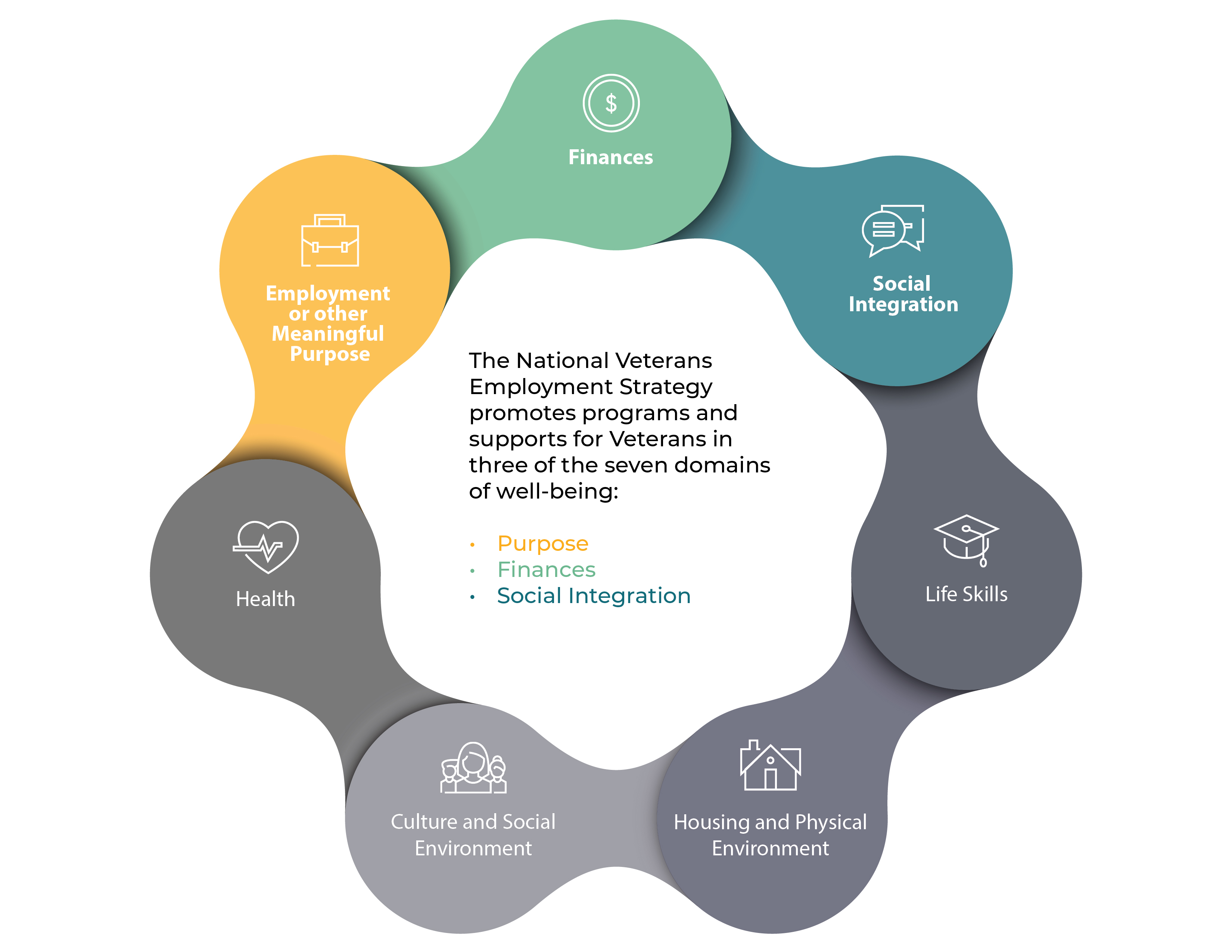
For the first time in 50 years, the 2021 Census of Population collected data on both Veterans and current serving CAF members. This data provides valuable insight into the Veteran population, in particular on their employment situation, such as their status in the labour force. Some noteworthy findings include:
- 461,240 Canadians were counted as Veterans.
- Almost one-third of Veterans were in the core working age group of 25 to 54 (32%).
- Over two in five Veterans were aged 65 and older (41.8%).
- One in six Veterans were women (16.2%).
- The unemployment rate among Veterans was reported to be slightly lower than the overall general population, standing at 8.6% compared to 10% for the Canadian public during the 2021 Census. Approximately 13% of Veterans earned income through self-employment compared to 15.4% in the general population.
- Over 65,000 Veterans aged 25-65 were not actively engaged in the labour force, meaning that they were unable or unavailable for work, or not actively looking in the four weeks leading up to the Census.
- While Veteran participation rate in the workforce is lower than the Canadian public, the Census identified that Veterans aged 25-64 represent a potential workforce of 259,605 people.
- Women+ Veterans were less likely to participate in the labour force than other Veterans and the Canadian public.
- Indigenous Veterans were shown as having higher unemployment rates than other Indigenous people.
At the time of the 2021 Census, Statistics Canada reported that there were 731,905 vacant jobs in Canada. Since that report, the fourth quarter statistics for the 2023-2024 fiscal year indicate job vacancies have fallen to 678,500 and a 6.1% unemployment rate as of April 2024. There are Veterans with the talent needed to fill these positions who can make an impact on the civilian workforce. Data from the 2021 Census, and the upcoming 2026 Census will be invaluable to informing this strategy, well-being programs, supports, and services for Canadian Veterans and their families for years to come.
2.2 Veteran transition to the civilian workforce
CAF members undergo extensive training that equips them with valuable skills and expertise which can translate effectively to the civilian workplace. These include leadership, project management, problem-solving abilities, teamwork, adaptability, dedication, and strategic planning, among others. Many CAF members also receive formal education while serving, including college or university courses, vocational training, and certifications, further increasing their potential.
As everyone’s transition experience is unique, a tailored approach is needed for providing employment support. On one hand, individuals who have dedicated 25 or more years to military service may opt for retirement without pursuing further employment, or they may only seek part-time work. On the other hand, Veterans may have five or ten years of service and may want to transition into the same field in the civilian workforce. For others, a new and entirely different path may be on the horizon, such as running their own business or volunteering in their community.
The National Veterans Employment Strategy aims to be reflective and responsive to the varying needs of individual Veterans. It will help ensure that every Veteran who wants to work has access to the support they need to find a suitable job that leverages the expertise they earned while in service. At a time when Canada looks to strengthen its economy and fill a wide variety of jobs, government, the private and not-for-profit sectors need to work together to create a more positive experience for those stepping out of uniform.
2.3 Existing employment programs and support for Veterans
A number of government initiatives already exist which work towards helping Veterans find careers following their time in the CAF. These programs provide Veterans with education and training, career counselling, mentoring, and networking opportunities, equivalency resources, and direct support for employers and human resource professionals. They are designed to ensure military members are equipped with the skills and knowledge they need to maximize their post-military employment potential.
Before their release, the CAF offers a range of services to assist members in planning and preparing for their transition to civilian employment. This includes career assistance seminars, career transition workshops and individual career and education counselling. Some of these education and awareness programs contain joint CAF/VAC programing intended to enhance their education while serving and to prepare for future employment opportunities post-service.
Veterans who have already released can access a series of supports and benefits through VAC, other government departments and providers to enhance their transition to the civilian job market. These include:
Career Transition Services: resources that provide still-serving and released members with career counseling, assistance with resume writing and interview preparation to help them find a new career.
Education and Training Benefit: a taxable benefit that facilitates access to formal post-secondary training, and short courses, such as those for career and personal development.
Vocational Rehabilitation Services: programs tailored to help ill and injured Veterans and RMCP members identify a suitable career path, which provides financial support for training and related costs, and job search skills development.
Veteran Employment Webinars: local, regional and national virtual showcases for Veteran-focused employers to connect with Veteran jobseekers in real-time.
LinkedIn Group for Veterans: This group called Hire A Veteran / Embauchez un(e) vétéran/vétérane currently has over 5500 members consisting of Canadian employers and Veterans and highlights dozens of new job opportunities on a weekly basis.
The Government of Canada has also launched several initiatives designed to increase entrepreneurship opportunities for equity-deserving groups. These include:
- Women Entrepreneurship Strategy, which helps women grow their business through increased access to financing, talent, networks, and mentorship.
- Aboriginal Entrepreneurship Program, which provides access to capital and business opportunities to Indigenous entrepreneurs and business owners in Canada.
- Black Entrepreneurship Program, a partnership between the Government of Canada, Black-led business organizations, and financial institutions, which will help Black Canadian business owners and entrepreneurs grow their businesses.
These are bolstered by initiatives such as The BuyVeteran directory, a national directory dedicated to promoting hundreds of businesses owned by Veterans and members of the military community, the not-for-profit organization Canadian Legacy project that runs a Veteran Business Boot Camp program, and the newly launched, Mission Entrepreneur is a virtual on-line program offered to Veterans by the University of Ottawa.
Yet despite these existing initiatives, there remain gaps in supporting Veterans seeking post-military career employment.
Annex A provides a detailed list of programs and support.
3.0 Consultation with Veterans and stakeholders
The Veteran Employment Strategy was informed by a series of consultations held between September 2022 and March 2024. Veterans, CAF members, military families, stakeholders, employers, VAC employees and organizations supporting provincial or federal employment opportunities participated in these consultations, including:
- Let’s Talk Veterans: an online consultation open to the public but targeting Veterans (September-October 2022).
- Employer Survey: Shared with employers that VAC corresponds with regularly and who already employ Veterans (September 2022).
- Ministerial meetings, with in-person and virtual participation, were held with employers, partners, third-party and post-secondary organizations (November 2022).
- Consortium of representatives from post-secondary institutions (February 2023).
- Intergovernmental consultation involving 16 federal government departments (May 2023).
- Ministerial roundtable event on equity-deserving Veterans which included women and Indigenous participants (June 2023).
- Four separate meetings took place with representatives from unions, post-secondary institutions, Indigenous and 2SLGBTQI+ communities (October 2023).
- A National Stakeholder Summit: a two-day event held with representatives from Ministerial advisory groups and stakeholder groups to provide a forum to share information and hear feedback on existing, new, and upcoming benefits and services, as well as other issues of interest to the participants, including Veteran employment (March 2024).
Consultations and engagement with stakeholders will continue over the life of the strategy including in the shape of a Veteran forum. This will ensure that the strategy continues to reflect Veterans' needs, as well as labour market data.
3.1 Key findings
The following themes emerged throughout the above noted consultations with more than 1,200 Veterans and stakeholders:
Many civilian jobs require specific credentials or qualifications, such as degrees, certifications or licenses, that may not be directly attainable through military service alone. As a result, employers may perceive that Veterans without civilian credentials lack the necessary qualifications for certain roles, even though their training and experience are highly relevant and transferable.
- Understanding military experience:
- Veterans often feel that civilian employers do not understand the full value of their military skills and experience. Veterans, on the other hand, do not always recognize how their military experience can translate into civilian roles. While some Veterans received training in the military that directly matches jobs, credentials and qualifications in the civilian workforce, other Veterans and employers have difficulty translating their transferrable skills. During consultations, many employers and human resource professionals confirmed they do not fully understand the nature and depth of various military occupations and their associated skills and responsibilities.
- Translation challenges:
- Veterans report that when searching for jobs, it can be difficult to translate their military experience into terms that resonate with civilian employers. Nearly half of the participants from the Let’s Talk Veterans consultation, held in the fall of 2022, indicated that their military occupation or trade does not have a recognized civilian equivalency. For some Veterans, applying for jobs after the military may be the first time they are filling out job applications or developing resumes, which leads them to often overlooking the soft skills they have acquired. Teaching Veterans how to effectively communicate the relevance of their accomplishments can lead to employers understanding the valuable skills Veterans possess and enable them to find meaningful, rewarding employment.
- Cultural differences:
- Military and civilian workplaces often have different organizational cultures, including communication styles, hierarchies and decision-making processes. Veterans can find it challenging to adapt to the more informal and decentralized structure of many civilian workplaces after being accustomed to the regimented nature of the military.
- Lack of civilian credentials:
- Many civilian jobs require specific credentials or qualifications, such as degrees, certifications or licenses, that may not be directly attainable through military service alone. As a result, employers may perceive that Veterans without civilian credentials lack the necessary qualifications for certain roles, even though their training and experience are highly relevant and transferable.
- Stereotypes:
- Some Veterans reported they felt employers may hold biases or stereotypes about hiring Veterans. These stereotypes, which vary but may include perceptions about adaptability, Veterans’ mental health issues, such as assumptions that all Veterans suffer from post-traumatic stress disorder (PTSD) or other psychological issues, can also influence employers’ perceptions and hinder recognition of Veterans' skills. However, it is important to note that these stereotypes are often inaccurate and unfair generalizations that do not reflect the diverse skills, experiences, and characteristics of individual Veterans. The reality is that most Veterans have a strong sense of dedication to their team and an overwhelming desire to be productive in the workplace.
- Networking:
- Many Veterans have spent much of their career within the military, resulting in fewer civilian connections compared to those who have been working in civilian industries. Their networks tend to be limited to members within the CAF; having fewer professional networks and connections than their civilian counterparts can impact their ability to find jobs that recognize their experience.
Addressing these challenges will require coordinated efforts to educate employers about the value of Veterans' skills, provide support for Veterans to translate their experiences more effectively, and combat stereotypes and biases through awareness and advocacy efforts. The following section outlines further measures that will empower Veterans and enable them to excel in civilian careers.
4.0 The strategy – goal, principles and strategic objectives
The National Veterans Employment Strategy aims to ensure that all Veterans can find meaningful work post-military service. While there are initiatives in place to help Veterans find meaningful employment, and many employers are seeing the benefits of hiring Veterans, more can always be done to increase awareness and develop new opportunities for both Veterans and employers.
Goal: To ensure Veterans experience a smooth transition to the labour market after service, where they find opportunities for meaningful employment in the career of their choice.
Principles: Veteran-centric, evidence-based and integrated.
There is no single career path that is preferred by Veterans. Some Veterans want to pursue a similar career path after service, others may look to move into completely new and different jobs, while some may look to start their own business. Research indicates Veterans are interested in pursuing employment in a wide range of industries, including healthcare and social assistance; administrative support; waste management and remediation services; retail; professional, scientific, and technical services; manufacturing; construction; transportation and warehousing; and education and training.
Using a Veteran-centric approach and building on the feedback heard in consultations with Veterans and stakeholders, the employment strategy is supported by four main objectives. Activities under each objective will be further developed to adapt to the changing Veteran employment landscape.
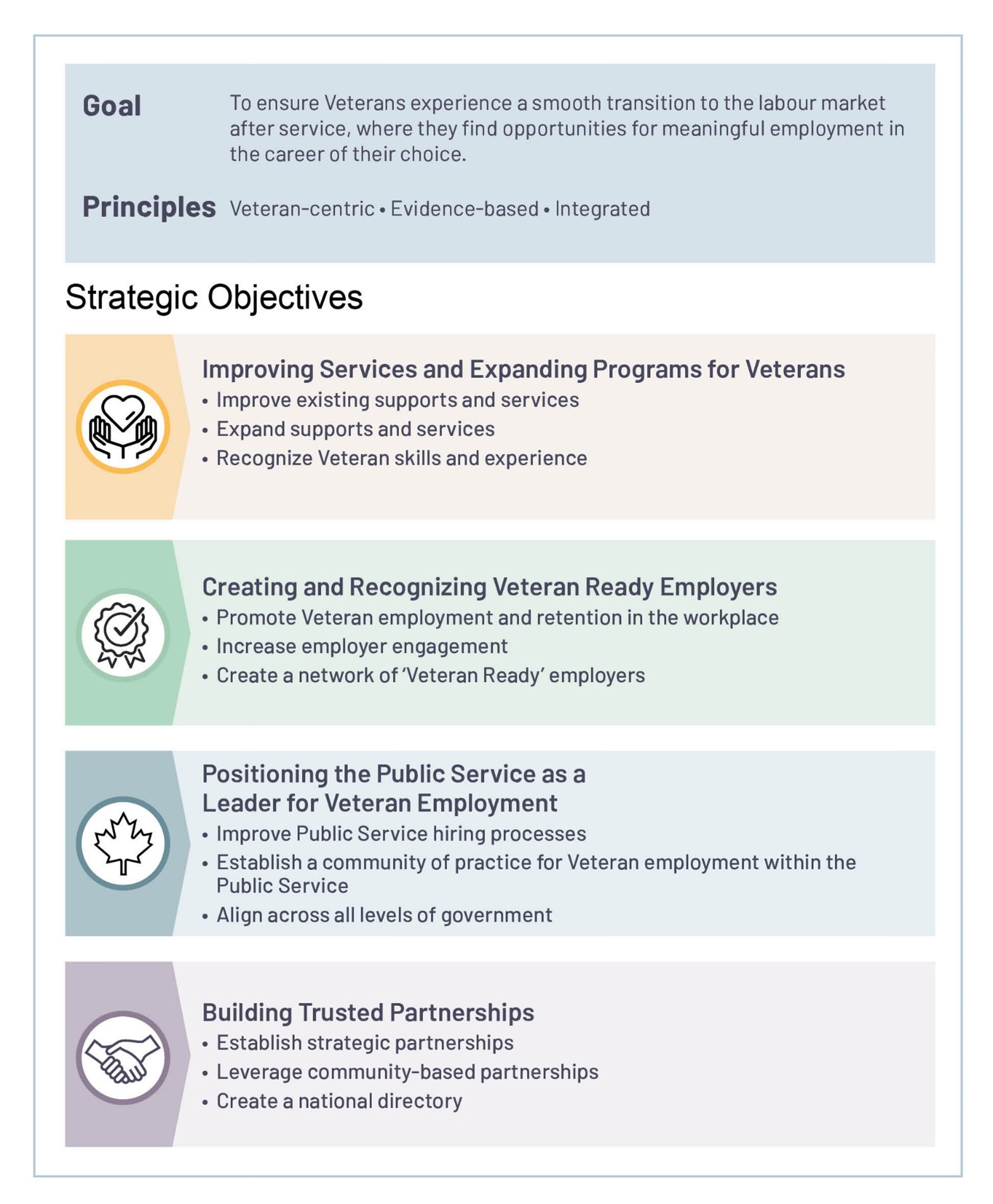
Chart summary
This chart lists the goal, principles and strategic objectives of the National Veterans Employment strategy.
The goal of the strategy is to ensure veterans experience a smooth transition to the labour market after service, where they find opportunity for meaningful employment in the career of their choice.
The principles are veteran-centric, evidence-based and integrated.
The strategic objectives of the strategy are to:
- Improve services and expand programs for Veterans
- Improve existing supports and services
- Expand supports and services
- Recognize veteran skills and experience
- Create and recognize veteran ready employers
- Promote Veteran employment and retention in the workplace
- Increase employer engagement
- Create a network of “Veteran Ready” employers
- Position the Public Service as a leader for Veteran employment
- Improve Public Service hiring processes
- Establish a community of practice for Veteran employment within the Public Service
- Align across all levels of government
- Build trusted partnerships
- Establish strategic partnerships
- Leverage community-based partnerships
- Create a national director
Objective 1: Improving services and expanding programs for Veterans
It is important that employment assistance and services are tailored to Veterans’ unique needs. Strengthening existing services will address gaps and barriers and improve employment outcomes for Veterans.
The following actions will lay the groundwork for new and improved employment supports and services for Veterans:
- VAC will redevelop its website to become a one-stop shop for information on Veteran employment. The Digital Hub will contain information and tools to support Veterans, employers and partner organizations. This work will begin in 2024.
- Enhance and promote existing peer mentoring networks that help connect Veterans in the civilian labour market. This work is ongoing.
- VAC, CAF and Military Family Services will work together to create materials to better prepare Veterans to enter the civilian workforce. This work is underway.
- To address the gap in knowledge regarding equity deserving groups, including women, 2SLGBTQI+ and Indigenous Veterans, VAC will begin a research study to identify gaps and barriers by fall 2024.
- Promote awareness of services available through Career Transition Services in the areas of career coaching, learning modules and job development. This work is underway.
- Improve and expand awareness of educational programs for serving CAF members, including the Education and Training Benefit and the High School Initiative. This work will begin in fall 2024.
- VAC will explore entrepreneurship opportunities, including partnering with more organizations, to support Veterans looking to start their own businesses. This work will begin in 2024.
Initiatives designed to recognize Veteran skills and experience are essential for maximizing their potential in civilian jobs and fostering a workplace culture that values and respects the contributions of Veterans.
VAC commits to undertake the following initiatives:
- Work with the Department of National Defence and the Department of Employment, and Social Development Canada (ESDC) to help Veterans and employers understand military expertise and competencies. This includes enhancing the online Veteran Job Bank as well as improving existing skills translator tools, which assist Veterans in articulating their qualifications in a way that employers understand and potentially position them as suitable candidates during the job application process. Work will begin in summer 2024.
- Continue to work alongside with federal partners, professional regulatory bodies, and certifying entities to take accreditation of military occupations and trades and align them with their civilian equivalents. This includes areas such as healthcare licenses, skilled trades certifications, and maritime and aviation transport qualifications. This work is underway.
- Work with Public Safety Canada to explore opportunities to increase support for Royal Canadian Mounted Police (RCMP) Veterans in need of career transition resources. This work will begin in 2024.
Objective 2: Creating and recognizing Veteran ready employers
Many organizations dedicated to hiring Veterans are already seeing first-hand the benefits of adding highly motivated, trained and dedicated individuals to their workforce. There is an informal network of employers who communicate regularly with VAC, CAF and Veteran stakeholders to promote and develop opportunities for Veteran employment. For example, Helmets to Hardhats, a national non-profit organization, has matched Veterans with career opportunities in the construction industry for more than a decade. Coding for Veterans is another successful partnership with the University of Ottawa that offers an online, instructor-led program which gives Veterans an opportunity to join the technology industry and start a career in software development and cyber security. These are two of many partners working in the Veteran employment space.
More work is needed to help employers connect with Veterans, understand the skillsets Veterans bring to their respective fields and break stereotypes surrounding Veterans’ health.
To increase employer engagement in hiring Veterans, the Government of Canada will:
- Commit to hosting a Veteran-Employer Forum to bring together Veteran Ready employers, and employers aspiring to become Veteran Ready so they can exchange best practices, foster collaboration and engage with other stakeholders. Planning is underway for a Veteran Employer Forum which will be held in early 2025.
- Encourage more employers to become Veteran Ready by recognizing their efforts, providing a seal of recognition to employers for use on their websites and promotional products. This work is underway and will launch in 2024. Veteran Ready employers will be defined using a set criteria, such as:
- A strong commitment to integrate and support Veterans;
- A Veteran hiring strategy;
- Commitment to Veteran mentorship;
- Dedicated professional development programs for Veterans; and,
- A willingness to share best practices with other organizations.
- Continue to align VAC and CAF career transition efforts in hosting webinars and promoting networking events that bring business leaders together with Veterans. This work is underway.
Objective 3: Positioning the public service as a leader for Veteran employment
Data, research, and consultations have consistently found that more than one-third of Veterans wish to work in the federal, provincial, territorial, or municipal public service. While government agencies are already championing Veteran employment initiatives, their continued support and collaboration will be essential for moving forward.
The Public Service Employment Act makes it easier for eligible CAF Veterans and serving members to obtain jobs in the federal public service. The Act provides them access to job opportunities and they are given priority consideration for certain positions based on their military service and experience. In addition, there are potentially several hundred Veterans employed as public servants across federal agencies and Crown Corporations. We will continue to improve data analytics tools to identify the number of Veterans, indicated through self-identification, employed throughout the public service.
The following initiatives and measures will be championed to enhance federal public service hiring opportunities for Veterans:
- VAC, in its role as a champion for Veteran employment is committed to adding more Veterans to its workforce, ensuring that hiring occurs across all levels of the Department. VAC will establish a Veteran hiring target and report back to the Minister annually.
- Develop a Community of Practice for the Government of Canada focused on Veteran employment in the federal public service. To ensure accountability, a Deputy Minister Champion will be identified to advocate and lead efforts working closely with VAC and DND. The Community of Practice will launch in 2025 and will provide a dedicated forum to:
- Collaborate across federal departments to share best practices and promote recruitment and retention of Veterans as key elements in human resource strategies.
- Create and disseminate targeted learning materials for hiring managers and human resources professionals to increase awareness of Veteran employment tools and share best practices for Veteran recruitment.
- Establish a method for peer-to-peer connections among Veterans working across government.
- Continuing to enhance and evolve current methods used to communicate employment opportunities for Veterans within the public service, including the Hire a Veteran LinkedIn group, Hire a Veteran day, DND/CAF and VAC Career Transition services webinars and ESDC’s Job Bank for Veterans. This work is underway.
- Increase awareness among CAF members and Veterans about priority entitlements and the provisions that apply to Veterans under the Public Service Employment Act.
- This will be done through more frequent presentations and work with CAF Transition Group to ensure still serving members know about supports available to them after their service. This work will begin in 2025.
- Explore sharing talent inventories of Veteran candidates for use throughout the public service. This work will begin in 2025.
- Increase awareness among RCMP members discharged for medical reasons of their options for public service positions. This work is underway.
It is important to note that in addition to the federal public service, there are provincial, territorial and municipal level initiatives focused on improving Veteran recruitment, hiring and retention in both the private sector and civil or public service. The Government of Canada is committed to reaching out to provinces and territories to learn about the work they do to promote Veteran employment.
Objective 4: Building trusted partnerships
Building partnerships between government and non-government organizations is essential to creating a large and diverse ecosystem filled with organizations motivated to provide comprehensive and tailored assistance to Veterans as they seek civilian employment. These organizations have different resources, expertise and networks; by working together, they can maximize their impact, reach a broader range of Veterans, and ensure that Veterans receive the help they need to successfully transition to civilian careers.
Transitioning out of military service can leave many Veterans searching for a sense of purpose, and volunteering can offer just that. Contributing to causes they care about allows Veterans to continue serving others and make a positive impact in their communities, which can be deeply rewarding on a personal level. By incorporating volunteer opportunities into the employment strategy, organizations can help Veterans find fulfillment and purpose in their post-military lives while also benefiting from their unique talents and perspectives.
True Patriot Love Foundation, a national charity that is dedicated to serving Canadian military members, Veterans and their families was awarded funding from VAC’s Veteran and Family Well-Being Fund for the 2022-2023 year for their project that addresses the loss of purpose that can occur when Veterans transition to life after service. The project will develop a National Action Plan on Veteran Volunteerism that will support their well-being.
Team Rubicon Canada, a Veteran-led humanitarian organization, and Veteran and Family Well-Being Fund recipient, offers free emergency management education to Veterans. The training, support and opportunities they provide allows Veterans to continue to help improve their communities after their service, and it enhances their employability in emergency management in their life after service.
Additionally, existing government partnerships can continue to be leveraged to support Veteran hiring. These include:
- Seamless Canada: launched in 2018 by the DND/CAF to improve services to CAF members and their families when they move to a different province or territory. It serves as a forum for discussions with provincial and territorial governments and partners; discussions directly affect Veterans by prompting changes in programming and services. There is an opportunity to improve Veteran employment issues such as credential recognition, certification and provincial Veteran employment programs.
- Canadian Military, Veteran and Family Connected Campus Consortium: a partnership between VAC, CAF and participating post-secondary institutions. It is a national community of practice that promotes the establishment of campuses which support the academic success and well-being of military members, Veterans and their families. This includes recognizing the skills and experience of these students to grant equivalencies and allow them to enter programs at an appropriate level.
- National Shipbuilding Strategy: there is a high demand for skilled labour and Veterans have been identified as a pool with the required expertise to meet these needs. Public Services and Procurement Canada leads a Human Resources network to support a sustainable talent recruitment strategy into shipbuilding trades and project management. Employers are provided with Veteran employment tools and encouraged to become Veteran Ready.
Finally, on an international level, VAC participates in a Five Eyes Veteran Employment Research working group which studies the services and supports offered by each participating nation for the military transition to the civilian labour market. These discussions and analyses have led to a collective understanding of the needs, challenges and aspirations of Veterans securing employment and pursuing careers after leaving the military. VAC and DND/CAF will continue to work with international partners to share best practices, collaborate on the development of policy ideas and initiatives, and share new research data as it becomes available.
In collaboration with these organizations and the many non-governmental organizations, both for profit and not-for-profit, that contribute to the Veteran employment ecosystem, the Government of Canada will:
- Undertake a review of community-based organizations in Canada to identify gaps in services and to create a directory of existing supports available to all Veterans, CAF members and their families. This work will augment and align with the on-going work undertaken by DND/CAF to develop a National Resource Directory. This work is underway.
- Increase engagement with non-governmental organizations to share information, align activities and identify opportunities to collaborate. This work is underway.
5.0 Gender-based analysis plus
Veterans represent a diverse population in terms of sex, gender, age, sexual orientation, race/ethnicity, language, religion, ability, residence, and more. In the past there were significant challenges with data limitations regarding the Veteran population. The 2021 Census of Population has contributed significantly to enhancing understanding of the broader Veteran population. It has provided valuable information to guide the design and delivery of equitable and inclusive programs and services, including those being developed within the National Veterans Employment Strategy.
The results of the Census, along with existing internal data, and voluntary research studies, have identified vulnerable groups. To date, VAC has consulted with women, 2SLGBTQI+ and Indigenous Veteran stakeholders to gain further insight about the barriers they face in their transition to the civilian workforce and to discuss ways to overcome these barriers.
Through consultation, VAC has heard from women Veterans that they face unique experiences inside, and outside the military, which necessitate tailored employment supports. This includes taking into account the experiences of women who experienced trauma or discrimination during their service, and those balancing work and caregiving responsibilities.
Discussions with Indigenous Veterans revealed that many releasing CAF members wish to return to their communities for post-service employment, however for communities in rural areas, employment opportunities may be limited, or they may face communication and accessibility challenges (e.g. lack of reliable internet). As such, it will be imperative to further develop relationships with Indigenous communities and Indigenous employment leaders to reduce barriers to civilian employment and create new employment opportunities in their preferred location.
The National Veterans Employment Strategy is underpinned by inclusive representation at all feedback opportunities and a performance measurement framework. Through this work, the Government of Canada strives to ensure Veterans have equitable opportunities in the labour market and equitable well-being outcomes. The consultations provided a clear indication that more work needs to be done to understand how to tailor supports to equity deserving Veteran to ensure equitable access to employment. As mentioned, VAC will be providing resources to conduct research to better identify these gaps and how to address them, so all Veterans find rewarding employment.
6.0 Conclusion
The National Veterans Employment Strategy is a roadmap to increase employment opportunities for Veterans, promote their well-being and enable their success as they transition to civilian life. By working together with all partners, this Strategy aims to ensure that all Veterans can find meaningful work and purpose, using the skills and qualifications they acquired while in service to Canada.
As we learn more about Veteran employment, identify new partnerships and adapt programs and services, the strategy will adapt. Future iterations of the strategy will draw on new research and feedback from Veterans and expand to include more volunteer opportunities for Veterans. The goal is for the strategy to evolve in line with Veterans' needs, through evidence-based approaches and ongoing consultation. VAC is committed to regularly update the strategy to ensure it effectively addresses new issues and meets the changing needs of Veterans through evidence-based approaches and ongoing consultations.
Veterans bring incredible value to the civilian workforce. By helping Veterans recognize and leverage their unique strengths and experiences, and by collaborating with employers, we can build stronger, more resilient and more inclusive workplaces. Unlocking the potential of Veterans, not only honours their service to Canada, it also promotes success and growth in all industries and sectors.