
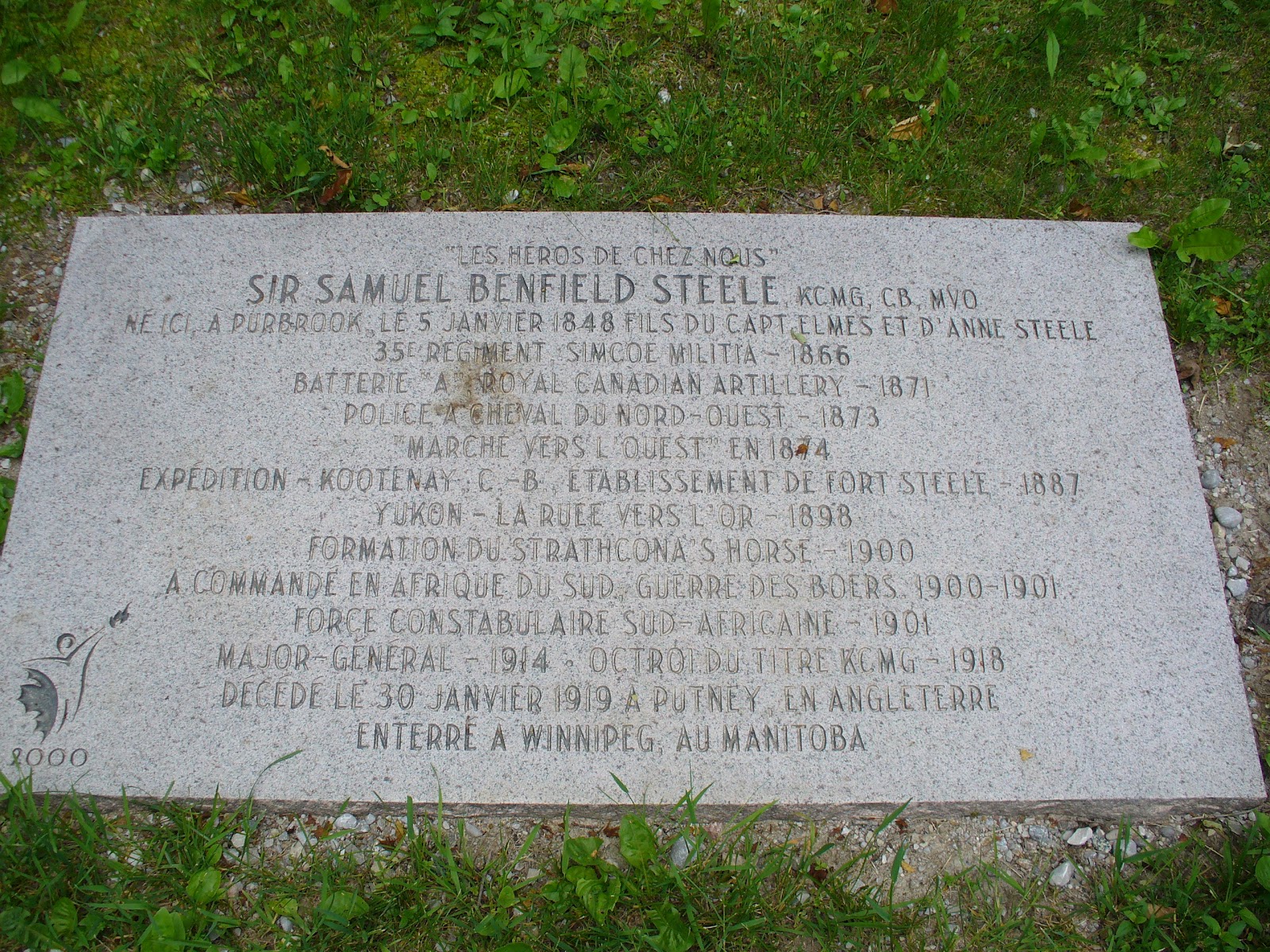
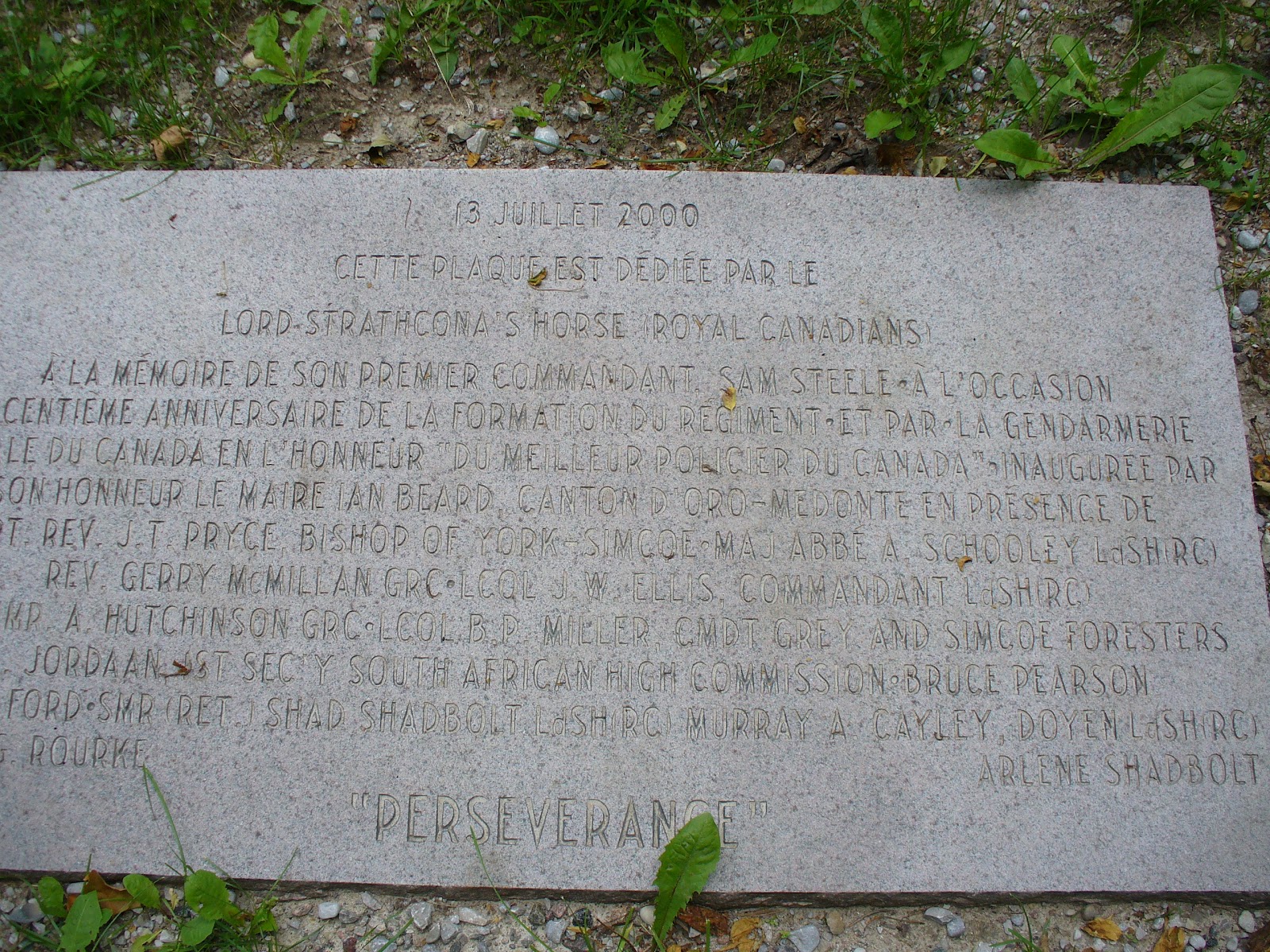
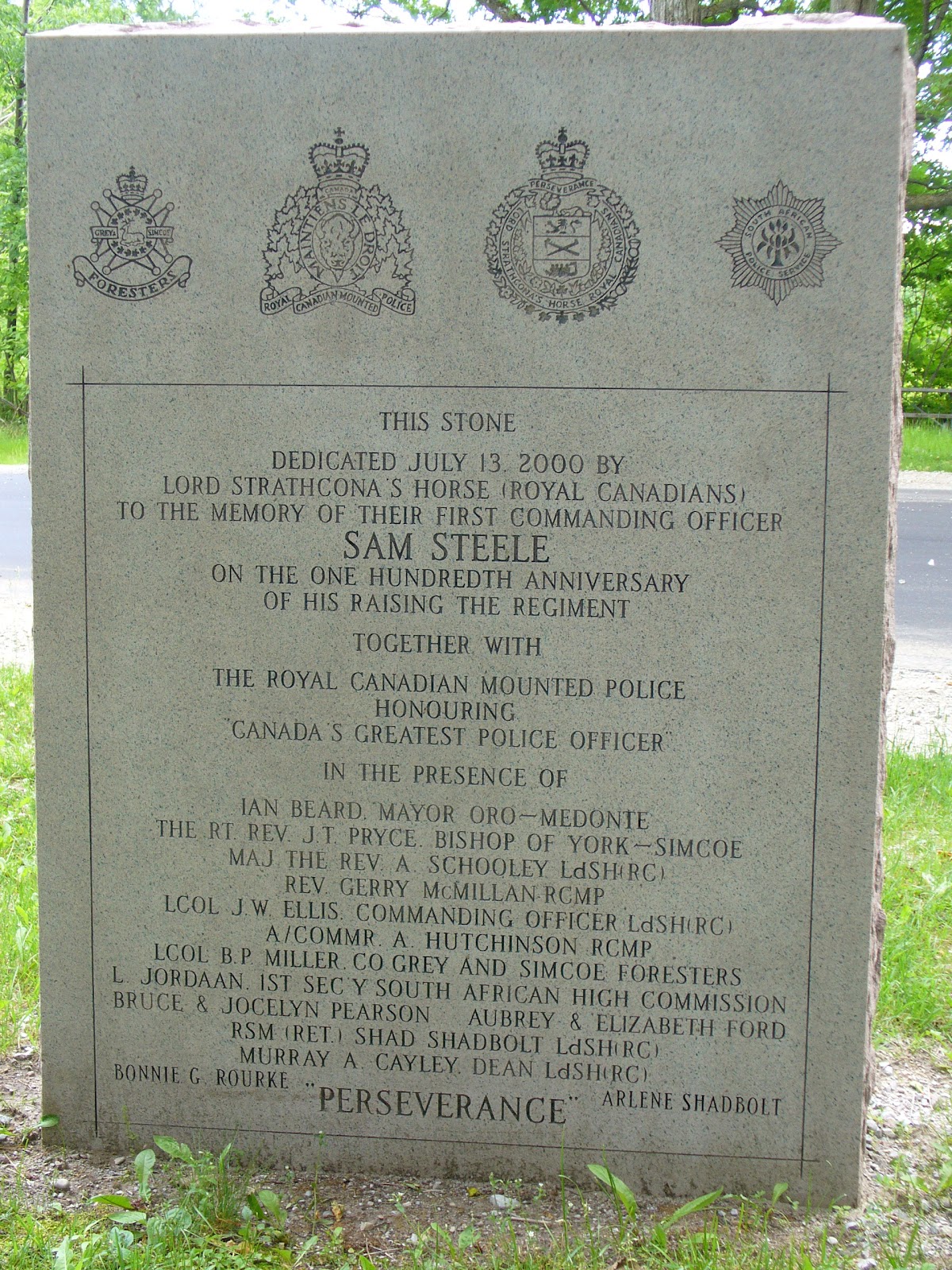
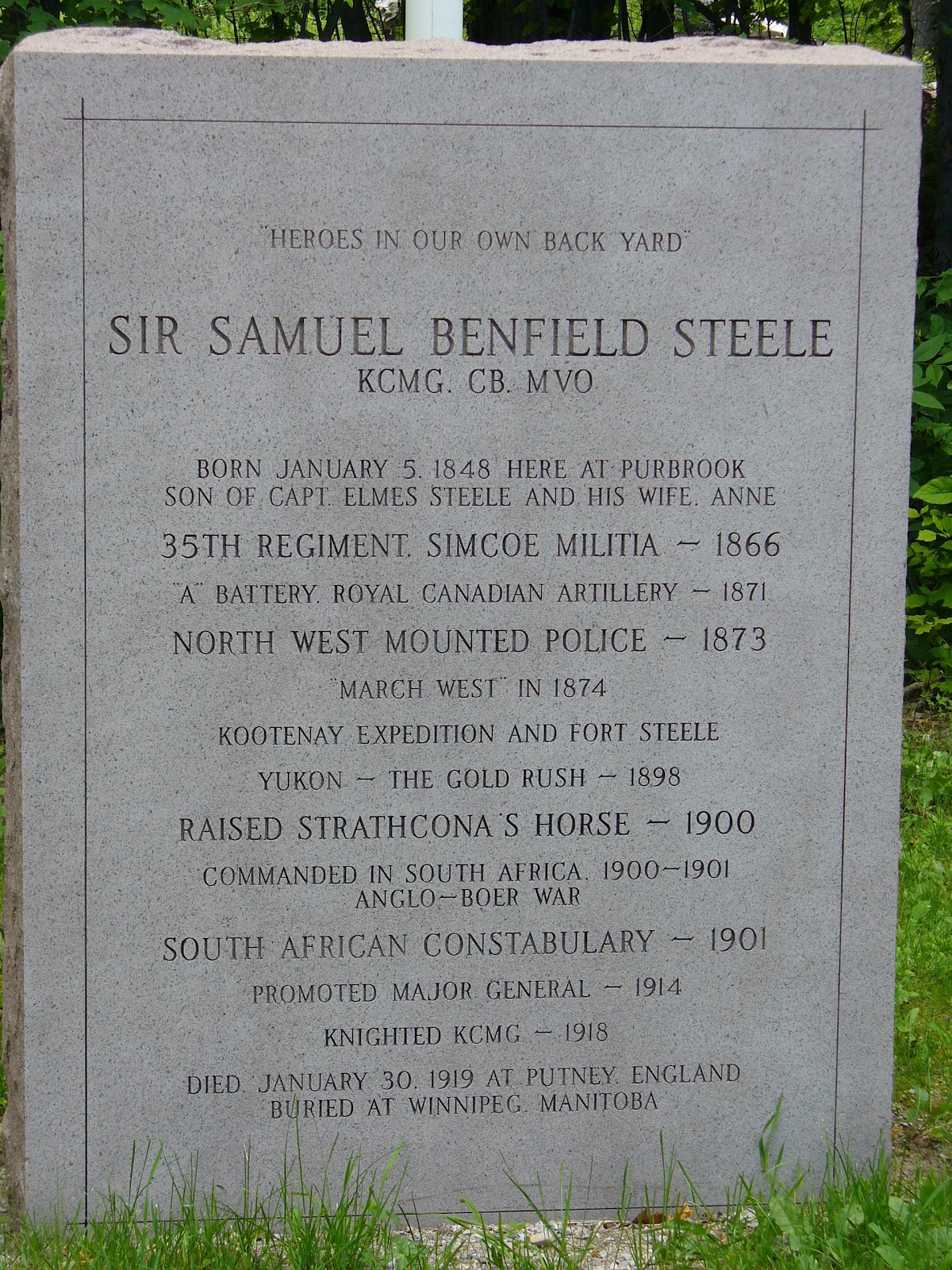
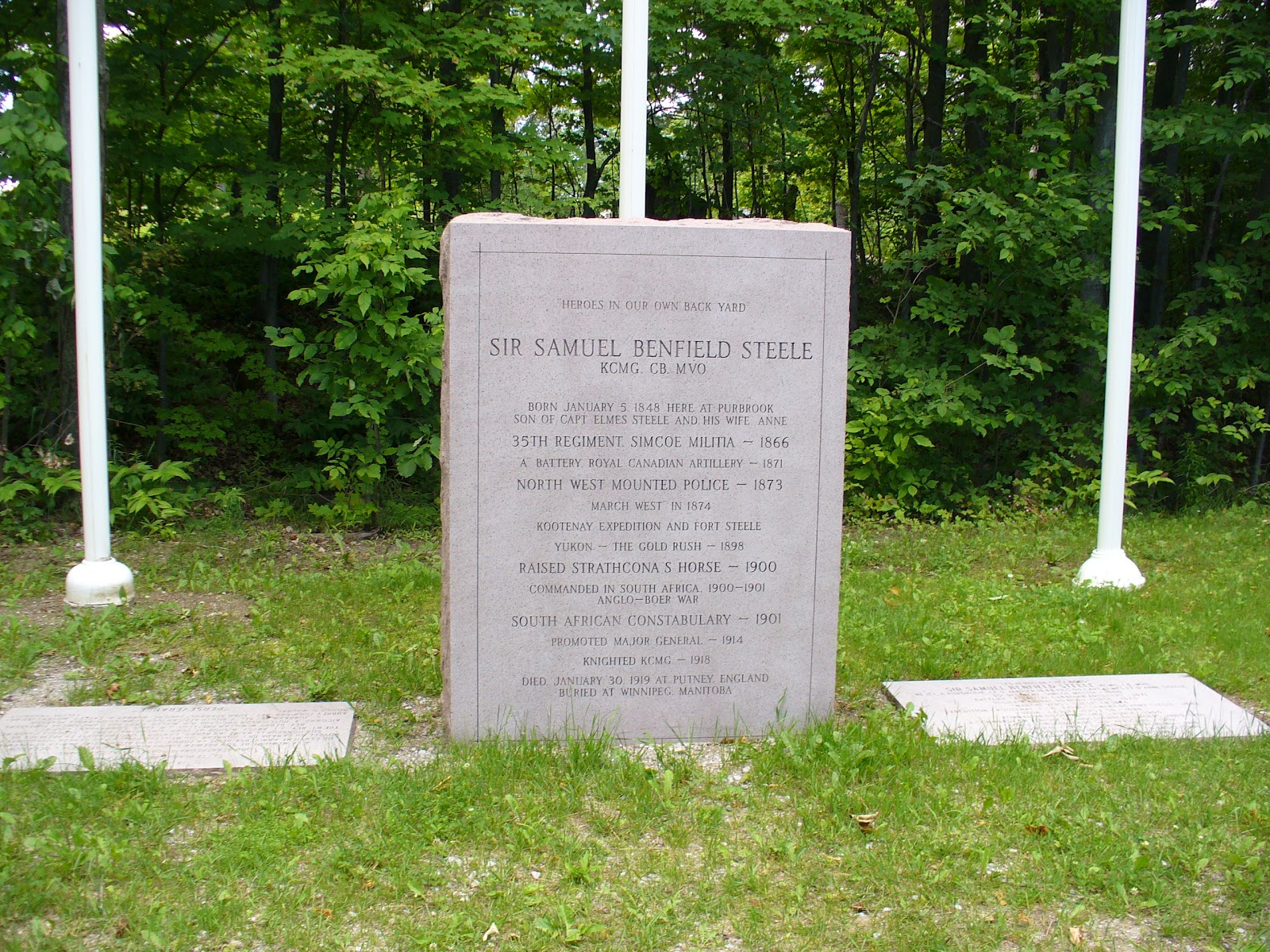
Organized by Murray A. Cayley and Chief Warrant Officer C.H. Shadbolt, OMM, CD (Retired), the Sir Samuel Benfield Steele Memorial was unveiled at the Pearson Farm (the Steele family homestead) on 13 July 2000. The five-foot high granite stone depicts badges of The Greg and Simcoe Forresters, Royal Canadian Mounted Police, Lord Strathcona’s Horse (Royal Canadians) and South African Police Service.
Major-General Sir Samuel Benfield Steele was born on 5 January 1848, in Purbrook, Ontario. At the age of 18, he joined the 35th Simcoe Regiment (now The Grey and Simcoe Forresters) and served in the Fenian Raids for which he received a medal with clasp. In 1867, he transferred to the 37th Haldimand Regiment. Three years later, he transferred to the Ontario Rifles, was promoted to corporal and took part in the Red River Expedition.
When A and B Batteries of the Royal Canadian Artillery were formed in 1871, Steele joined their ranks as a sergeant and assumed the role of gunnery instructor. In 1873, he joined the newly formed North West Mounted Police. During the North West Rebellion of 1885, he was requested to raise a small force known as “Steele’s Scouts.” After the Rebellion, he was promoted to superintendent of the North West Mounted Police and commanded through the Yukon Gold Rush.
In January 1900, he was selected to raise a regiment for special service in South Africa. On 26 January 1900 Lord Strathcona approved Steele’s suggestion that the Regiment be named Strathcona’s Horse. He was the regiment’s first commanding officer. By 25 February, Lieutenant-Colonel Steele had completed the organization and on 16 March, 28 officers, 512 other ranks and 599 horses sailed from Halifax bound for South Africa.
After the South African War, he was promoted to the rank of colonel in May 1901 and became a Companion of the Most Honourable Order of the Bath (CB) and a Member of the Royal Victorian Order (MVO). Realizing that Strathcona’s Horse would not soon become part of the Permanent Force, Steele took a leave of absence and returned to South Africa to command B Division of the South African Constabulary. In 1907, Steele returned to Canada and from 1910 – 1912, he was re-appointed the commanding officer of Strathcona’s Horse (Royal Canadians).
In December 1914, Steele was promoted to major-general and appointed Inspector General of Western Canada. In May 1915, he was appointed General Officer Commanding 2nd Canadian Division and took them to England. He remained in England as the Commander of Canadian troops at Shorncliffe, a position he held until retirement in 1918. That same year, he became the Knight Commander of the Most Distinguished Order of Saint Michael and Saint George (KCMG).