
The Toronto Scottish Regiment (M.G.) Monument

Toronto, Ontario
Type
Other

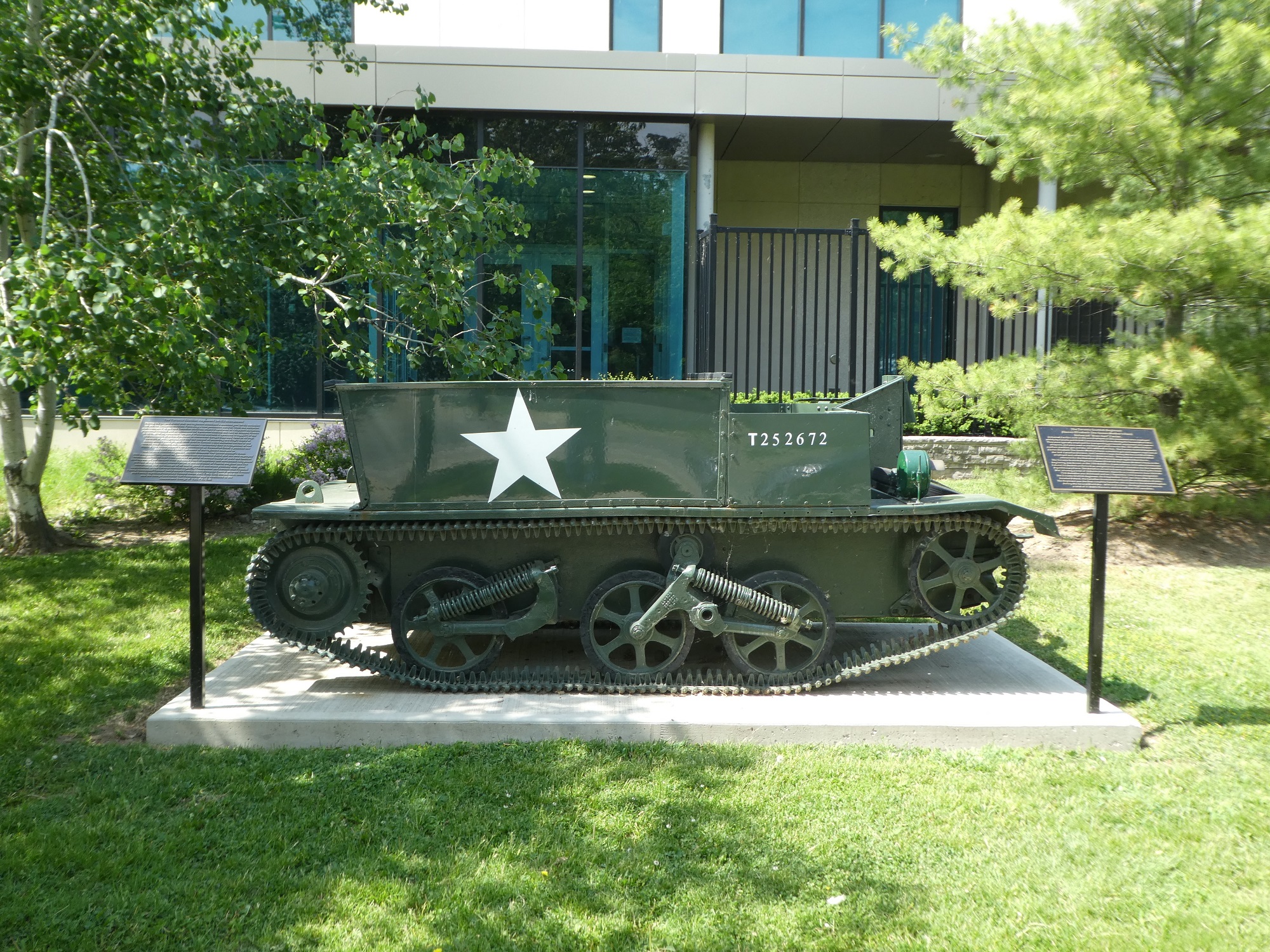
During the Second World War, The Toronto Scottish Regiment mobilized a machine gun (M.G.) battalion for the 1st Canadian Division. Following a reorganization in 1940, the battalion was reassigned to the 2nd Canadian Division, where it operated as a Support Battalion, providing machine-gun detachments for Operation Jubilee, the raid on Dieppe, France in 1942. With an additional company of heavy mortars, it operated in support of the rifle battalions of the 2nd Division in Northwest Europe from July 1944 to VE-Day. Soldiers of the regiment also had the honour of mounting the King's Guard at Buckingham Palace in April 1940. Back in Canada a 2nd Battalion served in the reserve army. In 2000, the regiment added a second title in recognition of Her Majesty The Queen Mother's long association a Colonel-in-Chief, a position she had held since 1937. The name of the regiment changed to The Toronto Scottish Regiment (Queen Elizabeth The Queen other's Own).

Universal Carriers such as the one displayed on this monument were employed widely by Canada and British Commonwealth forces during the Second World War. They were typically employed for transporting personnel, equipment and support weapons, and were used as machine gun platforms for the .303 calibre Vickers medium machine gun and the .303 calibre Bren Gun. The Toronto Scottish Regiment (Queens Elizabeth The Queen Mother's Own), a machine gun and support regiment of the 2nd Canadian Division, 2nd Canadian Corps during the Second World War, employed and relied heavily on these carriers. They were an essential Allied resource for the liberation of Northwest Europe against Nazi forces. The Toronto Scottish Regiment (Queen Elizabeth The Queen Mother's Own), in the beginning, was known as the 75th Battalion. It was raided in 1915 when Lieutenant Colonel SG Beckett undertook an assignment to recruit a battalion for the Canadian Expeditionary Force. The Battalion served in France and Belgium during the Great War, winning a total of 16 Battle Honours. Upon its arrival home in June 1919 the 75th Battalion was dismissed and on 1 September 1921 it was designated The Toronto Scottish Regiment. On 3 September 1939, two days after the Nazi forces invaded Poland, The Canadian Government ordered the mobilization of units. The Regiment was the first complete Canadian unit to land in the United Kingdom during the Second World War. With final victory, the Regiment had earned a total of 21 Battle Honours, and had suffered 425 casualties. 

This monument recognizes all Canadians from the Second World War era who deployed overseas, sacrificed their lives, suffered physical or mental injury, or were the families who supported our soldiers from the home front. In addition, this monument recognizes the role of the Canadian Armed Forces in the liberation of France, Belgium and The Netherlands and the triumph of all that is good. It was made possible by The Toronto Scottish Regiment Foundation and Senate, Max Franzini Family, Lieutenant-Colonel Garry Moore Family, Steve Ernewein Family, Michael Carlson and Family, especially Honorary Colonel Helen Vari, C.M., CLH, OONM, LL.D, LHD, and the George and Helen Vari Foundation.

Inscription

[plaque]

The Toronto Scottish Regiment (M.G.) Monument

During the Second World War, the regiment mobilized a machine gun (M.G.) battalion
for the 1st Canadian Division. Following a reorganization in 1940, the battalion
was reassigned to the 2nd Canadian Division, where it operated as a Support Battalion,
providing machine-gun detachments for Operation Jubilee, the raid on Dieppe, France
in 1942. With an additional company of heavy mortars, it operated in support of the
rifle battalions of the 2nd Division in Northwest Europe from July 1944 to VE Day.
Soldiers of the regiment also had the honour of mounting the King's Guard at
Buckingham Palace in April 1940. Back in Canada a 2nd Battalion served in the
reserve army. In 2000, the regiment added a second title in recognition of Her
Majesty The Queen Mother's long association a Colonel-in-Chief, a position she
had held since 1937. The name of the regiment changed to
The Toronto Scottish Regiment (Queen Elizabeth The Queen other's Own).
This monument recognizes all Canadians from the Second World War era who deployed
overseas, sacrificed their lives, suffered physical or mental injury, or were the families
who supported our soldiers from the home front. In addition, this monument recognizes
the role of the Canadian Armed Forces in the liberation of France, Belgium and The
Netherlands and the triumph of all that is good. It was made possible with great
appreciation to The Toronto Scottish Regiment Foundation and Senate, Max Franzini
Family, Lieutenant-Colonel Garry Moore Family, Steve Ernewein Family, Michael Carlson
and Family, especially Honorary Colonel Helen Vari, C.M., CLH, OONM, LL.D, LHD,
and the George and Helen Vari Foundation and is dedicated to the
Honourable George W. Vari, P.C., C.M.

[plaque]

The Toronto Scottish Regiment
(Queen Elizabeth The Queen Mother's Own)
Universal "Bren Gun" Carrier.

Universal Carriers such as the one displayed on this monument were employed
widely by Canada and British Commonwealth forces during the Second World War.
They were typically employed for transporting personnel, equipment and support
weapons, and were used as machine gun platforms for the .303 calibre Vickers
medium machine gun and the .303 calibre Bren Gun. The Toronto Scottish Regiment
(Queens Elizabeth The Queen Mother's Own), a machine gun and support regiment of
the 2nd Canadian Division, 2nd Canadian Corps during the Second World War,
employed and relied heavily on these carriers. They were an essential Allied
resource for the liberation of Northwest Europe against Nazi forces.
The Toronto Scottish Regiment (Queen Elizabeth The Queen Mother's Own), in the
beginning, was known as the 75th Battalion. It was raided in 1915 when Lieutenant
Colonel SG Beckett undertook an assignment to recruit a battalion for the Canadian
Expeditionary Force. The Battalion served in France and Belgium during the Great
War, winning a total of 16 Battle Honours. Upon its arrival home in June 1919 the
75th Battalion was dismissed and on 1 September 1921 it was designated
The Toronto Scottish Regiment. On 3 September 1939, two days after the Nazi forces
invaded Poland, The Canadian Government ordered the mobilization of units.
The Regiment was the first complete Canadian unit to land in the United Kingdom
during the Second World War. With final victory, the Regiment had earned
a total of 21 Battle Honours, and had suffered 425 casualties.

Location
The Toronto Scottish Regiment (M.G.) Monument

70 Birmingham Street
Toronto
Ontario
GPS Coordinates
Lat. 43.6041791
Long. -79.5022464

The Toronto Scottish Regiment (M.G.) Monument

1 of 4 images

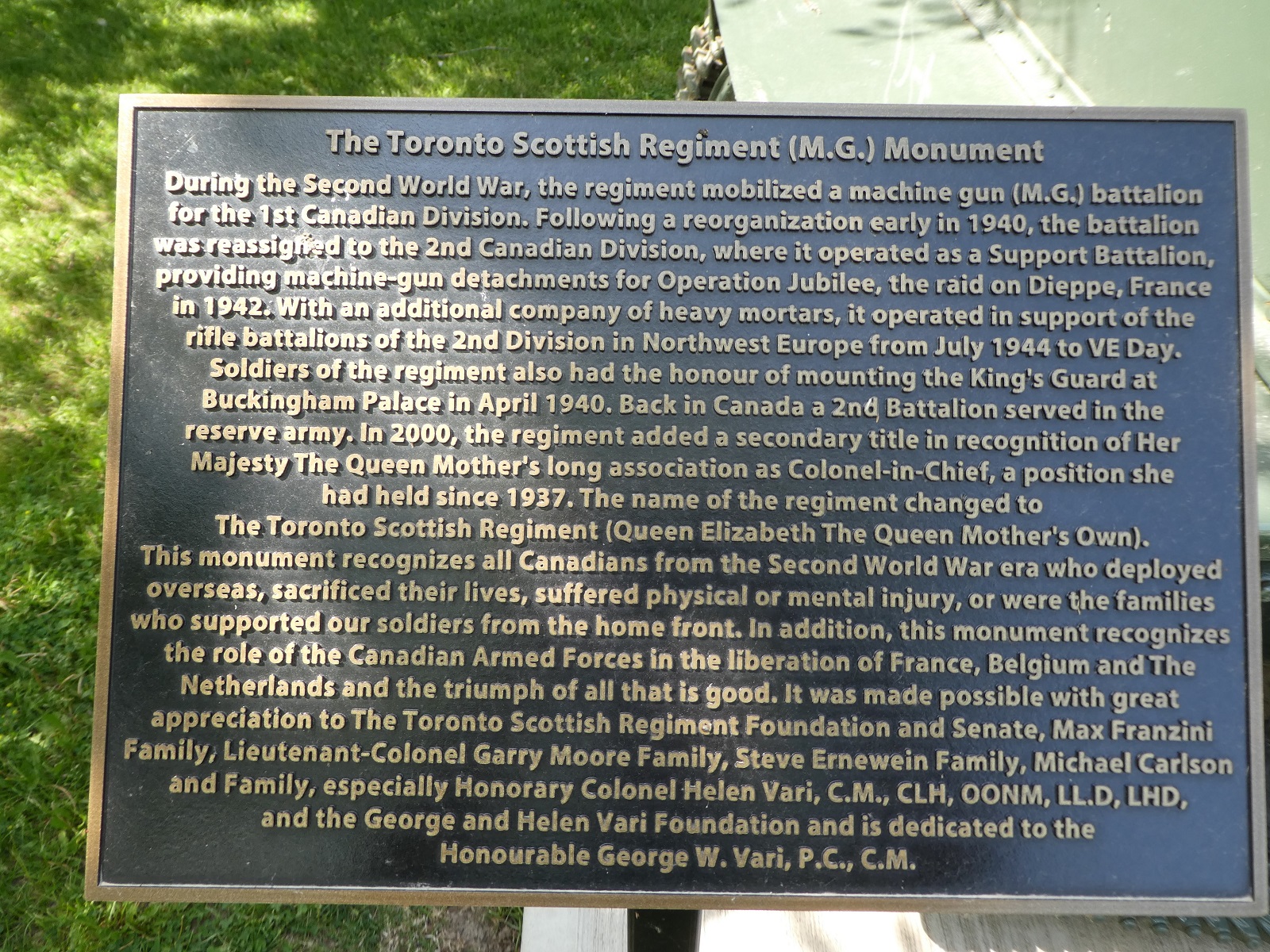
The Toronto Scottish Regiment (M.G.) Monument plaque

1 of 4 images

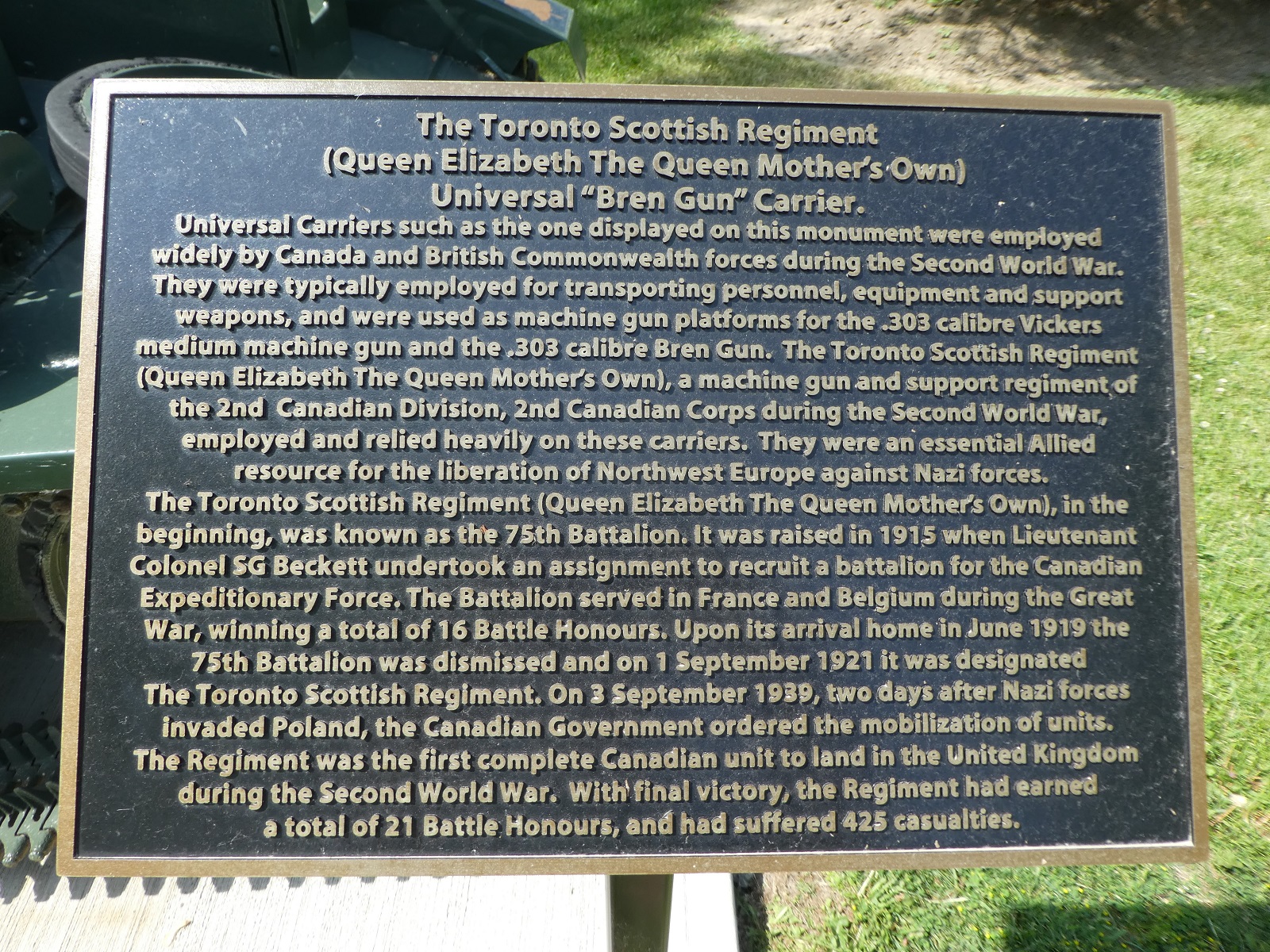
Universal Bren Gun Carrier plaque

1 of 4 images

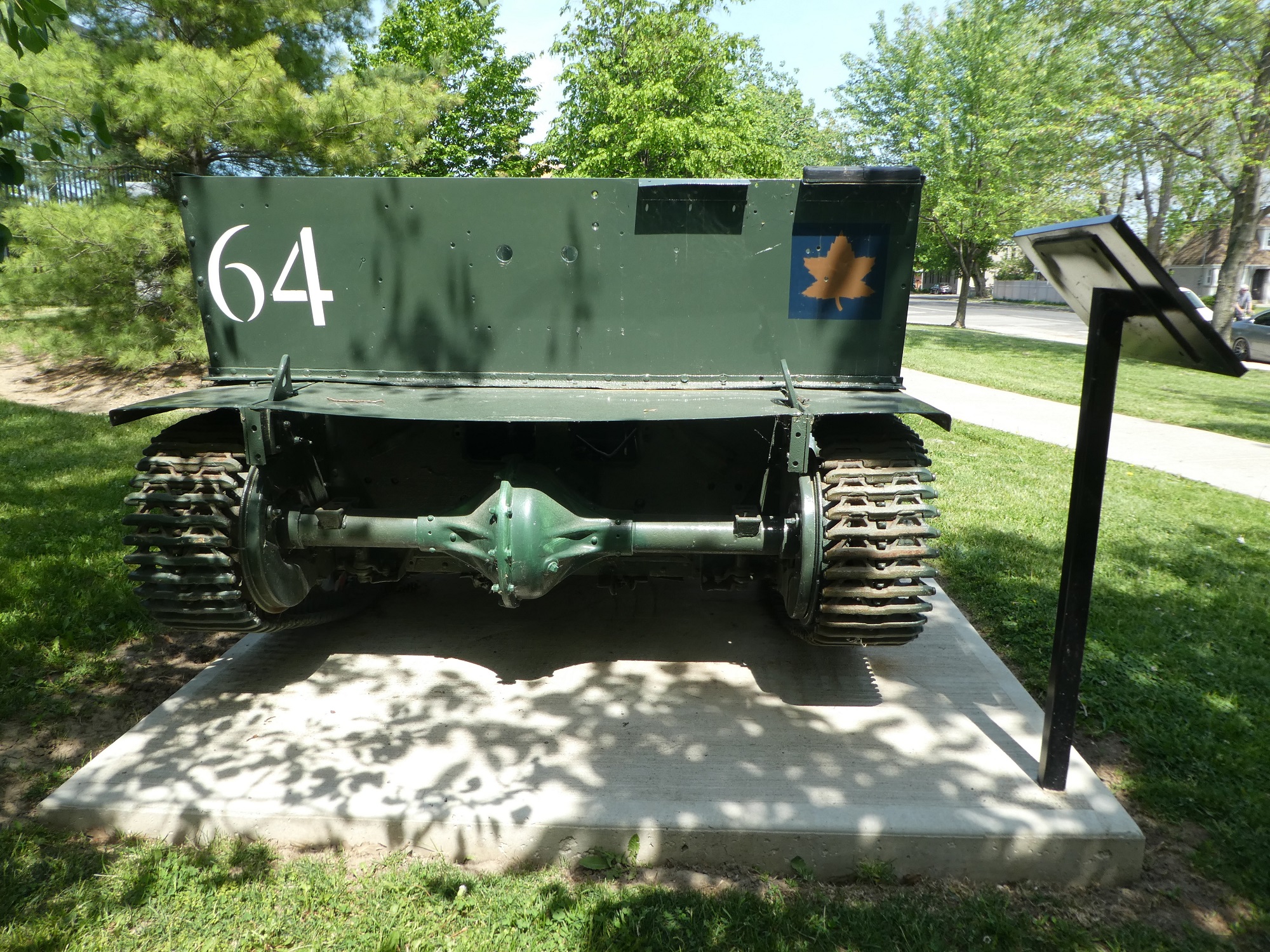
left side

1 of 4 images
Table of contents