
Introduction
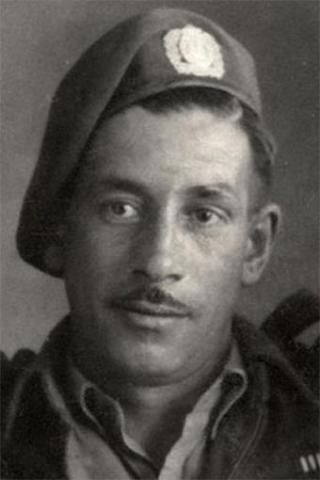
Considering his father's overseas exploits in the First World War, one would think fate had chosen Charles Henry Byce to be a military hero.
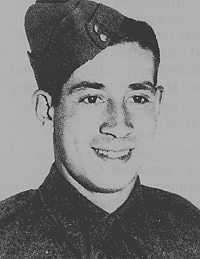
Charles Byce, shown at age 24
His mother, Louisa Saylors, a Cree from Moose Factory, Ontario, had married Henry Byce, a non-Indigenous man from Westmeath. When Charles was born in 1917 in Chapleau, the First World War was still raging, and his father was fighting in Europe, where he merited two decorations for valour: the Distinguished Conduct Medal – second only to the Victoria Cross – and France’s Médaille militaire.
Two decades later, 23-year-old Charles Byce joined the Lake Superior Regiment (Motor)—the "Lake Sups"—a regiment comprised primarily of Indigenous soldiers and began a remarkable journey that practically traced his father's path. When it was over, Byce had become the only man in his regiment to earn both the Distinguished Conduct Medal (DCM) and the Military Medal (MM).
Very few Canadians have received both a Distinguished Conduct Medal and Military Medal (or its equivalent) - remarkably, both Charles and his father, are two of them.
First act of heroism
Byce earned his first decoration for valour—the MM—in the Netherlands in January 1945. By that time, the Allies had established themselves in France and Belgium and, in another month, would launch an offensive for a final push over the Rhine into Germany.
Before dawn on 21 January, Acting Corporal Byce and twenty-three other Lake Sups set off in rowboats to cross the Maas River. Their mission was to sneak behind enemy lines and bring back German prisoners so information on enemy units could be gathered.
Byce headed a five-man team charged with providing cover for the reconnaissance group.
Soon after it had landed on enemy territory, the reconnaissance group was fired upon from three German positions. Byce personally located two of them and silenced them with grenades. He also managed to obtain information from a German prisoner before the group started back. The official history of the regiment describes the events that followed:
By this time the sky was filled with baleful red and yellow flares, and enemy machine-guns and light mortars were spurting into action . . . As the patrol hurried along the dyke several grenades hurtled through the air. Fortunately, they exploded harmlessly... but they did serve to reveal the location of two more enemy soldiers. Again, Corporal Byce took the initiative. He charged the German dugout and into it hurled a 36 [calibre] grenade.
The patrol escaped safely and, afterward, Byce became one of more than 1,200 Canadians awarded the MM.
His citation commended the corporal for his "coolness" and "devotion to duty" and credited him with the mission's success.
Second act of heroism
Some six weeks later, Byce became one of only 162 Canadians to earn the DCM during the Second World War.
The Rhineland campaign was well under way, but enemy defences still blocked the Allied path into Germany. This was the enemy's last major line of defence and it would not be broken easily. Counter-attacks were fierce and numerous.
On 2 March 1945, the Lake Sups engaged in the most difficult fighting the regiment had known. At 0400, Acting Sergeant Byce and the rest of C Company set out to occupy a group of buildings south of the Hochwald Forest. By 0600, they had accomplished their goal, but the day's first light revealed their location to the enemy.
C Company was bombarded with shells and mortar. All of its tanks were destroyed and casualties mounted quickly. The victims included every officer—even the company commander. Meanwhile, four enemy tanks were approaching. The regimental history explains what happened next:
In the confusion and general disorder, the enemy closed in upon C Company's position. Grimly, the Lake Sups held on, the perimeter of their defences becoming smaller and smaller, and their escape corridor to the rear, narrower and narrower . . . With ferocity and courage [Sergeant] Byce, now commanding the remnants of C Company, fought as long as he could; then gathering what few men he was able to find about him he made his way back through the bullet-strewn escape alley.
It was 1500 that same day. when Byce ordered the retreat of his men. He spent the rest of the afternoon behind his group, now armed with a sniper’s rifle, shooting at the enemy infantry so they could not trace the company's withdrawal.
Again, his citation was impressive:
The magnificent courage and fighting spirit displayed by this NCO when faced with almost insuperable odds are beyond all praise. His gallant stand, without adequate weapons and with a bare handful of men against hopeless odds will remain, for all time, an outstanding example to all ranks of the Regiment.
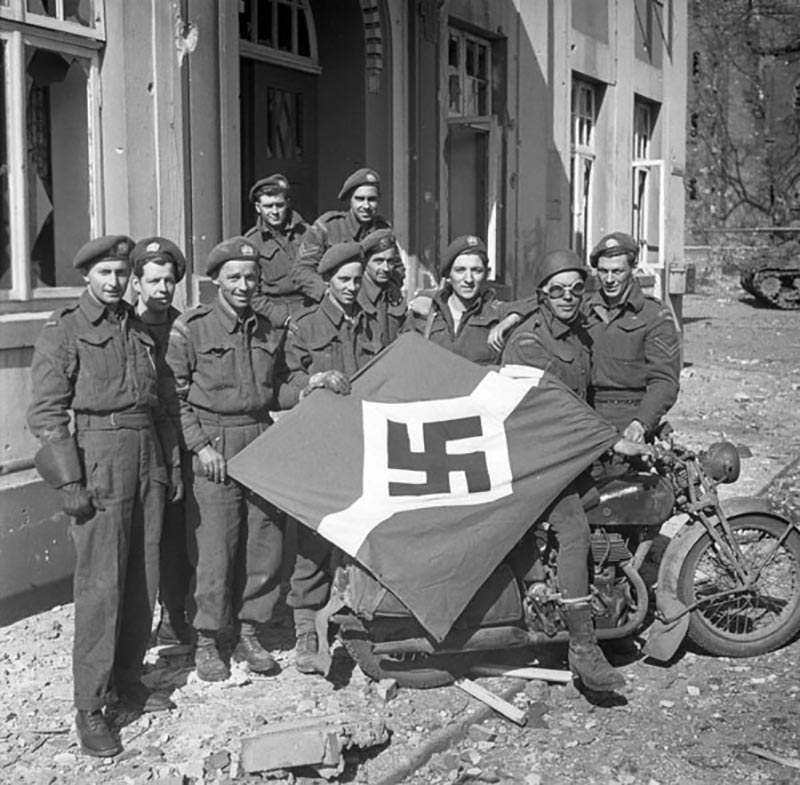
In Germany, in April 1945, a group from the Lake Superior Regiment display the enemy flag they had captured. Library and Archives Canada PA-137250
Wars end
Byce and the Lake Sups had advanced into Germany by the time the war in Europe ended on 8 May 1945.
The following month, he was sent to England. He returned to Canada in September 1945.
Epilogue
On 23 May 2008, at a private ceremony in the Canadian War Museum, members of the Byce family participated in the donation of the father’s and son’s medals.
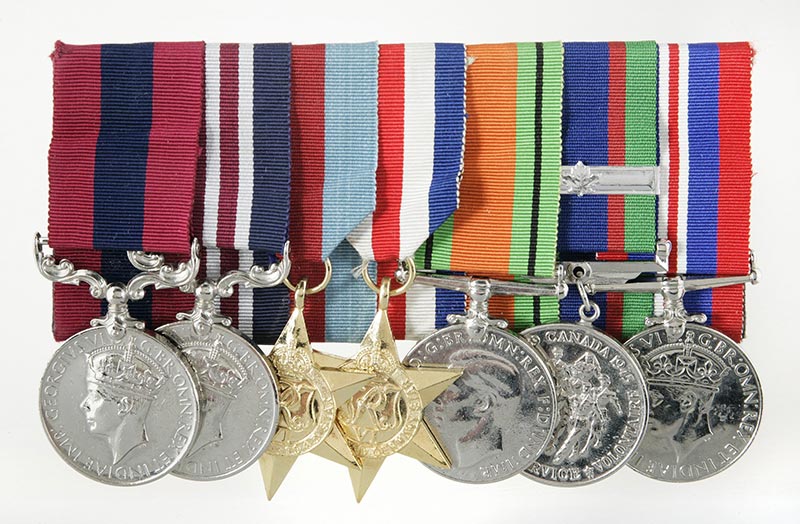
Medal set belonging to Charles Henry Byce. From left to right: Distinguished Conduct Medal (DCM), Military Medal (MM), 1939-1945 Star, France & Germany Star, Defence Medal, Canadian Volunteer for Service Medal with Overseas Bar, and British War Medal (1939-1945). Canadian War Museum, 20080061-001.
With courage, integrity and loyalty, Charles Henry Byce and his father left their mark. Discover more stories.
Related Information
The well-being of Canadian Veterans is at the heart of everything we do. As part of this, we recognize, honour and commemorate the service of all Canadian Veterans. Learn more about the services and benefits that we offer.