
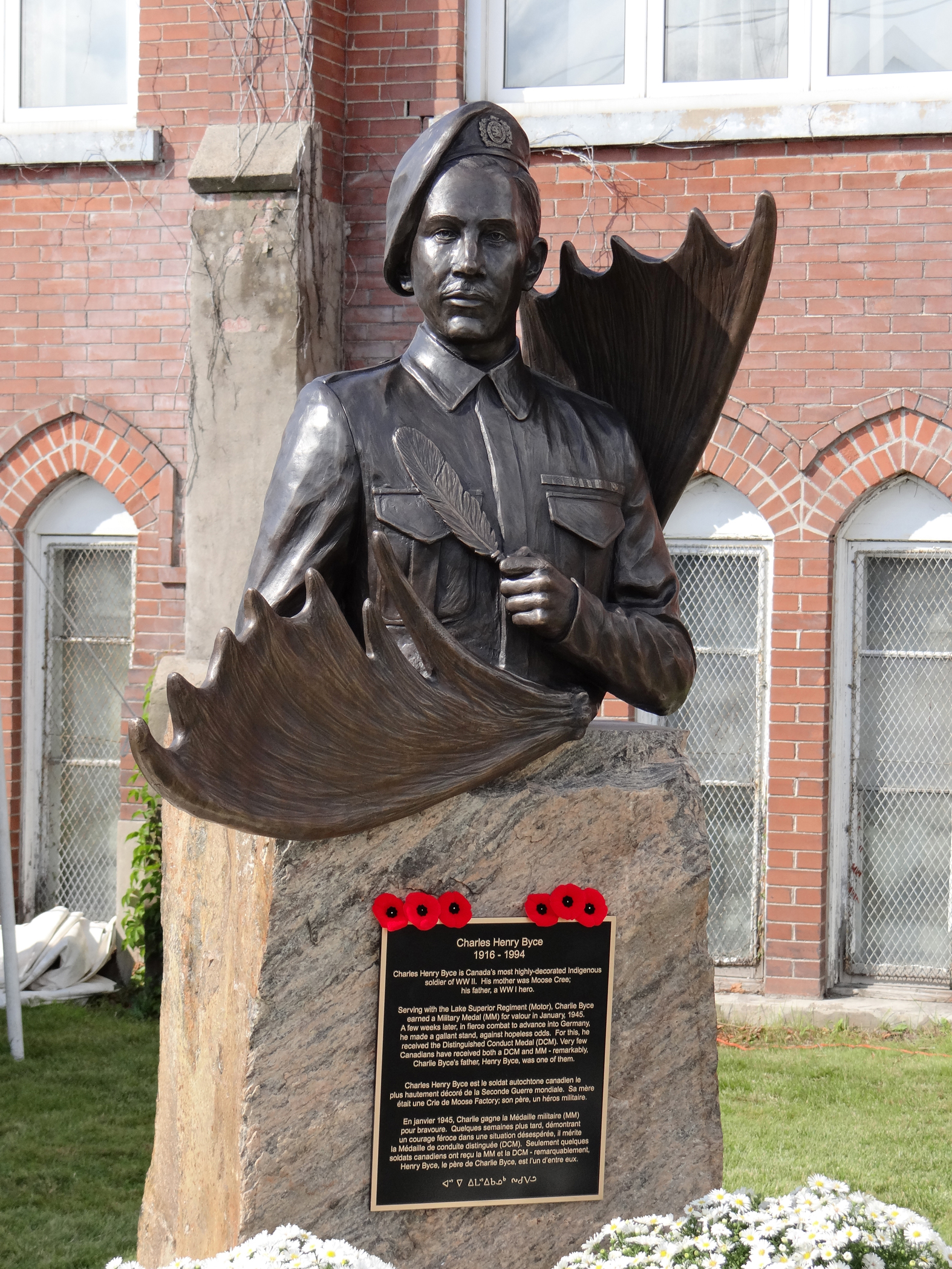
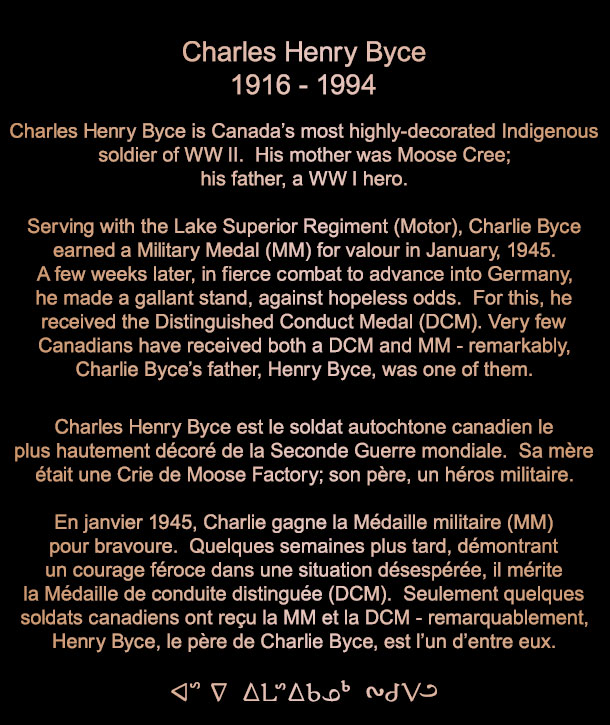
The Ontario Native Education Counselling Association, along with strong community support, led the effort to commemorate Charlie Byce. The bronze and granite monument was created by Tyler Fauvelle, a Sudbury-based sculptor and unveiled September 17, 2016.
Sergeant Charlie Byce in his uniform, with his ribbon bars and battle-aged eyes, and we realize that the artwork is telling the story of a hero. There's another story to see, and it's the story of Charlie's Moose Cree heritage. Antlers encircle him - but only in a broken circle, symbolizing what racism and the residential school system did to separate him from his culture. The eagle feather held close to his heart is a tribute to valour, and a reminder that Charles Henry Byce, the son of a proud Cree woman and a First World War hero, never forgot who he was.
Charles Henry Byce was born in Chapleau, Ontario. His mother was Cree, from Moose Factory and his father was a decorated hero of the First World War. Charlie's rebellious spirit was inflamed by the oppression he experienced in the residential school system. He was a teenager when he left Chapleau, eventually joining the army at Port Arthur (Thunder Bay).
Sergeant Byce served with the Lake Superior Regiment (Motor) - now the Lake Superior Scottish Regiment. He was awarded the British Military Medal for leadership and bravery on the night of January 20, 1945, in Holland. Just a few weeks later, he earned the Distinguished Conduct Medal for extreme bravery in the Hochwald Forest sector, Germany.
"The magnificent courage and fighting spirit displayed by this NCO [non-commissioned officer] when faced with almost insuperable odds are beyond all praise. His gallant stand, without adequate weapons and with a bare handful of men against hopeless odds will remain, for all time, an outstanding example to all ranks of the regiment.”
- from the Distinguished Conduct Medal Citation
The Distinguished Conduct Medal is second only to the Victoria Cross, making Charles Henry Byce one of the most highly-decorated Indigenous soldier in the Canadian Army, Second World War. Very few Canadians have received both a Distinguished Conduct Medal and Military Medal (or its equivalent) - remarkably, Henry Byce, Charlie's father, was one of them.