
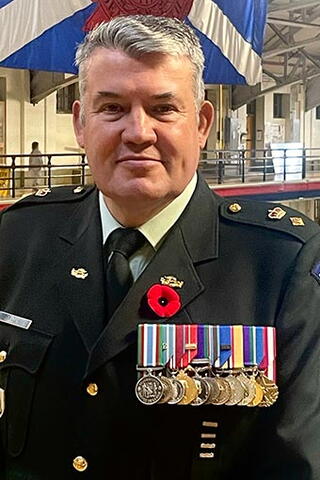

Joined
- 1998

Postings
- UK
- Germany
- Northern Ireland
- Texas
- Gagetown
- Ottawa
- Victoria

Deployments
- Iraq and Israel domestic deployments – (Ambulance strike, fuel strike, fireman’s strike, Foot and Mouth)
- Northern Ireland (3)
- Bosnia (2)

Medals/Awards
- Canadian Peacekeeping Service Medal
- United Nations Treaty Supervision Organization (UNTSO)
- Queens’s Diamond Jubilee
- Queens Golden Jubilee
- Canadian Decoration
- General Service Medal 1962 (Northern Ireland Clasp) (Op Banner)(three tours)
- United Nations Protection Force (UNPROFOR) (Op Grapple)
- Former Yugoslavia Non-Article 5 NATO (Op Palatine)
- Op TELIC (Iraq) (Op Telic)
- Accumulated Service Medal Meritorious Service Medal (United States)
- Level two commendations – Four.
On watch from a volcano
In 2013, Lieutenant-Colonel Adrian Fyfe’s job was to watch a war that, on paper, had ended decades earlier.
From his post atop the dormant volcano Mount Bental in the Golan Heights, he monitored a fragile ceasefire below.
Fyfe tracked movements along the border and observed activity near the ruined town of al-Quneitra, just beyond the line separating the Golan Heights from the UN buffer zone in Syria.
He and his team analyzed craters created by mortar, artillery and tank rounds during the Syrian Civil War.
He documented fighter jet, attack helicopter and artillery activity.
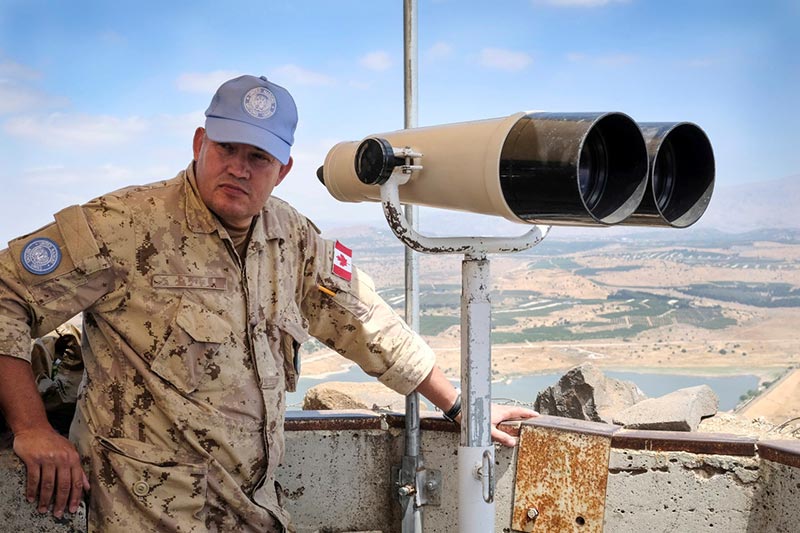
Adrian Fyfe at a UN observation post in the Golan Heights.
Fyfe has spent decades in uniform—more than twenty years in the British Army, then enlisted in the Canadian Armed Forces.
By the time he took command of Operation Jade (Canada’s contribution to the United Nations (UN) Truce Supervision Organization (UNTSO)), Canadian Armed Forces members were already serving as unarmed military observers. Their role was to monitor ceasefires and armistice agreements. As the Deputy Chief of Observer Group Golan (OGG), he organized the deployment of UNTSO Observers working alongside their armed counterparts in United Nations Disengagement Observer Force (UNDOF). He often met with representatives of the 26 nations involved in the mission.
When trust meant everything
During his 400 days in the Golan Heights, he learned to trust his teammates. He also relied on colleagues from Fiji, Ireland and India for information and safety. This trust mattered most when he faced dangerous tasks. These tasks included conducting bomb crater analysis along the technical fence. Often working close to nearby Syrian faction positions.
There were tense moments when trust meant everything.
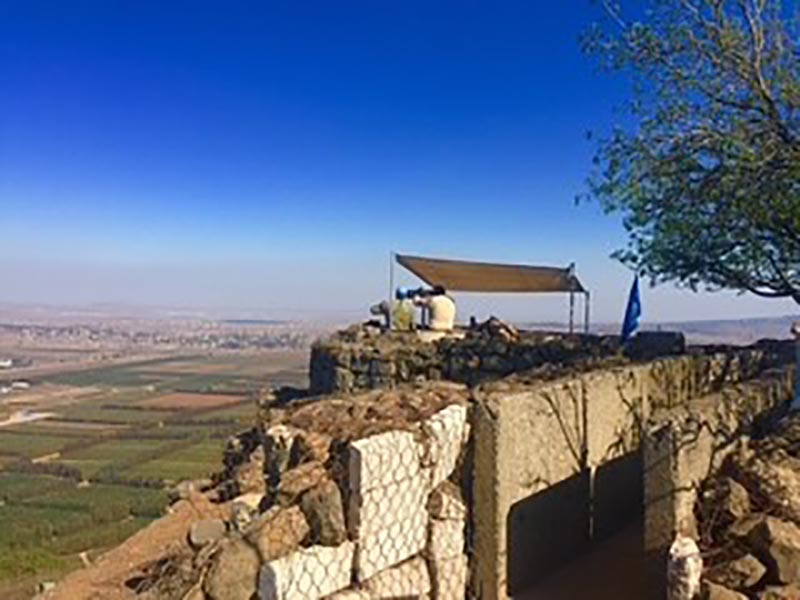
Adrian Fyfe and a peacekeeping colleague sit on top of a UN observation post in the Middle East.
As most peacekeepers know, missions aren’t always peaceful. One entry from his personal diary on Sunday 17 July 2013, read:
“3:30 p.m. Huge explosion. Dropped to the trench floor. Four minutes… then silence.”
In response to a Russian drone incursion, the Israel Defense Forces fired a multi-million-dollar air defence missile. The missile missed the drone but also just missed Fyfe and his New Zealand teammate. Moments later, two IDF F-15s screamed overhead and fired air-to-air missiles. There was then a deafening silence.
“There is no zero-risk environment,” Fyfe said. “You learn to be comfortable in that.”
A multinational team
The mission brought UN observers from across the world. Fyfe loved working with Dutch, Swiss, Australians, Fijians and Latvians. Each one brought their own military culture, national pride and unique characteristics.
“You’re dropped into it,” he said. “You’re representing your country and united by a common mission.”
“I was working with a whole range of amazing professionals,” he said, adding he was always proud to represent Canada.
His first month he was led by an Argentinian Infantry officer accompanied by two experienced Dutch officers. Their friendships have endured.
“There’s an understanding that when a Canadian shows up, it’s going to be a good thing,” he said. “Canadians are known for having a light and right touch.”
A chance to explore
Despite the tension of the mission, the deployment also allowed Fyfe time to explore the history and culture of the Middle East. While some stayed inside to escape the heat of a Mediterranean summer, he went out to explore. He hiked, swam in the Mediterranean and visited centuries-old Crusader castles. He slept out in the Negev Desert, exploring neighboring Jordan.
“I wanted to take advantage of the opportunity,” he said. “These are once-in-a-lifetime experiences.”
Making unforgettable memories
Some of his most memorable experiences serving in the Middle East weren’t work-related. He remembers the Christmas Eve visit with the Observation Post line before driving to Jerusalem to celebrate with Op PROTEUS soldiers. He remembers the afternoon he walked the silent streets of Jerusalem as snow gently fell. He remembers descending to the Dead Sea on Boxing Day to enjoy the tranquility of the Monastery of Saint Gerasimos, ending up at the Crusader Castle of Kerak.
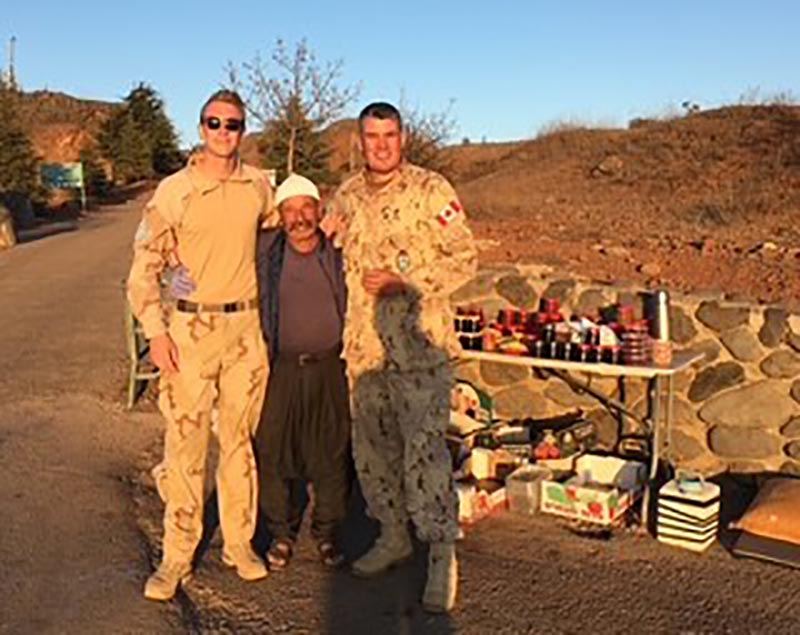
Adrian Fyfe, right, and his Syrian Army intelligence source in the North of his area of operations stand with a Bental honey seller.
The memories of times with fellow UN observers are also dear to him. They shared meals—Swiss seafood, Finnish meat and potatoes, Dutch desserts—with the Aussies who brought the party vibe. There were sights, sounds and smells that last a lifetime: months of drinking tea with the Bental Honey seller, buying dozens of jars of his delicious honey flavoured by the desert flowers of the Golan, and talking with him about his family in Syria.
In Iraq, Fyfe served as a deputy commanding officer, during his time with the British Army. He experienced life on the border with Iran, in the battlefield debris of the Iran/Iraq war, intercepting IEDs and experienced life of the locals.
He accompanied the British Museum to the ancient city of Ur and felt the buzz of commanding 1,200 combat soldiers in Central Basrah,
“The honour and dignity of people in the Middle East, that’s what stays with you,” he said.
Representing Canada
There is a responsibility that comes with wearing a flag on your shoulder in a multinational mission.
“People perceive Canada through you,” Fyfe said.
He’s enjoyed his military service so much, he jokes his mother-in-law once asked him when he planned to “grow up and get a real job.”
“When it stops being fun,’” he told her. “I always just wanted to get the job done, hand over something better that when I took it over, represent my country well and enjoy the journey,” he said.
Adrian Fyfe is featured on the 2026 Canadian Armed Forces in the Middle East poster.
Adrian Fyfe is leaving his mark. He is a Canadian Armed Forces Member. Discover more stories.
The well-being of Canadian Veterans is at the heart of everything we do. As part of this, we recognize, honour and commemorate the service of all Canadian Veterans. Learn more about the services and benefits that we offer.
If you are a Veteran, family member or caregiver, the support of a mental health professional is available anytime at no cost to you. Call 1-800-268-7708.