
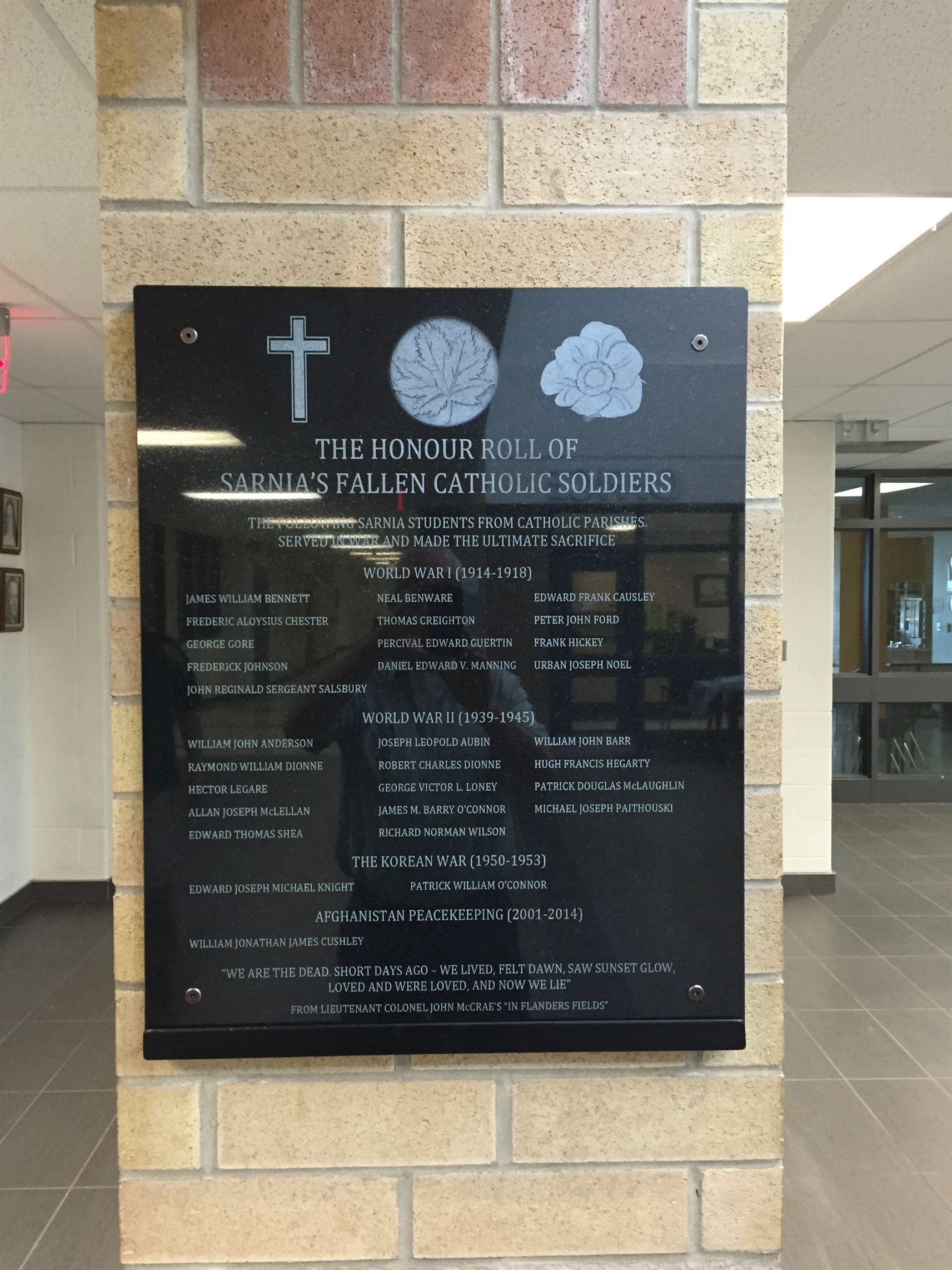
In November 2016, a plaque to honour the memory of former students of the Sarnia-Lambton Catholic School system who gave their lives in the service to their country was officially unveiled in St. Patrick’s Catholic High School. The idea to create the plaque was initiated in the spring of 2012 by Tom Slater, a former teacher at the school. The idea was based on the fact that during both World Wars and the Korean War, there were only two secondary schools in Sarnia; Sarnia Collegiate Institute, opened in October 1922, and St. Patrick’s High School, founded in 1935.
With the work of Blake Morrison, and support of Lou Giancarlo, Tom St. Amand and Principal Rob Cicchelli, the St. Patrick’s plaque became a reality. On November 10, 2016, a dedication ceremony was held in the school foyer officially unveiling the black granite plaque. Present at the ceremony were dignitaries that included Sarnia-Lambton MP Marilyn Gladu, Sarnia-Lambton MPP Bob Bailey, City of Sarnia Mayor Mike Bradley, Royal Canadian Legion’s Bill Chafe and several family members of fallen soldiers on the plaque.
The St.Patrick's Catholic High School War Memorial Plaque is an honour roll of thirty of Sarnia's fallen Catholic soldiers. The names inscribed on the plaque are of ordinary young men who had attended Sarnia Catholic schools and/or parishes, including Our Lady of Mercy, St. Joseph’s in Sarnia, Sacred Heart in Port Lambton and St.Patrick’s High School. The thirty names on the plaque are of fallen soldiers from two World Wars, the Korean War and Afghanistan Peacekeeping. There are three symbols across the top of the plaque: a crucifix, representing of God and faith; a maple leaf, representing country (the same leaf design as the one on thousands of fallen soldiers graves overseas); and a poppy, the international symbol of Remembrance. Along the bottom of the plaque is a quote from Colonel John McCrae’s poem “In Flanders Fields”.
The plaque serves as a tribute to the fallen and to their families. It also serves as a permanent reminder for students to always remember the sacrifices of young men and women not much older than themselves who served, past and present.