


Citation(s);
Military service
Burial/memorial information
Son of Luiz Duque and Emma Hye, of Hull, Outaouais, Québec. He signed «Duke » when he enlisted. He is also commemorated as Raymond Duke on page 401 of the First World War Book of Remembrance.
Enlisted in the 163rd Battalion of the Canadian Expeditionary Force under the name Duque, although he signed as Duke. He was sent to garrison duty in Bermuda, from where he left on November 18, 1916, for England via Halifax, Nova Scotia. He landed in Liverpool on December 6. On January 7, 1917, he was incorporated into the 10th Reserve Battalion and on March 28, 1918, into the 22nd Battalion. On the 29th, he crossed over to France and went to the front line on June 19. During the advance of the troops from Wancourt to Chérisy, Pas-de-Calais, he was hit by machine gun fire and killed instantly on August 28, 1918, during the Battle of Chérisy.
Digital gallery of Private Raymond Duque
-
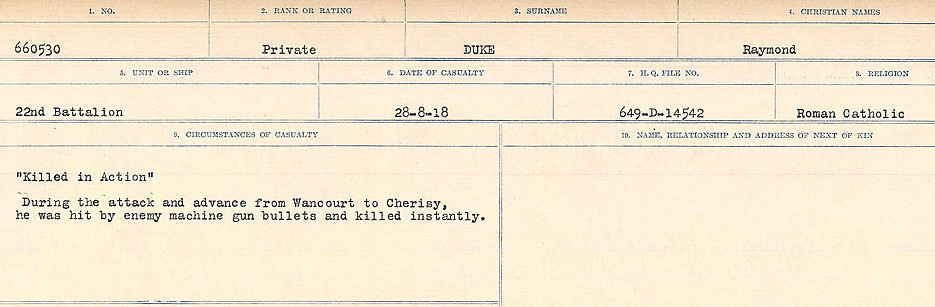
Circumstances of death registers
Source: Library and Archives Canada. CIRCUMSTANCES OF DEATH REGISTERS, FIRST WORLD WAR. Surnames: Duane to Dzhobiewski. Microform Sequence 30; Volume Number 31829_B016739. Reference RG150, 1992-93/314, 174. Page 287 of 1062. -

Memorial
His name as it is inscribed on the Vimy Memorial. Over 11,000 fallen Canadians having no known place of burial in France, are honoured on this Memorial. May they never be forgotten. (J. Stephens) -
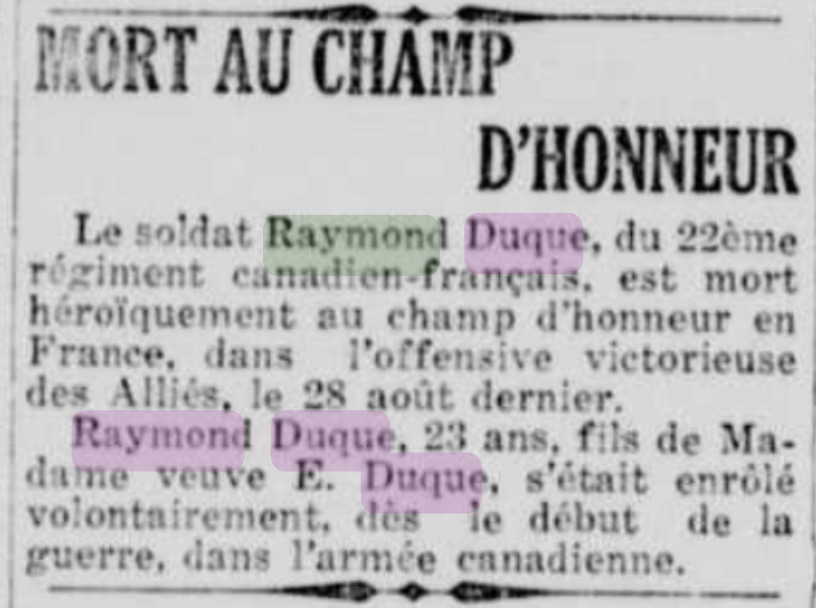
Newspaper clipping
The photo was taken from the BANQ (Bibliothèque et archives nationales du Québec) database. -
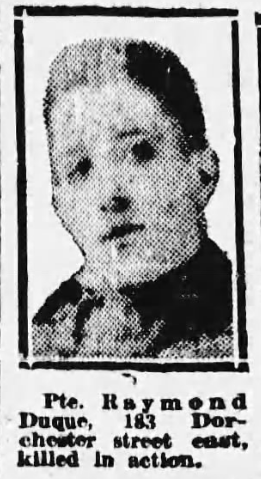
Newspaper clipping
From the Montreal Star c.1918. Submitted for the project Operation Picture Me
Digital gallery of
Private Raymond Duque
Digital gallery of
Private Raymond Duque
Digital gallery of
Private Raymond Duque
Digital gallery of
Private Raymond Duque
In the Books of Remembrance
Commemorated on:
Page 401 of the First World War Book of Remembrance.
Request this page
Download this page

The Poppy Design is a trademark of The Royal Canadian Legion (Dominion Command) and is used with permission. Click here to learn more about the poppy.
Did we miss something?
Contribute information to this commemorative page
Do you have photographs, information or a correction relating to this individual’s virtual memorial? Learn more about the CVWM and the information we collect.