

Military service
Burial/memorial information
Son of Henri Lalancette ("Henry Lancette"), who died in 1902, and Sarah Palmby, who died in 1900, of Woodstock, Ontario, and Chicoutimi, Quebec. He named his sister, Marie-Jeanne, as his next of kin. She married François Jean in 1908 and settled in St-Henri-de-Taillon, Lac-Saint-Jean, where she died in 1918.
The above date and place of birth were reported at the time of his enlistment, but a corresponding birth record could not be located. The Ontario birth register suggests that his given name at birth may have been Henry, like his father, and that he was born on September 11, 1892, in Woodstock, Ontario. His parents were married in London, Ontario, but resided in Woodstock. Orphaned at a very young age, it is understandable that some details concerning his family background may have been confused.
He enlisted in the 167th Battalion of the Canadian Expeditionary Force in Quebec City, Quebec, and was subsequently assigned to the 189th Battalion at Camp Valcartier, north of Quebec City. On September 23, 1916, he embarked for Great Britain, arriving in Liverpool, England, on October 6. Upon arrival, he was posted to the 69th Reserve Battalion. After being transferred to the 22nd Battalion on October 27, he proceeded to France and arrived there the same day. On November 3, he entered the trenches at Bully-Grenay, Pas-de-Calais. On November 21, he was seconded to the 2nd Canadian Entrenchment Battalion, which he was scheduled to join the following day. However, he went absent without leave. On December 27, he saw action at Lens. From April 5 to May 18, 1917, he remained absent, and upon his arrest was charged with desertion. He appeared before a court-martial on June 7, 1917, and was sentenced to death. He was executed by firing squad on July 3, 1917, at Aix-Noulette, Pas-de-Calais.
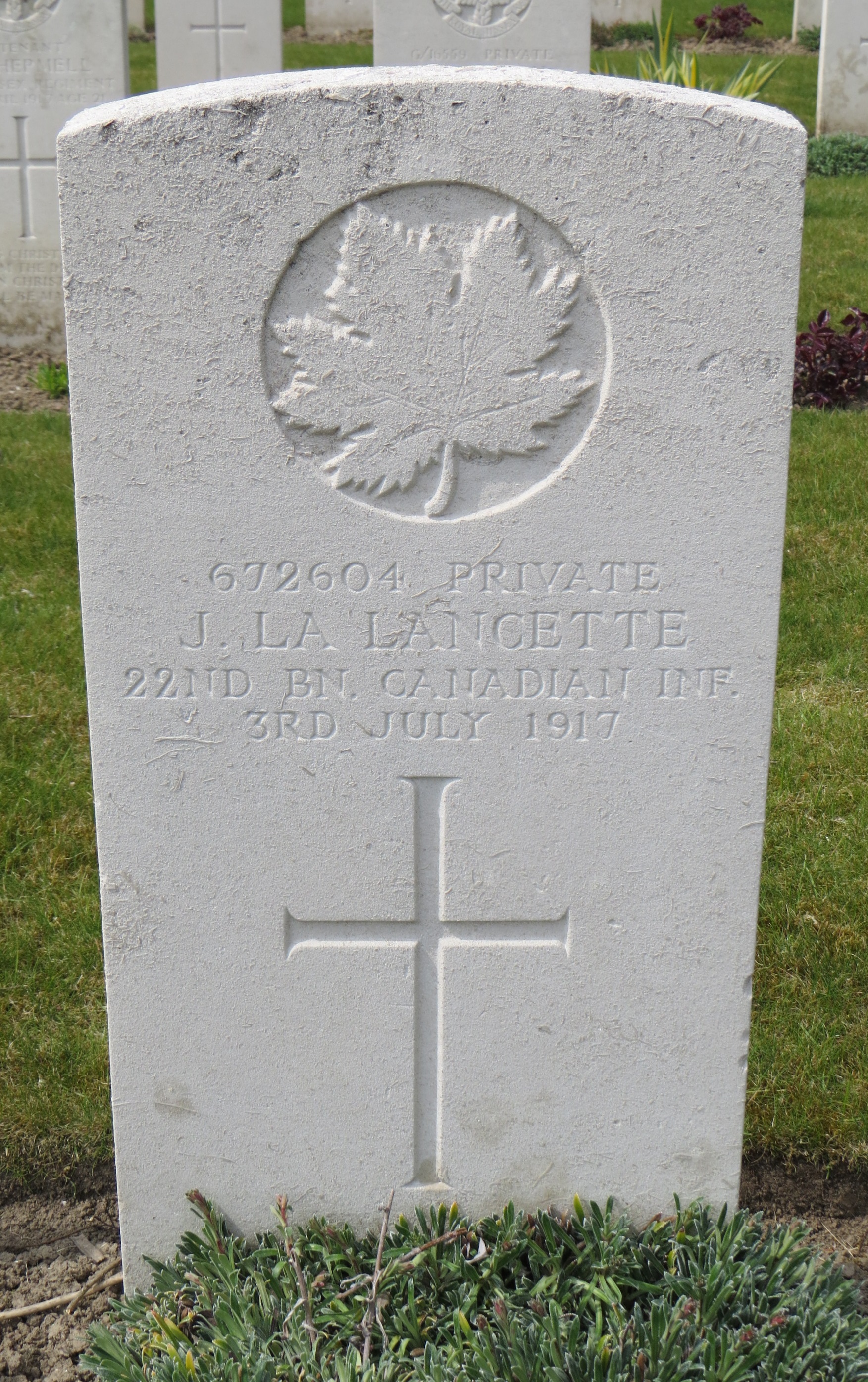
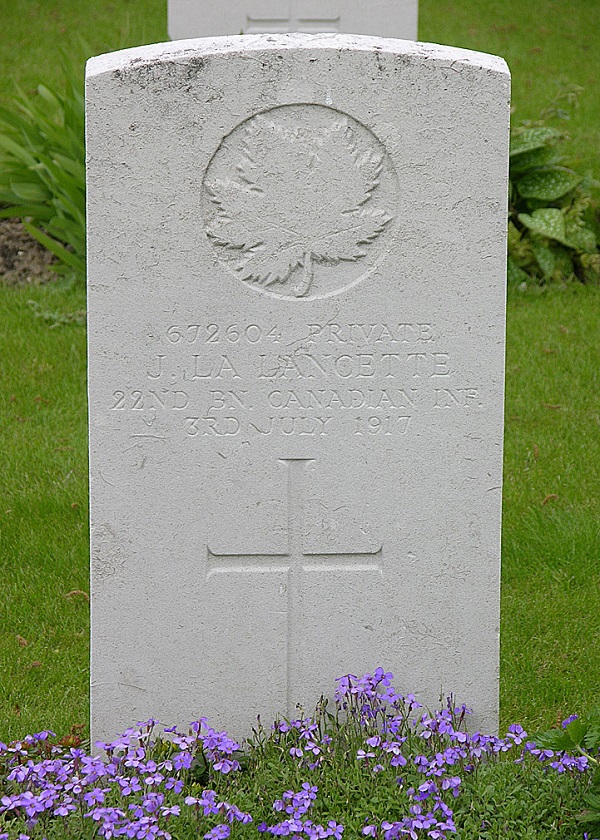
In an effort to address the recurring problem of unauthorized absences and desertion, military authorities adopted increasingly severe disciplinary measures. Despite repeated warnings, some soldiers continued to defy military regulations. As the 22nd Battalion prepared for the assault on Vimy Ridge, two men with previous records of unauthorized absences, Joseph Lalancette and Gustave Comte, abandoned their posts. Both remained absent for more than a month before being apprehended, indicating no intention of returning voluntarily. Tried by court-martial for desertion in the face of the enemy, they were convicted and sentenced to death. They were executed together on July 3, 1917, and are buried side by side in the cemetery at Aix-Noulette.
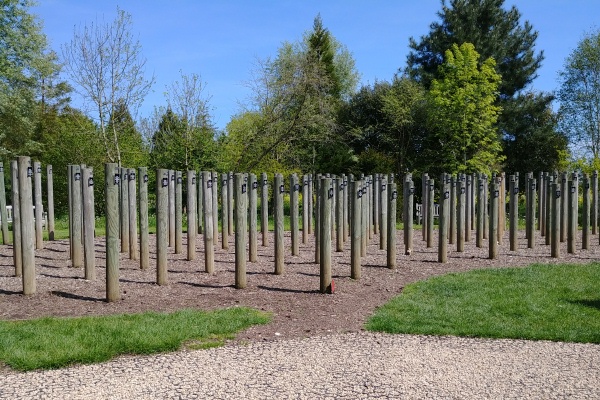
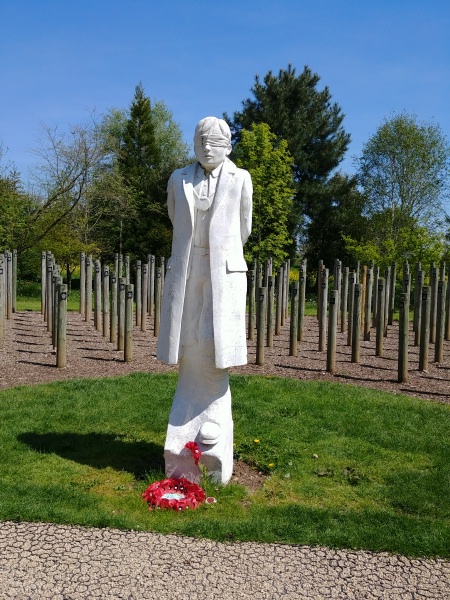
On December 11, 2001, the Government of Canada, represented by Veterans Affairs Minister Ronald Duhamel, issued an apology to the families of the 23 Canadians executed during the First World War for desertion. Three additional Canadian soldiers had been executed for serious criminal offences. Over time, changing social attitudes and a greater understanding of the psychological effects of warfare have influenced how these cases are viewed. Many of these volunteers endured immense combat stress, including what is now recognized as post-traumatic stress disorder, a condition not understood at the time. It is now widely acknowledged that some soldiers whose mental resilience had been shattered by the horrors of war may have been treated unjustly. Regardless of the circumstances surrounding their convictions, these men served in some of the war's most difficult battles and deserve to be remembered. To commemorate the executed soldiers, including the Canadians, the British government erected the Shot at Dawn Memorial at the National Memorial Arboretum near Alrewas, Lichfield. Created by artist Andy De Comyn, the memorial was unveiled on June 21, 2001. It is surrounded by 307 wooden posts, each bearing the name of an executed soldier.
Digital gallery of Private Joseph Lalancette
-

Statement by Hon. Ronald Duhamel
Statement by Hon. Ronald Duhamel (Minister of Veterans Affairs and Secretary of State (Western Economic Diversification) (Francophonie), Lib.) about the 23 soldiers of the Canadian Expeditionary Force who ¿were lawfully executed for military offences such as desertion and, in one case, cowardice¿ announcing that ¿the names of these 23 volunteers will be entered into The First World War Book of Remembrance along with those of their colleagues. Adding the names of these citizen soldiers to the pages of this sacred book, which lies in the Memorial Chamber not far from here, will be a fair and just testament to their service, their sacrifice and our gratitude forevermore.¿ Part 1 -
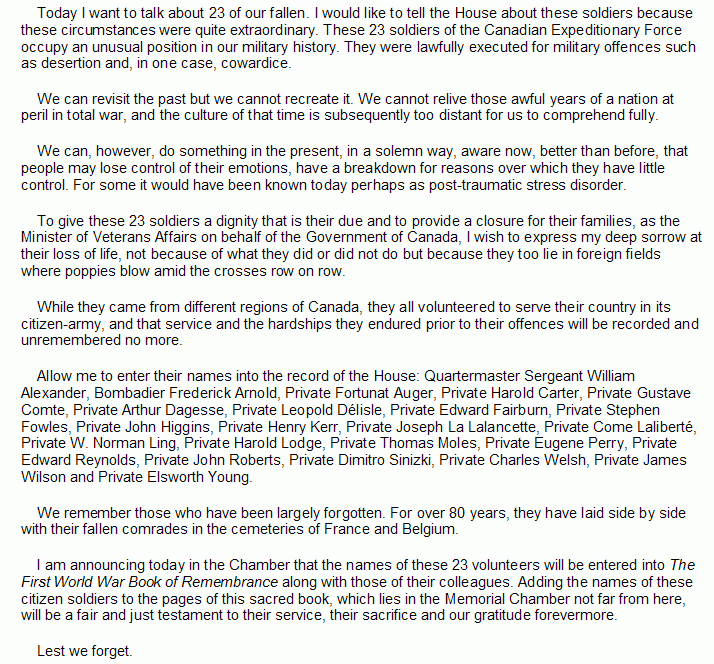
Statement by Hon. Ronald Duhamel
Statement by Hon. Ronald Duhamel (Minister of Veterans Affairs and Secretary of State (Western Economic Diversification) (Francophonie), Lib.) Part 2. Source: CANADA. House of Commons Debates. VOLUME 137 NUMBER 129 1st SESSION 37th PARLIAMENT OFFICIAL REPORT (HANSARD) Tuesday, December 11, 2001 -

Statement by Mr. Roy Bailey
Statement by Mr. Roy Bailey (Souris-Moose Mountain, Canadian Alliance). Source: CANADA. House of Commons Debates. VOLUME 137 NUMBER 129 1st SESSION 37th PARLIAMENT OFFICIAL REPORT (HANSARD) Tuesday, December 11, 2001 -

Statement by Mr. Louis Plamondon
Statement by Mr. Louis Plamondon (Bas-Richelieu-Nicolet-Bécancour, BQ) Source: CANADA. House of Commons Debates. VOLUME 137 NUMBER 129 1st SESSION 37th PARLIAMENT OFFICIAL REPORT (HANSARD) Tuesday, December 11, 2001 -
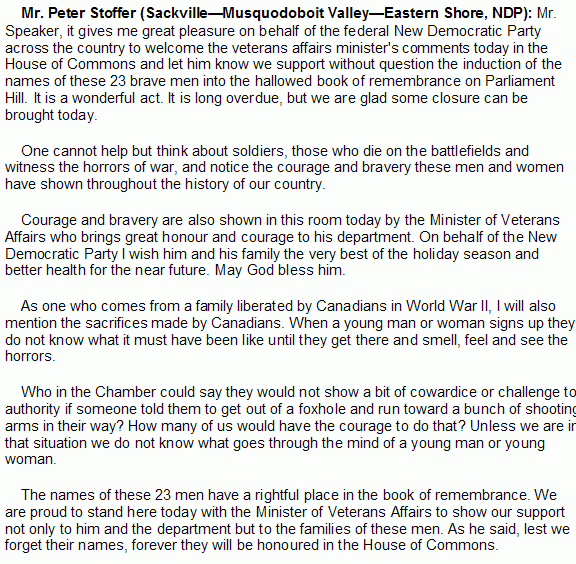
Statement by Mr. Peter Stoffer
Statement by Mr. Peter Stoffer (Sackville-Musquodoboit Valley-Eastern Shore, NDP) Source: CANADA. House of Commons Debates. VOLUME 137 NUMBER 129 1st SESSION 37th PARLIAMENT OFFICIAL REPORT (HANSARD) Tuesday, December 11, 2001 -

Statement by Mrs. Elsie Wayne
Statement by Mrs. Elsie Wayne (Saint John, PC/DR) Source: CANADA. House of Commons Debates. VOLUME 137 NUMBER 129 1st SESSION 37th PARLIAMENT OFFICIAL REPORT (HANSARD) Tuesday, December 11, 2001 -
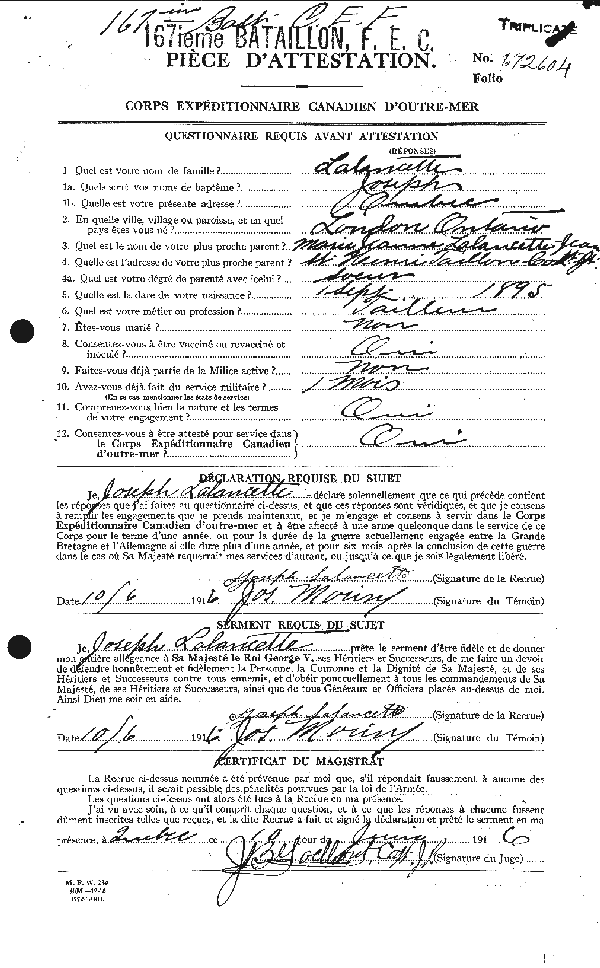
Attestation Papers
Source: Library and Archives Canada. -
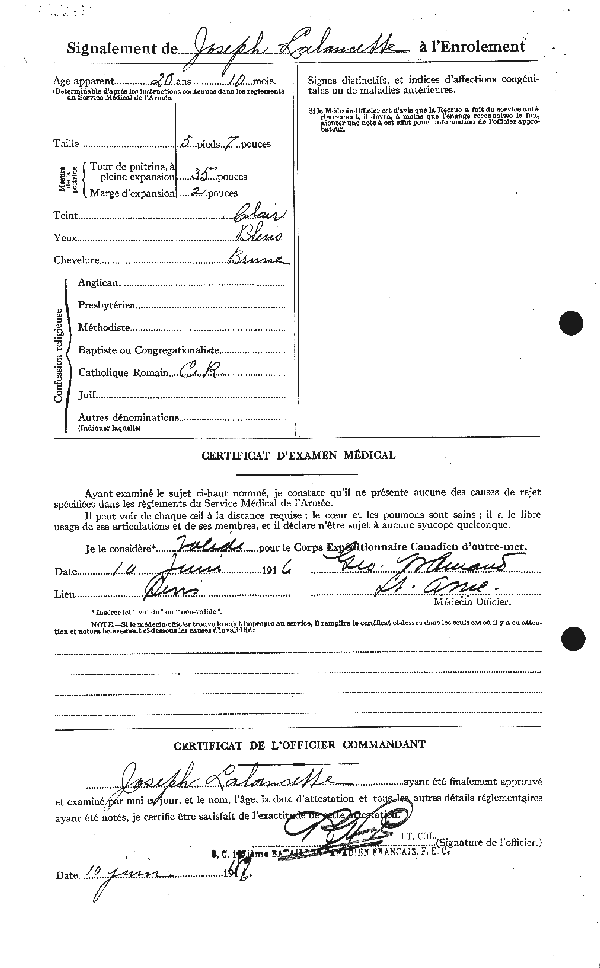
Attestation Papers
Source: Library and Archives Canada. -
Memorial
Private Joseph LaLancette is also commemorated at the Shot at Dawn Memorial, located at the National Memorial Arboretum, Staffordshire, UK - May 2019 … photo courtesy of Marg Liessens -
Memorial
Private Joseph LaLancette is also commemorated at the Shot at Dawn Memorial, located at the National Memorial Arboretum, Staffordshire, UK - May 2019 … photo courtesy of Marg Liessens -
Grave marker
24 April 2015, CEFRG (Canadian Expeditionary Force Research Group) -

Circumstances of death registers
-
Grave marker
Digital gallery of
Private Joseph Lalancette
Digital gallery of
Private Joseph Lalancette
Digital gallery of
Private Joseph Lalancette
Digital gallery of
Private Joseph Lalancette
Digital gallery of
Private Joseph Lalancette
Digital gallery of
Private Joseph Lalancette
Digital gallery of
Private Joseph Lalancette
Digital gallery of
Private Joseph Lalancette
Digital gallery of
Private Joseph Lalancette
In the Books of Remembrance
Commemorated on:
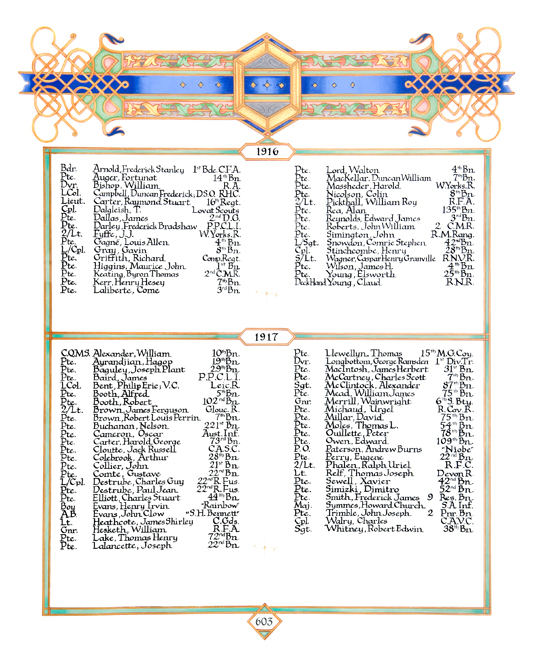
Page 603 of the First World War Book of Remembrance.
Request this page
Download this page
The Poppy Design is a trademark of The Royal Canadian Legion (Dominion Command) and is used with permission. Click here to learn more about the poppy.
Did we miss something?
Contribute information to this commemorative page
Do you have photographs, information or a correction relating to this individual’s virtual memorial? Learn more about the CVWM and the information we collect.