
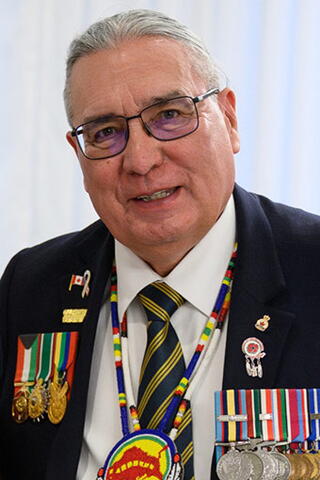

Joined
- 1970

Postings
- CFS Inuvik
- CFS Alert
- CFLS Ottawa
- CFB Gander
- NSGA Homestead, Florida
- CFB Kingston
- CFB Petawawa
- NDHQ Ottawa

Medals/Awards
- Gulf and Kuwait War – with Bar
- Saudi Arabia’s Liberation of Kuwait
- Kuwait Liberation Medal (Kuwait)
- Canadian Forces Decoration – Second Clasp
- United Nations Disengagement Observer Force (Israel/Syria)
- United Nations Iran/Iraq Military Observer Group
- NATO Non-Article 5 Medal – KFOR (Kosovo)
- Canadian Forces Special Service Medal – Alert
- Canadian Peacekeeping Service Medal
- Queen’s Diamond Jubilee Medal
- Operational Service Medal (OSM) – Southwest Asia
- Aboriginal Veterans Medal of Honour
Introduction
When Major (Retd) Bob Crane returned to Canada from the Persian Gulf War, the welcome was celebratory. After months in the desert, amid burning oil wells and under the relentless pressure of command, he was finally home. But relief did not come right away.
A Blackfoot Veteran from Siksika First Nation, Crane had already built a long military career by the time he deployed with 1 Canadian Field Hospital (1 CFH). He understood the demands of service. What he did not yet anticipate was that the experience would follow him home.
Crane enlisted in 1970, serving across Canada and internationally throughout his career. Upon commission, he became an Army Signal Officer in the Communications Electronics Engineering Branch. Prior to the Gulf War, Crane had already served in the Middle East under the United Nations Iran-Iraq Military Observer Group, known as UNIIMOG.
Deploying to the Gulf War
By 1990, at the outset of the Gulf War, Crane was the Operations Officer for the Special Service Force Headquarters and Signal Squadron in Petawawa, Ontario. He had just completed the intensive Army Landing Command Staff college course that would prove critical in the Gulf. With training under his belt, and experience in the Middle East, Crane was a natural choice for deployment with 1 CFH during Operation Desert Storm/Operation Friction/Operation Scalpel.
"I thank my lucky stars to have been on that course because I seriously don't think – with the duties I eventually fulfilled in the Gulf War – that I would have been able to carry them out as successfully as I had," says Crane.
Crane served as 1 CFH’s signal officer, overseeing communications between the field hospital and allied headquarters. He supported the massive medical unit that stretched nearly a square kilometre across the desert and was responsible for scouting for future locations with little more than a Jeep, a driver, a map and a compass.
“There aren’t a lot of visible landmarks out there,” he says about the challenges of navigating the desert. “You have to be real skillful at determining distances driven, direction – by guess and by golly.” He notes that you depend on your intuition in these moments.
The realities of war
Although the operation for Canadians in the Gulf War was short in duration, it was steady in threats. As the Troop Commander, Crane was in a constant state of worry for the signal troop that was attached to the hospital.
His lack of sleep, combined with anxiety and hazards surrounding them, was a recipe for post-traumatic stress disorder (PTSD).
One of the harsher realities was the threat of chemical warfare and biohazards. The troops took medications to protect against sarin gas and to prevent malaria. Oil well fires darkened the sky, turning day into night and staining the iconic white Tilley hats commonly worn by Canadian troops on this mission.
A moment that stands out to Crane is when he was flying in a CC-130 Hercules aircraft. He and his National Defence Headquarters reconnaissance team had just taken off from the Canadian base – Canada Dry – and reached altitude when the captain announced that they had to turn back. The air war had begun and the sky had suddenly filled with aircraft. “It’s like one fish swimming upstream against all those salmon,” describes Crane. “We were in a bad situation.”
While still in flight, Crane and his comrades suited up in full nuclear biological chemical warfare equipment. Once the Hercules landed, the crew dispersed towards the bunkers. “That's when I recall sensing that the whole world just exploded,” says Crane. He described the abrupt sensory-overloaded introduction to the conflict: fighters took off, Scuds and Patriot missiles fired, and smoke, light and noise filled the air.
Coming home
When the ground war ended, Crane returned to Canada expecting relief. He landed at CFB Uplands in Ottawa to throngs of people for a heroes’ welcome, but he found himself exhausted, angry and carrying the psychological weight of what he had just lived through. Despite the cheering crowds that greeted the returning troops, Crane felt unsettled, until he spotted two familiar faces.
Waiting for him were his friend Ken, also a Veteran, and Ken’s father, who had served in the Second World War. They drove him straight from the base to their horse farm in Maxville, on the outskirts of Ottawa. There, surrounded by horses, Crane began to recalibrate.
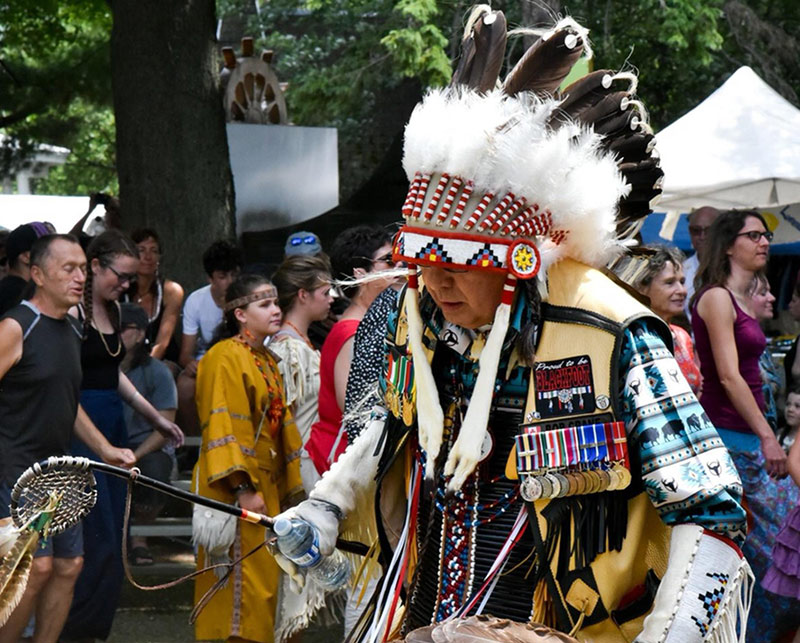
Major (Retd) Bob Crane dancing at the Odawa powwow in Ottawa.
Crane described this period as similar to equine-assisted therapy, but on a more personal level, he connected this experience to the significance of horses in Blackfoot culture. Centuries ago, the arrival of the horse to the Blackfoot territory transformed his ancestors’ livelihoods. “Blackfoot Warriors were called the best light horsemen since Genghis Khan,” explains Crane. “We were very much a war-like nation and it was because of the horse (…) That's how it is an immutable part of our culture.”
So when Crane returned from the Gulf, overwhelmed and exhausted, being around horses – taking care of them, riding them – eventually cleared his mind. “They’re very gentle,” he says. “If you know how to handle a horse, you become one with the horse, and it's just something that takes your mind away completely.”
His family’s understanding gave him the space he needed to recenter. “They understood why I had to isolate for a while,” he says. “And after that I never had to worry about PTSD.”
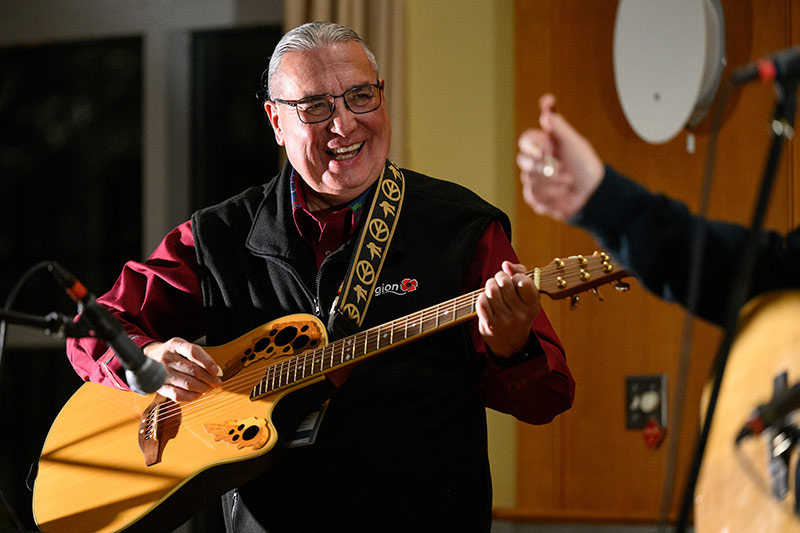
Major (Retd) Bob Crane playing guitar at a Veterans Open Mic Night in Halifax, NS.
Life beyond the military
After retiring from the military, Crane continued supporting operations abroad in the private sector before shifting into Indigenous economic development and consulting. Now retired, he advises leadership in his community and is working to learn the Blackfoot language, noting its endangered status.
Crane lives in Siksika First Nation and is the First Vice President of his local Legion branch in Strathmore, Alberta. He teaches music to other Veterans and participates in jam sessions. He previously took part in Music Healing Veterans programs in Ottawa and helped establish a chapter in Strathmore.
As he marks the 35th anniversary of the Gulf War, Crane is eager to reconnect, honour those who have passed and meet those whose experiences he has yet to hear first-hand, including others also affected by PTSD.
Mostly, though, he looks forward to the simple, grounding act of remembering together.
With courage, integrity and loyalty, Bob Crane is leaving his mark. He is one of our Canadian Veterans. Discover more stories.
The well-being of Canadian Veterans is at the heart of everything we do. As part of this, we recognize, honour and commemorate the service of all Canadian Veterans. Learn more about the services and benefits that we offer.
If you are a Veteran, family member or caregiver, the support of a mental health professional is available anytime at no cost to you. Call 1-800-268-7708