
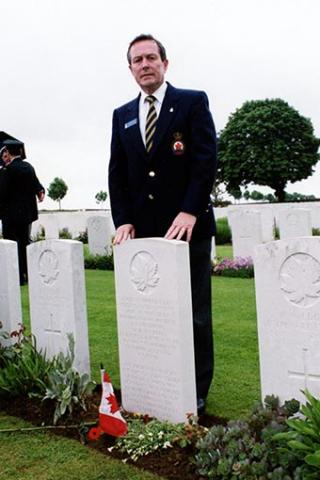

Joined
1962

Postings
- 415 Squadron, CFB Summerside
- Maritime Proving and Evaluation Unit, CFB Summerside
- Aerospace Systems, CFB Winnipeg
- Staff College, Toronto
- Commanding Officer of 415 Squadron, CFB Greenwood
- Base Commander, CFB Summerside
- National Defence Headquarters, Ottawa
- Commander, CF Northern Area Headquarters, Yellowknife

Deployments
- College of Air Warfare, Royal Air Force, UK
- VX 1 Squadron, Naval Air Sation Patuxent River, Maryland, USA
Tomb of the Unknown Soldier
The Tomb of the Unknown Soldier sits at the foot of the National War Memorial. It is a well-known element of what’s called the Memorial Precinct in downtown Ottawa. But it hasn’t always been there.
In 1996, Royal Canadian Air Force Brigadier General (Retired) Duane Daly of the Royal Canadian Legion could only imagine how the tomb would become “an enduring aspect of remembrance for all Veterans.”
The Inspiration
After the First World War, the Tomb of the Unknown Warrior in England aimed to represent all the Commonwealth’s unknown soldiers. But some people asked: how can Canadians and other Commonwealth nations remember the sacrifices made by those who served when the monument is across an ocean (or two), on another continent?
In 1993, Australia answered the question: it couldn’t. So the nation brought home one of its unknown fallen to mark the 75th anniversary of the end of the First World War, creating a Tomb of the Unknown Soldier. This became part of the inspiration that would later lead Daly—as the new Dominion Secretary of The Royal Canadian Legion—to push for Canada’s own Tomb.
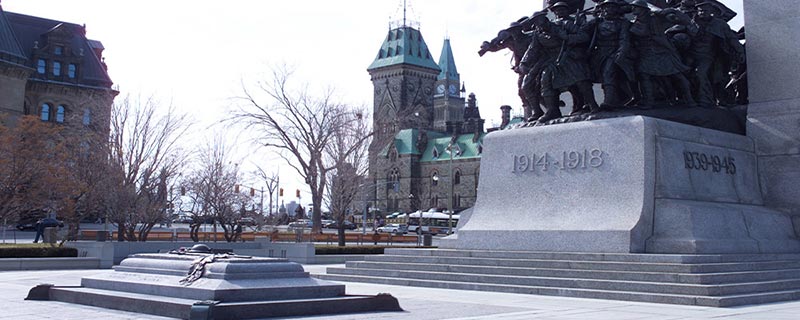
Soon to mark its 25th anniversary, the Tomb of the Unknown Soldier sits at the foot of the National War Memorial in Ottawa.
The other inspiration came when Daly and the Dominion President of The Legion travelled to South Africa in early 1996. They were there to represent Canada during the Royal Commonwealth Ex-Service League conference. The pair visited the lone grave of a fallen Canadian soldier from the South African War. Daly remarked that “many of these fallen soldiers are as forgotten as those unknown soldiers of the First World War.”
Picking up the torch
Daly felt strongly that something had to be done to reinforce the remembrance of them all. He says, “It would have been all too easy for Canadians to forget the cost of freedom when cemeteries and graves don’t cover the everyday landscape of our surroundings. With a few exceptions and never discounting the importance of the home front, the wars occurred ‘over there.’ The torch could not be allowed to fall just because our dead are buried an ocean away.”
The pitch
The idea was planted, and when Daly returned to Canada he suggested to the Dominion President that The Legion should encourage the Government of Canada to establish a Tomb of the Unknown Soldier—on behalf of all Canadians.
With the blessing of the Dominion President, Daly reached out to David Nicholson, Deputy Minister of Veterans Affairs and Admiral (Retired) Fred Mifflin, Minister of Veterans Affairs, both old acquaintances from his Air Forces days at CFB Summerside. He made the proposal.
However, with no funding available, the project did not move forward.
But Daly wasn’t done.
Persistence wears down resistance
In the end, he convinced The Legion’s Dominion Executive Council to provide major funding. They committed to building Canada’s Tomb of the Unknown Soldier as their Millenium Project. “What was important was that we were determined and we agreed that no matter how we were going to do it, the Legion was going to develop a Tomb of the Unknown Soldier and bring our soldier home,” Daly states with the same determination that must have rung in his voice in 1997.
That passion—to honour not only the fallen but all those who served—spread among the rest of The Legion working committee that was formed in 1998.
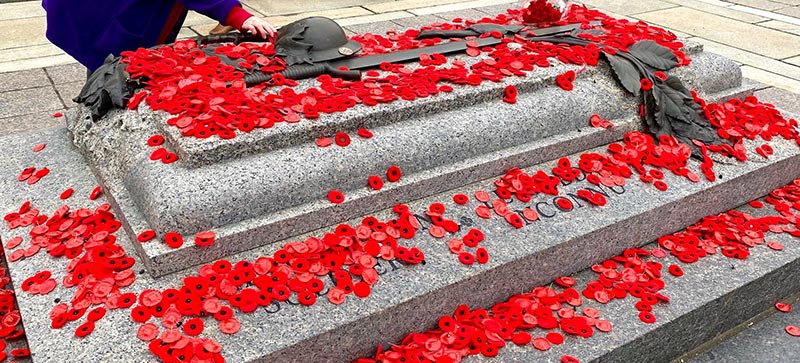
The Tomb of the Unknown Soldier covered in the poppies that not only represent remembrance, but The Legion, which took on the project to bring Canada’s unknown soldier home.
A group effort
When the project hit a critical point, the cost of repatriating the soldier’s remains had increased dramatically. Everyone involved refused to back down. This was too important. Encouraged by a survey that showed Canadians strongly supported The Legion and the Tomb project, Ministers from Veterans Affairs, National Defence, and Public Works stepped in. Daly recalls, “This was when the magic happened.”
With their support, government budgetary approval was given and the project moved forward. The gratitude echoes 25 years later when Daly states, “These three departments made this project a reality.”
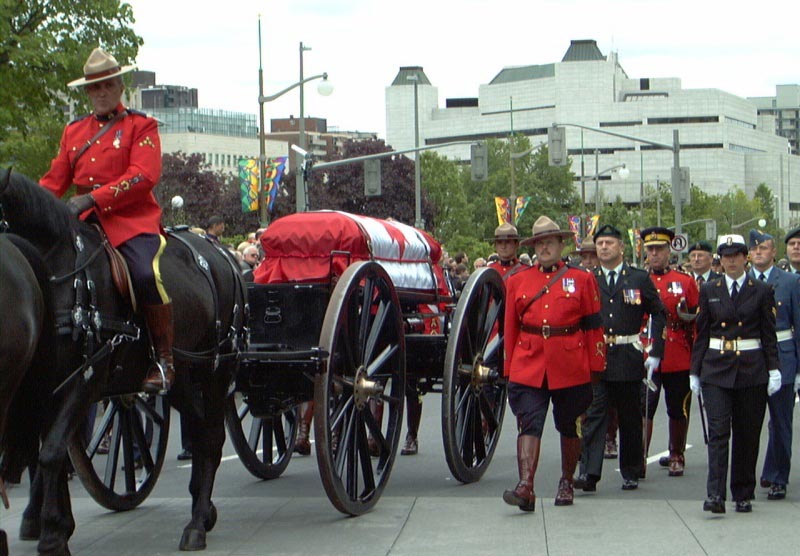
The procession bringing the Unknown Soldier to his final resting place in front of the National War Memorial in Ottawa on May 28, 2000.
Finally, on 28 May 2000, after the required ceremonies in France and the lying-in-state in Canada, the ceremony for the Unknown Soldier’s burial took place. It was broadcast nationally to include as many Canadians as possible.
Looking back
Looking back at the ceremony 25 years later, Daly remembers then-Governor General Adrienne Clarkson’s eulogy. “Her words really highlighted the solemnity and the significance of the ceremony,” Daly says.
Daly feels grateful to those who played key roles in seeing the project through. One key figure is Bradley Hall, Secretary-General of the Canadian Agency of the Commonwealth War Graves Commission. Hall helped secure the repatriation approval from the Commission and the French government. Hall passed away last year and is not here to bear witness to the anniversary, but his contribution is remembered by Daly and The Legion.
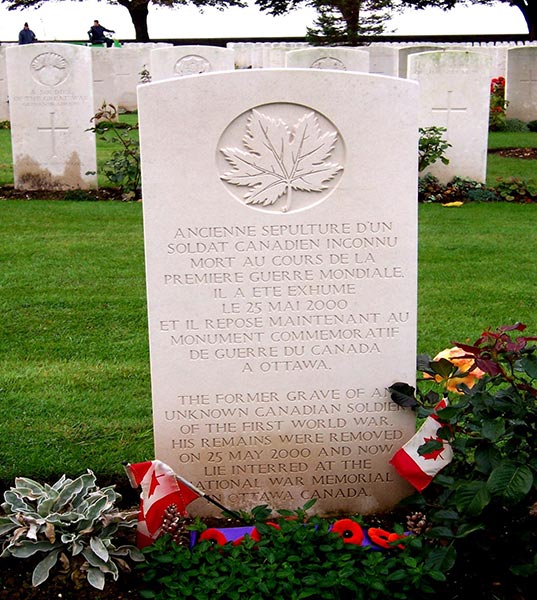
The grave marker in France marking the original resting place of the Unknown Soldier, explaining why the grave now sits empty.
But what Daly feels most is pride. Pride in the dedication of public servants and the conviction of Veteran organizations; pride in The Legion for their persistence; and pride that he was at the head of a project which has had a profound impact on Canadian memory.
Daly hopes Canadians understand the Tomb of the Unknown Soldier“ was a Legion project that is a ‘Legacy of Remembrance’ for all Veterans.”
With courage, integrity and loyalty, Duane Daly is leaving his mark. He is a Canadian Armed Forces Veteran. Discover more stories.
The well-being of Canadian Veterans is at the heart of everything we do. As part of this, we recognize, honour and commemorate the service of all Canadian Veterans. Learn more about the services and benefits that we offer.