
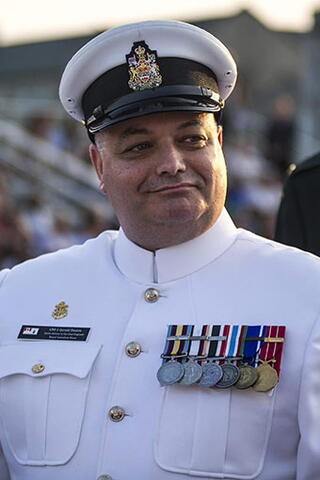

Joined
1987

Postings
- HMCS Athabaskan – 1988-1992
- HMCS Iroquois – 1992-1996
- Canadian Forces Naval Operations School – 1996-1999
- HMCS Athabaskan – 1999-2002
- HMCS Fredericton – 2002-2003
- Canadian Forces Maritime Warfare Centre – 2003-2007
- HMCS Athabaskan – 2007-2009
- Maritime Forces Atlantic Headquarters – 2009-2011
- Canadian Forces Maritime Warfare Centre – 2011-2014
- Director of Naval Requirements – 2014-2017
- HMCS Halifax – 2017-2018 (Coxswain)
- Director General Maritime Equipment and Program Management Division Chief – 2018-2021
- Assistant Deputy Minister (Materiel) Group Chief Warrant Officer – 2021-2024

Deployments
- Operation Friction, Persian Gulf: 1990-1991
- Operation Sharp Guard, Bosnian War: 1993-1994
- Operation Apollo, Persian Gulf: 2003
Following in his father’s footsteps
Born in Halifax in 1969, Gerald Doutre grew up in a military family in Lantz, Nova Scotia, moving between different communities throughout his childhood. His father served in the Navy, and several of his relatives had served in both the First and Second World Wars.
In high school, Doutre worked part-time at the warrant officers’ and sergeants’ mess in Ottawa, where his father served as the committee president. Seeing the military lifestyle up close inspired him to follow in his father’s footsteps and enlist.
"Serving my country was always something that appealed to me."
Doutre enlisted in the Navy immediately after graduating high school in 1987 and began a 36-year career marked by a significant early deployment.
Early days at sea
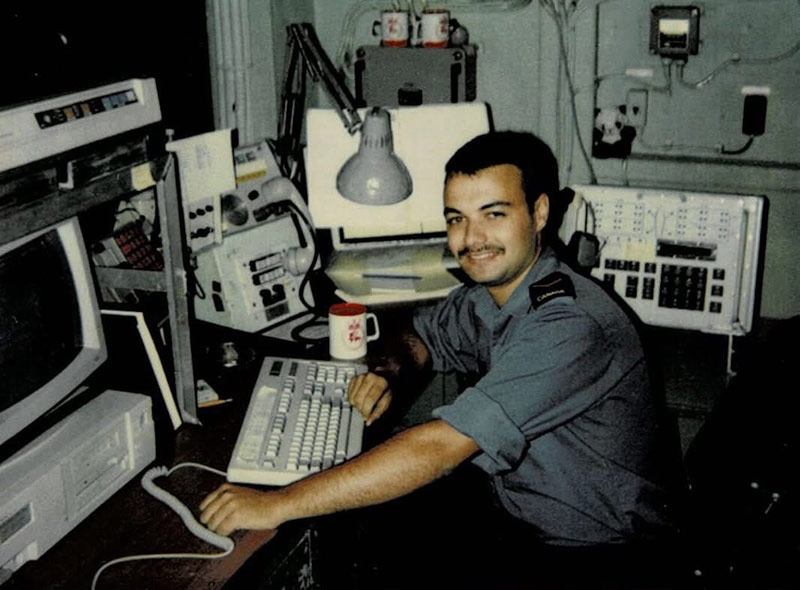
Gerald Doutre began his Navy career aboard HMCS Athabaskan in 1988. As a Naval Electronic Sensor Operator, he assisted his crew in identifying boats and aircraft at sea.
Doutre worked as a Naval Electronic Sensor Operator, starting his first posting aboard HMCS Athabaskan in 1988. He was responsible for identifying ships, submarines and airplanes at sea, and determining whether they were friend or foe. He also worked with his team to protect the ship through fire control operations, which included firing all the ships' missiles and guns, as well as deploying countermeasures to defend against incoming missiles.
On his first trip at sea, Doutre and his shipmates travelled to the coast of Norway for training exercises. Soon after arriving, HMCS Athabaskan received a request for help from a Belgian frigate that had run aground. The ship set out to tow the frigate, but the waters were shallower than expected, and Athabaskan soon found itself stuck as well.
"(On) my very first trip in the Navy, I hadn’t even gotten a port visit yet, and we ran aground," he says.
Soon, he would face an even greater mission.
Setting course for the Persian Gulf
In the summer of 1990, Iraq invaded Kuwait. Canada joined the international coalition of forces and sent three of its warships to the Persian Gulf. One of them was Doutre’s ship-HMCS Athabaskan.
The ships were outdated, requiring almost three weeks to perform six months’ worth of work to upgrade their weapon systems. Tension was in the air when the ships were preparing to leave. It was the first time Canada was sending the Navy to war since the Korean War.
But Doutre was ready.
“This was no longer an exercise. We were finally going to do the work we signed up for when we joined the Canadian Armed Forces.”
On 24 August 1990, the ships set sail, and Canadians were ready to show their support.
Tens of thousands of people lined up along the shores of Halifax and Dartmouth. A flotilla of sailboats gathered in the harbour. Families tied yellow ribbons on trees to honour soldiers fighting for their country.
“It was quite an event when we left,” Doutre recalls.
Serving in the Gulf War
Doutre and his team made their way to the Persian Gulf through the Suez Canal, passing the ruins of previous wars.
“As soon as we got there, it was nonstop,” says Doutre. “We got to the business at hand.”
The Canadian Task Group over saw combat logistics for the entire gulf aboard HMCS Athabaskan. They had to know where every ship was at all times, and ensure allied ships had enough fuel, ammunition and supplies throughout the war. They also made sure to keep merchant ships away from warships, and that sanctions on Iraq were being enforced. At one point, HMCS Athabaskan navigated a mine field and assisted a damaged American cruiser in returning back to shore.
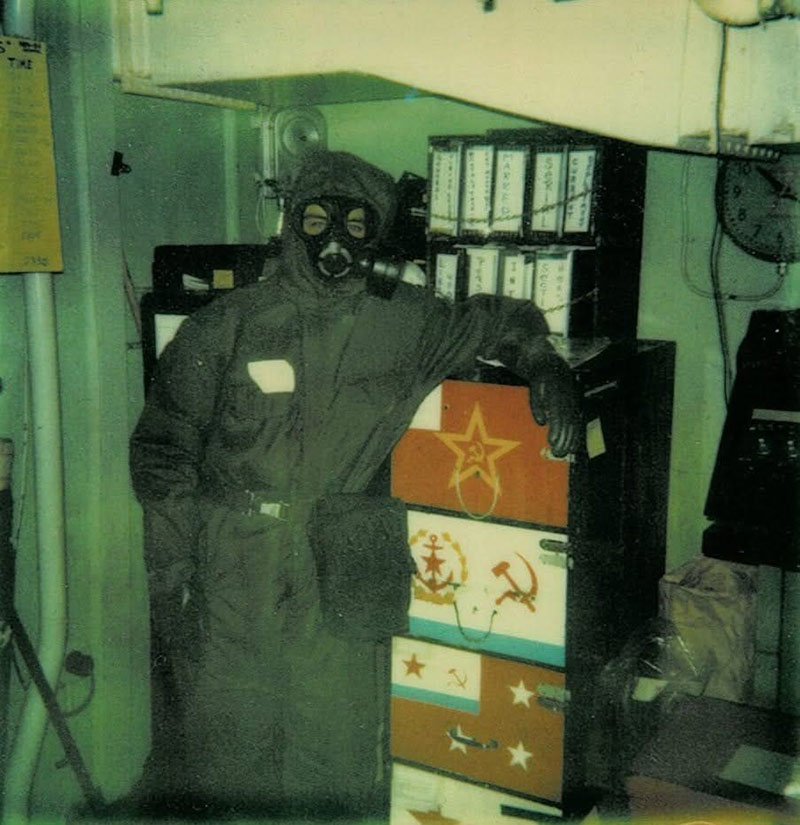
Just before the Gulf War ended, Iraqi forces lit hundreds of oil wells in Kuwait on fire while retreating. The fires blackened the sky with thick smoke, leaving Doutre and his shipmates able to work only 20 minutes at a time.
In the final week of the war, allied forces pushed the Iraqi army out of Kuwait. As they retreated, Iraqi forces lit hundreds of oil wells on fire. The resulting smoke was so dense that the sky turned dark, and Gerald and his shipmates could remain outside for only 20 minutes at a time.
“You couldn’t even see the sun for the week that we were up there…and then when it rained, it would just rain black on us.”
Throughout the war, Doutre was kept in good spirits thanks to his family. They kept in touch by sending letters, making phone calls when he was ashore and coordinating care packages in the mail. One Halifax business owner arranged to deliver personal cassette players to Doutre and his shipmates in Bahrain.
“They were personally engraved to all the sailors, soldiers and aviators on the ships over there for Christmas. I still have mine.”
Remembering the impact of the war
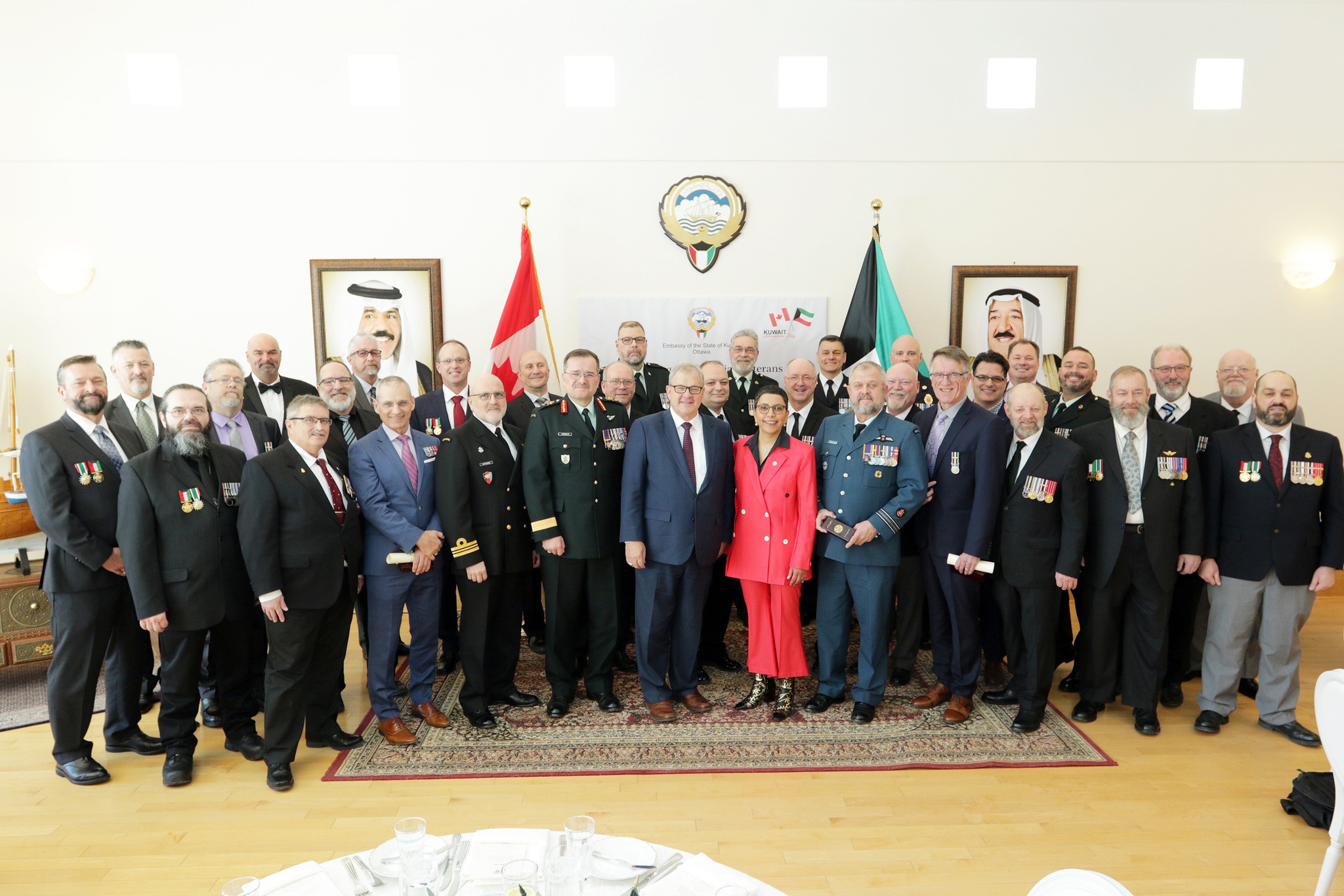
In 2021, Doutre was invited to Kuwait’s embassy in Ottawa, where the ambassador hosted him and a group of Veterans and others for lunch. It was there that he understood the impact of his service in the Gulf War.
While Doutre is proud to have helped liberate Kuwait, he did not realize the impact of his mission until many years later. Having spent most of his time on a ship, he did not get to see the faces of the people whose freedom he helped restore.
In 2021, he was invited to Kuwait’s embassy in Ottawa, where the ambassador hosted him and a group of Veterans for lunch. The ambassador was a young girl during the Gulf War, and she told stories of her family members and friends being kidnapped by Iraqi forces. That was the moment that he understood the importance of his service.
“I got to see the personal impact of what we did some 30 years ago.”
As an executive member of the Persian Gulf Veterans of Canada, he often helps organize commemorations of the Gulf War. His group also lobbied for the Canadian government to donate funds to a Gulf War monument to be built in Washington, D.C. He looks forward to celebrating the 35th anniversary of the war this year and reuniting with his fellow Veterans.
“When we see Gulf War Veterans, we sort of have a special connection to each other.”
Life after service
Doutre retired from the Canadian Armed Forces in 2024, after nearly four decades of service.
He stays busy with his involvement in the Bedford Basin Yacht Club, where he learned to sail. The club flies a Canadian flag previously used on HMCS Terra Nova, one of the ships that went to the Gulf War, serving as a reminder of how he helped free Kuwait.
Doutre knows other Gulf War Veterans like him are proud of their service in the war. He hopes Canadians remember what they fought for in Kuwait.
“The Gulf War and the liberation of Kuwait was the highlight of my career. Canada played a major role in a coalition of countries to liberate that country–hopefully we don’t have to do it again.”
With courage, integrity and loyalty, Gerald Doutre has left his mark. He is one of our Canadian Veterans. Discover more stories.
The well-being of Canadian Veterans is at the heart of everything we do. As part of this, we recognize, honour and commemorate the service of all Canadian Veterans. Learn more about the services and benefits that we offer.