
This memorial is dedicated to our comrades from the First and Second World Wars and the Korean War. It was erected by the Royal Canadian Legion Branch 83.
It was moved to its current location around 2000, after the Legion closed.
Sign in to My VAC Account
Sign in to My VAC AccountLEST WE FORGET
IN MEMORY OF OUR COMRADES
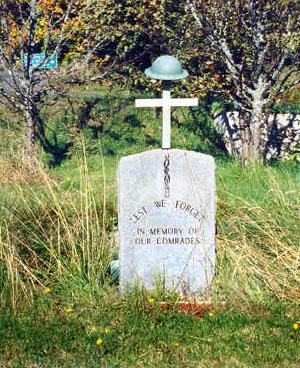
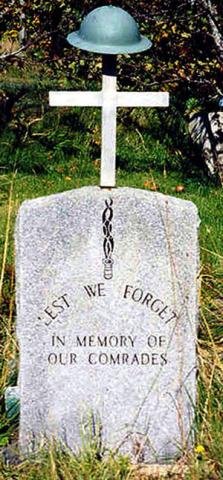
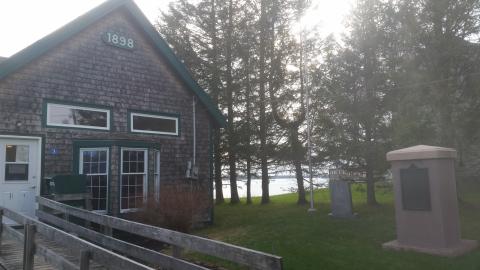
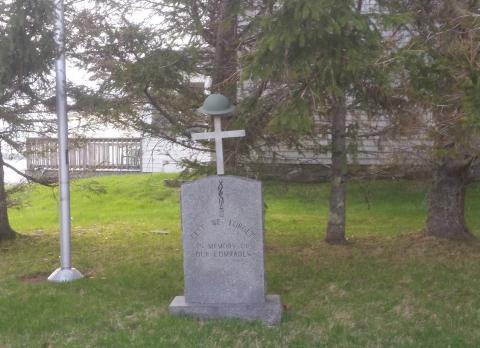
This memorial is dedicated to our comrades from the First and Second World Wars and the Korean War. It was erected by the Royal Canadian Legion Branch 83.
It was moved to its current location around 2000, after the Legion closed.
[left/gauche]
BLACKS
HAROUR
BRANCH
#39
ROYAL
CANADIAN
LEGION
[right/droit]
IN REMEMBRANCE OF THOSE
COMRADES WHO GAVE
THEIR LIVES
1914-1918 1939-1945
KOREA
LEST WE FORGET
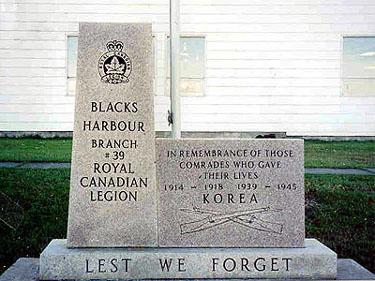
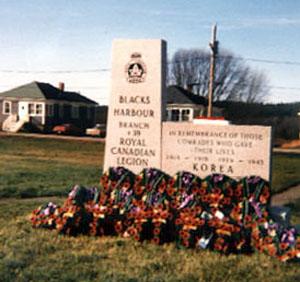
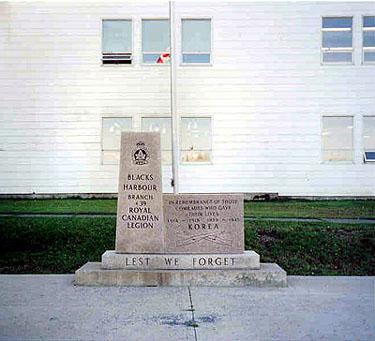
This memorial is dedicated to those who gave their lives during the First and Second World Wars and the Korean War. It was erected by the Ladies Auxiliary of Black's Harbour Branch #39 - Royal Canadian Legion. Made by Fundy Construction Smet Monuments.
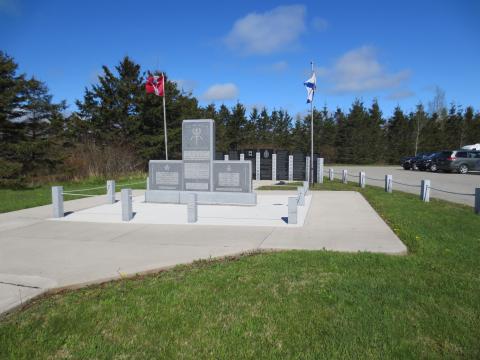
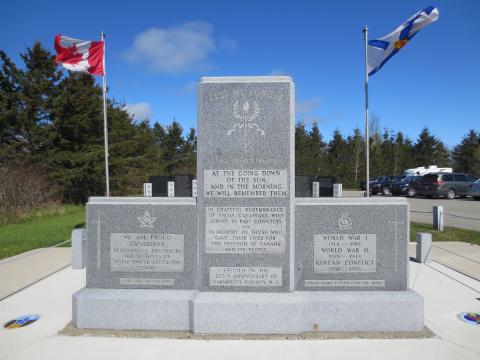
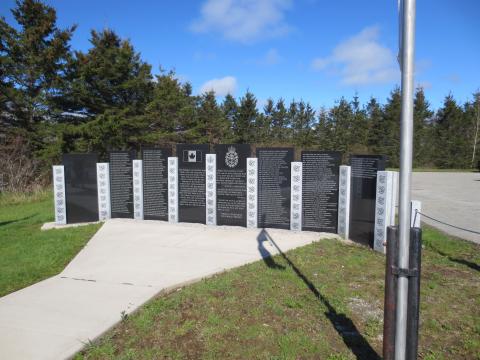
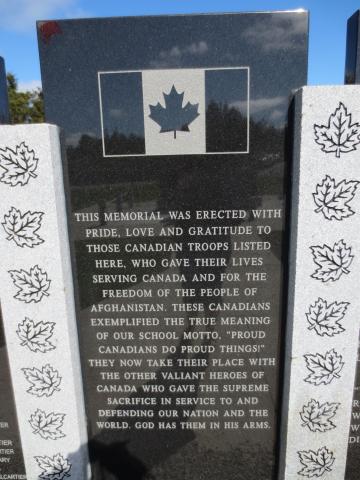
This monument was erected by the Maple Grove Education Center ("back" monument dedicated to Afghan fallen, May 2009) and Memorial Club Members ("front" monument dedicated to all fallen, unveiled in 1986). The back monument is made of slabs of black granite, in-between grey granite pillars adorned with maple leaves. It is set behind the first monument, made of slabs of grey granite.
The site for both monuments was chosen close to the school and on school grounds so that the students would have an on-site place to learn about the sacrifices of past and present generations.
The back monument was built by the efforts of Heritage Memorials of Windsor, Nova Scotia, Rose Valley Construction, The Royal Canadian Legion, students and staff of Maple Grove School and Yarmouth High School Memorial Club, citizens, Veterans organizations, and the Memorial Club Parent Support Group. The funds for the monument were raised through bake sales, ticket draws, and penny collections from the students, plus funds from all levels of government. In less than a year after the back monument was unveiled, all names of the Afghan fallen were etched into the stone.
More than 120 names, starting with Pte Nathan Smith, who died in a "friendly fire" incident in April 2002, have been etched into the face of four of the six black granite slabs standing in a single rank. Names of the fallen will continue to be added periodically.
[obverse/vue de face-First World War gun on top]
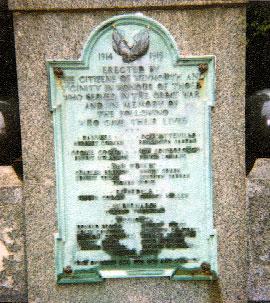
1914-1918
Erected by the citizens of Weymouth and vicinity in honour
of those who served in the Great War and in memory of the
following who gave their lives
[23 names/noms]
They offered all for King and country
[Left/gauche]
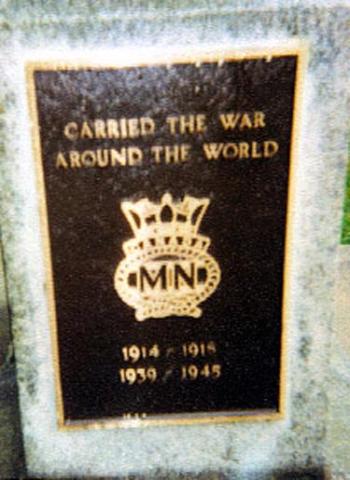
Carried the war around the world
1914-1918
1939-1945
[Right]
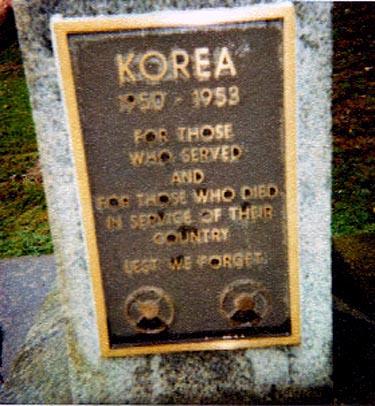
Korea
1950-1953
For those who served and for those who
died in service of their country
Lest we Forget
[Reverse]
In honour of those who served during World War II
and in memory of those who gave their lives
[10 names]
They gave for God and country
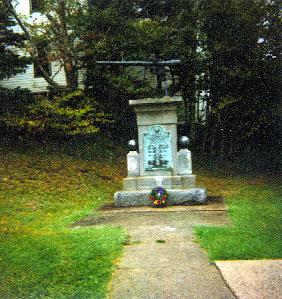
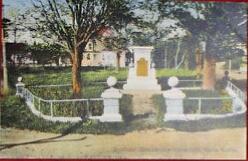
In 2009, the Weymouth memorial to honour those Veterans who made the supreme sacrifice was renovated. The concrete base was repaired, surfaces were cleaned and flagpoles replaced.
[obelisk/obélisque]
(needs further research/recherche incomplète)
[first stele/première stèle]
[second stele/deuxième stèle]
[plaque/plaque]
LEGION MEMORIAL PARK
ON THE OCCASION OF THE 60TH ANNIVERSARY
OF THE ROYAL CANADIAN LEGION
ARMSTRONG MEMORIAL BRANCH -19
IN RECOGNITION OF THE CONTRIBUTION
OF THE MEN AND WOMEN OF OUR TOWN
IN THE ARMED FORCES OF CANADA
DURING WAR AND PEACE
DEDICATED THIS 11TH DAY OF NOVEMBER 1987
MAYOR - COUNCIL AND CITIZENS
TOWN OF NORTH SYDNEY
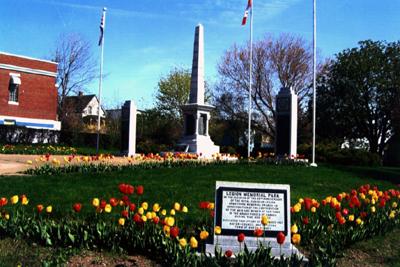
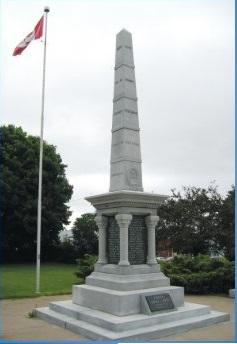
Unveiled on 11 November 1929, the North Sydney monument was dedicated to the local casualties of the First World War and was erected by John D. Steele and Sons.
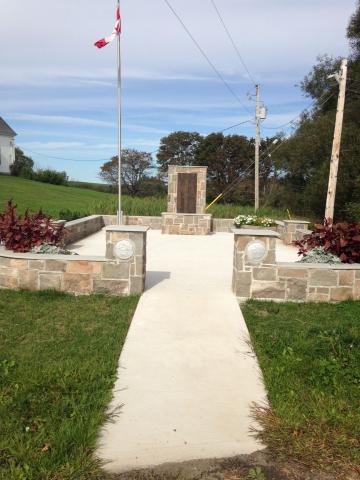
This park was a project of the Tracadie Veterans' Association. It underwent extensive renovations in 2016.
The face of the cenotaph highlights the dedication date, that we must always remember the sacrifice of our veterans, and the words "We Stand on Guard for Thee". Side two has the words from the poem "Flanders Fields." Side three has select words from the poem "For the Fallen." Side four's inscription honours the sacrifice of venteran's families. Around the top, Royal Canadian Navy, Canadian Merchant Navy, Canadian Army, Royal Canadian Air Force, Royal Canadian Mounted Police, and Allied Forces is inscribed.
There are five memorial boulders in the park. Boulder one provides a description of the sacred soil and water placed where Vigil Sentrys stand, boulder two and three are the French and English text of the citations from Nova Scotia Victoria Cross recipients action, while boulders four and five honour the Merchant Navy and Canadian peacekeeping.
Surrounding the cenotaph pad there are over 100 personal memorial messages inscribed on granite plaques.
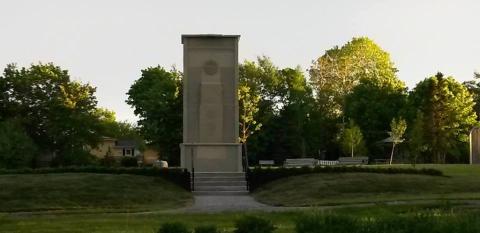
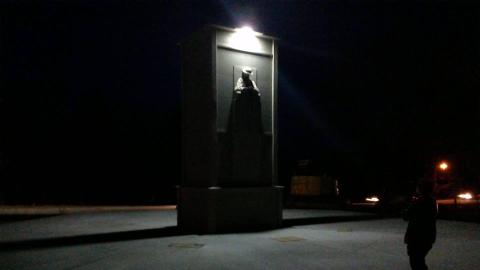
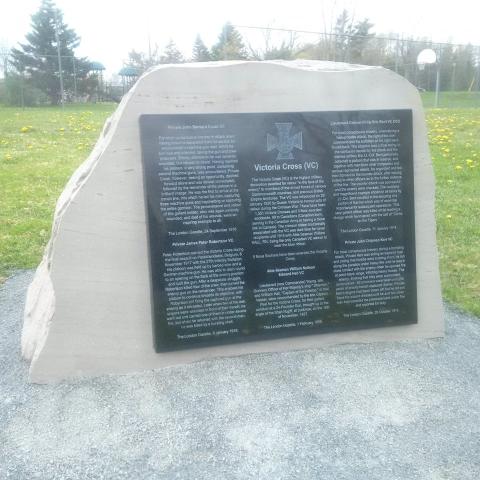
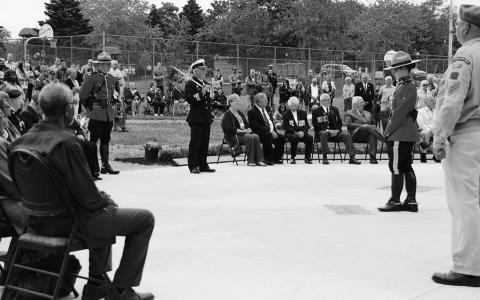
The cenotaph is 5.5 meter tall and was installed in 2006 on Hammonds Plains Road.
In 2010 the Greater Hammonds Plains and Lucasville community held its first local Remembrance Day Ceremony on the Phil Eishenauer baseball field; 100 people attended. In 2011 200 people showed up to this local service, still standing around a makeshift memorial. In 2012 400 people attended and in 2013 1,000. In 2014 the community moved this service to the Uplands Park baseball field with 2,000 people attending. The Greater Hammonds Plains and Lucasville Memorial Committee was formed to address the need for a permanent cenotaph. Local residents, Pam Lovelace, LCdr Todd Brayman, Maj Jason Samson, Rev Randy Townsend, and Andy and Anita Pearce took the lead. The crowd grew to 3,000 people in 2015, all anticipating what would come of this community initiative. On 2 July 2016 the Greater Hammonds Plains and Lucasville Cenotaph was dedicated with over 4,000 people in attendance and a three Sea King helicopter flypast.
There are many unique features to this memorial including soil having been repatriated from Vimy, Juno, RAF Stn Perranporth, Kapyong, Camp Julian, and water from the Atlantic. All represent points of great Canadian sacrifice. At the heart of the cenotaph is a medicine pouch, place by the Acadia First Nations.
Notable language diversity was a focus as well with "Lest we Forget" being displayed in Mi'kmaq, French, and English.
[largest bell/plus grosse cloche]
IN MEMORIAM
SAMUEL ORR JR. AND HIS WIFE
ANNIE S. ORR, AND THEIR CHILDREN
IAN MARY ARCHIE ISABEL & JAMES
WHO DEPARTED THIS LIFE
DEC. 6TH 1917
PRESENTED BY THEIR DAUGHTER BARBARA
1920
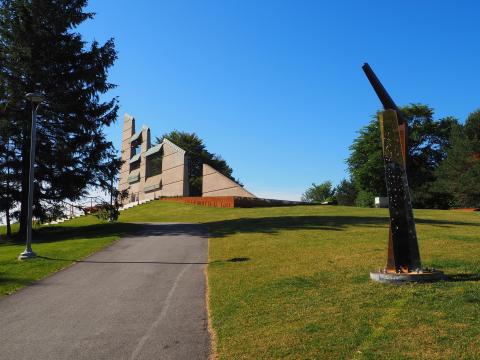
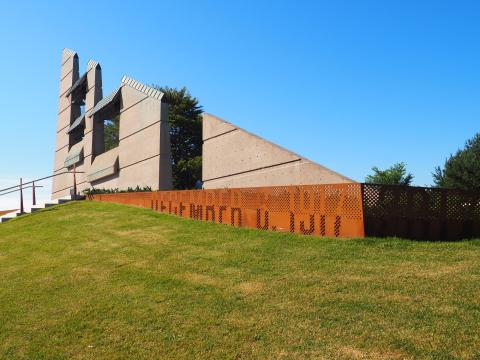
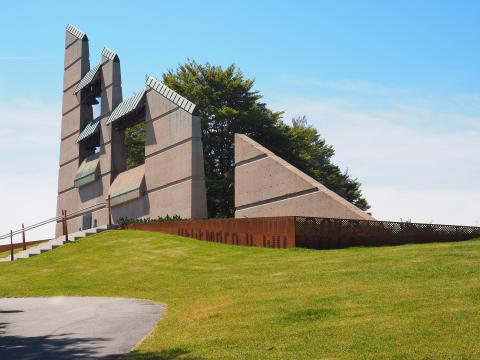
The tower and bells are a permanent memorial to those who were killed, the identified and the unidentified, to those who were never found, the maimed, the blinded and to the thousands who lost everything they owned in the Halifax Explosion on December 6, 1917. The north end of Halifax was wiped out by the blast and the tsunami that followed. Nearly 2,000 people died, another 9,000 were maimed or blinded, and more than 25,000 were left without adequate shelter.
The site of the Halifax Explosion Memorial Bell Tower, donated to the city years ago by the Halifax Relief Commission, overlooks the Narrows where the collision of Imo and Mont Blanc took place. Placed almost parallel to the harbour, the memorial directs the viewers’ attention to the explosion site.
Its narrow, angular construction is 60' at the highest point, descends in a steep and jagged slope, with a cut through near the north end, and sits on a granite platform. The large section represents rebirth and the smaller sloped section represents the past. It originally was sited with landscaping up to the concrete. In 2017, a new plaza around the memorial was created to make the site fully accessible.
Several rectangular openings house the 14 bronze bells. The two-part memorial was constructed with monolithic hydro-stone. A material was used in rebuilding much of the city’s north end after the explosion. Copper sheathing was used for the inclined surface and to protect the bell enclosures. It took almost 14 hours to install the bells.
Grove Presbyterian Church stood on the northerly slope of Fort Needham, while Kaye Street Methodist stood on the southerly slope. Both churches and manses were destroyed in explosion. Two hundred and thirty-nine parishioners were killed, others blinded or maimed for life and few with roofs over their heads. Friends and relatives gave shelter as best they could in their damaged homes. Some were in refuge far from Halifax. A number were in the local prison cells and many more were in the overcrowded hospitals.
For over three months the hospitality of other churches was accepted, but on March 17, the Tarpaper Church, a temporary structure built with Methodist and Presbyterian funds, was used for combined worship for the two congregations. Both ministers worked and were busy helping the victims of the explosion. The depleted congregations fit well together and they created a new building, the Kaye-Grove Church, to complete the union. In June, 1920, the union was official and the name changed to the United Memorial Church.
A chime of ten bronze bells were presented to the church by Barbara Orr in memory of her family. Her parents and four siblings were killed in the explosion. The memorial bells ranged in size from the largest at 1800 pounds and 43 inches in diameter, to the smallest at 175 pounds and 20.5 inches in diameter, for a total weight of 6150 pounds. They were purchased through her uncle from the Meneely Company, a firm in New York. The carillon of ten bells was played by Barbara at the dedication ceremony in 1921.
By the mid-1960s, the weight of the bells and their vibrations caused structural damage to the church tower and it was unsafe to play the bells. In 1975, they were remove and kept under canvas on the church lawn until 1983.
On July 4, 1983, a meeting was held to discuss the future of the bells. The Halifax Explosion Memorial Bells Committee was formed and the bells were moved for storage and refurbishing. Funds were provided by personal and corporate donations, as well as, provincial and federal grants.
A competition for a bell tower was held and the winning design was by Keith Graham of the Core Design Group. The first sod was turned by Barbara on June 1, 1984, and the dedication ceremony was held on June 9, 1985. Barbara played the carillon again at the ceremony. The bells were electrified and could be played from a room in the bottom of the memorial or by a remote set in the Kaye Street United Church. In 1990, the additional four bells were donated by Mr. Russell Isenor.
[stele front/stèle devant]
WELCOME TO
VETERAN'S MEMORIAL
GARDENS
A JOINT PROJECT OF
THE KENSINGTON LEGION
MILLENNIUM BUREAU OF CANADA
GOVERNMENT OF P.E.I.
TOWN OF KENSINGTON
MALPEQUE-BAY CREDIT UNION
H&P GLOVER INC.
COMMERCIAL CONSTRUCTION
[wall centre/mur du centre]
IN MEMORY OF THOSE
WHO SERVED THEIR
COUNTRY IN
PEACE & WAR
"TO YOU FROM FAILING HANDS
WE THROW - THE TORCH.
BE YOURS TO HOLD IT HIGH"
"LEST WE FORGET"
[wall base/mur base]
AT THE GOING DOWN OF THE SUN AND IN THE MORNING WE WILL REMEMBER THEM
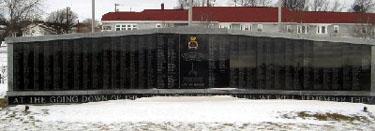
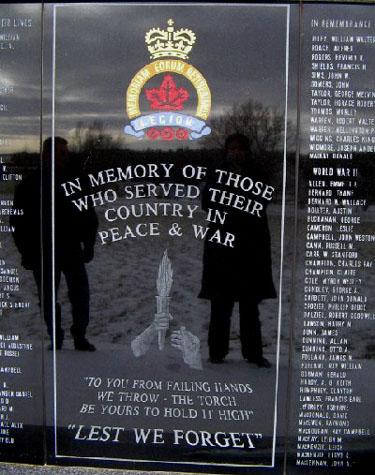
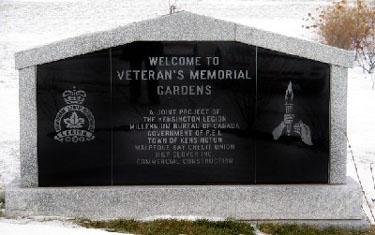
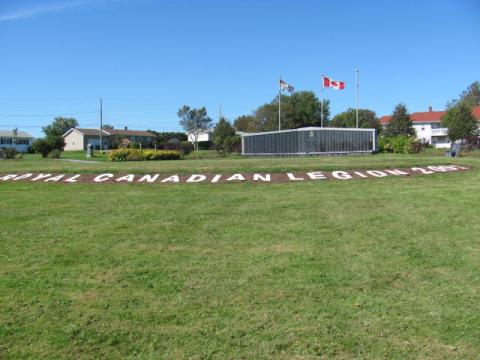
This monument was erected by the Kensington Legion to honour the war dead of the First and Second World Wars, the Korean War, and the conflict in Afghanistan, as well as those individuals from the Kensington area who have served in the Canadian Armed Forces in both war and peace.
[Centre Monument/Monument du centre]
Needs Further Research
[Surrounding Wall/Mur d'enceinte]
(Lists 1800 Veteran names dating back to the year 1700)
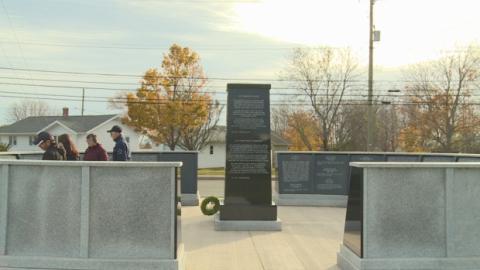
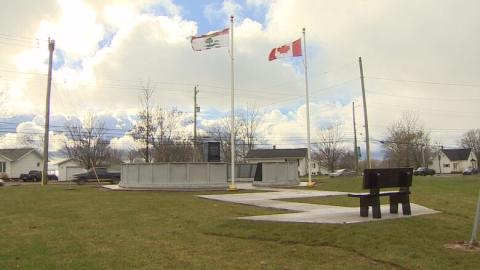
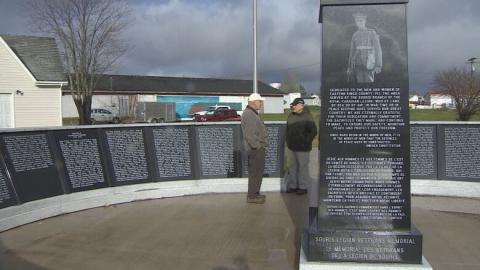
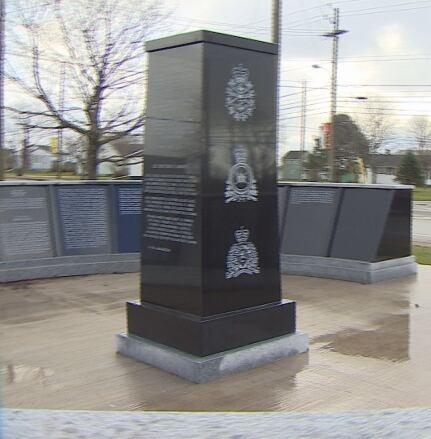
The Town of Souris, P.E.I., has officially unveiled a war memorial eleven years in the making. Engraved on the 28 stone panels are approximately 1,800 names of veterans and RCMP officers from the Souris area, with room to add more names in the future. Some of the names date back to the 1700's.
A memorial bench at the entrance, which offers a place to reflect, is inscribed: "Community memorial designed and manufactured by Heritage memorials Ltd. This memorial bench proudly donated by local representative Charles Dunphy."
QR codes for smartphones will be added to the site to give more detailed information about the veterans.
The monument is a project of the Royal Canadian Legion Branch 3 and was funded by Veterans Affairs Canada.