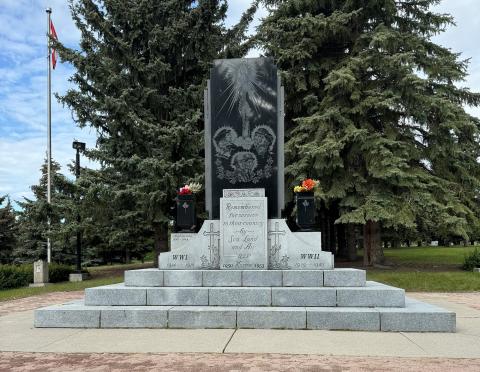
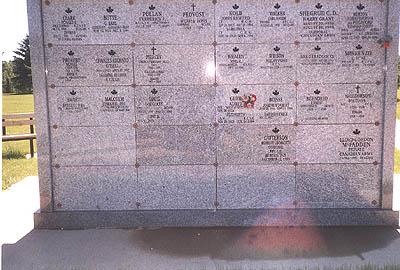
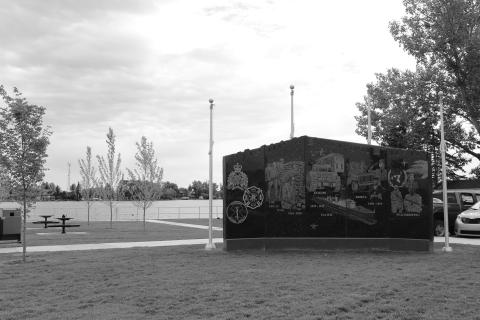
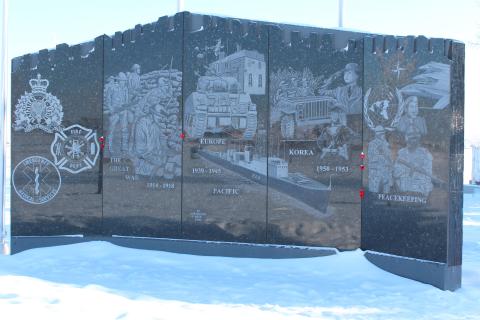
This memorial is dedicated to the Calgary Highlanders.
Calgary Highlanders Memorial Display
THE 10TH BATTALION
CASUALTIES
1315 Killed
3850 Wounded
THE CALGARY HIGHLANDERS
CASUALTIES
423 Killed
1334 Wounded
My VAC Account
My VAC AccountTHE 10TH BATTALION
CASUALTIES
1315 Killed
3850 Wounded
THE CALGARY HIGHLANDERS
CASUALTIES
423 Killed
1334 Wounded
This memorial is dedicated to the Calgary Highlanders.
no wording/aucune inscription
This lake was named after Corporal G.B. Leddy in the 1950s.
no wording/aucune inscription
This lake was named after a veteran in the 1950s.
THOSE THAT GAVE THE SUPREME SACRIFICE IN KOREA
The plaque is an Honour Roll of Korean Special Forces.
When the church opened in 1911, it was as the Wesley Methodist Church. In 1925, with the uniting of Methodist, Congregational, and Presbyterian churches in Canada it became known as the Wesley United Church.
The church at 1315 7 Street SW closed in 2003 and it is not known what happened to the Wesley United Church Second World War Honour Roll.
CANADIAN LEGION
1914 GREAT WAR VETERANS CLUB 1919
Veterans groups were formed to provide support for returning servicemen during the First World War. In 1916, a small community of soldiers returned to Calgary after fighting in Europe and banded together to form a mutual aid society. A year later, this group formed the Calgary branch of the Great War Veterans' Association of Canada, an organization dedicated to helping returning servicemen to reintegrate into civilian life. By 1919, the organization had grown dramatically and new facilities were required. That same year, the Prince of Wales broke sod on land provided by the city for the construction of a Memorial Hall honouring the heroic contributions of Canada's servicemen during the First World War. The building opened in 1922 and was dedicated to the memory of those who served in the Great War. In 1926, the Calgary branch of the Great War Veterans' Association of Canada joined the Canadian Legion of the British Empire Service League (later the Royal Canadian Legion).
[front/devant]
IN REMEMBRANCE OF OUR FALLEN COMRADES
THOSE WHOSE LIVES WERE SACRIFICED
THOSE WHO GAVE ANOTHER WAY OF LIMBS, OF SIGHT, OF AGONY A DEBT WE CANNOT PAY
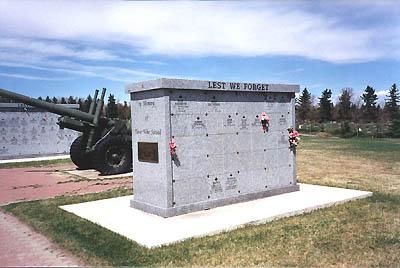
LEST WE FORGET
FOREST LAWN LEGION MEMORIAL
DEDICATED 1978
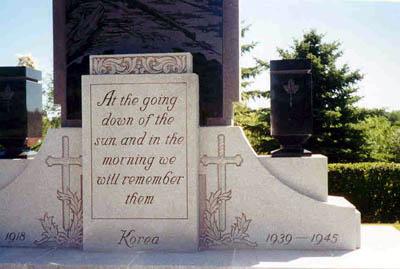
WE WILL REMEMBER THEM
[side plaque/plaque de côté]
KOREA
1950 - 1953
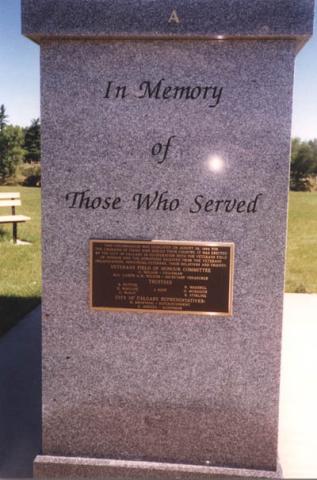
This memorial, erected by Royal Canadian Legion Branch No. 275 (Forest Lawn) in 1978, is dedicated to the local war dead and veterans of the First and Second World Wars and the Korean War.
[plaque/plaque]
ERECTED
TO THE MEMORY
OF
PTE. J.B. GALLACHER, P.P.C.L.I.
PTE. E.F. BURTON, P.P.C.L.I.
PTE. A.F. BOWDEN, 1ST CAN. PIONEERS
PTE. W.G. BARTLETT, 1ST CAN. DIV. M.T.
MEMBERS OF THE
CALGARY FIRE BRIGADE
WHO GAVE THEIR LIVES
IN THE
GREAT EUROPEAN WAR
1914 - 1919
This plaque was originally erected by the Calgary Fire Brigade in honour of their members who died during the First World War.
[plaque/plaque]
DEDICATED TO THE HONOUR OF THOSE WHO FELL IN THE SERVICE OF OUR SOVEREIGN AND COUNTRY DURING THE GREAT WARS
W.W.I - 1914-1918
W.W.II - 1939-1945
KOREA - 1950-1953
"WE WILL REMEMBER THEM"
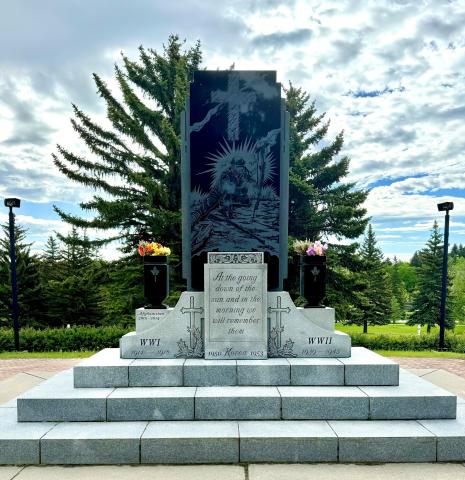
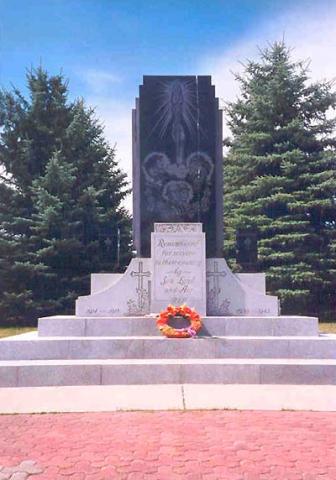
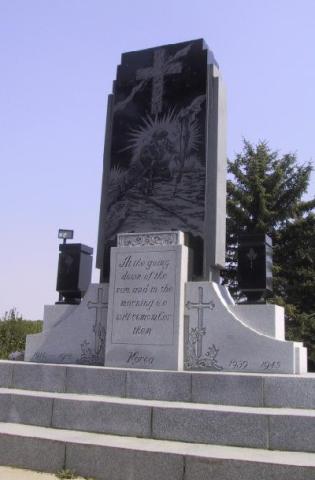
This memorial is dedicated to Canada's war dead from the First and Second World Wars and the Korean War. Behind the slab stand three flagpoles.
BARLOW TRAIL
Noel Holland Barlow was born in Denbeigh, Wales in December of 1912. His father was killed in the First World War and his mother remarried after the war. The family emigrated to Canada, and in 1932 owned and operated a farm near the small town of Carseland, southeast of Calgary. Barlow worked in the mining industry to pay for flying training at the Calgary Flying Club, where he earned his Canadian Private Pilot Certificate in 1937 and then at the end of the year, his Limited Commercial Pilot’s Certificate.
He saved for a one-way ocean liner ticket to England, but was devastated to learn at the Royal Air Force recruitment office in Great Britain that, at the age of 26, he was considered too old for military pilot training despite already having a license. He had no choice but to join as ground crew.
Shortly after the start of the Second World War, he was accepted on the newly formed 242 Canadian Squadron. During the Battle of France, he was part of the ground crew team that went to support the 242 Squadron pilots operating from the area south of the Seine River. Barlow was eventually evacuated to England to rejoin the squadron under the new leadership of then acting Squadron Leader Douglas Bader, the charismatic, capable and legless fighter pilot. Bader chose Noel Barlow as his personal fitter. Throughout the Battle of Britain, Barlow worked tirelessly to keep the squadron operational and to service Bader’s machine. A strong and lifelong bond was built between the two, based on mutual respect, the highest levels of performance and their shared experience. After the Battle of Britain, Bader and Barlow remained connected as 242 Squadron flew operations across the English Channel.
Shortly after Barlow had joined the Royal Air Force, the age limit for pilot trainees had been increased, but he stayed with 242 as a fitter until Bader’s departure to lead the new wing. After 18 months, despite a promised promotion to sergeant, Barlow requested a transfer to pilot training, something that was supported in by Bader himself. He soon found himself a lowly Leading Aircraftman crossing the Atlantic Ocean, bound for the all-through No. 3 British Flying Training School in Miami, Oklahoma. While Barlow was in Oklahoma, Bader was shot down on August 9, 1941, and taken prisoner.
Barlow did not receive his wings because of a dare and too much to drink, but he was not one to quit. He enlisted in the Royal Canadian Air Force back home in Alberta, was accepted for pilot training, and finished his Service Flying Training at No. 15 Claresholm, Alberta. Following his Wings Parade, Barlow was assigned to No. 5 Operational Training Unit at Boundary Bay in British Columbia.
Barlow remained close friends with Douglas Bader, and on Bader’s frequent trips to Calgary, he and his wife always stayed with Barlow and his wife Jeanne in the small farming town of Carseland. The story goes that when Bader was visiting Calgary on one occasion, the city leaders wanted to name a street in his honour, but Bader declined, suggesting that such an honour go to his Alberta-born fitter, a simple and unknown man named Noel Holland Barlow.