Needs further research
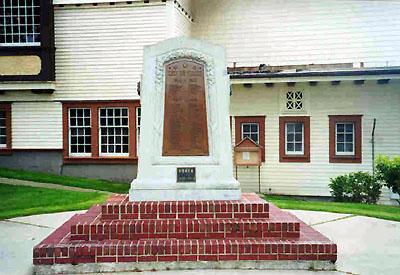
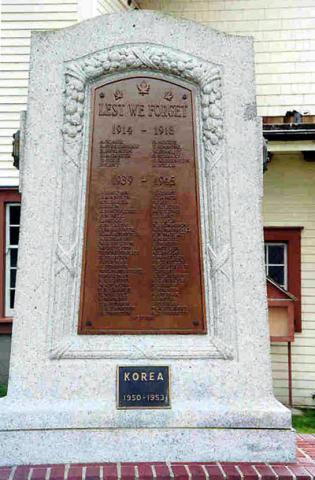
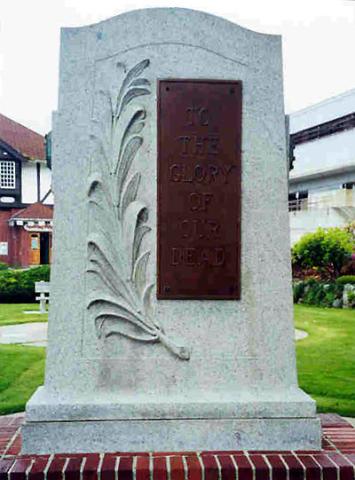
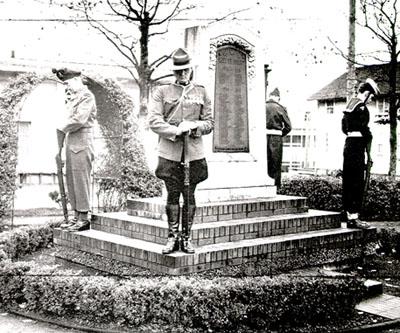
Gibsons Cenotaph
"Lest We Forget, 1914-1918, 1939-1945, 1950-1953"
Sign in to My VAC Account
Sign in to My VAC Account"Lest We Forget, 1914-1918, 1939-1945, 1950-1953"
Needs further research
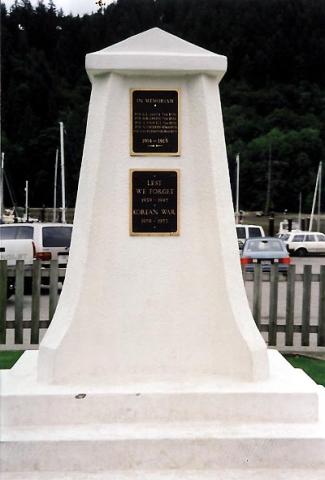
IN MEMORIAM
PTE. C.L. SMITH 7th BTN.
PTE. M.B. GREEN 7th BTN.
PTE. L. TUGWELL 7th BTN.
PTE. N. VICKERY 43rd BTN
PTE. C.D. REDMOND 16TH BTN.
1914-1918
LEST WE FORGET
1939-1945
KOREAN WAR
1950-1953
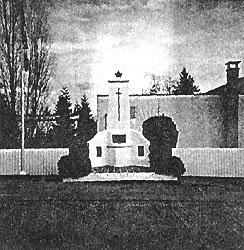
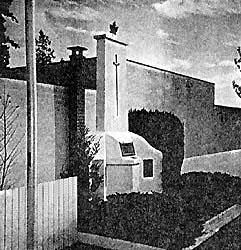
The Snug Cove cenotaph was built in 1937 by members of the Bowen Island community assisted by the Royal Canadian Legion No. 150 to commemorate friends and neighbours who had given their lives in World War I. When they built the base, they used old single cot, metal bed springs for reinforcement. As they poured the concrete, kids threw pennies in the cement.
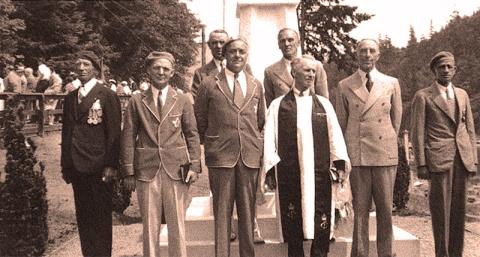
Officially unveiled on Sunday, June 9, 1929, Powell River's memorial was constructed in memory of World War I dead. Some of those present for the ceremony included Randolph Bruce, Lieutenant-Governor of British Columbia, Doctor Tolmie, Premier of British Columbia, war ace Major D.R. McLaren, representatives of Powell River's Ex-Servicemen's Association, and children from the boy scouts and girl guides. Later, a plaque was added for World War II dead and, in 1994, a plaque was added to honour Korean war dead.
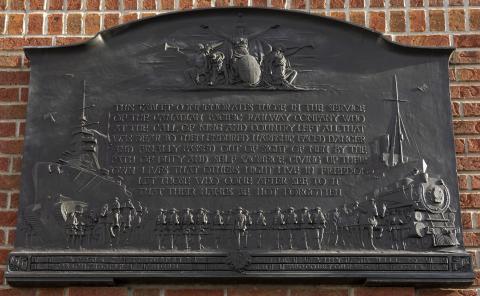
THIS TABLET COMMEMORATES THOSE IN THE SERVICE
OF THE CANADIAN PACIFIC RAILWAY COMPANY WHO
AT THE CALL OF KING AND COUNTRY LEFT ALL THAT
WAS DEAR TO THEM, ENDURED HARDSHIP, FACED DANGER
AND FINALLY PASSED OUT OF SIGHT OF MEN BY THE
PATH OF DUTY AND SELF SACRIFICE. GIVING UP THEIR
OWN LIVES THAT OTHERS MIGHT LIVE IN FREEDOM
LET THOSE WHO COME AFTER SEE TO IT
THAT THEIR NAMES BE NOT FORGOTTEN.
1914 YPRES FESTUBERT THE SOMME VIMY HILL 70 1918
PASSCHENDAELE AMIENS CAMBRAI DROCOURT QUEANT MONS
The Canadian Pacific Railway Great War Tablet in the Nelson Station was dedicated on April 28, 1922. It was relocated to the Nelson Museum, Archives and Gallery.
To honour those who served and gave their lives during the Great War, the Canadian Pacific Railway (CPR) erected a series of bronze memorial tablets in over twenty select locations along their railway system and offices in Canada, United States, England and China. The tablet depicts Britannia, the national personification of Britain, as a helmeted female warrior with a lion to her right and a shield at her feet, HMS Lion (Admiral Beatty's flagship during the Battle of Jutland) with airplanes above and a tank in front, Canadian Pacific Steamship RMS Empress of Russia (used during the war as an armed merchant cruiser and transport ship), Canadian troops, and a CPR locomotive in a nod to all those who travelled by train across Canada before heading overseas. The plaque was designed by Archibald Pearce, Chief Engineer's Department, Montreal, with its model and casting by the Bromsgrove Guild at Worcester, England.
| Original location | Current location |
| CPR Office, Saint John, New Brunswick | McAdam Railway Museum, McAdam, New Brunswick |
| Du Palais CPR Station, Quebec City, Quebec | Du Palais CPR Station, Quebec City, Quebec |
| Viger Station, Montreal, Quebec | Exporail, Montreal, Quebec |
| Windsor Station, Montreal, Quebec | Windsor Station, Montreal, Quebec |
| Angus Shops, Montreal, Quebec | CPKC Archives, Calgary, Alberta (in storage) |
| North Toronto Station, Toronto, Ontario | Union Station, Toronto, Ontario |
| West Toronto Station, Toronto, Ontario | unknown |
| North Bay Station, North Bay, Ontario | North Bay Memorial Park, North Bay, Ontario |
| Fort William Union Station, Fort William, Ontario | Thunder Bay Station, Thunder Bay, Ontario |
| Weston Shops, Winnipeg, Manitoba | Weston Shops, Winnipeg, Manitoba |
| Saskatoon Station, Saskatoon, Saskatchewan | Thomas Cook Restaurant, Saskatoon, Saskatchewan |
| Moose Jaw Station, Moose Jaw, Saskatchewan | Old Moose Jaw Station, Moose Jaw, Saskatchewan |
| Regina Station, Regina, Saskatchewan | Casino Regina, Regina, Saskatchewan |
| Calgary Station, Calgary, Alberta | CPKC Headquarters, Calgary, Alberta |
| Calgary Natural Resources Building, Calgary, Alberta | The Military Museums, Calgary, Alberta |
| Edmonton Station, Edmonton Alberta | CPKC Archives, Calgary, Alberta (in storage) |
| Nelson Station, Nelson, British Columbia | Nelson Museum, Archives & Gallery, Nelson, British Columbia |
| Vancouver Station, Vancouver, British Columbia | unknown |
| Steamship Office, Victoria, British Columbia | Royal British Columbia Museum, Victoria, British Columbia |
| CPR Office, New York, New York, United States | Exporail, Montreal, Quebec |
| CPR Office, Liverpool, England | Royal Liver Building, Liverpool, England |
| CPR Building, Charing Cross, London, England | unknown |
| CPR Office, Hong Kong, China | Believed destroyed during the Japanese occupation in the Second World War. |
All tablets were unveiled simultaneously on the same date along with three identical Winged Victory memorials in Montreal, Winnipeg and Vancouver.
IN MEMORY OF 1701 MEN OF THE CANADIAN
BANK OF COMMERCE WHO SERVED IN
THE GREAT WAR 1914-1918
+PTE R. ANDERSON
LT. R.M. CLARKE
STAFF SGT D.B. DARLEY
+PTE E. FITTON
LT A.F. GRAVES
PTE A.G. REID
PTE J.S.M. ROBSON
GNR E.K. THOMAS
? CADET M.THOMPSON
NELSON
BRANCH
In addition to the monument at its head office in Toronto, the Canadian Bank of Commerce honoured employees from each branch who served in the First World War. This plaque was commissioned shortly after the war and dedicated to the bank's 1701 employees who served in the war, 321 laid down their lives. The names of nine employees of the Nelson Canadian Bank of Commerce who served in the war are listed on the plaque.
The plaque features the caduceus logo of the bank - two snakes winding around a winged staff at the upper left, and two poppies intertwined with a symbolic olive branch at the lower right. The Canadian Bank of Commerce went to great lengths to commemorate its staff that served in the war including a two-volume book of staff profiles and accounts of their war experiences.
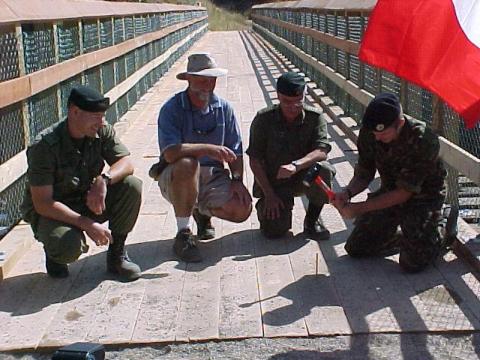
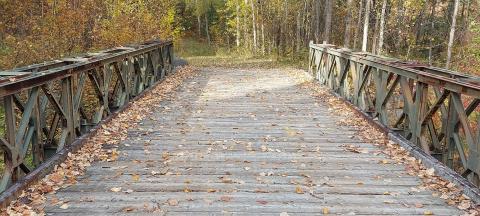
This is one of four existing railway bridges on the old Kettle Valley Railway, now Trans Canada Trail, that were converted from railway bridges to pedestrian/biking friendly crossings for the trail. The crossings were completed by the Canadian Military Engineers, assisted by the Royal Engineers on two of the crossings from 2002 to 2004.
The bridges were named Canadian Railway Troops Crossing after the First World War Canadian Railway Troops who were part of the Canadian Engineers.
The location of the four crossings are: Cascade, Grand Forks (first crossing completed southwest of Cacade Falls), Grand Forks (trail at end of Nagraeff or Popoff Roads) and Grand Forks (near Kettle River Drive and 13th Street).
This is one of four existing railway bridges on the old Kettle Valley Railway, now Trans Canada Trail, that were converted from railway bridges to pedestrian/biking friendly crossings for the trail. The crossings were completed by the Canadian Military Engineers, assisted by the Royal Engineers on two of the crossings from 2002 to 2004.
The bridges were named Canadian Railway Troops Crossing after the First World War Canadian Railway Troops who were part of the Canadian Engineers.
The location of the four crossings are: Cascade, Grand Forks (first crossing completed, southwest of Cascade Falls), Grand Forks (trail at end of Nagraeff or Popoff Roads 49), and Grand Forks (near Kettle River Drive and 13th Street).
This is one of four existing railway bridges on the old Kettle Valley Railway, now Trans Canada Trail, that were converted from railway bridges to pedestrian/biking friendly crossings for the trail. The crossings were completed by the Canadian Military Engineers, assisted by the Royal Engineers on two of the crossings from 2002 to 2004.
The bridges were named Canadian Railway Troops Crossing after the First World War Canadian Railway Troops who were part of the Canadian Engineers.
The location of the four crossings are: Cascade, Grand Forks (first crossing completed, southwest of Cacade Falls), Grand Forks (trail at end of Nagraeff or Popoff Roads), and Grand Forks (near Kettle River Drive and 13th Street).
Lest we forget...
HMCS
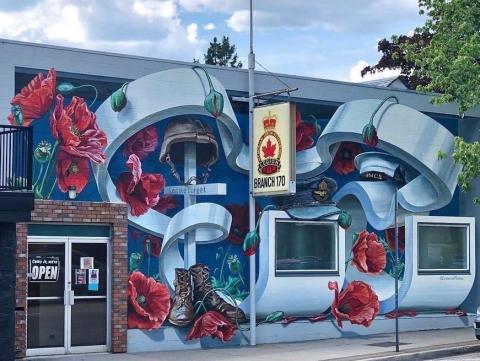
The Castlegar Legion Military Mural was created in 2021 by West Kootenay mural artist Tyler Toews of Canadian Murals. The design features a cross intertwined with a white ribbon and poppies. There is representation from all three branches of the Canadian Forces - a military helmet sits atop the cross, while military boots sit at its base; a sailor's cap sits along the ribbon and a Royal Canadian Air Force cap rests above an image.
The legion’s Ways and Means Officer Bev Storvold first suggested the idea of mural, but it took several years to come to fruition. Storvold didn’t give up and a Columbia Basin Trust grant was secured for the project. The organizers included Legion Vice President Dean Burdeyny, Ways and Means Officer Bev Storvold and President Chris McBain.
[plaque]
MAJOR J BIKER
BRIDGE
CONST
BY
44 FES
JUNE 1995
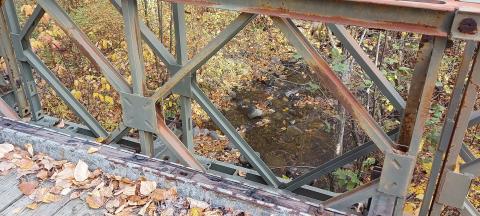
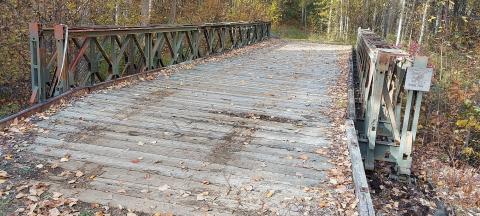
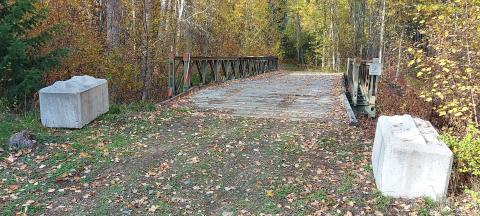
Construction of the Major John Biker Bridge began in 1995 and was completed in 1996 by 44 Field Engineer Squadron. It is a 50ft Double Single Bailey Bridge used to access the north part of the range.
Major Biker was an Officer Commanding 3 Engineer Services and Works Company during the Second World War and was the first Commanding Officer of 44 Field Squadron in 1947.