British Columbia

Province Code
BC
City/Municipality
Vancouver
Memorial Number
59026-047
Type
Address
Burrard Street and W 15th Avenue
Location
Canadian Memorial United Church
in Canada
Yes
GPS Coordinates
49.2580818, -123.1459623
Inscription

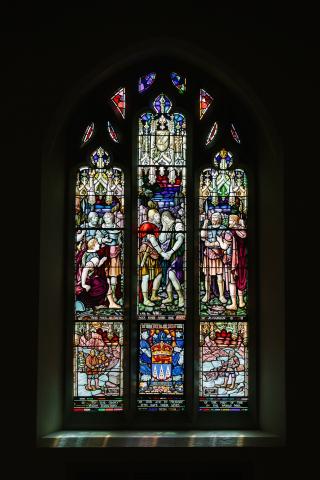
"BROTHERHOOD" "GOD HATH SHEWED ME THAT I SHOULD NOT CALL ANY MAN COMMON OR UNCLEAN."

Surrender of
Batoche
July 1885.

The Indian
Buffalo Hunt

Saskatchewan

TO THE GLORY OF GOD AND IN MEMORY OF THE MEN OF THE
PROVINCE OF SASKATCHEWAN WHO GAVE THEIR LIVES IN THE WORLD WAR.

Image
Photo Credit
Canadian Memorial United Church and Centre for Peace
Caption
Saskatchewan Window
War or Conflict Term
Province
!4v1622487793072!6m8!1m7!1sBhTo-GoGMRoV-vQ0me-CTw!2m2!1d49.25808175008721!2d-123.1459623271083!3f226.2479404422196!4f8.907012790348716!5f1.4499580245881227
Body Content

Canadian Memorial Chapel was born in the hearts of private soldiers in the First World War who, guided by a sergeant, formed a working party to bury six of Canada's war dead. On a November night of 1915, in the Ypres Salient, France, one of the soldiers said to Reverend Lieutenant-Colonel (Lt.-Col.) George Fallis, CBEEDDD: "Padre, after the war is over some chaplain should build a memorial in Canada in memory of fellows like these who have given their all." From that moment on, he would never lay away their beloved dead without the idea of a memorial chapel in his mind.

On his return to Canada he was advised by Reverend S.D. Chown, DD, General Superintendent of the Methodist Church, to go to Vancouver and choose a site in Shaughnessy Heights facing the eternal hills to erect the chapel of his dreams. He arrived in Vancouver in May 1920, to a willing congregation and plans were quickly laid. 

Lt.-Col. Fallis' friend Chris Spencer, CBE, advised him that in order for there to be national significance to the chapel, he should go across Canada and interview lieutenant governors, premiers, statesmen and leaders of each province, asking them to underwrite the windows. Saskatchewan was the eighth province he visited.

In Saskatchewan, Lt.-Col. Fallis went to Saskatoon first to interview His Honour the Lieutenant Governor, H.E. Munroe, who had been a Lieutenant-Colonel in the Canadian Army Medical Corps overseas, and an army friend. He was a great supporter of the soldiers being honoured in Canadian Memorial Chapel. He sent Lt.-Col. Fallis to interview President Murray of the University of Saskatchewan and no man could have been more deeply interested in the project. He felt that Scotland had produced more great men for its population than possibly any other part of the world because memorials all over the land told each rising Scottish generation of the greatness of their past. He subscribed to the Saskatchewan window not only in his own name, but in the name of his late great friend, Judge McLorg, who had done so much for northern Saskatchewan.

Colonel Robert Wallace Caswell, another good friend who had been in Lt.-Col. Fallis’ old battalion of 1915, made arrangements for Lt.-Col. Fallis to speak to the Canadian Club of which he was president. Friends in Regina were T.D. Brown, KC, Colonel J.A. Cross, DSO, and David Balfour, who were especially loyal in their help. In Moose Jaw, Lt.-Col. Fallis had the support of Reverend Captain Edward Church who had been a most successful chaplain in France. He took Lt.-Col. Fallis into his home and made appointments for him to meet a group of good citizens.

Depicted in Saskatchewan Window - “Peter’s Vision” symbolizes Universal Brotherhood. Peter dreams of all the things he fears about the Gentiles, yet God admonishes him saying, “How can anything I have made be profane?” Peter then sees God’s blessing fall upon the Gentiles and understands that the vision of God’s peace is meant for all. The historical events on this window portray the surrender at Batoche in 1885, and the Indian buffalo hunt. The end of WW I saw the formation of the League of Nations, an institution that also had as its goal a vision of peace for all. Its successor, the United Nations, continues to pursue that goal in a world that refuses to reject military might as its principal form of statesmanship.

City
Vancouver
Country
Type Description
Stained glass window
Photo Credit
Canadian Memorial United Church and Centre for Peace
Memorial CF Legacy ID
11102
City/Municipality
Vancouver
Memorial Number
59026-046
Type
Address
Burrard Street and W 15th Avenue
Location
Canadian Memorial United Church
in Canada
Yes
GPS Coordinates
49.2580818, -123.1459623
Inscription

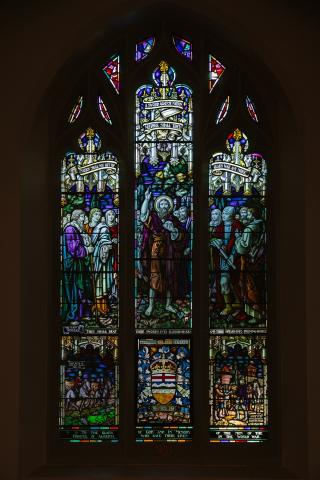
"A NATIONS SORROW." "AND JACOB MOURNED FOR HIS SON MANY DAYS."

La Vérendrye
Builds Fort
Rouge 1738

Trial of Thomas
Scott by Louis
Riel. 1870.

Manitoba

TO THE GLORY OF GOD AND IN MEMORY OF THE MEN OF THE
PROVINCE OF MANITOBA WHO GAVE THEIR LIVES IN THE WORLD WAR.

Image
Photo Credit
Canadian Memorial United Church and Centre for Peace
Caption
Manitoba Window
War or Conflict Term
Province
!4v1622487793072!6m8!1m7!1sBhTo-GoGMRoV-vQ0me-CTw!2m2!1d49.25808175008721!2d-123.1459623271083!3f226.2479404422196!4f8.907012790348716!5f1.4499580245881227
Body Content

Canadian Memorial Chapel was born in the hearts of private soldiers in the First World War who, guided by a sergeant, formed a working party to bury six of Canada's war dead. On a November night of 1915, in the Ypres Salient, France, one of the soldiers said to Reverend Lieutenant-Colonel (Lt.-Col.) George Fallis, CBEEDDD: "Padre, after the war is over some chaplain should build a memorial in Canada in memory of fellows like these who have given their all." From that moment on, he would never lay away their beloved dead without the idea of a memorial chapel in his mind.

On his return to Canada he was advised by Reverend S.D. Chown, DD, General Superintendent of the Methodist Church, to go to Vancouver and choose a site in Shaughnessy Heights facing the eternal hills to erect the chapel of his dreams. He arrived in Vancouver in May 1920, to a willing congregation and plans were quickly laid. 

Lt.-Col. Fallis' friend Chris Spencer, CBE, advised him that in order for there to be national significance to the chapel, he should go across Canada and interview lieutenant governors, premiers, statesmen and leaders of each province, asking them to underwrite the windows. Manitoba was the seventh province he visited.

In Winnipeg, Lt.-Col. Fallis enlisted the leadership of Captain Archibald Brown, DSO, MC, son of the Honourable Edward S. Brown. Archie Brown was one of the most courageous men physically and morally that Lt.-Col. Fallis had met in the war. He was wounded, returned to England and after a convalescent leave was made a staff captain. Soon there was an urgent call for seasoned officers to come back to France. Captain Brown gave up his ten dollar a day job, reverted to lieutenant and returned to France, only to have a bullet go right through his body as he led his men in a charge. Miraculously, the bullet missed his heart and both lungs. It was some minutes before he knew he had been hit, but loss of blood weakened him and his pals discovered blood staining his tunic, back and front.

For many years, Lt.-Col. Fallis kept his picture on his study table in a sterling silver frame as an inspiration for daily living. Captain Brown got together all Lt.-Col. Fallis' old buddies in Winnipeg at a dinner. They took the whole business off Lt.-Col. Fallis’ hands and told him to go visit his sister. A few days later, at the home of Creasor Crawford, another friend from the First World War, Lt.-Col. Fallis met many old friends and their wives. After an hour of reunion, Captain Archie Brown, made a speech and told Lt.-Col. Fallis he could go on his way as the Manitoba window had been underwritten.

Depicted in the Manitoba Window - “Jacob Mourning for Joseph,” symbolizing a nation’s sorrow. The historical events show Pierre Gaultier de Varennes, Sieur de La Vérendrye, building Fort Rouge in 1738, and the trial of Thomas Scott by Louis Riel 1870. 

City
Vancouver
Country
Type Description
Stained glass window
Photo Credit
Canadian Memorial United Church and Centre for Peace
Memorial CF Legacy ID
11101
City/Municipality
Vancouver
Memorial Number
59026-045
Type
Address
Burrard Street and W 15th Avenue
Location
Canadian Memorial United Church
in Canada
Yes
GPS Coordinates
49.2580818, -123.1459623
Inscription

"GLORY TO GOD IN
THE HIGHEST, ON EARTH
PEACE, GOODWILL
TOWARD MEN."

"THE WORD WAS MADE FLESH AND DWELT AMONG US."

UT INCEPIT FIDELIS SIC PERMANET

CHAMPLAIN on
Georgian Bay 1615

TECUMSEH attests
his loyalty to the
British flag {1812}

TO THE GLORY OF GOD AND IN MEMORY OF THE MEN OF THE
PROVINCE OF ONTARIO WHO GAVE THEIR LIVES IN THE WORLD WAR.

Image
Caption
Ontario Window
War or Conflict Term
Province
!4v1622487793072!6m8!1m7!1sBhTo-GoGMRoV-vQ0me-CTw!2m2!1d49.25808175008721!2d-123.1459623271083!3f226.2479404422196!4f8.907012790348716!5f1.4499580245881227
Body Content

Canadian Memorial Chapel was born in the hearts of private soldiers in the First World War who, guided by a sergeant, formed a working party to bury six of Canada's war dead. On a November night of 1915, in the Ypres Salient, France, one of the soldiers said to Reverend Lieutenant-Colonel (Lt.-Col.) George Fallis, CBEEDDD: "Padre, after the war is over some chaplain should build a memorial in Canada in memory of fellows like these who have given their all." From that moment on, he would never lay away their beloved dead without the idea of a memorial chapel in his mind.

On his return to Canada he was advised by Reverend S.D. Chown, DD, General Superintendent of the Methodist Church, to go to Vancouver and choose a site in Shaughnessy Heights facing the eternal hills to erect the chapel of his dreams. He arrived in Vancouver in May 1920, to a willing congregation and plans were quickly laid. 

Lt.-Col. Fallis' friend Chris Spencer, CBE, advised him that in order for there to be national significance to the chapel, he should go across Canada and interview lieutenant governors, premiers, statesmen and leaders of each province, asking them to underwrite the windows. Ontario was the sixth province he visited.

Arriving in Ontario, LC Fallis interviewed  the Honourable Newton Rowell, P.C., and a great friend of the war, Captain R. N. Burns, a distinguished chaplain. Mr. Rowell drew up a list of those to interview in Toronto and Captain Burns made the arrangements. Sir Edward Kemp, KC, MG, who was Overseas Minister for Canada during the greater part of the war, wrote a cheque for one thousand dollars. He made one stipulation, he would like pictures of the completed Chapel. The pictures were sent when his own church, Sherbourne Street, was about to be reconstructed. He had a set of slides made and showed them to the congregation. These pictures were a determining factor in bringing new beauty into an old church of Romanesque style of architecture.

Depicted in the Ontario Window - “The Nativity” symbolizes the birth of the Prince of Peace and his “Call to Peace.” The window also depicts two typical images of the troubled relationship between the First Nations and the explorers and empire builders of Europe. Champlain negotiated successful trading relationships between the French and the Huron nation. That was followed by the Jesuits bringing the story of the nativity to that nation. Father Brebeuf penned “Iesus Ahatonnia,” the song we sing as the Huron Carol, to place the birth of Christ in a 17th-century North American context. Ultimately, we see the clash of cultures in other panels. Chief Tecumseh, statesman and military strategist, was unable to negotiate equality of status with either the Americans or the British despite his willingness to lay down the lives of himself and his people. 

The Ontario Window was dedicated at the evening service on 2 December 1928 by Major-General Victor Odium, CB, CMG, DSO.

City
Vancouver
Country
Type Description
Stained glass window
Photo Credit
Canadian Memorial United Church and Centre for Peace
Memorial CF Legacy ID
11100
City/Municipality
Vancouver
Memorial Number
59026-044
Type
Address
Burrard Street and W 15th Avenue
Location
Canadian Memorial United Church
in Canada
Yes
GPS Coordinates
49.2580818, -123.1459623
Inscription

"AND STRAIGHTWAY THEY LEFT THEIR NETS AND FOLLOWED HIM."

MAISONNEUVE
Landing on Island
of Montreal 1642

FRONTENAC making
a treaty with the
Indians

Je me souviens

TO THE GLORY OF GOD AND IN MEMORY OF THE MEN OF THE
PROVINCE OF QUEBEC WHO GAVE THEIR LIVES IN THE WORLD WAR.

Image
Caption
Quebec Window
War or Conflict Term
Province
!4v1622487793072!6m8!1m7!1sBhTo-GoGMRoV-vQ0me-CTw!2m2!1d49.25808175008721!2d-123.1459623271083!3f226.2479404422196!4f8.907012790348716!5f1.4499580245881227
Body Content

Canadian Memorial Chapel was born in the hearts of private soldiers in the First World War who, guided by a sergeant, formed a working party to bury six of Canada's war dead. On a November night of 1915, in the Ypres Salient, France, one of the soldiers said to Reverend Lieutenant-Colonel (Lt.-Col.) George Fallis, CBEEDDD: "Padre, after the war is over some chaplain should build a memorial in Canada in memory of fellows like these who have given their all." From that moment on, he would never lay away their beloved dead without the idea of a memorial chapel in his mind.

On his return to Canada he was advised by Reverend S.D. Chown, DD, General Superintendent of the Methodist Church, to go to Vancouver and choose a site in Shaughnessy Heights facing the eternal hills to erect the chapel of his dreams. He arrived in Vancouver in May 1920, to a willing congregation and plans were quickly laid. 

Lt.-Col. Fallis' friend Chris Spencer, CBE, advised him that in order for there to be national significance to the chapel, he should go across Canada and interview lieutenant governors, premiers, statesmen and leaders of each province, asking them to underwrite the windows. Quebec was the fifth province he visited.

On arrival in Montreal, Lt.-Col. Fallis interviewed his old friend, Colonel Herbert Molson, Chancellor of McGill University. They had been in the same mess at Canadian Section, General Headquarters of the British Army at Montreuil. Colonel Molson had gone overseas with the 42nd Highlanders of Montreal, had been wounded and won the Military Cross. He showed boundless enthusiasm for Lt.-Col. Fallis’ dream of Canadian Memorial Chapel and invited leading Quebec citizens to dinner to hear his story.

His half hour speech on all he wished to accomplish with the Canadian Memorial Chapel was received with real enthusiasm. Colonel Molson produced a pad of counter-cheques, passed them around the table and said: "Gentlemen, I am ready to support the Padre. I invited you here because I believed you would like to share with me the privilege of erecting the Quebec window. If you wish to subscribe, use the counter-cheque." He then sat down and wrote his own cheque. The cheques were collected, and Colonel Molson placed them in a long envelope.

Back at the Windsor Hotel, Lt.-Col. Fallis opened the envelope and was amazed to find that the Quebec window was oversubscribed by thirty-seven hundred dollars. He phoned Colonel Molson the next day who said, "Oh, put it in the building fund. You'll be needing it."

W. McConnell was one of the great leaders for social betterment in Montreal. Lt.-Col. Fallis’ cousin, W. Shepherd Fallis, kindly wrote a note to Mr. McConnell asking him to see his cousin and he agreed to meet the next day. When Lt.-Col. Fallis arrived at his office a secretary said Mr. McConnell was having a meeting of the key men of Montreal on his hospital drive and would he mind waiting for half an hour. Lt.-Col. Fallis returned to his cousin's office and wrote Mr. McConnell a letter asking him for a hundred dollars towards the Quebec window. The answering letter was sent to Lt.-Col. Fallis cousin: "I am enclosing my cheque for two hundred dollars. I was asked for one hundred. One hundred is for the Quebec window, and the other hundred is out of my regard for the common sense of your ministerial cousin in not worrying me when I was so involved with the hospital drive."

Depicted in the Quebec Window - “The Call of the Disciples” symbolizes enlistment, both in the Christian tradition, but clearly with some colonial values. The historic events here are Paul de Chomedey, Sieur de Maisonneuve, landing on the island of Montreal in 1642, and Frontenac making a treaty with Indigenous Peoples.

The Quebec Window was dedicated at the evening service on 2 December 1928 by Mr. Stewart Cameron.

City
Vancouver
Country
Type Description
Stained glass window
Photo Credit
Canadian Memorial United Church and Centre for Peace
Memorial CF Legacy ID
11099
City/Municipality
Vancouver
Memorial Number
59026-042
Type
Address
Burrard Street and W 15th Avenue
Location
Canadian Memorial United Church
in Canada
Yes
GPS Coordinates
49.2580818, -123.1459623
Inscription

"BLESSED ARE THE PEACEMAKERS. FOR THEY SHALL BE CALLED THE CHILDREN OF GOD."

Coming of U.E.
Loyalists to New
Brunswick 1783

LATOUR builds his
fort at St. Jean NB
(about 1630)

new brunswick

TO THE GLORY OF GOD AND IN MEMORY OF THE MEN OF THE
PROVINCE OF NEW BRUNSWICK WHO GAVE THEIR LIVES IN THE WORLD WAR.

Image
Photo Credit
Canadian Memorial United Church and Centre for Peace
Caption
New Brunswick Window
War or Conflict Term
Province
!4v1622487793072!6m8!1m7!1sBhTo-GoGMRoV-vQ0me-CTw!2m2!1d49.25808175008721!2d-123.1459623271083!3f226.2479404422196!4f8.907012790348716!5f1.4499580245881227
Body Content

Canadian Memorial Chapel was born in the hearts of private soldiers in the First World War who, guided by a sergeant, formed a working party to bury six of Canada's war dead. On a November night of 1915, in the Ypres Salient, France, one of the soldiers said to Reverend Lieutenant-Colonel (Lt.-Col.) George Fallis, CBEEDDD: "Padre, after the war is over some chaplain should build a memorial in Canada in memory of fellows like these who have given their all." From that moment on, he would never lay away their beloved dead without the idea of a memorial chapel in his mind.

On his return to Canada he was advised by Reverend S.D. Chown, DD, General Superintendent of the Methodist Church, to go to Vancouver and choose a site in Shaughnessy Heights facing the eternal hills to erect the chapel of his dreams. He arrived in Vancouver in May 1920, to a willing congregation and plans were quickly laid. 

Lt.-Col. Fallis' friend Chris Spencer, CBE, advised him that in order for there to be national significance to the chapel, he should go across Canada and interview lieutenant governors, premiers, statesmen and leaders of each province, asking them to underwrite the windows. New Brunswick was the fourth province he visited.

As Lt.-Col. Fallis was travelling by train from Saint John to Fredericton he met Mr. McLean and spoke of his mission to the Maritimes and of the success so far. Mr. McLean gave him a letter of introduction to the Lieutenant Governor and before getting off the train said he'd like to be a subscriber for the New Brunswick window and handed him a bit of blue paper. After he got off the train, Lt.-Col. Fallis unfolded the paper and it was a cheque for five hundred dollars.

When Mr. McLean left the train it dawned on him that Lt.-Col. Fallis was the chaplain who had buried the son of Mr. O'Leary of Richibucto. He called him by long distance and told him that Lt.-Col. Fallis  would be speaking in Saint John at the Admiral Beattie Hotel the following Thursday. Mr. O'Leary travelled from Richibucto to Saint John with a letter Lt.-Col. Fallis had written in the fall of 1915 from Ploegstreet Wood where he had laid Mr. O’Leary’s son in Le Rossignol Cemetery. Trooper O'Leary was a Catholic and Lt.-Col. Fallis could not find a Roman Catholic priest to bury him, so tried all the harder to compose a letter of insight and comfort to a father and mother of another faith. Mr. O'Leary spoke of his two brothers in the Roman Catholic Church, one the Archbishop of Prince Edward Island, and the other the Archbishop of Edmonton. He left Lt.-Col. Fallis with a short note to say that Mr. McLean had told him about Canadian Memorial Chapel, and that he felt Lt.-Col. Fallis was building a memorial not only for the Protestants, but also for the Catholics of Canada and that he would be grateful if his attached cheque would be accepted as a subscription.

Years later, Lt.-Col. Fallis greeted two men standing before the New Brunswick window and they revealed that they were the brothers of Mr. O'Leary of Richibucto, New Brunswick, and they were viewing the window that their brother had written about and told them to see.

Fredericton, Saint John and Moncton all responded to the appeal for a Memorial Chapel. Mr. Howard P. Robinson gave great assistance.

Depicted in the New Brunswick Window - “The Sermon on the Mount.” Jesus tells his followers that those who suffer, mourn, and who are meek and righteous will be blessed by God. One historical window shows La Tour, protector of the Acadian people. Another illustrates the United Empire Loyalists coming to Canada to escape retribution by the newly formed American nation. Both represent peoples suffering under the persecution of others. The UE Loyalists claimed land that had been taken away from the Acadians a mere 20 years before. In some ways the window represents the cycle of violence in which the persecuted become the persecutor. As such, it demonstrates a need to return to the Sermon on the Mount: “Blessed are those who are persecuted for righteousness’ sake, for theirs is the Kingdom of Heaven.”

City
Vancouver
Country
Type Description
Stained glass window
Photo Credit
Canadian Memorial United Church and Centre for Peace
Memorial CF Legacy ID
11098
City/Municipality
Vancouver
Memorial Number
59026-041
Type
Address
Burrard Street and W 15th Avenue
Location
Canadian Memorial United Church
in Canada
Yes
GPS Coordinates
49.2580818, -123.1459623
Inscription

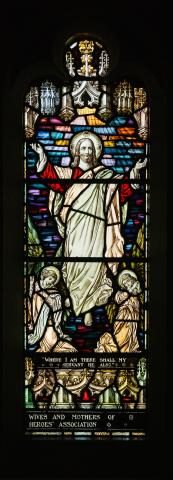
HE IS NOT HERE: FOR HE IS RISEN."

Landing of
CABOT 1497

Decree of
Expulsion to the
Acadians 1755

MUNIT HAEC ET ALTERA VINCIT

TO THE GLORY OF GOD AND IN MEMORY OF THE MEN OF THE
PROVINCE OF NOVA SCOTIA WHO GAVE THEIR LIVES IN THE WORLD WAR.

Image
Photo Credit
Canadian Memorial United Church and Centre for Peace
Caption
Nova Scotia Window
War or Conflict Term
Province
!4v1622487793072!6m8!1m7!1sBhTo-GoGMRoV-vQ0me-CTw!2m2!1d49.25808175008721!2d-123.1459623271083!3f226.2479404422196!4f8.907012790348716!5f1.4499580245881227
Body Content

Canadian Memorial Chapel was born in the hearts of private soldiers in the First World War who, guided by a sergeant, formed a working party to bury six of Canada's war dead. On a November night of 1915, in the Ypres Salient, France, one of the soldiers said to Reverend Lieutenant-Colonel (Lt.-Col.) George Fallis, CBEEDDD: "Padre, after the war is over some chaplain should build a memorial in Canada in memory of fellows like these who have given their all." From that moment on, he would never lay away their beloved dead without the idea of a memorial chapel in his mind.

On his return to Canada he was advised by Reverend S.D. Chown, DD, General Superintendent of the Methodist Church, to go to Vancouver and choose a site in Shaughnessy Heights facing the eternal hills to erect the chapel of his dreams. He arrived in Vancouver in May 1920, to a willing congregation and plans were quickly laid. 

Lt.-Col. Fallis' friend Chris Spencer, CBE, advised him that in order for there to be national significance to the chapel, he should go across Canada and interview lieutenant governors, premiers, statesmen and leaders of each province, asking them to underwrite the windows. Nova Scotia was the third province he visited.

At Halifax Lieutenant Governor, the Honourable James Tory, referred Lt.-Col. Fallis to the Premier, the Honourable Edgar M. Rhodes, who gave his blessing and submitted a list of citizens to be interviewed. Colonel Oxley arranged the introductions. Lt.-Col. Fallis visited Yarmouth, Kentville and Truro. In Yarmouth Eric H. Spinney, grandson of one of the Fathers of Confederation, said he called it one of the privileges of his life to help with the Nova Scotia Window.

Depicted in the Nova Scotia Window - “Immortality,” symbolized by the empty tomb of the risen Christ, is often a source of comfort to many grieving the loss of loved ones. The Gospel teaches that love triumphs over death. The historical panels depict the Landing of Cabot in 1497, and the Decree of Expulsion of the Acadians in 1755.

City
Vancouver
Country
Type Description
Stained glass window
Photo Credit
Canadian Memorial United Church and Centre for Peace
Memorial CF Legacy ID
11097
City/Municipality
Vancouver
Memorial Number
59026-040
Type
Address
Burrard Street and W 15th Avenue
Location
Canadian Memorial United Church
in Canada
Yes
GPS Coordinates
49.2580818, -123.1459623
Inscription

"IS NOT THIS THE BLOOD OF THE MEN WHO WENT IN JEOPARDY OF THEIR LIVES?"

Landing of
JACQUES CARTIER
1534

The Coming
of LORD ROLLO
1758.

Parva sub ingenti

TO THE GLORY OF GOD AND IN MEMORY OF THE MEN OF THE
PROVINCE OF PRINCE EDWARD ISLAND WHO GAVE THEIR LIVES IN THE WORLD WAR.

Image
Caption
Prince Edward Island Window
War or Conflict Term
Province
!4v1622487793072!6m8!1m7!1sBhTo-GoGMRoV-vQ0me-CTw!2m2!1d49.25808175008721!2d-123.1459623271083!3f226.2479404422196!4f8.907012790348716!5f1.4499580245881227
Body Content

Canadian Memorial Chapel was born in the hearts of private soldiers who, guided by a sergeant, formed a working party to bury six of Canada's war dead. On a November night of 1915, in the Ypres Salient, France, one of the soldiers said to Reverend Lieutenant-Colonel (Lt.-Col.) George Fallis, CBEEDDD: "Padre, after the war is over some chaplain should build a memorial in Canada in memory of fellows like these who have given their all." From that moment on, he would never lay away their beloved dead without the idea of a memorial chapel in his mind.

On his return to Canada he was advised by Reverend S.D. Chown, DD, General Superintendent of the Methodist Church, to go to Vancouver and choose a site in Shaughnessy Heights facing the eternal hills to erect the chapel of his dreams. He arrived in Vancouver in May 1920, to a willing congregation and plans were quickly laid. 

Lt.-Col. Fallis' friend Chris Spencer, CBE, advised him that in order for there to be national significance to the chapel, he should go across Canada and interview lieutenant governors, premiers, statesmen and leaders of each province, asking them to underwrite the windows.

The first visit was to Victoria and after securing subscription for the British Columbia Window, Honourable Walter Nichol  said: "Now that you have finished British Columbia, I should advise you to go to Prince Edward Island and if you get the support of the far West and the far East, I am sure the provinces in between will respond."

In winter 1928, Lt.-Col. Fallis left Vancouver for Charlottetown, Prince Edward Island. No one even knew he was on his way. Judge Shaw of Vancouver gave him a letter of introduction to his brother-in-law, Captain McLeod, who was the skipper on board the ice-breaker between the mainland and Prince Edward Island. Captain McLeod’s kind hospitality led him to believe that Islanders would understand his mission. He landed in Prince Edward Island on a Saturday, preached to a congregation in the First United Church on Sunday, spoke on Sunday night over the radio, and Monday contacted Lieutenant-Colonel Dan MacKinnon, a friend of war days. Lieutenant-Colonel MacKinnon made sure he saw Lieutenant Governor, the Honourable Frank R. Heartz, who called together a group of leading citizens as a general committee.

By Wednesday he was on the boat returning to the mainland with a very happy heart. Prince Edward Islanders were thrilled with a Canadian Memorial Chapel and eager to be the second province to subscribe for their window.

Depicted in the Prince Edward Island Window - “David and his Valiant Soldiers” symbolizes the sacrifice made by Canada’s servicemen. The story referenced here is of David’s elite troop of Three who break through the Philistine lines and obtain the water from the well for their King.

The Kings of both France and England also wanted to claim the “fairest land that may possibly be seen” and sent their explorers and soldiers to obtain it for them. The historical panels show images of great ships sailing forth into the unknown carrying Lord Rollo and Jacques Cartier, who brought new technology, goods and war to the “new world.” Their arrival also brought illness, death and the loss of land and status to the Acadians and Mi'kmaq.

City
Vancouver
Country
Type Description
Stained glass window
Photo Credit
Canadian Memorial United Church and Centre for Peace
Memorial CF Legacy ID
11096
City/Municipality
Vancouver
Memorial Number
59026-039
Type
Address
Burrard Street and W 15th Avenue
Location
Canadian Memorial United Church
in Canada
Yes
GPS Coordinates
49.2580818, -123.1459623
Inscription

"A SOLDIERS FAITH." "IHAVE NOT FOUND SO GREAT FAITH NO, NOT IN ISRAEL."

SIMON FRASER
Explores
Fraser River 1808

CAPT VANCOUVER
at Nootka Sound
1792

Splendor sine occasu

TO THE GLORY OF GOD AND IN MEMORY OF THE MEN OF THE
PROVINCE OF BRITISH COLUMBIA WHO GAVE THEIR LIVES IN THE WORLD WAR.

Image
Caption
British Columbia Window
1 of 2 images
Image
Caption
inscription
1 of 2 images
War or Conflict Term
Province
!4v1622487793072!6m8!1m7!1sBhTo-GoGMRoV-vQ0me-CTw!2m2!1d49.25808175008721!2d-123.1459623271083!3f226.2479404422196!4f8.907012790348716!5f1.4499580245881227
Body Content

Canadian Memorial Chapel was born in the hearts of private soldiers in the First World War who, guided by a sergeant, formed a working party to bury six of Canada's war dead. On a November night of 1915, in the Ypres Salient, France, one of the soldiers said to Reverend Lieutenant-Colonel (Lt.-Col.) George Fallis, CBEEDDD: "Padre, after the war is over some chaplain should build a memorial in Canada in memory of fellows like these who have given their all." From that moment on, he would never lay away their beloved dead without the idea of a memorial chapel in his mind.

On his return to Canada he was advised by Reverend S.D. Chown, DD, General Superintendent of the Methodist Church, to go to Vancouver and choose a site in Shaughnessy Heights facing the eternal hills to erect the chapel of his dreams. He arrived in Vancouver in May 1920, to a willing congregation and plans were quickly laid. 

Lt.-Col. Fallis' friend Chris Spencer, CBE, advised him that in order for there to be national significance to the chapel, he should go across Canada and interview lieutenant governors, premiers, statesmen and leaders of each province, asking them to underwrite the windows.

The first visit was to Victoria where Lieutenant Governor, the Honourable Walter C. Nichol was out of the capital for a few days. The Premier, the Honourable John Oliver, unreservedly commended the movement. He said, "I am a poor man, but I should like to subscribe the first hundred dollars towards the British Columbia window." Lt.-Col. Fallis interviewed several other men in public life and was met with cordial reception.

When the Honourable Walter Nichol returned he required twelve hundred dollars more to underwrite the window. He said: "You are going to be a very busy person visiting all the Provinces. I will underwrite the balance for the British Columbia Window." He added, "Now that you have finished British Columbia, I should advise you to go to Prince Edward Island and if you get the support of the far West and the far East, I am sure the provinces in between will respond."

Mr. Nichol became ill and eventually died. Lt.-Col. Fallis received a letter from a trust company asking for the balance on the British Columbia. Mr. Nichol had left instructions that it was to be paid out of his estate - one of the most touching moments in building the Chapel.

Depicted in the British Columbia Window - “A Soldier’s Faith” portrays a majestic Christ meeting the Roman centurion who pleads on behalf of his palsied servant. Disease and war wounds suffered by the troops were responded to by medical staff who played an essential role during the war. The historic panels show Simon Fraser in 1808 and Captain Vancouver at Nootka Sound.

City
Vancouver
Country
Type Description
Stained glass window
Photo Credit
Canadian Memorial United Church and Centre for Peace
Memorial CF Legacy ID
11095
City/Municipality
Vancouver
Memorial Number
59026-038
Type
Address
Burrard Street and W 15th Avenue
Location
Canadian Memorial United Church
in Canada
Yes
GPS Coordinates
49.2580818, -123.1459623
Inscription

FARMING

YPRES
SOMME

COAL MINING

RIGHT NOT MIGHT
SHALL RULE THE WORLD

DIEU ET MON DROIT

VIMY
CAMBRAI

FISHING

THIS WINDOW IS ERECTED IN HONOUR OF ALL MEN AND WOMEN OF CANADA WHO ENDURED SERVICE IN THE WORLD WAR.

Image
Photo Credit
Canadian Memorial United Church and Centre for Peace
Caption
All Canada Window
War or Conflict Term
Province
!4v1622487793072!6m8!1m7!1sBhTo-GoGMRoV-vQ0me-CTw!2m2!1d49.25808175008721!2d-123.1459623271083!3f226.2479404422196!4f8.907012790348716!5f1.4499580245881227
Body Content

Canadian Memorial Chapel was born in the hearts of private soldiers in the First World War who, guided by a sergeant, formed a working party to bury six of Canada's war dead. On a November night of 1915, in the Ypres Salient, France, one of the soldiers said to Reverend Lieutenant-Colonel (Lt.-Col.) George Fallis, CBEEDDD: "Padre, after the war is over some chaplain should build a memorial in Canada in memory of fellows like these who have given their all." From that moment on, he would never lay away their beloved dead without the idea of a memorial chapel in his mind.

On his return to Canada he was advised by Reverend S.D. Chown, DD, General Superintendent of the Methodist Church, to go to Vancouver and choose a site in Shaughnessy Heights facing the eternal hills to erect the chapel of his dreams. He arrived in Vancouver in May 1920, to a willing congregation and plans were quickly laid. 

The window depicting services rendered by all men and women of Canada throughout the war was made possible through the generosity of leading statesmen and other men and women in the public life of Canada. The Building Committee thought it was wise for Lt.-Col. Fallis to go to Ottawa as Parliament was in session, and interview the leaders of Canadian life. Through the kindness of the Honourable H.H. Stevens, PC, and the Honourable Layton Ralston, he was able to interview Prime Minister Mackenzie King and three cabinet ministers in one afternoon, who were all most gracious and responsive.

In a few days the story of Canadian Memorial Chapel was a topic of conversation among parliamentarians who ate in the Parliamentary Club. The Right Honourable Arthur Meighen thought the idea was worthy of the support of all Canadians. Lt-Col. Fallis was greeted in the hall by the Honourable Robert Manion, a devout Catholic and a friend in the war days. At lunch when Lt-Col. Fallis unfolded his napkin he found a cheque for one hundred dollars from his friend. While still at lunch, General A. D. McRae, CB, came over and said: "Padre, I must do my bit for Canadian Memorial Chapel," and handed over a cheque for one thousand dollars. Nearly twenty years later Senator General McRae was buried from Canadian Memorial Chapel.

The Honourable R.B. Bennett, afterwards Viscount Bennett, was Leader of the Opposition and Lt-Col. Fallis' cousin, Reverend Dr. Samuel Fallis was his minister in Central Church, Calgary. When Parliament was idle, Lt-Col. Fallis went to his suite and told him the story of Canadian Memorial Chapel and asked him to subscribe to the All Canada Window. Mr. Bennett was a great Canadian and a great patriot. He was delighted with the idea of Canadian Memorial Chapel and immediately wrote a very ample cheque.

Located over the main entrance to Canadian Memorial United Church, the All Canada Window represents a vision of the coming together of Canada as a nation throughout its history, including the First World War. The window contains Canada’s discovery by Cartier, its birth by fire under Wolfe, its place as a safe haven for the Loyalists, its struggle for democracy through rebellion and negotiation at Fort Garry, and its joining together into a great nation connected by the Canadian Pacific Railway. Within the windows are four of the great battles fought by Canadians in the First World War: Ypres, Cambrai, Vimy and the Somme. “Right, not Might, shall rule the world” instructs the central figure, an angelic visitor, Miss Canada, who holds the symbol of peace in her right hand: a laurel wreath.

The All Canada Window was dedicated at the evening service on 2 December 1928 by the Honourable H. H. Stevens, PC, LLD.

City
Vancouver
Country
Type Description
Stained glass window
Memorial CF Legacy ID
11093
City/Municipality
Vancouver
Memorial Number
59026-037
Type
Address
1825 W 16th Avenue
Location
Canadian Memorial United Church
in Canada
Yes
GPS Coordinates
49.2572049, -123.1467808
Inscription

CANADIAN MEMORIAL CENTRE FOR PEACE

Image
Photo Credit
Canadian Memorial United Church and Centre for Peace
Caption
Canadian Memorial United Church and Centre for Peace
1 of 2 images
Image
Photo Credit
Canadian Memorial United Church and Centre for Peace
Caption
Canadian Memorial United Church and Centre for Peace
1 of 2 images
War or Conflict Term
Province
!4v1667844165416!6m8!1m7!1s5GF0l2pMYLBcuckQceKp6g!2m2!1d49.25720494022967!2d-123.1467808152055!3f353.5917097276755!4f6.938869348058461!5f1.1476978130216184
Body Content

Canadian Memorial Chapel was born in the hearts of private soldiers who, guided by a sergeant, formed a working party to bury six of Canada's war dead. On a November night of 1915, in the Ypres Salient, France, one of the soldiers said to Reverend Lieutenant-Colonel (Lt.-Col.) George Fallis, CBEEDDD: "Padre, after the war is over some chaplain should build a memorial in Canada in memory of fellows like these who have given their all." From that moment on, he would never lay away their beloved dead without the idea of a memorial chapel in his mind.

On his return to Canada he was advised by Reverend S.D. Chown, DD, General Superintendent of the Methodist Church, to go to Vancouver and choose a site in Shaughnessy Heights facing the eternal hills to erect the chapel of his dreams. He arrived in Vancouver in May 1920, to a willing congregation and plans were quickly laid. The first project was Memorial Hall and all plans were sent to Professor C.H.C. Wright, Head of the Department of Architecture in the University of Toronto, for judging. He awarded the project to McCarter & Nairn. 

Memorial Hall was opened on 18 February 1923 and Sunday services were held in the gymnasium until Memorial Church was built in 1928. The corner-stone of Canadian Memorial Hall was laid by Mrs. Christopher Spencer and the address was given by Corporal J. A. Paton, MLA. The spirit operating in Canadian Memorial Hall is the same spirit of fellowship that existed in the trenches in France among Canadian soldiers—all men were brothers, irrespective of creed or colour.

A new addition was built in 1962 and was replaced by the Centre for Peace in 1997. Canadian Memorial United Church and the Centre for Peace remain committed to being a memorial for peace.

City
Vancouver
Country
Type Description
Building
Memorial CF Legacy ID
11092