Newfoundland & Labrador

Province Code
NF
City/Municipality
Logy Bay-Middle Cove-Outer Cove
Memorial Number
10006-037
Type
Address
36 Outer Cove Road
Location
Saint Francis of Assisi Catholic Church
in Canada
Yes
GPS Coordinates
47.6358422, -52.6938072
Inscription

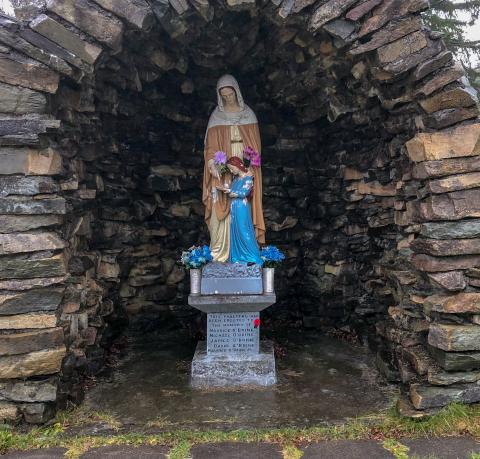
THIS PEDESTAL HAS BEEN
ERECTED TO THE MEMORY OF

MAURICE O'BRIEN
MICHAEL O'BRIEN
JAMES O'BRIEN
DAVID O'BRIEN
MAURICE O'BRIEN JR.

Image
Caption
O'Brien Family War Memorial
1 of 5 images
Image
Caption
Grotto and storyboard
1 of 5 images
Image
Caption
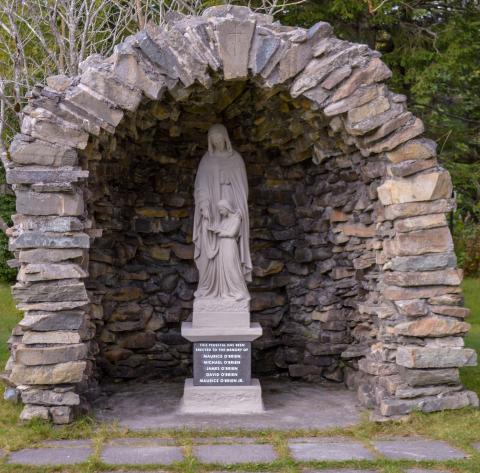
Original O'Brien Family War Memorial
1 of 5 images
Image
Caption
inscription
1 of 5 images
Image
Caption
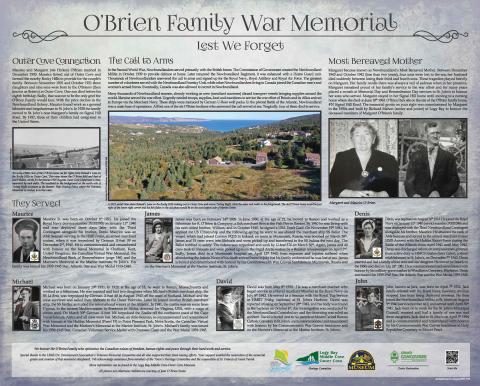
O'Brien Family War Memorial storyboard
1 of 5 images
War or Conflict Term
!4v1694003662095!6m8!1m7!1srOjCraMWGWBHXSoXFerBPA!2m2!1d47.6358421635312!2d-52.69380723415632!3f267.66893276012473!4f-6.493291181761251!5f0.4000000000000002
Body Content

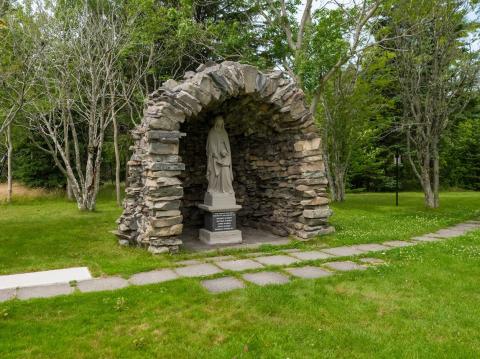
Margaret O’Brien commissioned the family war memorial grotto after losing four of her six sons over a period of two years during the Second World War. She is recognized on a plaque at Signal Hill Road in St. John's as Newfoundland's "Most bereaved mother for World War II". Her husband Maurice passed away in 1942 between losing their third and fourth sons.

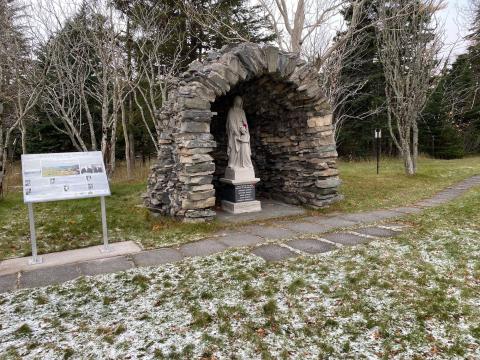
The grotto is a free-standing stone structure with a statue of Anne, the patron saint of mothers, resting on a pillar with the names of the O'Brien men who died in the war. Mrs. O'Brien herself paid for its creation in the mid-1950s. It was built by the father and son team Richard (senior and junior) Mahon, formerly of Logy Bay. Over the years its foundation had shifted, leaving the structure unstable and the statue of St. Anne badly damaged. In 2020, the Logy Bay Development Association, a community non-profit, raised funds and contracted the Grand Concourse Authority to stabilize the foundation and restore the grotto and statue to its original condition. At this time, the spelling of the family name on the memorial was corrected from O’Brine to O’Brien.

The Veterans Memorial Committee of the Development Association created the nearby storyboard of the family's history in 2002 to ensure the town remembered why the memorial was there. Maurice Jr. served with the Royal Navy and his ship was torpedoed in the northeast Atlantic on December 2, 1940. Michael worked on an American merchant ship and his vessel was torpedoed on March 30, 1941. David served with the Royal Navy Auxiliary and accidently drowned on September 28, 1942, in St. John's Harbour when his ship was in port. Denis served in the Royal Navy and returned home safely. John briefly enlisted with the Royal Navy, but his health prevented him from going overseas. He then joined the Newfoundland Militia and served until April 30, 1941.

The committee's research of James, the third son lost, took an unexpected turn. The family thought he was lost at sea, but the researcher found a detailed account of what had happened to him and a picture of his grave site. In June 1930, he moved to Boston to be with his oldest brother William, and to seek work as a fisherman. In the Spring of 1942, James was with the American Merchant Marine aboard the SS Ballot as part of Convoy PQ13. The Ballot was bombed on March 28, as the family had believed, but that wasn't the end of James's story. He was one of 15 crew members to survive in lifeboats and was picked up by the SS Induna. This ship was sunk two days later and once again James ended up in a lifeboat. He spent days injured and exposed to the icy Arctic Ocean before being picked up by a Russian minesweeper. He died in a Murmansk hospital a week later and was buried nearby.
City
Logy Bay-Middle Cove-Outer Cove
Country
Type Description
Grotto, statue, storyboard
Photo Credit
Logy Bay Development Association Inc.
Memorial CF Legacy ID
12008
City/Municipality
St John's
Memorial Number
10006-036
Type
Address
88 Water Street
in Canada
Yes
GPS Coordinates
47.5675677, -52.7032049
Inscription

[plaque]
THE
CROW'S
NEST

[plaque]
HERITAGE FOUNDATION OF NEWFOUNDLAND AND LABRADOR

CROW'S NEST
1892

Originally built as a warehouse after
the Great Fire of 1891, and occupying
the site of the 18th century inn, "The
Ship", this building ws converted to
the Sea-Going Officers' Club in 1942.
An unusual feature is the periscope
from the captured German U-Boat
190, which now projects from the
roof of the building.

[plaque]

  • CROW'S NEST
    OFFICERS' CLUB
  • Founded during the Second World War
    by Captain E.R. Mainguy, RCN, Captain
    (Destroyers) of the Newfoundland
    Escort Force, this private social club
    brought together Allied naval officers
    and their Merchant Navy counterparts
    in order to bolster their effectiveness
    on the high seas. Here, officers gathered
    in the spirit of camaraderie to relax and
    share stories. The Club’s rich collection
    of military artifacts is a testament to
    naval traditions and preserves the
    memory of the officers and sailors who
    bravely escorted ships across the North
    Atlantic during the long fierce battle
    between German U-boats and Allied
    convoys.
  • Historic Sites and
    Monuments Board of Canada
    and Parks Canada
  • LE CLUB DES
    OFFICIERS CROW'S NEST
  • Fondée pendant la Seconde Guerre
    mondiale par le Capitaine E.R. Mainguy,
    MRC, Capitaine (Destroyers) de la force
    d'escorte de Terre-Neuve, ce club
    privé encourageait les rencontres
    entre officiers navals alliés et ceux
    de la marine marchande dans le but
    d'augmenter leur efficacité en haute
    mer. Ici, les officiers se détendaient et
    partageaient leurs exéperiences dans un
    esprit de camaraderie. Evocatrice des
    traditions navales. La riche collection du Club
    d'objets militaires témoignent de
    traditions navales, la riche collection
    d'objects militaires rappelle le courage
    de ceux qui ont escorté les navires dans
    l'Atlantique Nord pendant le longue et
    feroce combat entre les sous-marins
    allemands et les convois alliés.
  • Commission des lieux et
    monuments historiques du Canada
    et Parcs Canada

[plaque]
CROW'S NEST
OFFICERS' CLUB
MEMBERS ONLY

War or Conflict Term
!4v1693482022791!6m8!1m7!1slE4x9CgOycZ6gy6yY6TyHA!2m2!1d47.56756769686258!2d-52.70320489421315!3f320.165647313606!4f5.100768527128807!5f0.7820865974627469
Body Content

During the Second World War, there were various messes around the city, but none were designated for naval officers, so Captain Rollo Mainguy decided to establish a Seagoing Officers Club. The Crow's Nest opened on January 27, 1942, as a safe haven for naval officers fighting in the Battle of the Atlantic. The club's name is believed to have originated when a Lieutenant Colonel in the Canadian Army, puffing and winded when he arrived at the top of the club's 59 steps, mopped his forehead and gasped, “Crikey, this is a snug little Crow’s Nest.” His companions were delighted with the observation and the name stuck.

On opening night the club had a contest for who could hammer a spike into the floor faster and it was won by the captain of HMCS Spikenard. They were torpedoed off Iceland on the night of February 10. During the war the club had a brass ring put around the spike in the floor and then after the war it was removed from the floor and put on the wall where it still remains.

As a memento before entering the theatre of war, many men visiting the club would scratch the name of their ship on the walls. Captain Mainguy gave each ship a space on the wall so they could put their gun shield there. Each ship had their own unique crest that they usually put on the gun shield of the four inch gun in the bow of their ship. Each gun shield in the club has its own story.

At the end of war, U-190 surrendered off the coast of Newfoundland on May 8, 1945, to HMCS Victoriaville and HMCS Thorlock. U-190 was brought into the Bay Bulls harbour because the submarine had sunk HMSC Esquimalt on April 16 and they were was afraid if they brought the crew to Halifax so soon after that, there could be some sort of public incident. The periscope was removed from the submarine and still remains in the club.

In the spirit of camaraderie, the club brought together officers from all nations to relax, share stories and develop solidarity. The Crow’s Nest reflects a rich body of naval tradition, preserves the memory of those who bravely escorted ships across the Atlantic, and honours their service.

City
St John's
Country
Type Description
Building
Memorial CF Legacy ID
11990
City/Municipality
Conception Bay South
Memorial Number
10006-035
Type
in Canada
Yes
GPS Coordinates
47.4550612, -53.0652939
Inscription

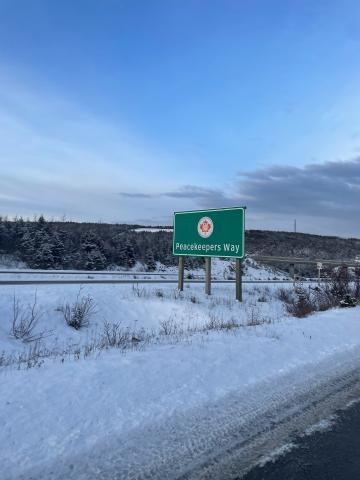
CANADIAN PEACEKEEPERS
VETERANS ASSOCIATION

Peacekeepers Way

Image
Photo Credit
Town of Conception Bay South
Caption
Peacekeepers Way sign
War or Conflict Term
!4v1673536983991!6m8!1m7!1sTSDVfAQlLAlLjzA2d33Wnw!2m2!1d47.45506120551877!2d-53.06529387299872!3f67.37748288679508!4f0.43686063808456765!5f0.7820865974627469
Body Content

In 2015, a busy highway through Conception Bay South has been named Peacekeepers Way. The Canadian Peacekeeping Veterans Association advocated strongly for the new name. It commemorates the enormous cost of the freedom we enjoy and the peace that has been achieved in so many areas around the globe.

City
Conception Bay South
Country
Type Description
Highway
Memorial CF Legacy ID
11262
City/Municipality
Conception Bay South
Memorial Number
10006-034
Type
Address
54 Rideouts Road
in Canada
Yes
GPS Coordinates
47.5065114, -52.976206
Inscription

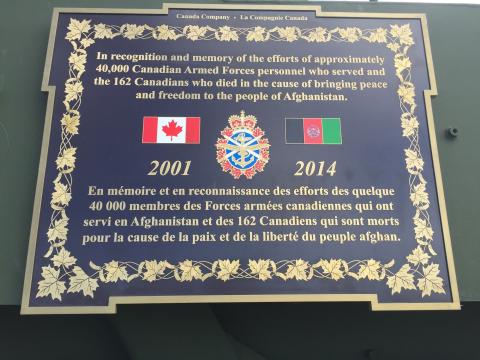
Canada Company •  La Compagnie Canada

In recognition and memory of the efforts of approximately
40,000 Canadian Armed Forces personnel who served and
the 162 Canadians who died in the cause of bringing peace
and freedom to the people of Afghanistan.

2001     2014

En mémoire et en reconnaissance des efforts des quelque
40 000 membres des Forces armées canadiennes qui ont
servi en Afghanistan et des 162 Canadiens qui sont morts
pour la cause de la paix et de la liberté du peuple afghan.

Image
Photo Credit
Wayne Miller
Caption
surroundings
1 of 6 images
Image
Photo Credit
Wayne Miller
Caption
LAV III Monument
1 of 6 images
Image
Photo Credit
Town of Conception Bay South
Caption
LAV III Monument
1 of 6 images
Image
Photo Credit
Wayne Miller
Caption
plaque
1 of 6 images
Image
Photo Credit
Brandon Cooney
Caption
LAV III Monument and accessible ramp.
1 of 6 images
Image
Photo Credit
Brandon Cooney
Caption
LAV III Monument
1 of 6 images
War or Conflict Term
!4v1665078689562!6m8!1m7!1sn_R8-RECNwHVMXJkPxf_GA!2m2!1d47.50651143822485!2d-52.9762060159739!3f140.78903114407194!4f13.156520992384586!5f0.7820865974627469
Body Content

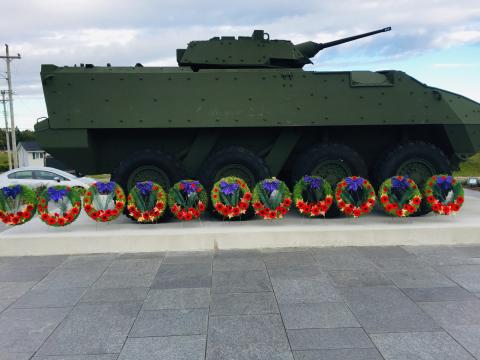
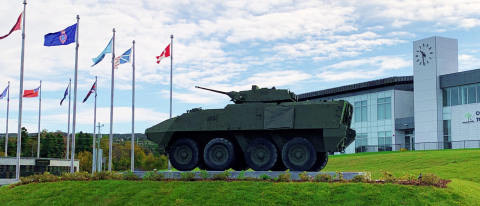
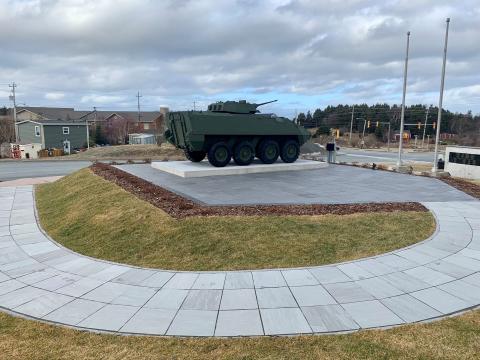
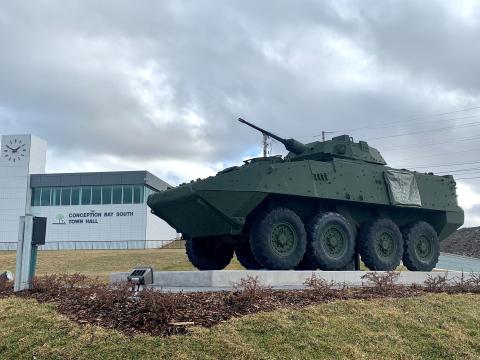
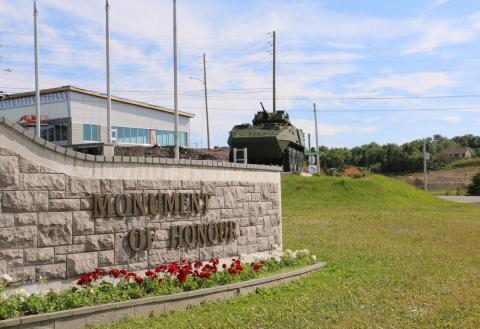
The Conception Bay South LAV lll Monument was dedicated on 2 October 2022 and recognizes the sacrifices of military members who served in Afghanistan. Eleven wreaths were laid in remembrance of 11 Newfoundland and Labrador Veterans who lost their lives in the Afghanistan War. 

Light Armoured Vehicles (LAV) III were originally manufactured by Canadians at General Dynamics Land Systems Canada in London, Ontario and were instrumental to troops in carrying out their missions while in Afghanistan. The monuments were created from decommissioned LAV III hulls, donated by the Government of Canada and built by Militex Coating Inc. and Fanshawe College students in London, Ontario.

On November 5, 2014, the Canada Company Light Armoured Vehicle (LAV) lll Monument Program was launched to recognize the 40,000 Canadians Armed Forces who served in Afghanistan and to commemorate the 162 Canadians who lost their lives. The program closed after awarding 33 monuments to communities across Canada. This monument is the last of 33 LAV III monuments to be dedicated in Canada and the only one of its kind in Newfoundland and Labrador. 

City
Conception Bay South
Country
Type Description
Vehicle - LAV III
Memorial CF Legacy ID
11016
City/Municipality
St. John's
Memorial Number
10006-033
Type
Address
305 Waterford Bridge Road
Location
Bowring Park
in Canada
Yes
GPS Coordinates
47.5272331, -52.7497825
Inscription

needs further research/recherche incomplète

[interpretive panel/panneau d’interprétation]

Into NO MAN's Land

The first 500 volunteers who signed up for the Newfoundland Regiment at the outbreak of World War 1 expected adventures and a quick trip home. Most would never return.

The men's first battle at Gallipoli in Turkey late in 1916 was a trial by fire. Their next battle on the Somme in Northern France marked the Regiment and the nation of Newfoundland forever.

When the Battle of the Somme began on July 1, 1916 at 7:30 a.m., the Newfoundlanders were the only unit from outside the British Isles. They crouched in their trenches near the little town of Beaumont Hamel — awaiting their orders. The call came at 9:15 am and 801 young Newfoundlanders headed out into enemy machine gun fire. It was over in 30 minutes. 68 men answered roll call the next morning. Newfoundland's Prime Minister was told that the assault failed only because "dead men can advance no further".

A Lost Generation

57,000 other British soldiers were killed and wounded on July 1st, 1916, but losing so many young men had a huge impact on a country as small as Newfoundland. Raising the Regiment was the nation's first great effort as a people. July 1st became Newfoundland's Memorial Day - the forget-me-not was worn as a sign of remembrance.

The Caribou — the emblem of the Newfoundland Regiment. Days after the Regiment was devastated at Beaumont Hamel, the Corps commander told his soldiers that they were "better than the best". This remains the Regiment's proud motto.

Aged only 16, Private William Morgan of St. John's, was one of many killed in action at Beaumont Hamel on July 1st, 1916. Down this path, you'll find his name among those on the plaques commemorating men with no known graves.

[interpretive panel/panneau d’interprétation]

Tread softly here —
Go reverently and slow,
Yea, let your soul go down upon its knees,
And with bowed head and heart abased
Strive hard to grasp the future gain in this sore loss.
For not one foot of this dank sod
But drank its surfeit of the blood of gallant men
Who for their Faith, their Hope, for Life and Liberty
Here made the sacrifice.
Here gave their lives, and right willingly for you and me.

Epitaph at the Beaumont-Hamel Memorial, composed by John Oxenham.

Beaumont Hamel Park opened in 1925. It is the largest of Newfoundland's memorial sites in Europe. Landscape architect RHK Cochius' vision made this the only place on the Somme where the trenches and battlefield were preserved. Today, the sits is managed by Veterans Affairs Canada and draws over 250,000 visitors every year.

Forget∼Me∼Not

After the terrible losses at Beaumont Hamel, the Newfoundland Regiment rebuilt with volunteers and fought on. 1,201 members of the Regiment died in World War I - a small portion of the one million British Empire soldiers killed.

1n 1917, King George V granted the Newfoundland Regiment the title of "Royal" — a wartime honour given to only two other regiments in the history of the British Army.

Four years of devastating war. Thousands of sons and husbands buried in the mud on a far off continent and lost at sea. The memorial effort began soon after the war ended in 1918. Thomas Nangle, the Regimental Padre, recommended memorials to mark each of the Regiment's main battles: Gallipoli, Beaumont Hamel, Gueudecourt, Monchy-le-Preux, Masnières and Courtrai. Five caribous still stand watch over the battlefields in Europe where so many fell.

Down this path you'll find a sixth caribou and the 820 names of Newfoundland soldiers, seamen, and sailors whose final resting places are 'known only to God". These plaques are replicas of the ones unveiled at Beaumont Hamel in 1925.

Lt. Col. Thomas Nangle, the Royal Newfoundland Regiment's Padre in France during the War, was the Dominion of Newfoundland's representative in the Imperial War Graves Commission. He headed up the memorial effort in Europe.

Image
Photo Credit
© Bowring Park Foundation
Caption
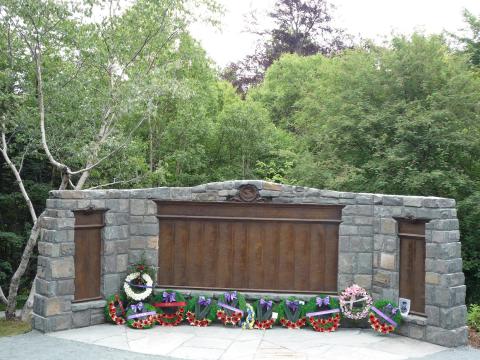
Beaumont Hamel Memorial Plaque Replicas
War or Conflict Term
!4v1662633420336!6m8!1m7!1sCAoSLEFGMVFpcE8tZFJtZV9NdGpYdEIzYWFEMktpeTFlaFNfT3NwdUdnclNVRmt6!2m2!1d47.52723309381105!2d-52.74978253437322!3f142.49065390962835!4f-5.433898813905813!5f2.236862335193121
Body Content

The names of 820 members of the Royal Newfoundland Regiment, the Newfoundland Royal Naval Reserve and the Mercantile Marines who gave their lives in the First World War and whose final resting places were then unknown are inscribed on these plaques. They are replicas of the ones unveiled at Beaumont-Hamel on 7 June 1925.

Engineer Randal Power of College of the North Atlantic and a team from Morgan Sculptures Inc., the company responsible for replicating and installing the plaques, painstakingly studied, documented and scanned the three-piece monument in France. The replicas were generated without even touching the master plaques, using advancements in virtual and manufacturing sciences. Having the memorial plaques replicated and mounted in Bowring Park was an initiative of the Government of Newfoundland and Labrador. The plaques were unveiled on 1 July 2009.

Directly across from the Beaumont Hamel Memorial Plaque Replicas is The Caribou Monument.

City
St. John's
Country
Type Description
Wall, plaques
Memorial CF Legacy ID
10965
City/Municipality
Bell Island
Memorial Number
10006-032
Type
Address
13 Compressor Hill
Location
Bell Island Community Museum
in Canada
Yes
GPS Coordinates
47.6472206, -52.9479619
Inscription

needs further research/recherche incomplète

Image
Caption
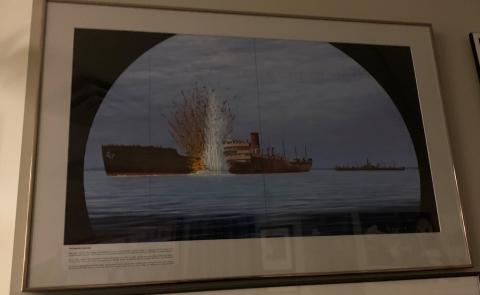
Sinking of the Saganaga by Joe Dwyer
!4v1701718278329!6m8!1m7!1sXiG2T4cmkzZC_nl-V84mgQ!2m2!1d47.64722055536393!2d-52.94796187825803!3f236.30701345564103!4f5.86089441847011!5f1.0995559454151462
Body Content

This 2003 painting by Joe Dwyer was donated by the Cambridge Newfoundland Club. The painting shows the explosion from a German torpedo that struck the side of the SS Saganaga on September 5, 1942. SS Lord Strathcona, is anchored in the background.

Four fully-loaded ships were anchored in Bell Island Tickle on the morning of 5 September 5 1942. Two more ships were loading iron ore at the Scotia and Dominion piers. At 11:46 am, an explosion on SS Saganaga sent two sailors, decking and ore high into the air. Another explosion occurred moments later, as a second torpedo struck the ship. Cut nearly in two, Saganaga sank in just 30 seconds. With no warning of the attack, many drowned inside the sinking ship. Twenty-nine sailors died in the attack, most of the crew was from the United Kingdom.

The survivors struggled to swim in the cold seawater. Crew of nearby Lord Strathcona abandoned ship to help Saganaga's survivors. In the confusion, Lord Strathcona swung about, hitting the submarine’s conning tower, but U-boat 518 recovered quickly and sank Lord Strathcona.

City
Bell Island
Country
Type Description
Painting
Memorial CF Legacy ID
10945
City/Municipality
St. John's
Memorial Number
10006-031
Type
Address
76 Queens Road
Location
St. Andrew's Presbyterian Church, front of vestibule
in Canada
Yes
GPS Coordinates
47.5657502, -52.7111588
Inscription

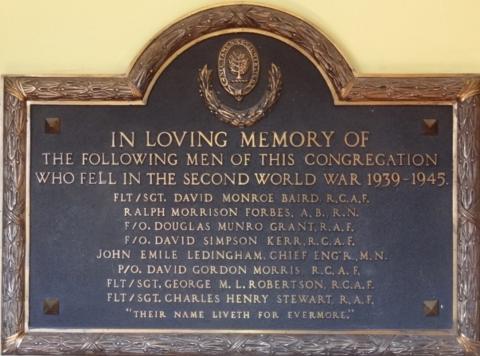
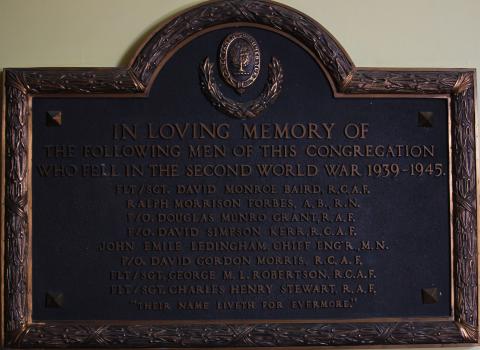
IN LOVING MEMORY OF
THE FOLLOWING MEN OF THIS CONGREGATION
WHO FELL IN THE SECOND WORLD WAR 1939-1945

FLT/SGT DAVID MONROE BAIRD RCAF
RALPH MORRISON FORBES AB RN
F/O DOUGLAS MUNRO GRANT RAF
F/O DAVID SIMPSON KERR RCAF
JOHN EMILE LEDINGHAM CHIEF ENG'R M.N.
P/O DAVID GORDON MORRIS RCAF
FLT /SGT GEORGE M.L. ROBERTSON RCAF
FLT /SGT CHARLES HENRY STEWART RAF
"THEIR NAME LIVETH FOR EVERMORE"

Image
Caption
plaque
1 of 2 images
Image
Caption
inscription
1 of 2 images
War or Conflict Term
!4v1650368332441!6m8!1m7!1sPrgvRthy1I1f2UEQ0CgdSA!2m2!1d47.56575022312735!2d-52.71115883581543!3f144.6665800939716!4f4.835979631657835!5f0.7820865974627469
Body Content

This plaque commemorates those who were members of the congregation and gave the supreme sacrifice in the Second World War. There is a Presbyterian, Burning Bush Insignia at the superior aspect of the plaque.

City
St. John's
Country
Type Description
Plaque
Photo Credit
St. Andrew's Church
Memorial CF Legacy ID
10860
City/Municipality
St. John's
Memorial Number
10006-030
Type
Address
76 Queens Road
Location
St. Andrew's Presbyterian Church, North wall, east side transept facing congregation
in Canada
Yes
GPS Coordinates
47.5657502, -52.7111588
Image
Caption
plaque
1 of 2 images
Image
Caption
inscription
1 of 2 images
War or Conflict Term
!4v1650368332441!6m8!1m7!1sPrgvRthy1I1f2UEQ0CgdSA!2m2!1d47.56575022312735!2d-52.71115883581543!3f144.6665800939716!4f4.835979631657835!5f0.7820865974627469
Body Content

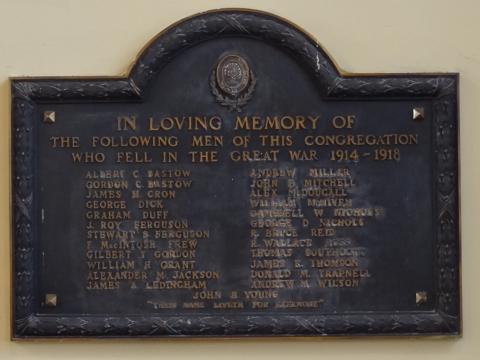
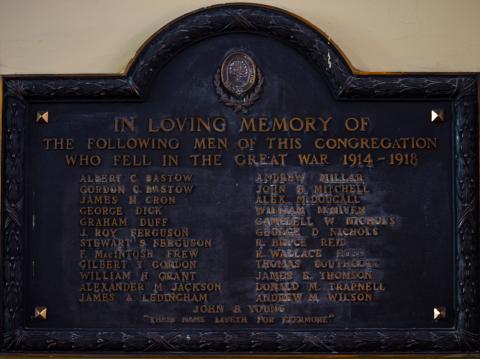
This plaque commemorates members of the congregation who died in the First World War. Some of these Church members lived outside St. John’s. It was funded by donations from members of the church.

There are 23 names listed as members of the Church which includes eight individuals who were also members of the Newfoundland Highlanders. The congregational plaque is topped by the Presbyterian Church badge - the Burning Bush. It was dedicated at a service on June 12, 1921.

City
St. John's
Country
Type Description
Plaque
Photo Credit
St. Andrew's Church
Memorial CF Legacy ID
10859
City/Municipality
St. John's
Memorial Number
10006-029
Type
Address
76 Queens Road
Location
St. Andrew's Presbyterian Church, (east transept, north window)
in Canada
Yes
GPS Coordinates
47.5657502, -52.7111588
Inscription

BE THOU FAITHFUL UNTO DEATH

TO THE GLORY OF GOD IN MEMORY OF THOSE WHO
WORSHIPPED HERE AND GAVE THEIR LIVES IN THE WAR 1914-1919

Image
Caption
stained glass window
War or Conflict Term
!4v1650368332441!6m8!1m7!1sPrgvRthy1I1f2UEQ0CgdSA!2m2!1d47.56575022312735!2d-52.71115883581543!3f144.6665800939716!4f4.835979631657835!5f0.7820865974627469
Body Content

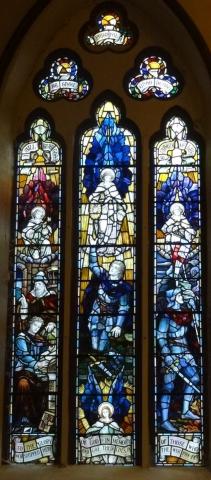
The War Memorial Window was created by A. Ballantine and Son of Edinburgh, Scotland and placed in the sanctuary and dedicated on May 28, 1922. James Ballantine, principal of the stained glass company, travelled to Newfoundland to help install the window. “A Veteran of the Great War himself, and a good friend of one of the young men the window commemorates, Mr. Ballantine had a particular interest in seeing that the window was a fitting memorial.” The most likely friend of James Ballantine from St. Andrew’s was Gilbert Thomas Gordon.

The window was funded by generous donations from members of the congregation of St. Andrew’s. In the first, or left light our attention is immediately drawn to the figure in the forefront - a boy reading at a desk, with a teacher and angel above him. It is that of one upon whose features the fresh bloom of youth still rests. In his hands he holds the ‘Book of Books’, which he has been thoughtfully reading. He has been pondering deeply over the part he may soon be called upon to play in the great struggle, the fires of which have already been lit. As he listens to the words of a wise counsellor, the sudden gleam in his eyes suggests to us that he has made his great decision. He will be true to himself and the Christian principles he has been taught. He will grasp firmly the torch of duty and by its light he will step bravely along that difficult path which stretches out before him.

In the center light is an image of an angel and a kneeling knight in armour with broken sword. An angel holding a laurel wreath is above the knight. Our soldier, has returned tired and worn from the conflict. We see him on his knees, but not as one defeated. He has cast aside his helmet and with uncovered head and with the hand which held his now broken sword, symbol of duty done, uplifted he looks up to receive the victor’s laurel wreath.

In the third light is an image of a knight in armour, wearing helmet, standing with sword and spear in hand, an angel is behind the knight’s Red Cross banner. Our youth has accepted the challenge and goes forth in the pride of young manhood, to answer the call of duty. Fully clad in the armour of a Christian Soldier, with sword in hand, and the banner of the Red Cross held high, with face set he goes out to meet unknown dangers, and perhaps death itself.

The wording through three small windows above the main window states, "Be thou faithful unto death.” Which is from Rev. 2:10 and is followed in the text, but not the window by - "And I will give thee a crown of life."

City
St. John's
Country
Type Description
Stained Glass Window
Photo Credit
St. Andrew's Church
Memorial CF Legacy ID
10858
City/Municipality
St. John's
Memorial Number
10006-028
Type
Address
76 Queens Road
Location
St. Andrew's Presbyterian Church, North wall, west side transept facing congregation
in Canada
Yes
GPS Coordinates
47.5657502, -52.7111588
Image
Photo Credit
St. Andrew's Church
Caption
plaque
1 of 2 images
Image
Photo Credit
St. Andrew's Church
Caption
inscription
1 of 2 images
!4v1650368332441!6m8!1m7!1sPrgvRthy1I1f2UEQ0CgdSA!2m2!1d47.56575022312735!2d-52.71115883581543!3f144.6665800939716!4f4.835979631657835!5f0.7820865974627469
Body Content

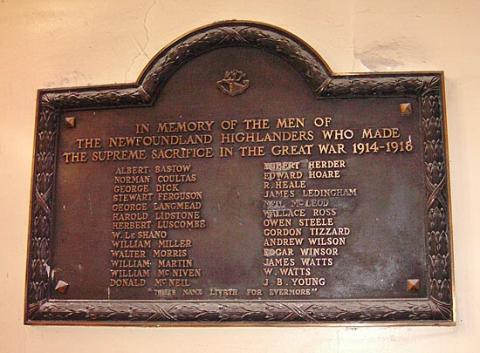
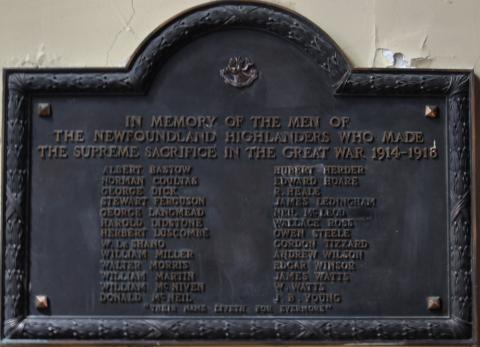
This plaque commemorates members of the Newfoundland Highlanders a paramilitary, pre First World War group that gave the supreme sacrifice in the Great War. It was funded by donations from members of the church.

Although the Highlanders were affiliated with St. Andrew's Presbyterian Church, many members had their home congregation in other churches. Twenty-six names are on the plaque and eight of those, as they were members of St. Andrew’s Church, are also on the congregational plaque.

The plaque, at its superior aspect, has affixed a Newfoundland Highlander Badge - a Caribou with ‘Newfoundland Highlanders’ in scroll under it. The plaque was dedicated at a service on June 12, 1921.

City
St. John's
Country
Type Description
Plaque
Memorial CF Legacy ID
10857