
This cenotaph is a tall marble slab adorned by the statue of a First World War soldier. Originally placed in 1919 to honour those who died in the Great War, names for those who died in the Second World War were added in 1946/1947.
Sign in to My VAC Account
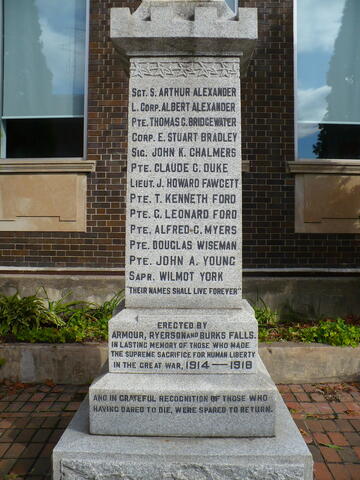
Sign in to My VAC Account[front/devant]
Sgt S. ARTHUR ALEXANDER
L. Corp. Albert Alexander
Pte. Thomas C. Bridgewater
Corp. E. Stewart Bradley
Sig. John K. Chalmers
Pte. Claude C. Duke
Lieut. J. Howard Fawcett
Pte. T. Kenneth Ford
Pte. C. Leonard Ford
Pte. Alfred C. Myers
Pte. Douglas Wiseman
Pte. John A. Young
Sapr. Wilmot York
"THEIR NAMES SHALL LIVETH FOREVER"
ERECTED BY
ARMOUR, RYERSON AND BURK'S FALLS
IN LASTING MEMORY OF THOSE WHO MADE
THE SUPREME SACRIFICE FOR HUMAN LIBERTY
IN THE GREAT WAR, 1914-1918
AND IN GRATEFUL RECOGNITION OF THOSE WHO
HAVING DARED TO DIE, WERE SPARED TO RETURN
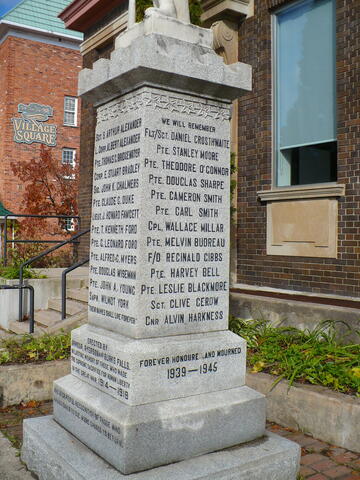
[left side/côté gauche]
WE WILL REMEMBER
Flt/Sgt Daniel Crosthwaite
Pte. Stanley Moore
Pte. Theodore O'Connor
Pte. Cameron Smith
Pte. Carl Smith
Cpl. Wallace Millar
Pte. Melvin Budreau
F/O Reginald Gibbs
Pte. Harvey Bell
Pte. Leslie Blackmore
Sgt. Clive Gerow
Gnr Alvin Harkness
FOREVER HONOURED AND MOURNED
1939-1945
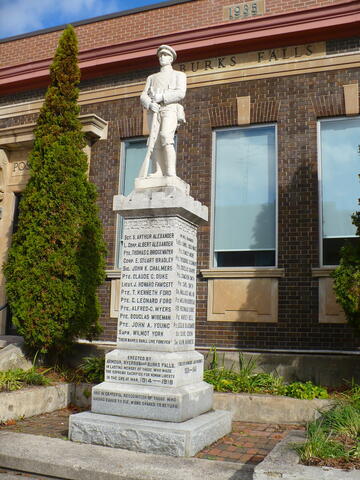
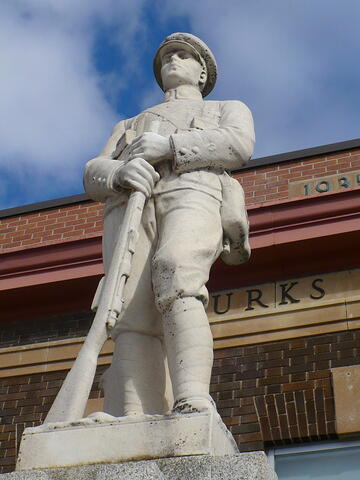
This cenotaph is a tall marble slab adorned by the statue of a First World War soldier. Originally placed in 1919 to honour those who died in the Great War, names for those who died in the Second World War were added in 1946/1947.
The Algonquin Regiment evolved from the Northern Pioneers formed after the First World War from a number of northern Ontario military units. When The Algonquin Regiment was mobilized for active service on July 22, 1940, its purpose was to assist in the defeat of Adolph Hitler's Nazi Germany and its Allies. 130 men from the Parry Sound area flocked to join A Company of the Algonquins at local recruiting centers.
[slab/dalle]
IN MEMORY OF
THE MEN OF BAYSVILLE
WHO GAVE THEIR LIVES
THAT WE MIGHT LIVE
1914 - 1918 1939 - 1945
LEST WE FORGET
[wall/mur]
needs further research/recherche incomplète
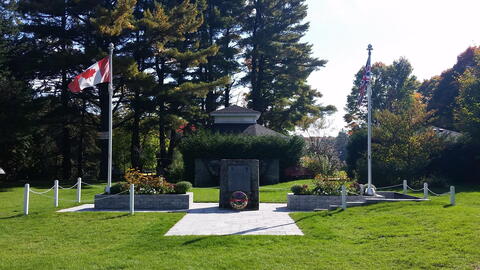
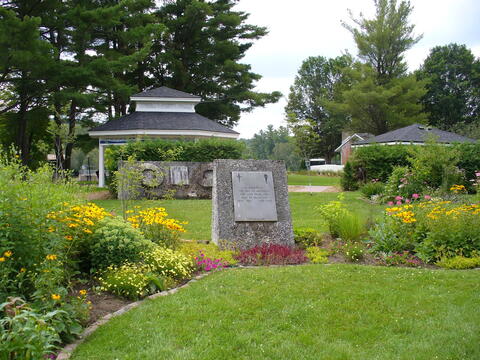
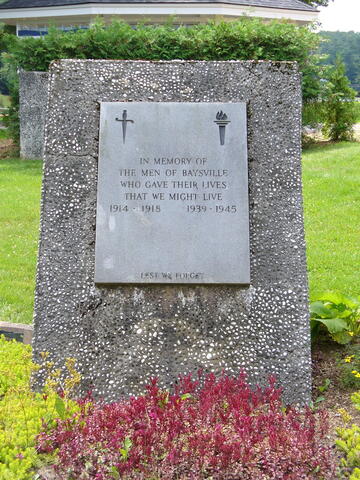
The Baysville Cenotaph was originally constructed in 1975 by a group of Veterans from the First and Second World Wars, Korean War, Peacekeeping missions and general service. The center pillar was dedicated during the November 11 Remembrance Service in 1975, which was presided over by Rev. S. Littlewood, a First World War Veteran. Over the course of the next 40 years the center pillar remained as originally constructed while the surrounding landscape changed like the seasons.
The Baysville Cenotaph underwent a rejuvenation in 2016 under the direction of Peter Ruttan. Mr. Ruttan has been involved with the Baysville Remembrance Service since 1995 and has organized and directed the service since 2001.
Funding for the cenotaph came entirely from public donations of money, time, equipment, and material. The Cenotaph area is now 36 ft wide x 10 ft deep x 10 ft x 10 ft and covers 460 square feet. The flowers that are planted in the two raised gardens all have a meaning to war, remembrance, sacrifice, peace, love, loss, grief, sorrow.
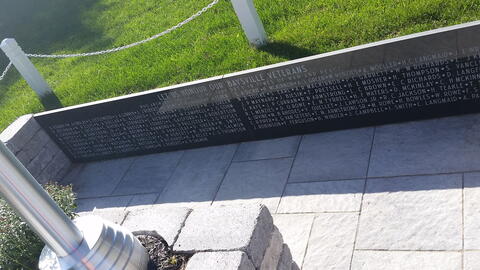
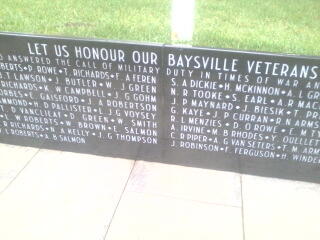
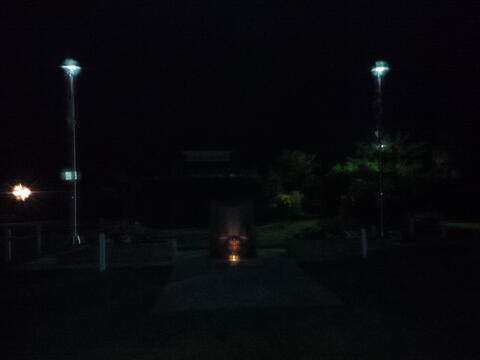
At the west side of the cenotaph a polished black granite slab 10 ft long by 18 inches high, proudly lists the names of Baysville's Veterans who answered the call and never came home or have returned home safely. The wall is positioned so that when the sun rises in the morning it is first to be illuminated. The cenotaph now contains two flag poles with the Canadian and Union Jack flags. At night the flags and the cenotaph center pillar are illuminated with lights.
Bethune Memorial House National Historic Site
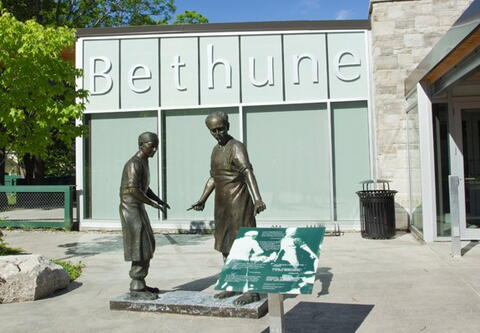
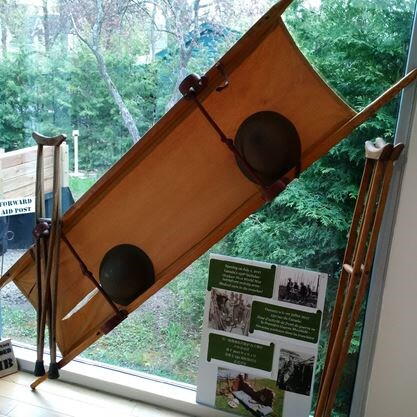
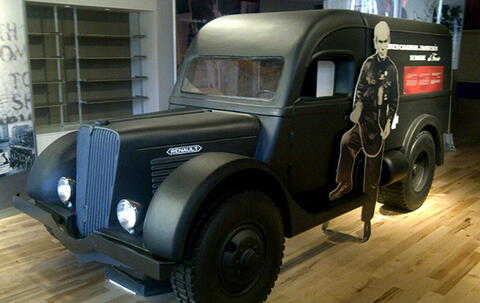
Bethune Memorial House, a National Historic Site of Canada in Gravenhurst, Ontario, Canada, commemorates the life and achievements of Dr. Henry Norman Bethune, who served in all three branches of the military – Army, Navy, and Air Force – during the First World War. Dr. Norman Bethune was reputedly the 8th person in Toronto to enlist on August 4th, 1914 being assigned as a stretcher-bearer, which was one of the more dangerous roles.
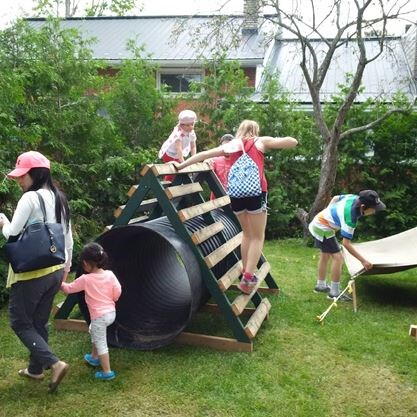
At 12:30 p.m., July 1, 2017 a new outdoor activity area was officially unveiled to honour the centennial year of two of the most significant events for Canadians during the First World War: The battles of Vimy Ridge and Passchendaele.
The outdoor space presents a child-friendly snapshot of the work of medics and stretcher bearers during the Great War. It also features a wooden and sand-bagged trench flanked by a “training area”, with climbing apparatus, balance beams, a bridge, and tunnels. The trench is as historically accurate as possible, complete with rubber rats, tin cans featuring reproduction labels of popular brands of the day and faux barbed wire. Kids can even wear military getup and keep an eye on the advancement of the enemy by looking through periscopes, while gunshots can be sporadically heard.
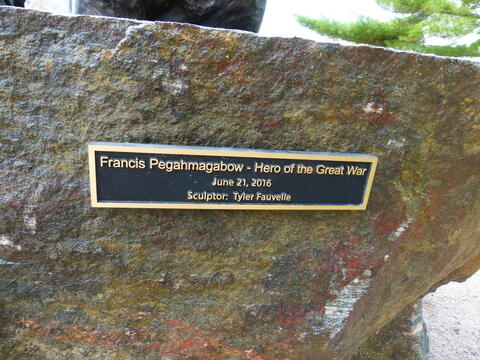
[plaque]
Francis Pegahmagabow - Hero of the Great War
June 21, 2016
Sculptor: Tyler Fauvelle
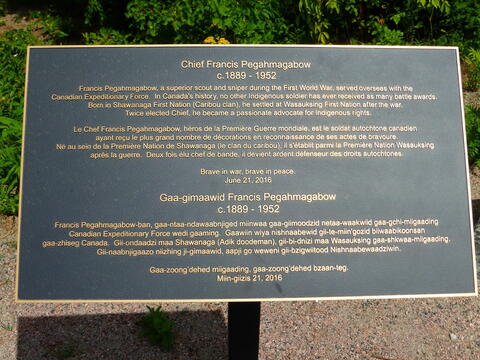
[plaque]
Chief Francis Pegahmagabow
c. 1889 - 1952
Francis Pegahmagabow, a superior scout and sniper during the First World War, served overseas with the Canadian Expeditionary Force. In Canada's history, no other Indigenous soldier has ever received as many battle awards. Born in Shawanaga First Nation (Caribou Clan), he settled at Wasauksing First Nation after the war. Twice elected Chief, he became a passionate advocate for Indigenous rights.
Le Chef Francis Pegahmagabow, héros de la Première Guerre mondiale, est le soldat autochtone canadien ayant reçu le plus grand nombre de décorations en reconnaissance de ses actes de bravoure. Né au sein de la Première Nation de Shawanaga (le clan de caribou), il s'établit parmi la Première Nation Wasauksing aprés la guerre. Deux fois élu chef de bande, il devient ardent défenseur des droits autochtones.
Brave in war, brave in peace
June 21, 2016
Gaa-gimaawid Francis Pegahmagabow
c. 1889 - 1952
Francis Pegahmagabow-ban, gaa-ntaa-ndawaabnjiged miinwaa gaa-giimoodzid netaa-waakwiid gaa-gchi-miigaading Canadian Expeditionary Force wedi gaaming. Gaawiin wiya nishnaabewid gii-te-miin'gozid biiwaabikoonsan gaa-zhiseg Canada. Gii-ondaadzi maa Shawanaga (Adik doodeman), gii-bi-dnizi maa Wasauksing gaa-shkwaa-miigaading. Gii-naabnjigaazo niizhing ji-gimaawid, aapji go weweni gii-bzigwiitood Nishnaabewaadziwin.
Gaa-zoong'dehed miigaading, gaa-zoong'dehed bzaan-teg.
Miin-giizis 21, 2006
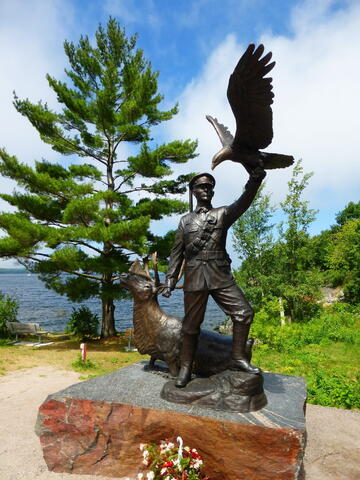
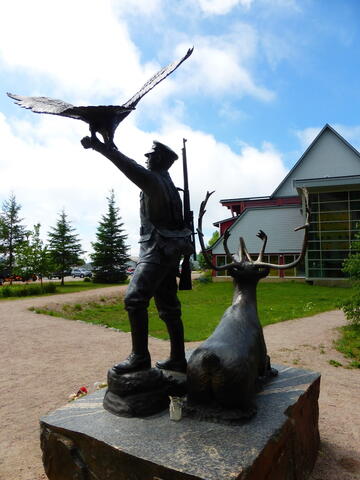
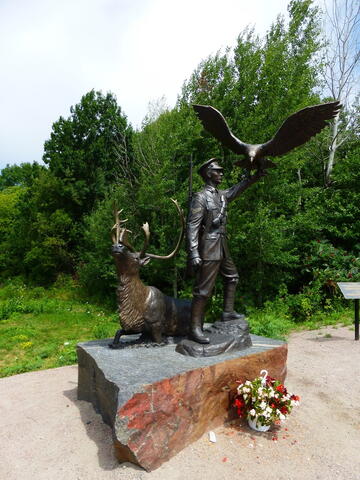
A bronze likeness of Sergeant-Major Francis Pegahmagabow was unveiled June 21, 2016, on National Aboriginal Day (today, National Indigenous Peoples Day) in Parry Sound, Ontario. The monument overlooks his home at Wasauksing First Nation, and stands not far from Shawanaga First Nation, where he was born. The event featured significant military representation, including Lieutenant General Marquis Hainse, who was then Commander of the Canadian Army, as well as a 50-soldier honour guard. Chief Perry Bellegarde, then-National Chief of the Assembly of First Nations, was among the honoured guests paying tribute to the great Anishinaabe hero.
The monument was created by Tyler Fauvelle, a professional sculptor based in Sudbury, Ontario. The statue, which stands approximately 10 feet high, depicts Pegahmagabow in his wartime uniform with an eagle above and a caribou at his side. The caribou represents Pegahmagabow's clan, hunting and sustenance; it pushes up through water, a sign of Pegahmagabow’s battle through the depths of war. It symbolizes the spirit of his people crossing the ocean with him, and of their own struggle to emerge from the depths of injustice.
The rock at his feet resembles the far-away Canadian Shield. Even on foreign soil that never knew his ancestors, he was grounded by his home, by the culture written in his heart.
The eagle is the sign of the Thunderbird - the powerful, mystical protector, the first messenger, the prayer carrier. It calls to mind Pegahmagabow’s dangerous role as a scout and messenger, and all the prayers rising up from the battlefield. Migizi was needed as it must have seemed like the end of the world. The eagle’s acute vision represents Pegahmagabow’s – his sharp sniper’s eye, but also his figurative vision, as a man who saw the vital necessity of preserving his people’s language and traditions and of advocating for Indigenous rights. It echoes the eagle feathers in his Chief’s headdress, a reminder of his lineage and that he twice served as Chief of Wasauksing First Nation. The shock of war followed Francis Pegahmagabow home. Thunder, artillery and the Thunderbirds would forever be linked in his mind and spirit.
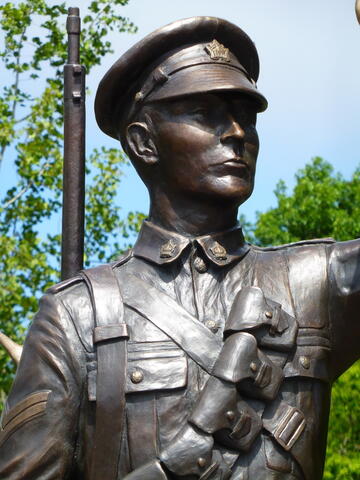
Francis Pegahmagabow is shown in the Canadian Expeditionary Force uniform he would have worn, with the rifle that his own life and the lives of his fellow soldiers depended on. His pose is noble, uplifted, alluding to his bravery and to his spiritual strength.
A small medicine pouch in his hand; Pegahmagabow said he never knew what was in the pouch he was given by a medicine man. There is no doubt that it was part of the strong sense of spiritual protection that sustained him throughout some of the Great War’s most horrific battles.
The entire concept came to Tyler in a dream. It took months to sculpt, during which he often had the honour of speaking with Francis Pegahmagabow’s family. However, the concept never really changed much from the sculptor’s first dream of the warrior’s monument.
Pegahmagabow is one of the few to have fought in the Great War almost entirely from beginning to end. Revered as the most decorated Indigenous Canadian soldier to fight in the First World War, he is one of only a handful of members of the Canadian Expeditionary Force to have earned the Military Medal (MM) with two bars, the equivalent of receiving the MM three times. The first commendation came during his first year on the Western Front; it recognized his disregard for danger and his faithfulness to duty while carrying critical messages during battle. The second award (first bar) honoured his brave actions keeping in touch with the flanks and guiding relief during the Battle of Passchendaele, where the Canadian Corps joined British Divisions to take and hold the village. The third battle award (second bar) was for his actions during the Battle of the Scarpe (part of the 2nd Battle of Arras), where he charged into heavy machine gun and rifle fire to bring back ammunition for his desperate comrades.
After the war, Pegahmagabow served Wasauksing First Nation as Councilor and as Chief. He continued to lead by example as a member of the Non-Permanent Active Militia (Canadian Army Reserve), and as an early, passionate activist in the national Indigenous rights movement.
Francis Pegahmagabow died in 1952, and is buried in a military-marked grave at Wasauksing First Nation (Parry Island), Ontario. The medals honouring his remarkable achievements are on permanent display at the Canadian War Museum in Ottawa.
The Ontario Native Education Counselling Association (ONECA), a registered charity supporting Indigenous education, commissioned the monument. ONECA raised half of the funds needed, while the remaining half was provided by the Department of Canadian Heritage.
Following the unveiling of the bronze monument commemorating Francis Pegahmagabow:
- The Canadian Armed Forces announced the addition of the historic name 'Northern Pioneers' to the official title of The Algonquin Regiment. This was in tribute to Pegahmagabow, who was among the first to sign on with the 23rd Regiment (Northern Pioneers) overseas contingent in August 1914.
- Sounding Thunder: The Stories of Francis Pegahmagabow, was written by Dr. Brian D. McInnes, an educator and great-grandson of Pegahmagabow. Published in 2016, the book celebrates Francis Pegahmagabow’s extraordinary life and accomplishments.
- Sounding Thunder: The Song of Francis Pegahmagabow was commissioned by the Festival of the Sound in 2018. (Tim Corlis, composer and Armand Garnet Ruffo, librettist.) Created in consultation with Brian D. McInnes and Jodi Contin Baker, the production is a musical journey into the life of Pegahmagabow, drawn from the Great War hero's memoirs.
IN MEMORY AND HONOUR
OF THOSE WHO SERVED
IN
WORLD WAR I 1914 - 1918
WORLD WAR II 1939 - 1945
KOREAN CONFLICT 1950 - 1953
AND IN
CANADA'S PEACEKEEPING
MISSIONS
AT HOME AND ABROAD
"To you...we throw the torch..."
LEST WE FORGET
__________________
THIS CENOTAPH
ERECTED BY A GRATEFUL COMMUNITY
2003
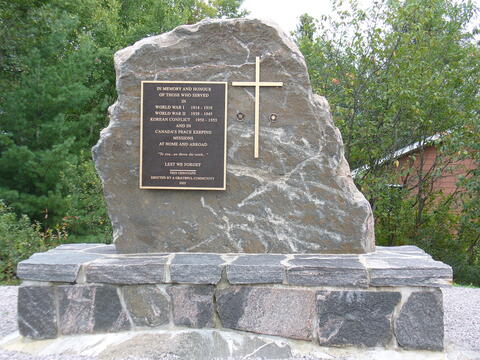
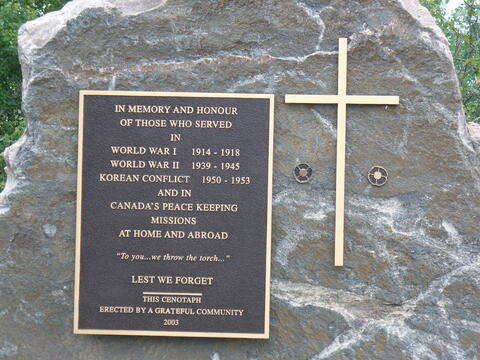
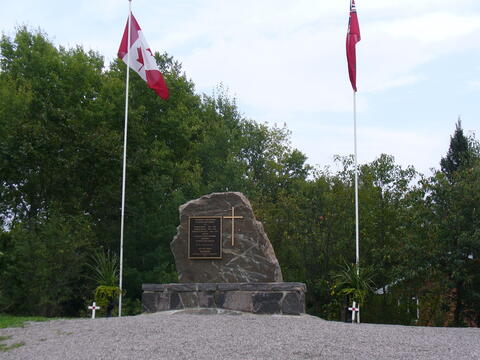
This cenotaph was erected in 2003 by the Magnetawan Legion, which has since amalgamated with the Dunchurch Branch #394. The cenotaph and park are dedicated to the local war fallen.
MACTIER
UNION
CEMETERY
JULY 1947
IN MEMORY OF
THE MEN OF
FREEMAN TOWNSHIP
WHO GAVE THEIR LIVES
IN THE
SECOND WORLD WAR
1939 - 1945
GREATER LOVE HATH NO MAN
THAN THIS, THAT A MAN
LAY DOWN HIS LIFE
FOR HIS FRIENDS
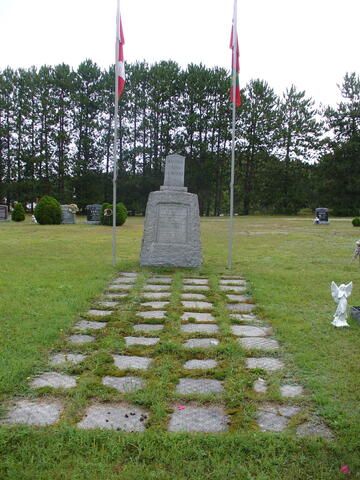
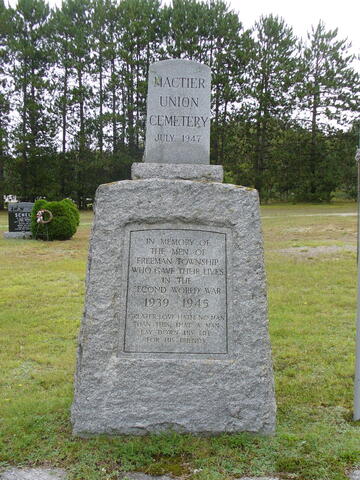
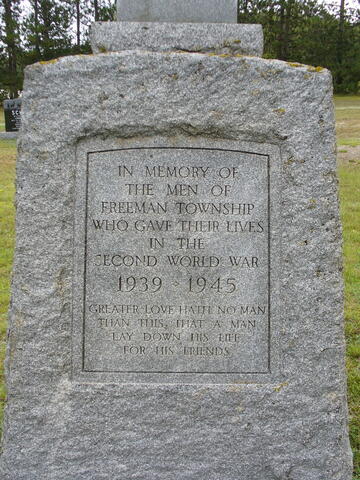
This granite memorial was dedicated in 1947 by the Port Loring Legion Branch #415. It is dedicated to the local war fallen.
IN MEMORY OF THE MEN OF
PORT LORING & VICINITY
WHO GAVE THEIR LIVES IN THE
TWO WORLD WARS
1914 — 1918
EDGAR COOK
W.S. KETTYLE
FRED SIMMS
FRANK STEVENS
1939 — 1945
ARTHUR BUCHANAN
DAN GOOLEY
HECTOR LAMONT
ARNOLD PARK
AUBREY SHAPTER
BERNARD TRUE
R.G. BROOKS DIED ON ACTIVE SERVICE
GREATER LOVE HATH NO MAN
KOREA
1950 - 1953
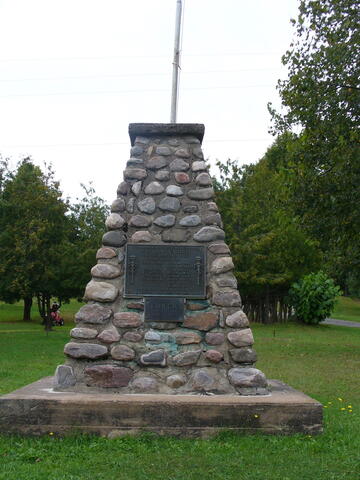
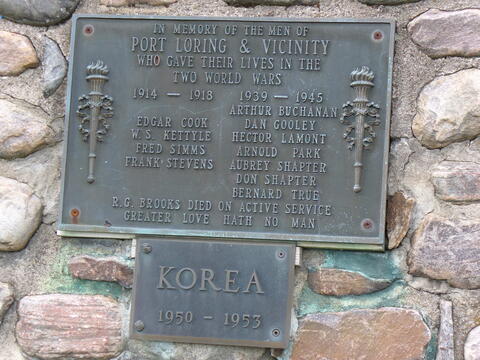
The Port Loring Legion Branch 415 unveiled the memorial in 1918 for the First World War, in 1949 for the Second World War, and in 1953 for the Korean War. The memorial is a fieldstone cairn, dedicated to the local war dead.
[front/devant]
THEIR NAMES SHALL-
PTE. ORIN E. WHITE
NO. 657421 . 162nd BATT
KILLED IN ACTION AT
AMIENS AUG 9th 1918
IN HIS 24th YEAR
PTE. NELSON J. THAW
NO. 657212 162nd BATT
KILLED IN ACTION AT
FRESNOY MAY 3rd 1918
IN HIS 21st YEAR
[right side/côté gauche]
LIVE FOR EVER MORE
PTE. T. GOOCH
NO. 409716 13th BATT
DIED MAY 21st 1916
KOREA
1950 - 1953
ERECTED BY THE
WOMENS INSTITUTE
AND GIRLS CLUB
[left side/côté gauche]
IN MEMORY OF
OUR BOYS
WHO GAVE THEIR LIVES
FOR HONOUR & FREEDOM
1939 - 1945
PTE. JOHN E. BIRD
L. CPL. CHARLES E. BUFFY
PTE. SAMUEL J. McQUILLAN
TPR. JOHN A. ROWLEY
SGT. HARVEY C. TODD
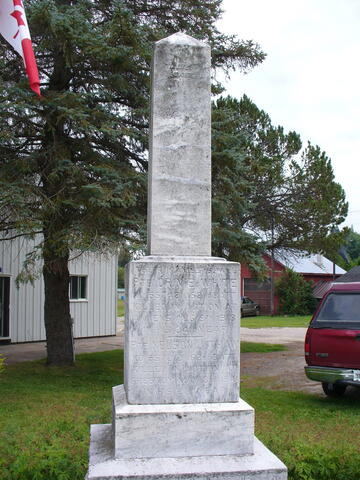
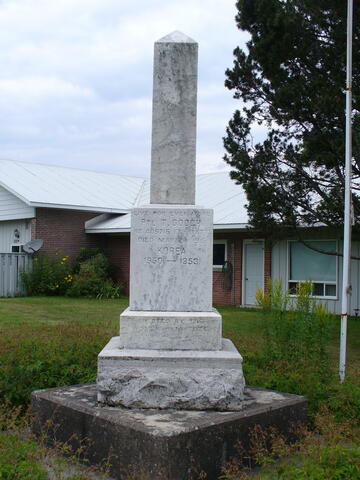
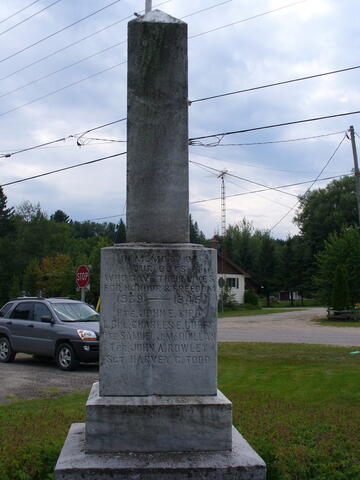
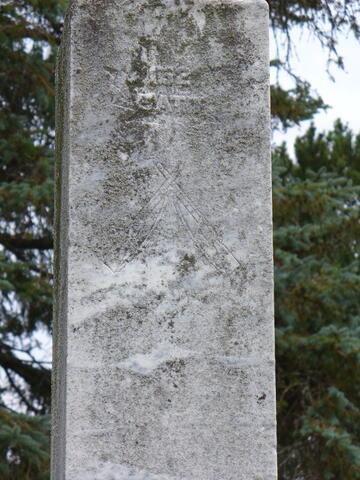
This memorial was erected by the Womens Institute and Girls Club to Soldiers Killed in War in the major conflicts of the 1900s.
[plaque]
IN MEMORY OF
LT. DONALD WELLMAN
408 HELICOPTER SQN
CFB EDMONTON, ALTA.
10 - OCT - 1991
[cross/croix]
10
10
91
Lt
WELLMAN
408
SQN
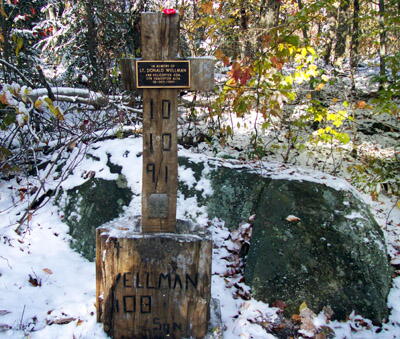
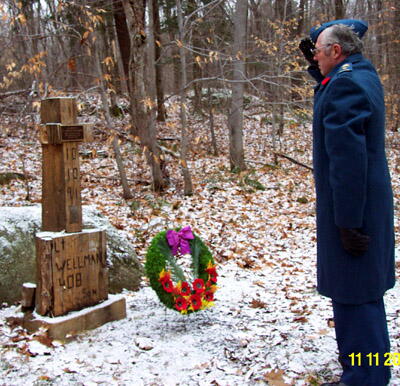
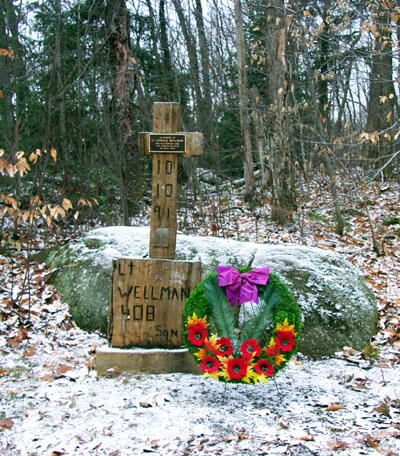
This memorial was dedicated at the helicopter crash site where Lieutenant Donald Wellman was killed. On October 10, 1991, a 408 "Goose" Tactical Helicopter Squadron, CH-135 Twin Huey (tail number 115) from Canadian Forces Base (CFB) Namao (Edmonton), crashed 10 miles west of Burk's Falls. Although there were two survivors, both of whom were thrown clear of the crash, Lieutenant Wellman did not survive.
The Ground Search and Rescue (GSAR) Team from CFB North Bay was immediately deployed to secure the scene and help with the clean up. The cross was made from the tree the helicopter crashed into and erected in 1991 by the former 22 Wing Ground Search and Rescue Team. Mr. Bill Baker, who owned the land at the time, permitted the GSAR Team to erect the memorial.
A plaque was added to the memorial by the GSAR Team in 2005. At an unknown later date, the wooden cross was brought to Canadian Forces Base North Bay for refurbishment, but was too far deteriorated so the plaque was mounted on granite. The Canadian Forces Museum of Aerospace Defence received this piece in 2015 and it is currently in storage.
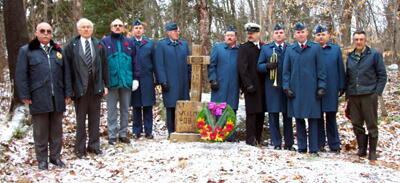
Until 1997, members of the GSAR Team did ground maintenance of the crash site. Since the GSAR Team's disbandment in 1997, volunteers (former GSAR members) and Mr. Bill Baker have kept the crash site clean. On Remembrance Day, General (Ret'd) Paul Argue, former C.O. of 408 "Goose" Tactical helicopter squadron, former GSAR members and 22 Wing personnel have been paying their respects to Lieutenant Wellman.
A memorial commemorating Lieutenant Wellman was erected at the Royal Canadian Legion, Branch 405.