Ontario

Province Code
ON
City/Municipality
Ottawa
Memorial Number
35059-238
Type
Address
355 Cooper Street
Location
Dominion-Chalmers United Church
in Canada
Yes
GPS Coordinates
45.4170283, -75.6950717
Inscription

[plaque/plaque]

In loving memory of Alexis Hannum Helmer
Lieut 2nd Battery 1st Field Artillery Brigade
Canadian Expeditionary Force
Fell in action near Yprs May 2nd 1915
Aged 22 years

“Be God’s gentleman and the King’s gentleman”

Image
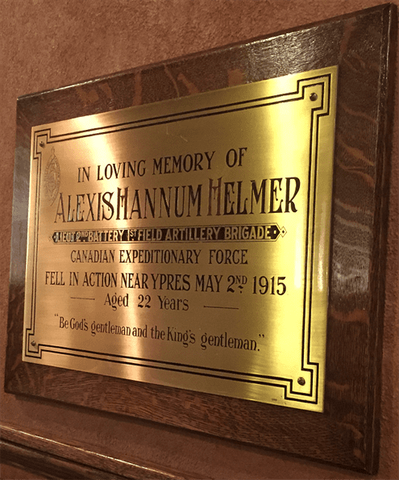
Photo Credit
Victoria Edwards
Caption
plaque
War or Conflict Term
Province
!4v1625851556645!6m8!1m7!1sHQSIRRSUu1SeOHLs0Ph0rg!2m2!1d45.41702834382596!2d-75.69507165545224!3f240.8291958461898!4f14.300342300852122!5f0.7820865974627469
Body Content

This brass plaque at Dominion-Chalmers United Church is dedicated to the memory of Alexis Hannum Helmer, whose death was the inspiration for John McCrae’s poem, “In Flanders Fields”. It was erected by the parishioners of Dominion Methodist Church (now Dominion-Chalmers United Church), sometime after the First World War.

City
Ottawa
Country
Type Description
Plaque; brass
Memorial CF Legacy ID
9189
City/Municipality
Ottawa
Memorial Number
35059-237
Type
Address
101 Colonel By Drive
Location
National Defence Headquarters, Major-General George R. Pearkes Building
in Canada
Yes
GPS Coordinates
45.4227886, -75.6886639
Inscription

[plaque/plaque]

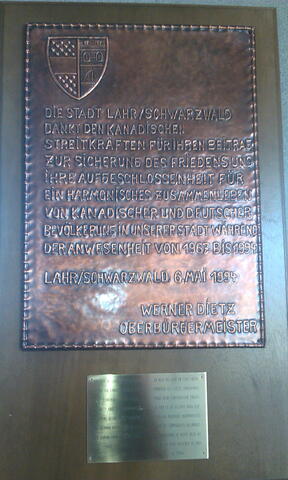
DIE STADT LAHR/SCHWARZWALD
DANKT DEN KANADISCHEN
STREITKRAFTEN FURIHREN BEITRAG
ZUR SICHERUNG DES FRIEDENSUND
IHRE AUFGESCHLOSSENHEIT FUR
EIN HARMONISCHES ZUSAMMENLEBEN
VON KANADISCHER UND DEUTSCHER
BEVOLKERUNG IN UNSERER STADT WAHREND
DERANWESENHEIT VON 1967 BIS 1994

LAHR/SCHWARZWALD 6 MAI 1994

[plaque/plaque]

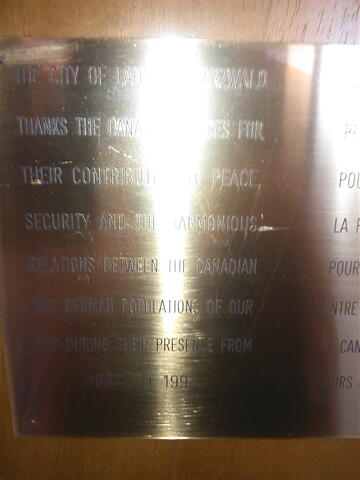
THE CITY OF LAHR/SCHWARZENWALD
THANKS THE CANADIAN FORCES FOR
THEIR CONTRIBUTION TO PEACE,
SECURITY AND HARMONIOUS
RELATIONS BETWEEN THE CANADIAN
AND GERMAN POPULATIONS OF OUR
CITY DURING THEIR PRESENCE FROM
1967 TO 1994

Image
Photo Credit
Victoria Edwards
Caption
plaque
1 of 2 images
Image
Photo Credit
Victoria Edwards
Caption
English inscription
1 of 2 images
War or Conflict Term
Province
!4v1625851248734!6m8!1m7!1s0jIECyH_iXQFxVyG--HC4Q!2m2!1d45.42278857334564!2d-75.68866389419555!3f334.52757402772766!4f3.1106973058719234!5f1.4342800702043683
Body Content

This bronze plaque was erected by Werner Dietz, the Mayor of Lahr, Germany, on May 6, 1994. It is dedicated to the Canadian Forces for the contribution to Peace, Security, and harmonious relations between Canadian and German populations of Lahr/Schwarzenwald during their presence from 1967 to 1994.

The plaque is located in the main concourse of the Pearkes Building. It is engraved in German and features the Lahr’s coat of arms. There is an additional plaque providing translation in English and French.

City
Ottawa
Country
Type Description
Plaque; brass
Memorial CF Legacy ID
9193
City/Municipality
Ottawa
Memorial Number
35059-236
Type
Location
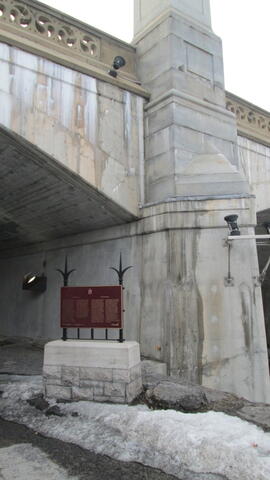
Along footpath bordering the Rideau Canal, under the Plaza Bridge
in Canada
Yes
GPS Coordinates
45.424192, -75.6941138
Inscription

[plaque/plaque]

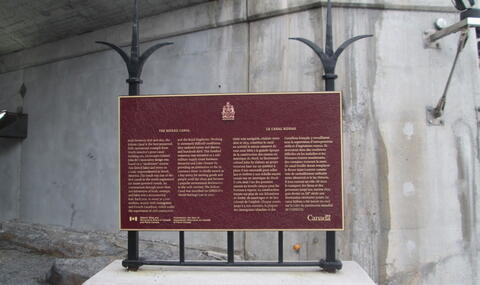
The Rideau Canal

Built between 1826 and 1832, the Rideau Canal is the best preserved, fully operational example from North America’s great canal-building era. Lieutenant-Colonel John By’s innovative design was based on a “slackwater” system that linked lakes and rivers on a scale unprecedented in North America. The result was one of the first canals in the world engineered for steam-powered vessels. It’s construction through more than 200 kilometres of bush, swamps, and lakes was a monumental feat. Each year, as many as 5000 workers, mainly Irish immigrants and French Canadians, toiled under the supervision of civil contractors and the Royal Engineers. Working in extremely difficult conditions, they endured injury and disease, and hundreds died. This fortified waterway was intended as a safe military supply route between Montréal and Lake Ontario by providing an alternative to the St. Lawrence River. It chiefly served as a key artery for moving goods and people until the 1830’s and became a popular recreational destination in the 20th century. The Rideau Canal was inscribed on UNESCO’s World Heritage List in 2007.

Le Canal Rideau

Cette voie navigable, réalisée entre 1826 et 1832, constitue le canal en activité le mieux conservé de tous ceux bâtis à la grande époque de la construction des canaux en Amérique du Nord. Le lieutenant-colonel John By élabora un projet novateur basé sur un système à plans d’eau successifs pour relier lacs et rivières à une échelle encore jamais vue en Amérique du Nord. Il créa ainsi l’un des premiers canaux au monde conçus pour les bateaux à vapeur. La construction menée sur plus de 200 kilomètres de forêts, de marécages et de lacs relevait de l’exploit. Chaque année, jusqu’à 5000 ouvriers, la plupart des immigrants irlandais et des Canadiens français, y travaillaient sous la supervision d’entrepreneurs civils et d’ingénieurs royaux. Ils œuvraient dans des conditions difficiles où les maladies et les blessures étaient nombreuses, des centaines trouvant la mort. Ce canal fortifié devait remplacer le fleuve Saint-Laurent comme voie de ravitaillement militaire entre Montréal et le lac Ontario. Il joua surtout un rôle clé dans le transport des biens et des personnes jusqu’aux années 1850, puis devint au XXe siècle une destination récréative prisée. Le canal Rideau a été inscrit en 2007 sur la Liste du patrimoine mondial de l’UNESCO.

Historic Sites and Monuments Board of Canada & Parks Canada

Commission des lieux et monuments historiques du Canada et Parcs Canada

Image
Photo Credit
Richard Turcotte
Caption
surroundings
1 of 2 images
Image
Photo Credit
Richard Turcotte
Caption
plaque
1 of 2 images
Province
!4v1625850906474!6m8!1m7!1sYAb0qo6cu_qNCPaaGZYhhQ!2m2!1d45.42419200303635!2d-75.69411379849721!3f300.6453435558188!4f6.7501934170164475!5f1.1775552910137623
Body Content

This metal plaque commemorates the construction of the Rideau Canal under the supervision of the Royal Engineers. The construction of the 200 km-long Rideau Canal (1826 – 1832) was a preventive military measure undertaken after a report that during the War of 1812 the United States had intended to invade Upper Canada via the St. Lawrence River.

The initial purpose of the Rideau Canal was military, as it was intended to provide a secure supply and communications route between Montreal and the British Naval Base in Kingston. Westward from Montreal, travel would proceed along the Ottawa River to Ottawa, then southwest via the canal to Kingston, and out into Lake Ontario. The objective was to bypass the stretch of the St. Lawrence bordering New York; a route which would have left supply ships vulnerable to an attack or a blockade of the St. Lawrence. The plaque was erected by Historic Sites and Monuments Board of Canada & Parks Canada in 2014.

City
Ottawa
Country
Type Description
Plaque
Memorial CF Legacy ID
9206
City/Municipality
Ottawa
Memorial Number
35059-235
Type
Address
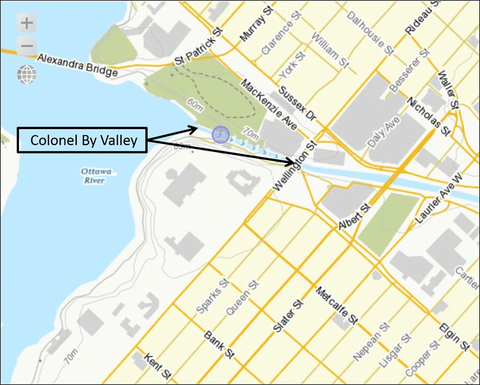
Colonel By Valley
Location
Between Parliament Hill and Major's Hill Park/Chateau Laurier
in Canada
Yes
GPS Coordinates
45.4263614, -75.6984487
Inscription

[on maps/sur les cartes]

Colonel By Valley

Image
Photo Credit
Richard Turcotte
Caption
map
1 of 3 images
Image
Photo Credit
Richard Turcotte
Caption
locks of the Rideau Canal
1 of 3 images
Image
Photo Credit
Richard Turcotte
Caption
locks of the Rideau Canal
1 of 3 images
Province
!4v1625777591881!6m8!1m7!1s9x4l5AKC3mJJ0BNPeO_loA!2m2!1d45.42636139249105!2d-75.69844866810558!3f116.35259883959084!4f10.003252888989493!5f0.7820865974627469
Body Content

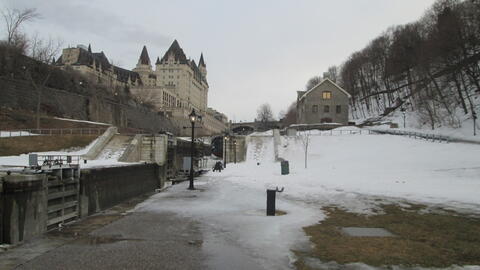
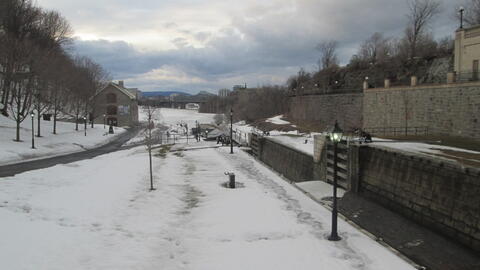
Colonel By Valley, also known as Entrance Valley, is named in honour of Lieutenant-Colonel John By, Royal Engineers and is located at the first eight locks of the Rideau Canal. The valley was named on August 18, 1976 by the Government of Ontario.

John By was born in Lambeth (London) England in 1779 and graduated from the Royal Military Academy, Woolwich in 1799. He joined the Royal Engineers on December 20 of the same year and in 1802 was posted to Canada for the first time, where he worked on the fortification of Quebec City and on the construction of a canal at Iles aux Cascades. During the Napoleonic wars he returned to Europe, where he served in Spain under the Duke of Wellington from 1811 until 1815. In 1826, he returned to Canada to supervise the construction of the Rideau Canal. His first task was the construction of a town to house the men who were to work on the canal. The resulting settlement, called Bytown, would later be named Ottawa. The 200 km canal was completed in 6 years, and was acclaimed as an engineering triumph. However, Colonel By was recalled to London to face accusations that he had made a number of unauthorized expenditures. The charges were spurious and a parliamentary committee exonerated him. He died in 1836 and is buried in the village of Frant in East Sussex, southeast of England.

City
Ottawa
Country
Type Description
Geographical feature
Memorial CF Legacy ID
9207
City/Municipality
Ottawa
Memorial Number
35059-234
Type
Address
212 Glebe Avenue
Location
Glebe Collegiate Institute entrance
in Canada
Yes
GPS Coordinates
45.402102, -75.6970027
Inscription

Plaque #1

Glebe Collegiate Institute

Forever Honoured

Forever Mourned

1939 - 1945

Adams, Peter

Bradley, Royden G.

Connor, Donald D.

Dunlop, T. Edwin

Graves, William D.

Aitkenhead, Lloyd D.

Bradshaw, Richard A.

Coughlin, Clifton

Eagleson, James L.

Halcro, Frank

Allen, Fred C.

Breadner, Donald L.

Courtright, Homer C.

Earls, J. John

Hale, A. Cecil

Andersen, James B.

Buchanan, J. Donald

Courtright, Joseph W.

Eastman, Donald M.

Hall, Clement W.

Anderson, Peter

Bussell, A. Arthur

Cowan, Weldon E.

Eddy, Dudley I.

Harrington, William H.

Arneil, Douglas J.

Butterworth, Robert S.

Cowley, Robert H.

Engler, Joseph L.

Higgins, Arnold

Ault, Arthur W.

Byshe, Arthur G.

Crockatt, David

Ernst, William B.

Hogg, James E.

Baldwin, William H.

Caldwell, Carl E.

Cummings, Ellard A.

Fisher, Harold C.

Holland, John J.

Bennett, Thomas L.

Cameron, Earl W.

Cummings, Kenneth G.

Foster, William M.

Howe, T. Edward G.

Berry, Douglas E.

Cameron, Robert L.

Dadson, Donald

Foy, Dennis

Hunter, Archibald

Blake, Richard B.

Cantrill, Charles T.

Darling, Gordon J.

Fresque, Leonard N.

Hunter, Calvert H.

Blakeney, Lester F.

Carmichael, John W.

Darling, Sidney

Gabie, Earle

Hutt, Donald

Bonell, W. Stewart

Charron, Arthur E.

Darragh, Francis W.

Gardiner, J. Edwin

Hydes, Harry G.F.

Boomer, Kenneth A.

Cheetham, Gerald H.

Dean, T. Malcolm

Garland, Stewart F.

Ide, Douglas G.

Booth, G. Arnold

Clarke, Robert W.

Detlor, Perry

Garrett, Eric T.

Irwin, David L.

Bosloy, Philip

Code, Peter B.

Dewar, Eric C.

Gilchrist, Donald R.

Jamieson, John

Botten, Eric D.R.

Cole, Saxon M.

Donald, Douglas W.

Goodwin, George J.

Jeffrey, George W.

Boucher, T. Gerald

Collingwood, J. Vincent

Dowd, Elbert W.

Goold, George G.

Johnson, A. John

Bourdon, Gregory R.

Collis, S. Reginald

Dunlevie, Sidney


Kennedy, Donald S.

Boyle, John G.


Kennedy, Wilfred G.

Bradley, John L.R.


Kerr, C. William

Bradley, Robert J.


Plaque #2

Glebe Collegiate Institute

Forever Honoured

Forever Mourned

1939 - 1945

Kimmins, Gordon P.

McFarlane, Alexander I.

Murphy, William J.

Price, David M.

Stackhouse, Donald

Kingsland, Edwin H.

McKenna, Donald

Naylor, Firle E.

Prosperine, J. Frank

Steeves, Warwick E.W.

Labarge, Leo S.

McLachlin, William M.

Nettleton, T. Gordon

Prosser, Robert H.

Sterling, Donald J.

Lalonde, Gaston M.

McLean, G. Daryll

Niblock, Z. Manford

Quinlan, Francis

Stewart, Douglas H.

Lidington, Gerald

McMahon, M.J. Vincent

O’Leary, Owen A.

Ralph, Howard, P.

Stewart, Fern

Little, W. Robert

McMillan, David J.

Olmsted, Charles R.

Read, Montague F.B.

Stewart, Richard N.

Livingston, John A.

McWilliam, Frederick

Orme, Frank K.

Reynolds, G. Gilbert

Tabor, Jack F.E.

Lochnan, Peter W.

Maundrell, C. Richard

Owens, J. Summer

Rheaume, S. Earl

Taylor, William M.

Macdonald, Ashley K.

Maynard, John R.

Palmer, Lionel M.

Richard, Robert L.

Thom, William C.

MacDonald, Colin S.

Millar, James R.

Patterson, John R.

Richardson, Denis J.

Townsend, John

MacDonald, John A.

Miller, John D.

Pattison, John D.

Robertson, David B.

Turner, Allan B.

MacDonald, Neil R.F.

Minard A. Murray

Pavely, William G.

Robinson, Eldred

Watterson, Irwin A.

MacIntyre, John S.

Moffit, Frank

Pearson, Jack A.

Rogers, Franklin A.

Wetmore, Linley D.

MacLean, A. Kenneth

Monck, Russell M.

Phillips, S. Alexander

Rombough, John N.

Whyte, Robert L.

MacLean, G. Murray

Moodie, M. Donald

Player, James K.

Scollon, Clyde

Wilkins, H. Archibald

MacNeil, John

Morehouse, Winston H.

Pollock, Bruce

Shearn, Donald F.

Wilkinson, Arthur C.

MacNeill, Norman A.

Morrison, V. Merrill

Post, Willard I.

Slack, Warren O.

Willett, Donald A.

McCallum, Robert J.

Morrison, William R.

Powell, David H.

Smith, Donald

Williams, Thomas R.

McCann, Eric W.

Murchison, R. Bruce

Powis, Ralph E.

Smith, Stuart E.

Windeler, William J.

McCann, Leonard M.


Wright, Bernard

McCrum, J. Frederick


Wright, Keith F.


Wyse, George B.

Image
Photo Credit
Richard Turcotte
Caption
plaque 1
1 of 2 images
Image
Photo Credit
Richard Turcotte
Caption
plaque 2
1 of 2 images
War or Conflict Term
Province
!4v1625777288726!6m8!1m7!1sUUYNGIFfMQQ_Lj_AGmx6YA!2m2!1d45.40210201564454!2d-75.69700273483107!3f134.74063335032332!4f8.194550733323296!5f1.0719888258123628
Body Content

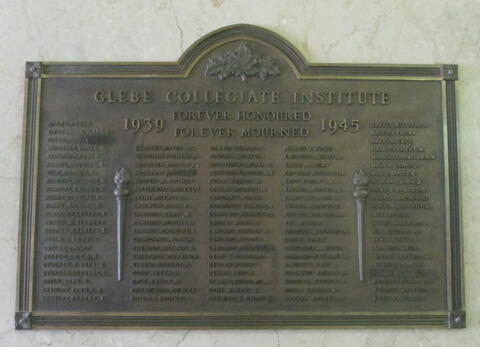
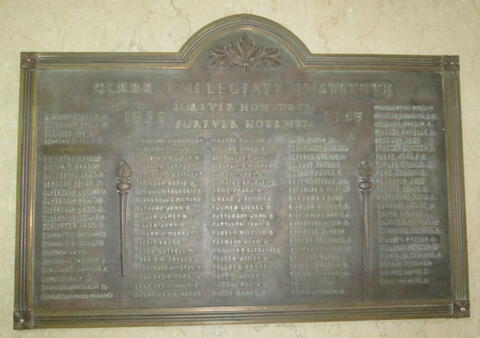
This memorial, erected by the Glebe Collegiate Institute, consists of two bronze plaques and is dedicated to former members of Glebe Collegiate Institute who lost their lives in the Second World War.

City
Ottawa
Country
Type Description
Plaques; bronze
Memorial CF Legacy ID
8557
City/Municipality
Ottawa
Memorial Number
35059-233
Type
Address
391 Richmond Road
Location
Royal Canadian Legion Branch 480
in Canada
Yes
GPS Coordinates
45.3910321, -75.7561083
Inscription

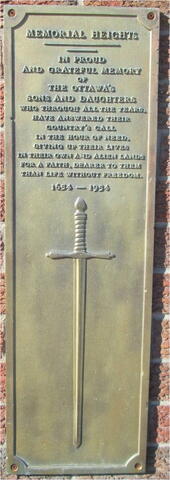
MEMORIAL HEIGHTS

IN PROUD
AND GRATEFUL MEMORY
OF
THE OTTAWA'S
SONS AND DAUGHTERS
WHO THROUGH ALL THE YEARS,
HAVE ANSWERED THEIR
COUNTRY'S CALL
IN THE HOUR OF NEED,
GIVING UP THEIR LIVES
IN THEIR OWN AND ALIEN LANDS
FOR A FAITH DEARER TO THEM
THAN LIFE WITHOUT FREEDOM
1654 — 1954

Image
Photo Credit
Richard Turcotte
Caption
Memorial Heights Plaque
1 of 4 images
Image
Photo Credit
Richard Turcotte
Caption
surroundings
1 of 4 images
Image
Caption
Sundial at Carlington Reservoir.
1 of 4 images
Image
Photo Credit
Royal Canadian Legion Branch 480
Caption
Memorial on the north-west side of the Richmond Road-Roosevelt Avenue intersection.
1 of 4 images
Province
!4v1723828181500!6m8!1m7!1s2eqYibK2l9CDbSeKnG8njw!2m2!1d45.39108023626154!2d-75.75607000026432!3f314.6452674569972!4f-3.750568215740927!5f3.325193203789971
Body Content

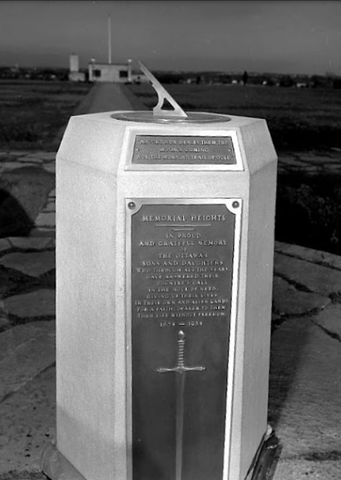
In 1950, a year after the Carlington Reservoir officially opened, a sundial was placed on a circle of flagstones in the center of the reservoir and two bronze plaques were attached to the hexagonal base. The City had intended to create a park with symmetrical pathways on top of the reservoir. The renaming of Carlington Heights as Memorial Heights in tribute to Second World War Veterans never stuck.

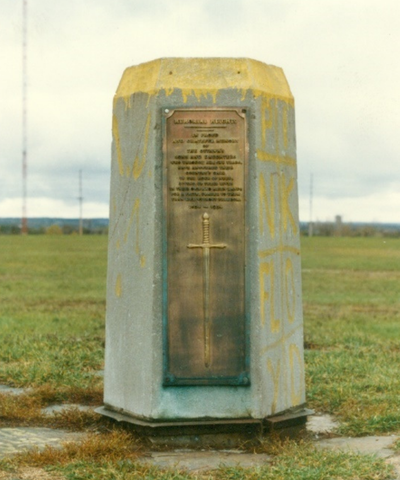
At some point, the memorial was moved to the north-west side of the Richmond Road-Roosevelt Avenue intersection. Its remains were found in 1952 in a city owned yard. The city rebuilt the monument at Carlington Heights with the remnants of the old memorial and replaced the commemorative plaque which had disappeared.

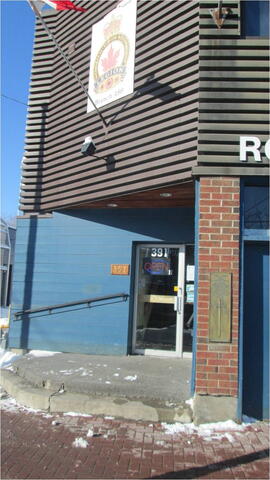
By 1984, vandalism took its toll on the memorial, so Charley Timms and a dozen other members of the Royal Canadian Legion Branch 480 looked into relocating the memorial. Regional Council gave permission for the vandalized monument on Carlington Heights to be dismantled and the plaque was moved to the Branch 480 building.

City
Ottawa
Country
Type Description
Plaque - metal
Memorial CF Legacy ID
8556
City/Municipality
Ottawa
Memorial Number
35059-232
Type
Address
149 Somerset Street West
Location
Army Officers' Mess
in Canada
Yes
GPS Coordinates
45.4181645, -75.6896163
Inscription

[front/devant]

Blowpipe Figure
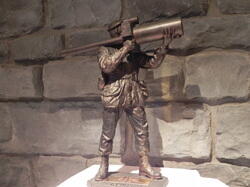
This model features a gunner with the Blowpipe, a man-portable surface-to-air missile (MANPADS) which was in use with 129th Air Defence Battery, Royal Canadian Artillery in the 1980s. This model was presented to Artillery Section by LCol NH Connolly, Maj HP Mundell, Maj MD Capstick and CWO (Mr Gnr) CM Bowden in July 1985. 

Image
Photo Credit
Victoria Edwards
Caption
statuette
War or Conflict Term
Province
!4v1625772069192!6m8!1m7!1s-YL-Om1eGjAgmoAuVmAMLw!2m2!1d45.41816446320544!2d-75.68961627091671!3f344.5817928686985!4f9.0518451077578!5f0.7820865974627469
Body Content

This statuette was sculpted by Colonel (Retired) André D. Gauthier OMM, CD. It was presented to the Artillery Section by LCol NH Connolly, Maj HP Mundell, Maj MD Capstick and CWO (Mr Gnr) CM Bowden in July 1985.

It is stored on the 2nd floor of the Army Officers Mess in Ottawa. The statuette is dedicated to the Ottawa Gunners.

City
Ottawa
Country
Type Description
Statuette; wood and steel
Memorial CF Legacy ID
8589
City/Municipality
Ottawa
Memorial Number
35059-231
Type
Address
149 Somerset Street West
Location
Army Officers' Mess
in Canada
Yes
GPS Coordinates
45.4181645, -75.6896163
Inscription

[front/devant]

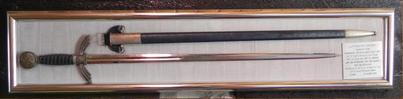
The Luftwaffe Sword was "Liberated" from Wangerooge, Frisian Island in May 1945 by "B" Flight, 664 R.C.A.F. Air O.P. Squadron Capt G.E. Nixon (KIA), Capt R.L. Morton, Capt J.M. Sutherland, Capt W.B. Hagarty and Capt G.M. Henderson. Presented to the Royal Regiment at the Air O.P. Pilots Reunion Dinner, Ottawa, 19 October 1991.

Image
Photo Credit
Victoria Edwards
Caption
Luftwaffe Sword
1 of 2 images
Image
Photo Credit
Victoria Edwards
Caption
surroundings
1 of 2 images
War or Conflict Term
Province
!4v1625772069192!6m8!1m7!1s-YL-Om1eGjAgmoAuVmAMLw!2m2!1d45.41816446320544!2d-75.68961627091671!3f344.5817928686985!4f9.0518451077578!5f0.7820865974627469
Body Content

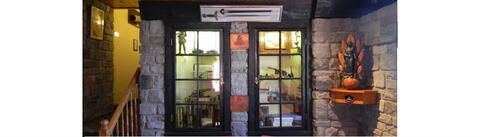
The Luftwaffe Sword and hilt is contained in a glass case located in Observation Post de Hart (Op de Hart) on the 2nd floor of the Officers Mess in Ottawa. The sword and case were presented to the Royal Regiment of Canadian Artillery at the Air O.P. Pilots Reunion Dinner in Ottawa on October 19, 1991.

The Luftwaffe Sword was "Liberated" from Wangerooge, Frisian Island in May 1945 by "B" Flight, 664 RCAF Air OP Squadron, Capt G.E. Nixon (KIA), Capt R.L. Morton, Capt J.M. Sutherland, Capt W.B. Hagarty and Capt G.M. Henderson. It is dedicated to the honour of the Officers and Men of the Royal Regiment of Canadian Artillery who served during the Second World War.

City
Ottawa
Country
Type Description
Sword; wood, steel and glass
Memorial CF Legacy ID
8588
City/Municipality
Ottawa
Memorial Number
35059-230
Type
Address
149 Somerset Street West
Location
Army Officers' Mess
in Canada
Yes
GPS Coordinates
45.4181645, -75.6896163
Image
Photo Credit
Victoria Edwards
Caption
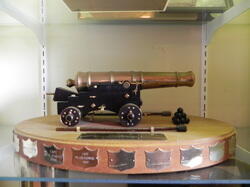
Royal Military College Gunnery Trophy
1 of 2 images
Image
Photo Credit
Victoria Edwards
Caption
Royal Military College Gunnery Trophy
1 of 2 images
War or Conflict Term
Province
!4v1625772069192!6m8!1m7!1s-YL-Om1eGjAgmoAuVmAMLw!2m2!1d45.41816446320544!2d-75.68961627091671!3f344.5817928686985!4f9.0518451077578!5f0.7820865974627469
Body Content

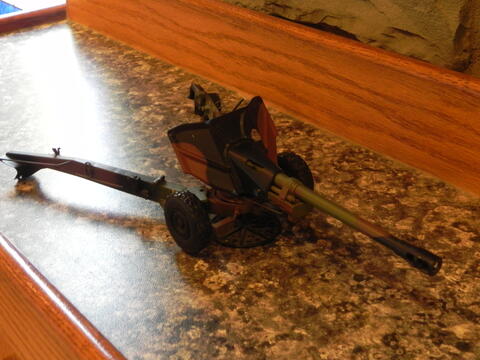
The Royal Military College Gunnery Trophy was unveiled in 1979. Brigadier General W. W. Turner, CD, RMC 2816, Colonel Commandant The Royal Regiment of Canadian Artillery, 1 September 1979 - 31 August 1986, provided this trophy for the Ottawa Gunners to present to the best third year Artillery Cadet at the Royal Military College of Canada in Kingston.

It is stored in the Observation Post de Hart (Op de Hart), on the 2nd floor of the Army Officers Mess in Ottawa. The statuette (which depicts a cannon) is engraved with the names of the award winners.

The Royal Military College Gunnery Trophy is currently at the Royal Canadian Artillery Museum as part of the W.W. Turner, former Commandants display. 

City
Ottawa
Country
Type Description
Statuette; wood and steel
Photo Credit
Victoria Edwards
Memorial CF Legacy ID
8587
City/Municipality
Ottawa
Memorial Number
35059-229
Type
Address
149 Somerset Street West
Location
Army Officers' Mess
in Canada
Yes
GPS Coordinates
45.4181645, -75.6896163
Inscription

[front/devant]

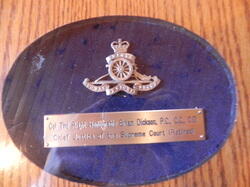
  • Presented to the Ottawa Gunners by the Gunners of the Supreme Court of Canada October 1986 Ubique
  • Colonel the Right Honourable Brian Dickson P.C. C.C. C.D. Chief Justice of the Supreme Court (Retired)
  • Lieutenant Colonel The Right Honourable Antonio Lamer P.C. C.D. Chief Justice of the Supreme Court
  • The Honourable Mr. Justice Julien Chouinard Justice of the Supreme Court (Retired)
  • The Honourable Mr. Justice W.R. McIntyre Justice of the Supreme Court (Retired)
  • The Honourable Mr. Justice Gerald E. LeDrain Justice of the Supreme Court (Retired) 
Image
Photo Credit
Victoria Edwards
Caption
surroundings
1 of 3 images
Image
Photo Credit
Victoria Edwards
Caption
plaque
1 of 3 images
Image
Photo Credit
Victoria Edwards
Caption
justices table
1 of 3 images
War or Conflict Term
Province
!4v1625772069192!6m8!1m7!1s-YL-Om1eGjAgmoAuVmAMLw!2m2!1d45.41816446320544!2d-75.68961627091671!3f344.5817928686985!4f9.0518451077578!5f0.7820865974627469
Body Content

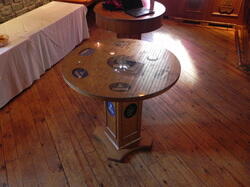
The Justices Table is a wooden table with 6 inset glass plaques and Royal Canadian Artillery pins, which is located in Observation post de Hart (Op de Hart), on the 2nd floor of the Army Officers Mess in Ottawa. It was presented to the Ottawa Gunners by the Gunners of the Supreme Court of Canada in October 1986, in honour of all Canadian Gunners.

City
Ottawa
Country
Type Description
Table; wood and glass
Memorial CF Legacy ID
8586