Ontario

Province Code
ON
City/Municipality
Ottawa
Memorial Number
35059-199
Type
Address
217 First Avenue
Location
St. Matthew’s Anglican Church
in Canada
Yes
GPS Coordinates
45.404073, -75.6899681
Inscription

[front/devant]

This organ is dedicated to the worship of God here on earth and in memory of the parishioners called to His worship in heaven in the Second World War also as a thank offering for the safe return of the others who served.

Image
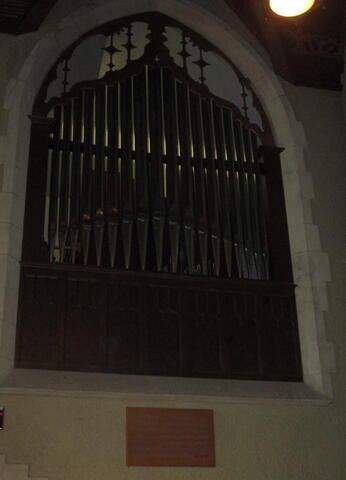
Photo Credit
Richard Turcotte
Caption
Church organ
1 of 2 images
Image
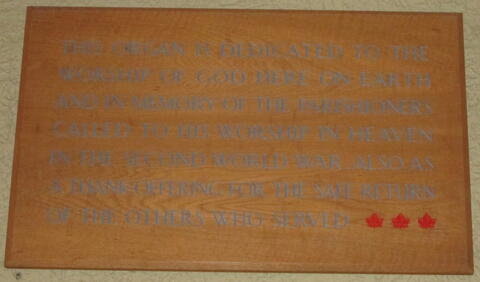
Photo Credit
Richard Turcotte
Caption
Plaque
1 of 2 images
War or Conflict Term
Province
!4v1625768273199!6m8!1m7!1sDbM4g2ifRv2WYMwWou1Oww!2m2!1d45.40407301058526!2d-75.68996807962263!3f337.73876744785064!4f5.271415658030719!5f0.7820865974627469
Body Content

The organ is dedicated to the memory of the parishioners who were killed in the Second World War and for the safe return of the others who served.

City
Ottawa
Country
Type Description
Pipe organ and dedication plaque
Photo Credit
Richard Turcotte
Memorial CF Legacy ID
8886
City/Municipality
Ottawa
Memorial Number
35059-198
Type
Address
217 First Avenue
Location
St. Matthew’s Anglican Church
in Canada
Yes
GPS Coordinates
45.404073, -75.6899681
Inscription

[top/haut]

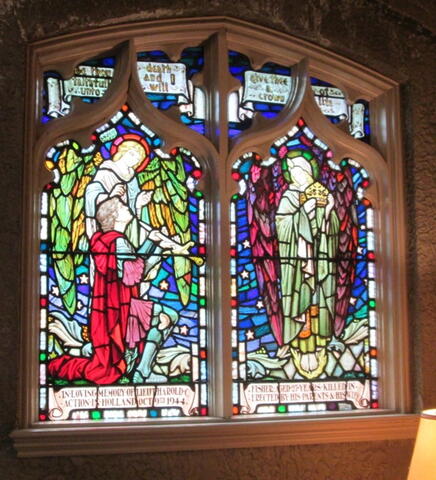
Be though faithful unto death and I will give thee a crown of life.

[bottom/bas]

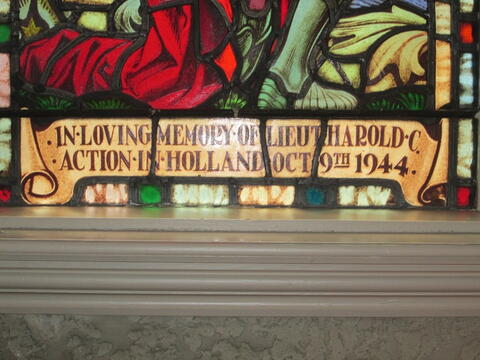
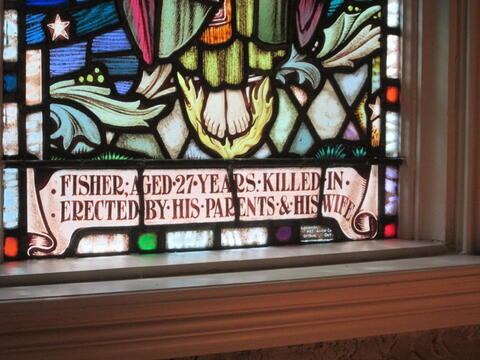
In loving memory of Lieut. Harold C. Fisher; aged 27 years. Killed in Action in Holland Oct 9th 1944. Erected by his parents & wife.

Image
Photo Credit
Richard Turcotte
Caption
stained glass window
1 of 3 images
Image
Photo Credit
Richard Turcotte
Caption
inscription
1 of 3 images
Image
1 of 3 images
War or Conflict Term
Province
!4v1625768273199!6m8!1m7!1sDbM4g2ifRv2WYMwWou1Oww!2m2!1d45.40407301058526!2d-75.68996807962263!3f337.73876744785064!4f5.271415658030719!5f0.7820865974627469
Body Content

This stained glass window is dedicated to the memory of Lieutenant Harold C. Fisher, a member of the church, who was killed on October 9, 1944 in Holland.

City
Ottawa
Country
Type Description
Stained glass window
Photo Credit
Richard Turcotte
Memorial CF Legacy ID
8885
City/Municipality
Ottawa
Memorial Number
35059-197
Type
Address
149 Somerset Street West
Location
Army Officers' Mess
in Canada
Yes
GPS Coordinates
45.4181645, -75.6896163
Inscription

[front/devant]

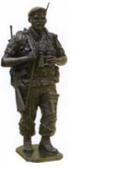
"PEACEKEEPER" 1990 ANDRE GAUTHIER

Image
Photo Credit
Victoria Edwards
Caption
sculpture
War or Conflict Term
Province
!4v1625767853327!6m8!1m7!1s-YL-Om1eGjAgmoAuVmAMLw!2m2!1d45.41816446320544!2d-75.68961627091671!3f341.1651469715216!4f8.92414272638706!5f0.7820865974627469
Body Content

The Peacekeeper sculpture depicts a typical Canadian Infantryman on United Nations (UN) duties. He is dressed with protective vest, UN beret and shoulder patch, with a portable radio on his back and C7 rifle slung. On his chest are a pair of binoculars, and two water bottles on his equipment belt indicates he is serving in a hot climate area. The model for this work was Master Corporal Landry, Company “D”, 2e Battalion, Royal 22nd Regiment. This sculpture was unveiled in 1990 and is dedicated to current and past Canadian Peacekeepers.

City
Ottawa
Country
Type Description
Sculpture; bronze
Photo Credit
Victoria Edwards
Memorial CF Legacy ID
9236
City/Municipality
Ottawa
Memorial Number
35059-196
Type
Address
149 Somerset Street West
Location
Army Officers' Mess
in Canada
Yes
GPS Coordinates
45.4181645, -75.6896163
Inscription

[front/devant]

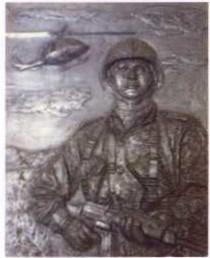
"MOBILE COMMAND" 1973 ANDRE GAUTHIER

Image
Photo Credit
Victoria Edwards
Caption
sculpture
Province
!4v1625767853327!6m8!1m7!1s-YL-Om1eGjAgmoAuVmAMLw!2m2!1d45.41816446320544!2d-75.68961627091671!3f341.1651469715216!4f8.92414272638706!5f0.7820865974627469
Body Content

The Mobile Command sculpture depicts a paratrooper of the Canadian Airborne Regiment in the foreground with the HUEY helicopter taking off in the background. Andre Gauthier gifted the copy of this sculpture in 1989, and it is dedicated to current and past members of the Canadian Airborne Regiment.

City
Ottawa
Country
Type Description
Sculpture; epoxy
Photo Credit
Victoria Edwards
Memorial CF Legacy ID
9275
City/Municipality
Ottawa
Memorial Number
35059-195
Type
Address
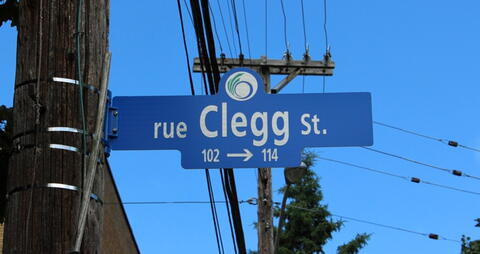
Clegg Street
in Canada
Yes
GPS Coordinates
45.406184, -75.6764825
Inscription

[front/devant]

rue Clegg St.

Image
Photo Credit
Richard Turcotte
Caption
street sign
Province
!4v1625767512509!6m8!1m7!1sKMDRVcwNfk0WDQXdJjD9cg!2m2!1d45.40618396388862!2d-75.67648246788941!3f340.30924349372657!4f2.5072809028222167!5f2.541634579092438
Body Content

Clegg Street is named in honour of William Clegg of the Royal Engineers. Born in Ireland, William T. Clegg (1796 – 1894) was a Clerk with the Royal Engineers during the construction of the Rideau Canal. Clegg arrived in Canada with the Royal Engineers and remained with them until 1845. He was also somewhat of an artist, and documented some of the work through his sketches. Clegg remained in Ottawa until his death in 1894.

City
Ottawa
Country
Type Description
Street; street sign
Photo Credit
Richard Turcotte
Memorial CF Legacy ID
9007
City/Municipality
Ottawa
Memorial Number
35059-193
Type
Address
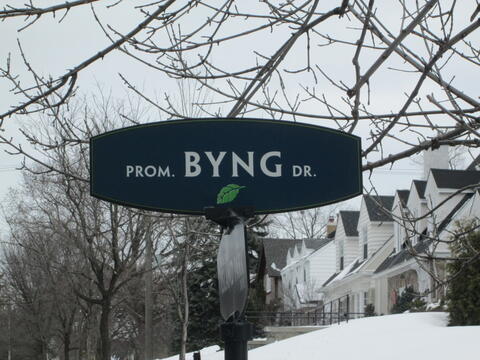
Byng Drive
in Canada
Yes
GPS Coordinates
45.3901693, -75.7333652
Inscription

[front/devant]

Prom. Byng Dr.

Image
Photo Credit
Richard Turcotte
Caption
street sign
Province
!4v1625767302827!6m8!1m7!1sD8N6LhtbjC6tHZ59AC7b8A!2m2!1d45.39016928474416!2d-75.73336524597953!3f222.20520828225824!4f-1.6155323051646348!5f1.5194927616505857
Body Content

Byng Drive is named in honour of Field Marshall Lord Julian Byng, 1st Viscount Byng of Vimy, GCB, GCMG, MVO, DCO, and Commander of the Canadian Corps during the Battle of Vimy Ridge.

Field Marshall Byng (Sept 1862 – June 1935) was born in England and upon graduation, was commissioned in the King’s Royal Rifle Corps in 1879, but transferred to the 10th Royal Hussars 4 years later. He served in India, Egypt and Sudan before attending the Staff College at Camberley in 1892 following which he became a squadron commander in his Regiment. In 1899, he deployed to South Africa and tasked with raising and commanding the South African Light Horse.

He returned to England in 1902, but was soon sent back to India to command the 10th Royal Hussars. Between 1904 and 1906, he commanded successively the Cavalry School, the 2nd and 1st Cavalry Brigades, before being promoted to Major General in 1909.

At the outbreak of the First World War, Byng was Commander of the 3rd Cavalry Division and saw action at Ypres in Oct-Nov 1914. In early 1915, Byng was sent to Gallipoli to command IX Corps in their withdrawal from the ill-fated campaign. By June 1916, he was in command of the Canadian Corps and, along with his subordinate officer, Major-General Arthur Currie, led the Canadians to victory in April 1917 at the Battle of Vimy Ridge. Shortly afterwards, Byng was appointed Commander of the 3rd Army until the cessation of hostilities. Following the First World War, he was appointed Governor General of Canada in 1921, a position he held until 1926.

City
Ottawa
Country
Type Description
Street; street sign
Photo Credit
Richard Turcotte
Memorial CF Legacy ID
9004
City/Municipality
Ottawa
Memorial Number
35059-192
Type
Address
Elgin Street and Laurier Avenue
Location
Confederation Park
in Canada
Yes
GPS Coordinates
45.4218011, -75.6923819
Inscription

[left plaque/plaque gauche]
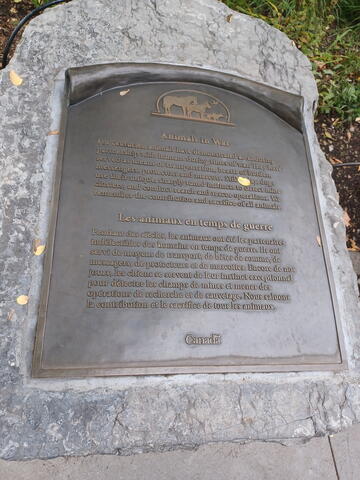
Animals in War

For centuries, animals have demonstrated an enduring partnership with humans during times of war. They have served as means of transportation, beasts of burden, messengers, protectors and mascots. Still today, dogs use their unique, sharply tuned instincts to detect mine clusters, and conduct search and rescue operations. We remember the contribution and sacrifice of all animals.

Les animaux en temps de guerre

Pendant des siècles, les animaux ont été les partenaires indéfectibles des humains en temps de guerre. Ils ont servi de moyens de transport, de bêtes de somme, de messagers, de protecteurs et de mascottes. Encore de nos jours, les chiens se servent de leur instinct exceptionnel pour détecter les champs de mines et mener des opérations de recherche et de sauvetage. Nous saluons la contribution et le sacrifice de tous les animaux.

[center plaque/plaque centre]
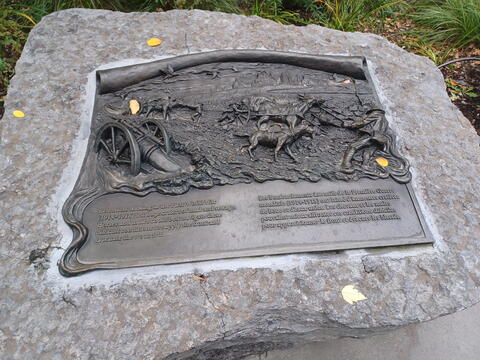
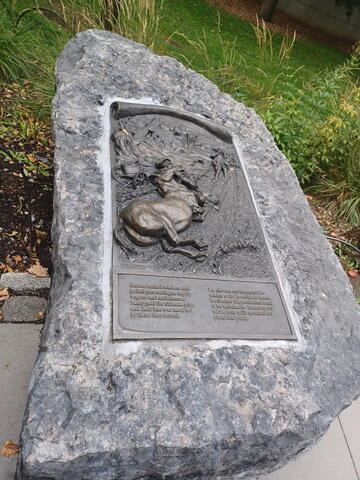
Relentless shelling in the First World War (1914 – 1918) left huge craters of mud and sewage. Horses and mules could best navigate these difficult conditions to supply the front and evacuate the wounded.

Les bombardements intensifs de la Première Guerre mondiale (1914 – 1918) ont laissé d’immenses cratères de boue at d’eaux usées. Les chevaux et les mules pouvaient mieux affronter ces conditions difficiles pour approvisionner le front et évacuer les blessés.

[right plaque/plaque droit]
Horse carried soldiers, and pulled gun carriages, supply wagons and ambulances. Many paid the ultimate price and their loss was mourned by those they served.

Les chevaux ont transporté les soldats, et tire les affûts de canon, les chariots d’approvisionnement et les ambulances. Beaucoup ont péri et ceux qu’ils servaient ont pleuré leur perte.

[stone plaque/plaque sur la pierre]

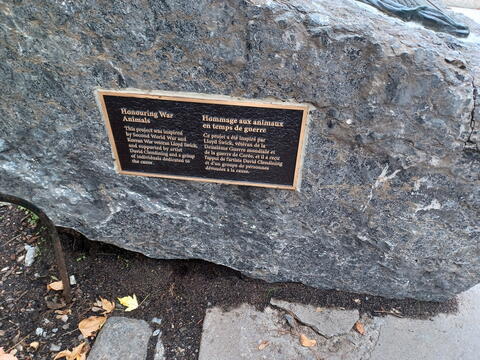
  • Honouring War
    Animals
  • This project was inspired
    by Second World War and
    Korean War veteran Lloyd Swick,
    and supported by artist
    David Glendining and a group
    of individuals dedicated to
    the cause.
  • Hommage aux animaux
    en temps de guerre
  • Ce projet a été inspiré par
    Lloyd Swick, vétéran de la
    Deuxième Guerre mondiale et
    de la guerre de Corée, et il a reçu
    l'appui de l'artiste David Glendining
    et d'un groupe de personnes
    dévouées à la cause.
Image
Caption
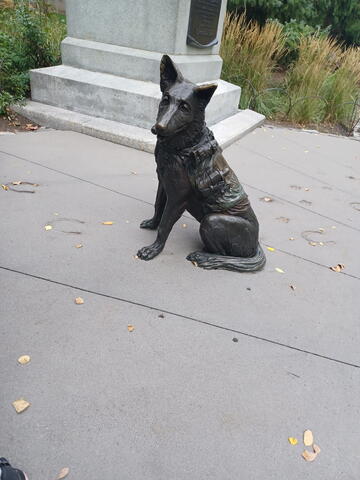
Bronze, life-sized statue of a medical service dog.
1 of 6 images
Image
Caption
center plaque
1 of 6 images
Image
Caption
right plaque
1 of 6 images
Image
Caption
left plaque
1 of 6 images
Image
Caption
Honouring war animals plaque
1 of 6 images
Image
Caption
Animals in War Dedication
1 of 6 images
Province
!4v1696505326448!6m8!1m7!1sCAoSLEFGMVFpcE1rSExEcnEzcHVkSV9fNmtuOEtFdWpSdXhvdGhUZ2lWcnhNRVc5!2m2!1d45.4218011!2d-75.6923819!3f354.019172379366!4f3.0947065513746423!5f3.325193203789971
Body Content

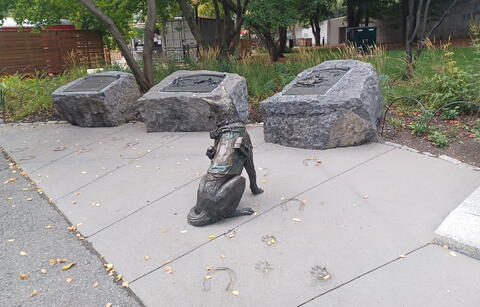
The Animals in War Dedication honours animals that served alongside their human comrades in war. It is symbolically set next to the South African War Memorial, a battle for which Canada supplied 50,000 horses for mounted troops. The footprints of dogs, horses and mules are stamped into the concrete of the Animals in War Dedication, representing the marks they left on the battlefield.

A bronze, life-sized statue of a medical service dog stands guard over the dedication. It is wearing an authentic replica of a medical backpack that war dogs used during the First World War. Canada’s military still employs dogs to this day. The Animals in War Dedication was created in 2012 by Canadian artist and sculptor David Clendining.

Three bronze plaques depict animals in war and provide interesting facts about their roles, their sacrifices, and their unwavering loyalty. Among the roles animals have played in war:

  • Mules: carried panniers and artillery.
  • Horses: carried mounted troops and hauled field guns.
  • Carrier pigeons: delivered messages to specific destinations.
  • Dogs: used as messengers, medical assistants, bomb detectors, and search and rescue workers.
City
Ottawa
Country
Type Description
Statue - bronze, plaques
Photo Credit
Veterans Affairs Canada
Memorial CF Legacy ID
9002
City/Municipality
Ottawa
Memorial Number
35059-191
Type
Address
111 Wellington Street
Location
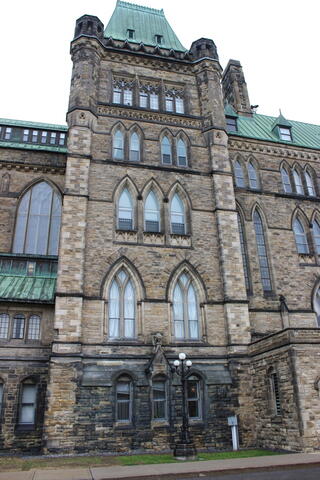
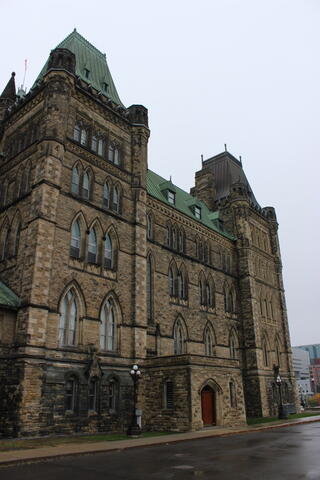
Parliament Hill, West side of Centre Block
in Canada
Yes
GPS Coordinates
45.4231448, -75.6986204
Inscription

[front/devant]

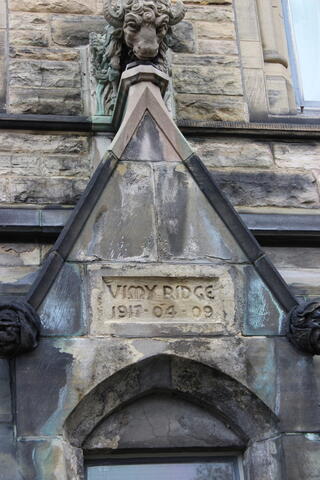
Vimy Ridge

1917 - 04 - 09

Image
Photo Credit
Richard Turcotte
Caption
inscription
1 of 3 images
Image
Photo Credit
Richard Turcotte
Caption
surroundings
1 of 3 images
Image
Photo Credit
Richard Turcotte
Caption
West Side of Centre Block
1 of 3 images
War or Conflict Term
Province
!4v1625766355600!6m8!1m7!1sG3Pg-fPk5oZj8jtwiULABQ!2m2!1d45.42314478263413!2d-75.69862043753562!3f310.82921694773045!4f9.372110000962337!5f1.3144131633412845
Body Content

This stone inscription on the west side of Centre Block on the Parliament Buildings is dedicated to the Battle of Vimy Ridge.

City
Ottawa
Country
Type Description
Stone inscription
Memorial CF Legacy ID
9000
City/Municipality
Ottawa
Memorial Number
35059-190
Type
Address
516 Somerset Street W
in Canada
Yes
GPS Coordinates
45.4126068, -75.7008851
Inscription

[front/devant]

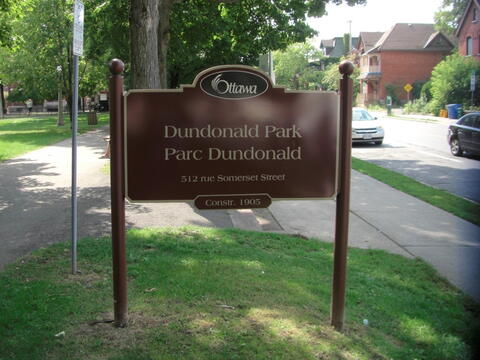
Dundonald Park
Parc Dundonald

512 rue Somerset Street

Constr. 1905 

Image
Photo Credit
Richard Turcotte
Caption
sign
1 of 2 images
Image
Photo Credit
Richard Turcotte
Caption
park
1 of 2 images
War or Conflict Term
Province
!4v1625766112347!6m8!1m7!1sb2PGvLG7b2pptT9gmDh7bA!2m2!1d45.41260678505162!2d-75.70088512968263!3f331.48837947787535!4f5.516700653036992!5f0.7820865974627469
Body Content

Dundonald Park is named in honour of Lieutenant-General Douglas Mackinnon Baillie Hamilton Cochrane, 12th Earl of Dundonald, KCB, KCVO, the last British officer to command the Canadian militia. The park was dedicated in 1905 by the City of Ottawa, who maintains it.

Lieutenant-General Cochrane was born in 1852 and commissioned in the Life Guards in 1870. He served in the Nile Expedition, Desert March and Relief of Khartoum in 1885. In 1895, he was appointed Commanding Officer of 2nd Battalion, Life Guards. He served in the Second Boer War where in 1899 he was appointed Commander of the Mounted Brigade, part of the South Natal Field Force. He took part in the Relief of Ladysmith in February 1900. He was appointed General Officer Commanding the Militia of Canada in 1902. He served in the First World War in the British Admiralty Office. Lieutenant-General Cochrane, 12th Earl of Dundonald, died in 1935 at the age of 82.

City
Ottawa
Country
Type Description
Memorial park
Photo Credit
Richard Turcotte
Memorial CF Legacy ID
8999
City/Municipality
Ottawa
Memorial Number
35059-189
Type
Address
Lebreton Street
in Canada
Yes
GPS Coordinates
45.405463, -75.7067721
Inscription

[front/devant]

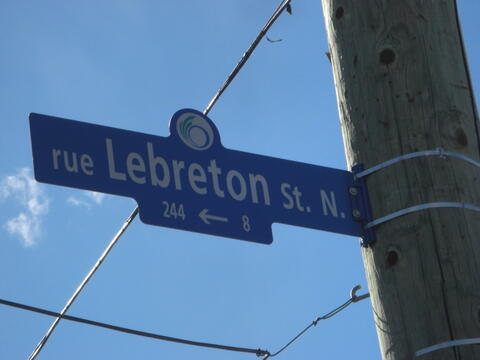
rue Lebreton St.

Image
Photo Credit
Richard Turcotte
Caption
street sign
Province
!4v1625765702651!6m8!1m7!1sbOFrHrTuQuFoFc3kDQB4JA!2m2!1d45.40546299852615!2d-75.70677209976855!3f118.45792989714609!4f0.5182937672108068!5f1.6205516757981315
Body Content

Lebreton Street is named in honour of Captain John Lebreton, born in 1779 in England, moving to Newfoundland with his parents as an infant. In 1795, he joined the Royal Newfoundland Fencible Regiment as an ensign and became a lieutenant in 1798. Between 1809 and 1812, he held the position of Deputy Assistant Quartermaster-General in Quebec, followed by an appointment as adjutant of the Voltigeurs Canadian.

Lebreton participated with distinction in nine actions during the War of 1812. In October 1813, he was sent to Detroit under truce to request the humane treatment of prisoners taken by the Americans, but secretly he was to assess the American’s strength at Detroit and on Lake Erie. He was severely wounded and disabled at the Battle of Lundy’s Lane in July 1814. Promoted captain in the 60th Foot in 1816, he went on half pay soon after.

In 1819, he was granted a parcel of land in Nepean Township, an area that he called Britannia but which later would become known as Lebreton’s Flats. Settling on his land and erecting mills, he was the subject of a controversy when the Governor accused him of acting on privileged information about the government’s intention to build a new depot at Richmond Landing (near the present-day Supreme Court building), and a possible starting point for the Rideau Canal.

Following the death of his wife, Lebreton moved to Toronto where he died a year later in 1848.

City
Ottawa
Country
Type Description
Street; street sign
Photo Credit
Richard Turcotte
Memorial CF Legacy ID
8997