Ontario

Province Code
ON
City/Municipality
Manotick
Memorial Number
35050-137
Type
Address
1138 Bridge Street
Location
Inside St. James Anglican Church
in Canada
Yes
GPS Coordinates
45.2270789, -75.6853644
Inscription

[front/devant]

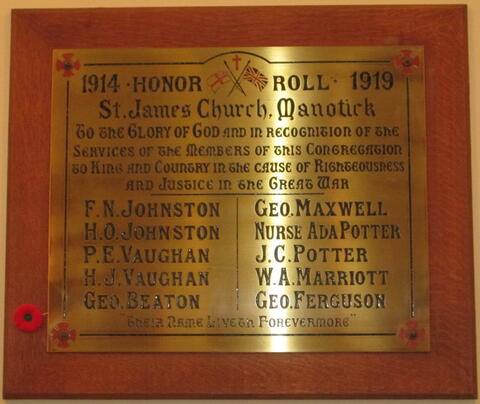
1914 – 1919
HONOR ROLL
St. James Church Manotick
TO THE GLORY OF GOD AND IN RECOGNITION OF THE
SERVICES OF THE MEMBERS OF THIS CONGREGATION
TO KING AND COUNTRY IN THE CAUSE OF RIGHTEOUSNESS
AND JUSTICE IN THE GREAT WAR

F.N. JOHNSTON                                    GEO. MAXWELL
H.O. JOHNSTON                                   Nurse ADA POTTER
P.E. VAUGHAN                                      J.C. POTTER
H.J. VAUGHAN                                      W.A. MARRIOTT
GEO. BEATON                                      GEO. FERGUSON
“THEIR NAME LIVETH FOREVERMORE” 

Image
Photo Credit
Richard Turcotte
Caption
plaque
War or Conflict Term
Province
!4v1629127824829!6m8!1m7!1slrYifPxVHfWlKc935gFR_A!2m2!1d45.22707892989822!2d-75.68536439910403!3f123.91106954575953!4f16.095262989757003!5f1.4858783316257096"
Body Content

This brass plaque is dedicated to the members of St. James Manotick Church who served in the First World War.

City
Manotick
Country
Type Description
Plaque; brass
Memorial CF Legacy ID
9037
City/Municipality
Manotick
Memorial Number
35050-136
Type
Address
1138 Bridge Street
Location
St. James Anglican Church
in Canada
Yes
GPS Coordinates
45.2270639, -7
Inscription

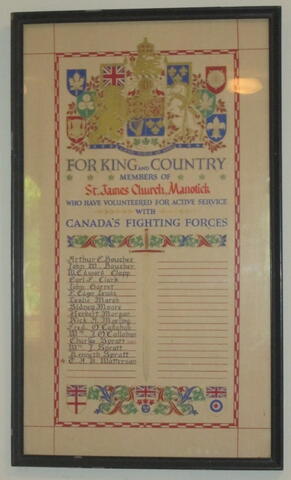
FOR KING AND COUNTRY
MEMBERS OF
ST. JAMES CHURCH, MANOTICK
WHO VOLUNTEERED FOR ACTIVE SERVICE
WITH
CANADA’S FIGHTING FORCES

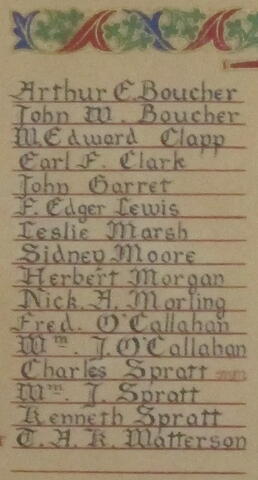
Arthur E. Boucher
John W. Boucher
M. Edward Clapp
Earl F. Clark
John Garret
F. Edger Lewis
Leslie Marsh
Sidney Moore
Herbert Morgan
Nick A. Morling
Fred O’Callahan
Wm. J. O’Callahan
Charles Spratt
Wm. J. Spratt
Kenneth Spratt
*T.A.K. Watterson

Image
Caption
St. James Manotick Church Second World War Roll of Honour
1 of 2 images
Image
Caption
inscription
1 of 2 images
War or Conflict Term
Province
!4v1629127642509!6m8!1m7!1slrYifPxVHfWlKc935gFR_A!2m2!1d45.22707892989822!2d-75.68536439910403!3f124.22098769035021!4f17.902442723728882!5f1.528621055215356"
Body Content

This framed scroll is dedicated to the members of St. James Manotick Church who served in the Second World War. This style of an Honour Roll was designed by A.J. Casson when he worked at Sampson-Matthews, a prominent midtown Toronto lithography and commercial art company.

City
Manotick
Country
Type Description
Honour Roll
Photo Credit
Richard Turcotte
Memorial CF Legacy ID
9036
City/Municipality
Richmond
Memorial Number
35050-135
Type
Address
6095 Perth Street
Location
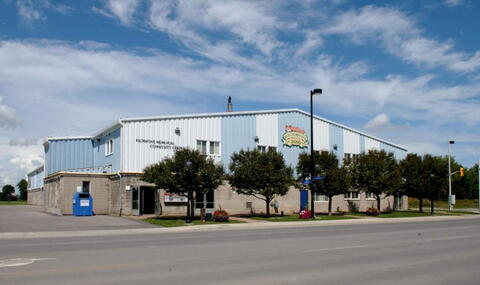
Richmond Memorial Community Centre
in Canada
Yes
GPS Coordinates
45.1952961, -75.8374992
Image
Photo Credit
Victoria Edwards
Caption
front
War or Conflict Term
Province
!4v1624372288433!6m8!1m7!1sbPROVvjnjwtouxsfkHGknA!2m2!1d45.19525070486291!2d-75.83744398369764!3f335.95241946933027!4f3.1308627595410172!5f0.4000000000000002"
Body Content

The building was erected by the residents of Richmond in 1950 and is dedicated to the soldiers from the Richmond region who served and, in particular, those who gave their lives in the Second World War.


City
Richmond
Country
Type Description
Building; community centre
Memorial CF Legacy ID
8677
City/Municipality
Ottawa
Memorial Number
35050-134
Type
Address
226 Leamington Way
in Canada
Yes
GPS Coordinates
45.2671688, -75.7305678
Inscription

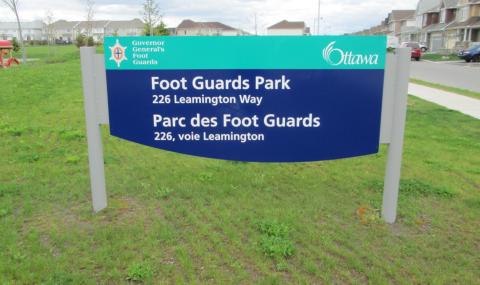
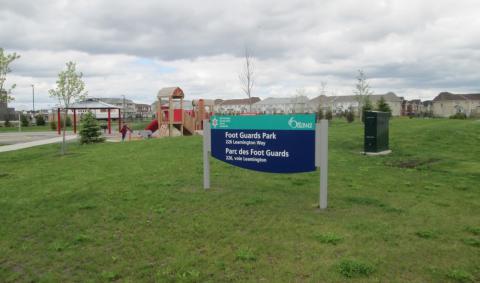
[park sign/enseigne du parc]

Governor General's Foot Guards

Foot Guards Park
226 Leamington Way

Parc des Foot Guards
226, voie Leamington 

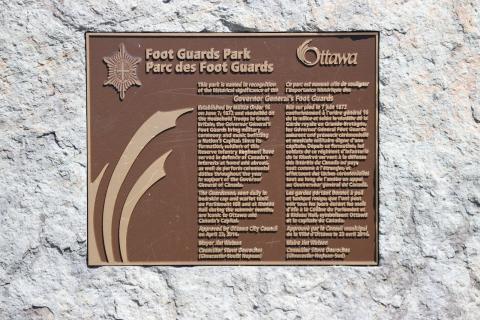
[plaque]

Foot Guards Park
Parc des Foot Guards

  • This park is named in recognition
    of the historical significance of the
  • Ce parc est nommé afin de souligner
    l'importance historique des

GOVERNOR GENERAL'S FOOT GUARDS

  • Established by Militia Order 16 on June 7, 1872 and modelled on the Household Troops in Great Britain, the Governor General's Foot Guards bring military ceremony and music befitting a Nation's Capital. Since its formation, soldiers of this Reserve Infantry Regiment have served in defence of Canada's interests at home and abroad, as well as perform ceremonial duties throughout the year in support of the Governor General of Canada.
  • The Guardsmen, seen daily in bearskin cap and scarlet tunic on Parliament Hill and at Rideau Hall during the summer months are iconic to Ottawa and Canada's Capital.
  • Approved by Ottawa City Council on April 23, 2014.
  • Mayor Jim Watson
    Councillor Steve Desroches
    (Gloucester-South Nepean)
  • Mis sur pied le 7 juin 1872 conformément à l'ordre général 16 de la milice et selon le modèle de la Garde royale en Grande-Bretagne, les Governor General Foot Guards assurent une présence cérémoniell et musicale militaire digne d'une capitale. Depuis sa formation, les soldats de ce régiment d'infanterie de la Réserve servent à la défense des intérêts du Canada au pays tout comme à l'étranger, et effectuent des tâches cérémonielles tout au long de l'année en appui au Gouverneur général du Canada.
  • Les gardes portant bonnet à poil et tunique rouge, qui l'ont peut voit tous les jours durant les mois d'été à la Colline du Parlement et à Rideau Hall, symbolisent Ottawa et la capitale du Canada.
  • Approuvé par le Conseil municipal de la Ville d'Ottawa le 23 avril 2014.
  • Maire Jim Watson
    Conseiller Steve Desroches
    (Gloucester-Nepean-Sud)
Image
Photo Credit
Richard Turcotte
Caption
Foot Guards Park sign
1 of 3 images
Image
Photo Credit
Richard Turcotte
Caption
Foot Guards Park
1 of 3 images
Image
Photo Credit
William Frederick George Williams M.S.M., Memorials in Ottawa
Caption
Foot Guards Park plaque
1 of 3 images
Province
!4v1624469860659!6m8!1m7!1sa0yUSnG1stW0qvKHF2q0Cg!2m2!1d45.26720447990204!2d-75.73052788361671!3f10.470279865891106!4f-0.04089917821826816!5f1.935958858239184
Body Content

Foot Guards Park is named in honour of the Governor General's Foot Guards. It was dedicated on May 16, 2014 by the City of Ottawa. The Governor General’s Foot Guards was formed on June 7, 1872 in Ottawa. The Regiment has been headquartered at the Cartier Square Drill Hall since 1879.

Members of the Regiment took part in the Nile Expedition of 1884 and the following year provided a company of sharpshooters to the Battleford column during the Northwest Resistance, where the Regiment suffered its first two casualties at the battle of Cut Knife Hill. During the South African War the Regiment contributed volunteers for the various Canadian contingents, mainly the 2nd (Special Service) Battalion, Royal Canadian Regiment of Infantry.

The Governor General’s Foot Guards perpetuates two battalions of the Canadian Expeditionary Force who took part in the First World War. The 2nd (Eastern Ontario) battalion “The Iron Second”, which was a part of the 1st Canadian Division and saw continuous service on the Western front from 1915 to end of war in 1918. The 2nd Battalion also fought at the battles of Ypres, St. Julien, Festubert, Pozières, Vimy (1917), Arleux, Hill 70, Passchendaele, Amiens, and Canal du Nord, to name only a few. By the end of the war, 242 officers and 5,084 other ranks had fought with the battalion. Of those, 52 officers and 1,227 other ranks were killed. The 77th (Ottawa) battalion provided reinforcements for the Canadian Corps until 22 September 1916, when its personnel were absorbed by the 47th Battalion (British Columbia), Canadian Expeditionary Force and the 73rd Battalion (Royal Highlanders of Canada) and the battalion was disbanded. The honours and traditions of these battalions are perpetuated by the Governor General’s Foot Guards.

During the Second World War the Governor General’s Foot Guards was mobilized in May 1940. In 1942 the regiment was re-rolled to become an armoured unit to address the need for more armoured units in the Canadian Army, assuming the name “21st Canadian Armoured Regiment (Governor General’s Foot Guards)”. It embarked for Great Britain on 23 September 1942. On 24 July 1944, it landed in France as part of the 4th Armoured Brigade, 4th Canadian Armoured Division and it continued to fight in northwest Europe until the end of the war taking part in the battle of Normandy, the battle of the Scheldt, and the Rhineland. Over the course of the war the Regiment’s casualties were 101 dead and 284 wounded. Forceful III, a Sherman tank that served with the regiment is currently on display at the Canadian War Museum in Ottawa and is dedicated to the memory of the members of the Governor General’s Foot Guards killed during the Second World War.

In the intervening years, members have participated in numerous United Nations and NATO operations, including service in the Cyprus, Somalia, the Former Republic of Yugoslavia, Haiti, Ethiopia, and Sierra Leone. During the Canadian mission in Afghanistan, the Governor General’s Foot Guards deployed numerous members, taking part Task Force 3-06, Task Force 3-08, and Task Force 1-10 in Kandahar, as well as the Op ATTENTION training mission in Kabul.

Presently the Governor General’s Foot Guards provides individual augmentation to regular force when they deploy on operations. Most recently the regiment has deployed members on Op IMPACT in Iraq and Jordan, Op CALUMET in Egypt, Op SOPRANO in Sudan, Op REASSURANCE in Poland and Latvia, and Op UNIFIER in the Ukraine.

The Regiment maintains a robust domestic response capability to support Canadians at home in the event of natural disaster or emergency. The regiment has deployed soldiers to the 1998 Ice Storm, floods 2017 and 2019, and during the COVID-19 pandemic in 2020.

For service on active duty, members of the Regiment have been awarded over 500 decorations, including 3 Victoria Crosses. The regiment has 34 Battle Honours.

City
Ottawa
Country
Type Description
Park
Memorial CF Legacy ID
8653
City/Municipality
Ottawa (Nepean)
Memorial Number
35050-133
Type
Address
André Audet Avenue
in Canada
Yes
GPS Coordinates
45.2458742, -75.7341155
Inscription

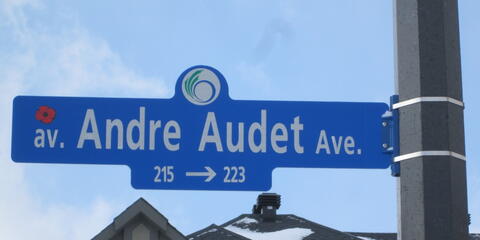
[front/devant]

av. Andre Audet Ave.

Image
Photo Credit
Richard Turcotte
Caption
Street sign
War or Conflict Term
Province
!4v1626727116690!6m8!1m7!1sMgyT4FrlKycapd70A1eaQQ!2m2!1d45.24587419056579!2d-75.73411551267931!3f117.52214116407272!4f4.591528695006474!5f1.8979006070150208
Body Content

André Audet Avenue, is named in honour of Able Seaman Jean Frederick André Audet, who enlisted in the Royal Canadian Navy on May 4, 1942 as an Ordinary Seaman. The street was named in November 2010 by the city of Ottawa.

Audet served on many ships, including HMCS ATHABASCA, spending 26 months at sea during the Second World War as an Able Seaman. Wounded as the Athabaskan sunk in the English Channel on April 29, 1944, Mr. Audet was very lucky to have survived as 128 of his fellow crew members lost their lives.

Audet received the 1939-45 Star, the Atlantic Star, the Canadian Volunteer Service Medal and Clasp, as well as the War Medal (1939-45) for his service.

City
Ottawa (Nepean)
Country
Type Description
Street; street sign
Memorial CF Legacy ID
8884
City/Municipality
Manotick
Memorial Number
35050-132
Type
Address
520 Bridgeport Avenue
Location
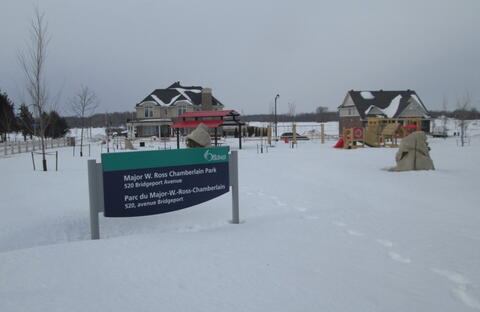
Major W. Ross Chamberlain Park
in Canada
Yes
GPS Coordinates
45.2179112, -75.6753896
Inscription

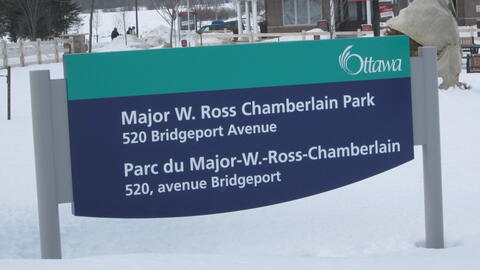
[front/devant]

Major W. Ross Chamberlain Park
520 Bridgeport Avenue

Parc du Major-W.-Ross-Chamberlain
520, avenue Bridgeport

[Military Cross citation/Croix militaire citation]

On 21 May 1944, 4 Canadian Reconnaissance Regt. (4 Princess Louise Dragoon Guards) were in action against the ADOLF HITLER line to the south of PONTECORVO (MR 7217). On the afternoon of that day Lieut. William Ross CHAMBERLAIN led his troops in an assault against an enemy position in the area MR 7215. So successful was the attack that the post was overrun and twelve prisoners were captured. These were the first Germans to be taken from the defended localities in front of the unit.

During the advance, one of this officer’s men was wounded and a few others trapped by cross-fire from another enemy position. With complete disregard for his own safety Lieut. CHAMBERLAIN picked up a Bren gun and ran across a fire swept open field. Positioning himself he provided covering fire while his party moved back. Then he went to the assistance of the wounded man and dragged him to safety.

Largely as a result of this officer’s skillful and dashing leadership his troops carried out a successful raid on the enemy positions. Encouraged by his example the patrols of his unit assaulted the enemy positions with increased vigour.

Image
Caption
sign
1 of 2 images
Image
Caption
surroundings
1 of 2 images
War or Conflict Term
Province
!4v1629126745341!6m8!1m7!1slO84Nbu1GFZcXCL-entpMA!2m2!1d45.21791124651686!2d-75.67538960348054!3f269.3963872632754!4f-3.194749984423993!5f2.647493998935097"
Body Content

The Major W. Ross Chamberlain Park is named in honour of Major William Ross Chamberlain, MC, who joined the Canadian Army in November 1941, and served in North-west Europe, Africa, Italy, and Indo-China during the Second World War. He gallantly served with the 4 Canadian Reconnaissance Regiment (4 Princess Louise Dragoon Guards) and was awarded the Military Cross (MC) for the exemplary courage he displayed as a young lieutenant leading a successful attack against German positions on May 21, 1944.

Following the end of hostilities, he remained in the Army until 1962 after which he became a teacher. As a teacher and guidance counsellor for many years, he helped innumerable students at Fisher Park and Merivale high schools. A member of the Manotick Branch of the Royal Canadian Legion for 36 years, he founded and chaired the Youth Education Committee, developing a student bursary program for deserving high school students.

Mr. Chamberlain was also particularly devoted to providing services to seniors, founding the Rideau Seniors Association, the Manotick Senior Citizens Service Centre and assisted in the creation of Highlands Apartments (a low-cost senior’s residence) as well as a not-for-profit senior’s café in Manotick.

City
Manotick
Country
Type Description
Memorial park
Photo Credit
Richard Turcotte
Memorial CF Legacy ID
9012
City/Municipality
Greely
Memorial Number
35050-131
Type
Address
8021 Mitch Owens Road
Location
At the entrance of the Royal Canadian Legion, Branch 627
in Canada
Yes
GPS Coordinates
45.300983, -75.5196917
Inscription

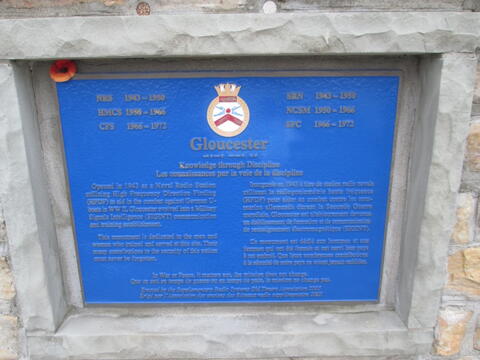
*Note : the dots and dashes below “Gloucester” are Morse code for CGI

[front/devant]

NRS 1943 – 1950
HMCS 1950 – 1966
CFS 1966 – 1972

SRN 1943 – 1950
NCSM 1950 – 1966
SFC 1966 – 1972

Gloucester

_._.  _ _.  . .

Knowledge through Discipline
Les connaissances par la voie de la discipline

Opened in 1943 as a Naval Radio Station utilizing High Frequency Direction Finding (HFDF) to aid in the combat against German U-Boats in WWII, Gloucester evolved into a Military Signals Intelligence (SIGINT) communication and training establishment.

This monument is dedicated to the men and woman who trained and served at this site. Their many contributions to the security of this nation must never be forgotten.

Inaugurée en 1943 à titre de station de radio navale utilisant la radiogoniométrie haute fréquence (HFDF) pour aider au combat contre les sous-marins allemands durant la Seconde Guerre mondiale, Gloucester est ultérieurement devenue un établissement de formation et de communication de renseignement électromagnétique (SIGINT).

Ce monument est dédié aux hommes et aux femmes qui ont été formés et ont servi leur pays à cet endroit. Que leurs nombreuses contributions à la sécurité de notre pays ne soient jamais oubliées.

In war or Peace, it matters not, the mission does not change.
Que ce soit en temps de guerre on en temps de paix, la mission ne change pas.

Erected by the Supplementary Radio Systems Old Timers Association. 2005
Érigé par l’Association des anciens des Réseaux radio supplémentaire. 2005

Image
Caption
plaque
1 of 3 images
Image
Caption
front
1 of 3 images
Image
Caption
surroundings
1 of 3 images
Province
!4v1631891495103!6m8!1m7!1sitrqUY20iYZMwhNyq3unTA!2m2!1d45.30098302842431!2d-75.5196916786201!3f3.7207190809030344!4f-0.12022013895519024!5f3.325193203789971"
Body Content

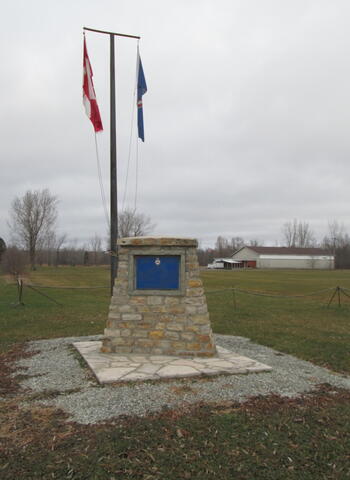
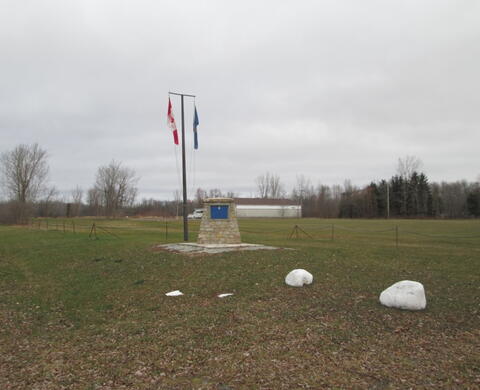
This stone cairn on the grounds of the Royal Canadian Legion Branch #627 (Greely and District) was unveiled in 2005 and is dedicated to the men and women who trained and served at NRS/HMCS/CFS Gloucester. It was erected by the Supplementary Radio Systems Old Timers Association.

Naval Radio Station Gloucester, call sign CGI, was established as a HFDF facility on February 23, 1943. During the war years, the station was known as “Number 1 Station HMCS Bytown” and for brevity it was sometimes referred to as “No. 1”. From December 1, 1950 to April1, 1953 the name was changed to HMCNRS. Between 1953 and 1966 the base was known as HMCS Gloucester, and then CFS Gloucester until it closed. HMCS Gloucester became a training facility and also the home of the Special Communications Branch, responsible for all Special Communication Stations and signals intelligence.

Over its lifetime, the base saw many changes to its infrastructure including the construction of about 20 PMQs in the 1950’s. The present Royal Canadian Legion (RCL) is housed in the station’s former gymnasium.

City
Greely
Country
Type Description
Stone cairn and metal plaque
Photo Credit
Richard Turcotte
Memorial CF Legacy ID
9011
City/Municipality
Ottawa (Nepean)
Memorial Number
35050-130
Type
Address
103 Malvern Drive
Location
In front of John McCrae Secondary School
in Canada
Yes
GPS Coordinates
45.2796207, -75.7625808
Inscription

[headstone/pierre tombale]

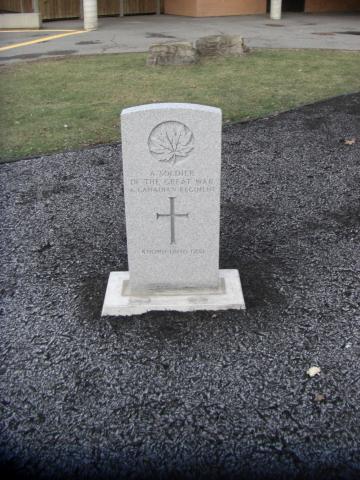
A soldier
Of the Great War
A Canadian Regiment

Known unto God

[English plaque/plaque anglais]

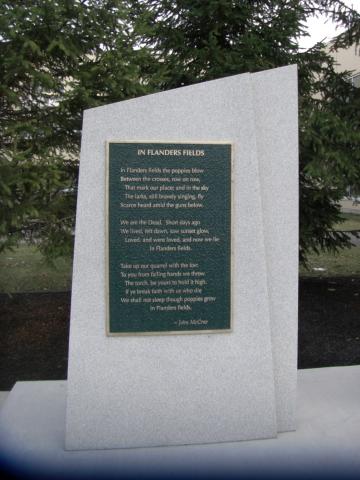
In Flanders Fields

In Flanders fields the poppies blow
Between the crosses, row on row,
That mark our place; and in the sky
The Larks, still bravely singing, fly
Scarce heard amid the guns below.
We are the Dead. Short days ago
We lived, felt dawn, saw sunset glow,
Loved, and were loved, and now we lie
In Flanders fields.
Take up our quarrel with the foe:
To you from failing hands we throw
The torch, be yours to hold it high.
If ye break faith with us who die
We shall not sleep though poppies grow
In Flanders fields

-John McCrae

[French plaque/Français plaque]

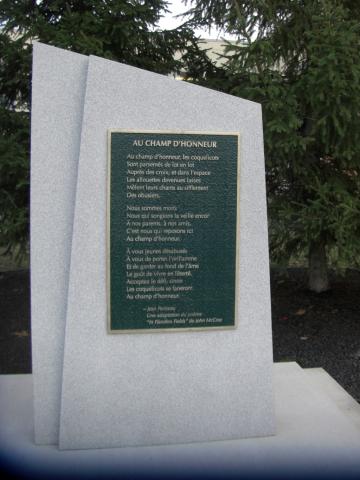
Au Champ d’Honneur

Au champ d’honneur, les coquelicots
Sont parsemés de lot en lot
Auprès des croix; et dans l’espace
Les alouettes devenues lasses
Mêlent leurs chants au sifflement
Des obusiers.
Nous sommes morts
Nous qui songions la veille encor’
À nos parents, à nos amis,
C’est nous qui reposons ici
Au champ d’honneur.
À vous jeunes désabusés
À vous de porter l’oriflamme
Et de garder au fond de l’âme
Le goût de vivre en liberté.
Acceptez le défi, sinon
Les coquelicots se faneront
Au champ d’honneur.

-Jean Parizeau
Une adaptation du poème
“In Flanders Fields” de John McCrae

Image
Photo Credit
Richard Turcotte
Caption
front
1 of 4 images
Image
Photo Credit
Richard Turcotte
Caption
English plaque/stele
1 of 4 images
Image
Photo Credit
Richard Turcotte
Caption
French plaque/stele
1 of 4 images
Image
Photo Credit
Richard Turcotte
Caption
Replica Canadian soldier headstone
1 of 4 images
War or Conflict Term
Province
!4v1626726703644!6m8!1m7!1szPB7IoxKVBc_ToN48lSl4A!2m2!1d45.27962070507772!2d-75.76258080585897!3f77.20150440645825!4f4.814277144244258!5f0.7820865974627469
Body Content

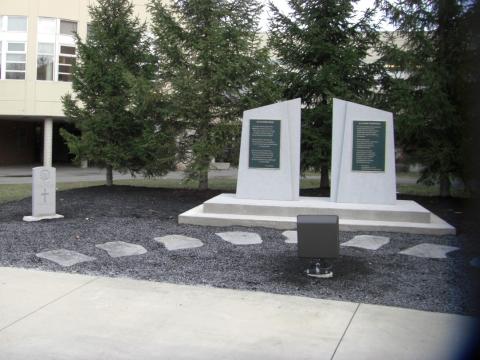
This grey granite monument commemorates the poem “In Flanders Fields” by Lieutenant-Colonel John McCrae. On the monument are two metal plaques, on which is inscribed “In Flanders Fields” and “Au Champ d’Honneur”, the French adaptation of “In Flanders Fields”, affixed to two granite stelæ. The monument also includes a replica headstone typically used in Commonwealth War Graves Commission cemeteries.

The Barrhaven Cenotaph is located in front of the John McCrae Secondary School.

City
Ottawa (Nepean)
Country
Type Description
Monument; granite (grey)
Memorial CF Legacy ID
8962
City/Municipality
Ottawa (Nepean)
Memorial Number
35050-129
Type
Address
103 Malvern Drive
in Canada
Yes
GPS Coordinates
45.2798066, -75.7631324
Inscription

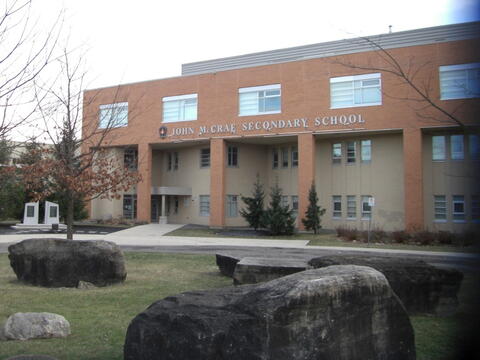
[building/bâtiment]
 JOHN McCRAE SECONDARY SCHOOL

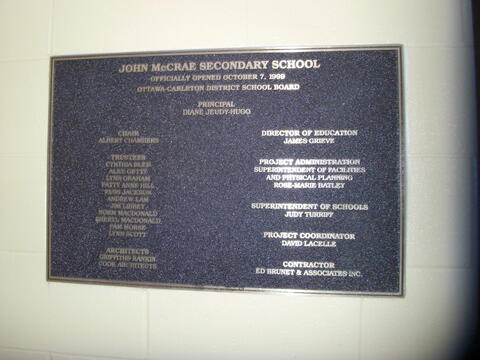
[plaque]
JOHN McCRAE SECONDARY SCHOOL
OFFICIALLY OPENED OCTOBER 7, 1999
OTTAWA-CARLETON DISTRICT SCHOOL BOARD

PRINCIPAL
DIANE JEUDY-HUGO

  • CHAIR
  • ALBERT CHAMBERS
  •  
  • TRUSTEES
  • CYNTHIA BLED
  • ALEX GETEY
  • LYNN GRAHAM
  • PATTY ANNE HILL
  • RUSS JACKSON
  • ANDREW LAM
  • JIM LIBBEY
  • NORM MACDONALD
  • SHERYL MACDONLD
  • PAM MORSE
  • LYNN SCOTT
  •  
  • ARCHITECTS
  • GRIFFITHS RANKIN
  • COOK ARCHITECTS
  • DIRECTOR OF EDUCATION
  • JAMES GRIEVE
  •  
  • PROJECT ADMINISTRATION
  • SUPERINTENDENT OF FACILITIES
  • AND PHYSHICAL PLANNING
  • ROSE-MARIE BATLEY
  •  
  • SUPERINTENDENT OF SCHOOLS
  • JUDY TURRIFF
  •  
  • PROJECT COORDINATOR
  • DAVID LACELLE
  •  
  • CONTRACTOR
  • ED BRUNET & ASSOCIATES INC.
  •  
  •  
Image
Photo Credit
Richard Turcotte
Caption
John McCrae Secondary School
1 of 4 images
Image
Photo Credit
Richard Turcotte
Caption
School opening plaque
1 of 4 images
Image
Photo Credit
Richard Turcotte
Caption
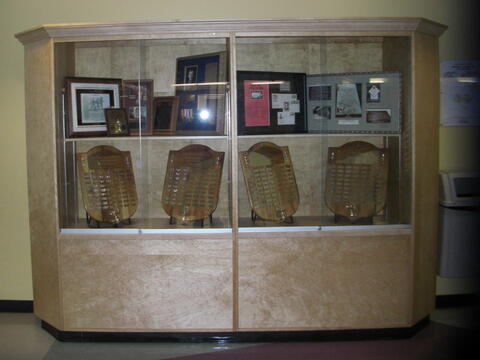
Display case
1 of 4 images
Image
Photo Credit
Richard Turcotte
Caption
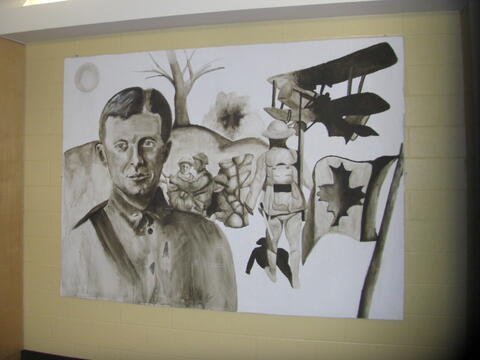
Mural
1 of 4 images
War or Conflict Term
Province
!4v1626726325700!6m8!1m7!1s_X-AyjlFD8FXuuwYG_FfEg!2m2!1d45.27980656371391!2d-75.76313239485007!3f138.39609680299796!4f5.699270418499367!5f0.7820865974627469
Body Content

The John McCrae Secondary School was named in honour of Lieutenant-Colonel John McCrae, best known for composing the poem “In Flanders Fields”. The school was officially opened on October 7, 1999.

Lieutenant Colonel John Alexander McCrae (1872-1918) was born in Guelph where he became a member of the Guelph militia regiment. McCrae studied at the University of Toronto and joined The Queen’s Own Rifles of Canada. In 1893, he trained as an artilleryman at the Royal Military College in Kingston. He returned to university, completed his B.A. and went on to study medicine.

McCrae served in the artillery during the Second Boer War and upon his return taught at the University of Vermont and McGill University. Joining at the very start of the First World War, McCrae worked as a field surgeon and was in charge of a field hospital during the Second Battle of Ypres when McCrae’s friend Lt Alexis Helmer was killed in battle. His burial inspired the poem “In Flanders Fields” which was written on 3 May, 1915 and published later that year.

In June 1915, McCrae was made responsible for No. 3 Canadian General Hospital (McGill) at Dannes-Cammiers near Boulogne-sur-Mer. On 28 January 1918, while still in command, McCrae died of pneumonia. He was buried in the Wimereux Cemetery with full military honours and in the presence of General Sir Arthur Currie.

City
Ottawa (Nepean)
Country
Type Description
Building - school
Memorial CF Legacy ID
8961
City/Municipality
Ottawa (Nepean)
Memorial Number
35050-128
Type
Address
100 Malvern Drive
Location
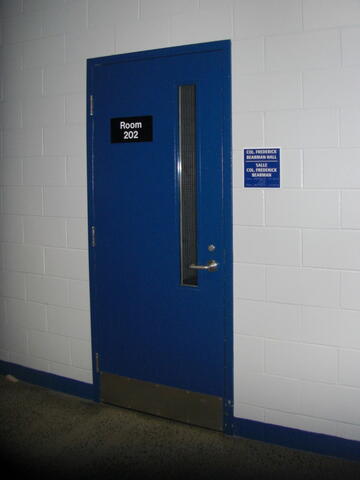
Walter Baker Sports Centre, room 202
in Canada
Yes
GPS Coordinates
45.2809876, -75.762178
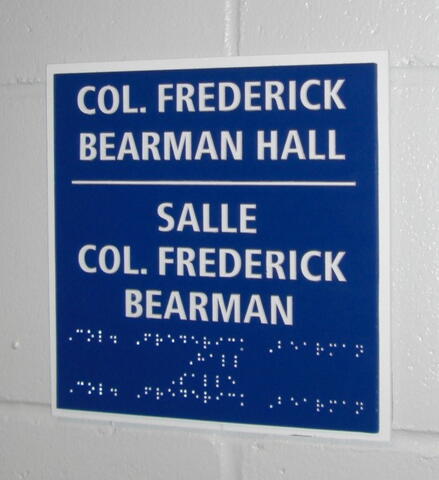
Inscription

[front/devant]

Col. Frederick Bearman Hall

Salle Col Frederick Bearman

Image
Photo Credit
Richard Turcotte
Caption
Colonel Frederick Bearman Hall – entrance
1 of 2 images
Image
Photo Credit
Richard Turcotte
Caption
plaque
1 of 2 images
Province
!4v1626726162970!6m8!1m7!1sDE8Gzj32z27bjjGchZpk4Q!2m2!1d45.28098761789607!2d-75.76217802816062!3f168.110530288708!4f1.0939585511491714!5f0.8743529790920215
Body Content

Colonel Frederick Bearman Hall is named in honour of Colonel Frederick Bearman, who was the first Reeve to be appointed by the Nepean Township in 1850.

Born in 1804, little detailed information is available regarding Frederick Bearman’s childhood or early adulthood. He is known to have settled in Nepean in 1819, most likely in the Bell’s Corner area of the township. Records indicated that in 1828, at the age of 24 years old, he was a member of the 1st Carleton Regiment and in the ensuring years, rose through the ranks.

By 1850 he had risen to the senior officer ranks and was elected Nepean Township councilor for the first township council elected under the new Municipal Act of 1849. He was subsequently appointed the first Reeve of the township. (source: “The City Beyond: A History of Nepean, birthplace of Canada’s Capital 1792 – 1990”, Bruce S. Elliot; Published by the Corporation of the City of Nepean, 1991)

City
Ottawa (Nepean)
Country
Type Description
Building
Memorial CF Legacy ID
8960