Ontario

Province Code
ON
City/Municipality
London
Memorial Number
35042-103
Type
Address
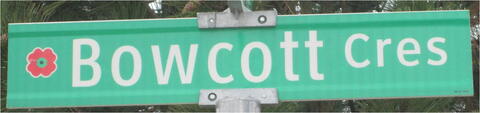
Bowcott Crescent
Location
Off of Tartan Drive
in Canada
Yes
GPS Coordinates
42.9917159, -81.150481
Inscription

Bowcott Cres

Image
Photo Credit
Richard Turcotte
Caption
Photo- Bowcott Crescent- street sign (photo by R. Turcotte)
War or Conflict Term
Province
!4v1629467860080!6m8!1m7!1suSNYT1SdfkO9pkgqZfv3WA!2m2!1d42.9917158962723!2d-81.15048103608932!3f251.22106520704773!4f6.7217594870162145!5f2.269233329635735"
Body Content

This street is named in memory of Lance-Corporal Wilfred William Bowcott


Wilfred William Bowcott was born in Tillsonburg on 28 July 1918. He moved to London, ON with his family, residing on Egerton Street. Following the completion of his education, he entered the workforce and joined the 1st Hussars (6th Canadian Armoured Regiment) in 1940.

The 1st Hussars trained in Canada for numerous months before sailing for England in October 1941. Once in the UK, they trained with Lee and Ram tanks until re-equipped with the Sherman tank in April 1944, in preparation for the D-Day invasion. Lance-Corporal Bowcott took part in this operation and would serve with the 1st Hussars throughout France, Belgium and the Netherlands.

On 13-14 April 1945, the 1st Hussars were supporting the 1st Infantry Brigade in their advance towards Apeldoorn and their assault across the Apeldoorn Canal. It is during these actions that Lance-Corporal Wilfred William Bowcott was killed in action on the 14 April 1945. He is buried at Holten Canadian War Cemetery, The Netherlands.

City
London
Country
Type Description
Street
Memorial CF Legacy ID
9582
City/Municipality
London
Memorial Number
35042-102
Type
Address
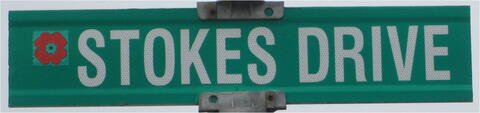
Stokes Drive
Location
Off of Chelton Road
in Canada
Yes
GPS Coordinates
42.9621558, -81.1739239
Inscription

Stokes Drive

Image
Photo Credit
Richard Turcotte
Caption
Photo- Stokes Drive- street sign (photo by R. Turcotte)_
War or Conflict Term
Province
!4v1629467691712!6m8!1m7!1s4_PWEJpFaKMZEZPi7iHwbA!2m2!1d42.96215575431033!2d-81.17392387601181!3f30.2178107012936!4f2.2362136148731366!5f2.8116235765964444"
Body Content

This street is named in memory of Sergeant John Ridley Stokes.


John Ridley Stokes was born in Lucan, ON on 29 January 1923 but moved to London, ON with his family and resided on Oxford Street. He joined the Canadian Fusiliers (City of London Regiment) at a young age and remained with them until October 1942 when he enlisted in the Royal Canadian Air Force. After completing his aircrew training as an air gunner, he embarked for England where he was attached to No. 101 Squadron, RAF, based at Ludford Magna. This squadron flew Lancasters fitted with electronic counter-measure equipment that allowed them to jam and intercept enemy radio transmissions.

On the night of 13 September 1944, Sgt. Stokes’ crew were flying a cross-country night training flight from their base to Inverary- Mull of Kintyre and back. At one point during the mission, the aircraft entered a steep dive and broke up before crashing on Conic Hill, near Drymen Scotland. All seven aircrew, including Sergeant Stokes and 3 other RCAF members, were killed. Sergeant John Ridley Stokes is buried at Dumbarton Cemetery in the town of Dumbarton, UK.

City
London
Country
Type Description
Street
Memorial CF Legacy ID
9581
City/Municipality
London
Memorial Number
35042-101
Type
Address
Evans Boulevard
Location
Off of Jackson Road
in Canada
Yes
GPS Coordinates
42.9512596, -81.1675229
Inscription

Evans Blvd

Image
Photo Credit
Richard Turcotte
Caption
Photo- Evans Boulevard- street sign (photo by R. Turcotte)
War or Conflict Term
Province
!4v1629467259179!6m8!1m7!1sKa91UOVt7eH1gjCnhy5oUg!2m2!1d42.95125960477359!2d-81.16752294589008!3f127.55330365637498!4f0.1268814869246171!5f3.325193203789971"
Body Content

This street is named in memory of Private Herbert Morris Evans


Herbert Morris Evans was born on 4 November 1920 in Brantford ON. His family moved to London where Herbert completed his education in 1938 after which he joined the workforce. He was working at the Kelvinator Refrigerator Manufacturing Company, when he enlisted on 1 February 1942. Initially assigned to the Royal Canadian Army Service Corps, he completed his basic training in Kitchener before being transferred to the Royal Canadian Regiment and undergoing his infantry training at Camp Borden in May 1942. He sailed for the UK in June, arriving in England on 25 June 1942.

For the next 12 months, he trained with the RCR in England before taking part in the landings at Pachino, Sicily on 10 July 1943. After the 38 day Sicilian campaign, the Regiment took part in the Allied invasion of mainland Italy in September and the subsequent advance along the Adriatic coast. By December, the Canadians were in the Moro River area. On 8-9 December, the RCR took part in the Battle for San Leonardo, during which Private Evans was wounded. On 18 December, the RCR, as part of the 1st Brigade, launched an attack to capture a vital crossroad, nicknamed “Cider”, in the battle of Ortona. Meeting fierce resistance, Pte Evans was wounded during the initial attack with the RCR suffering numerous casualties. The attack continued the following day and it is during this renewed effort that Private Herbert Morris Evans was killed on 19 December 1943. Pte Evans is buried at the Moro River Canadian War Cemetery.

City
London
Country
Type Description
Street
Memorial CF Legacy ID
9580
City/Municipality
London
Memorial Number
35042-100
Type
Address
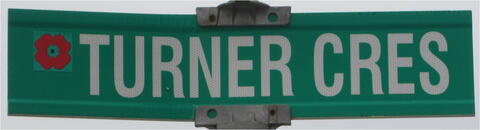
Turner Crescent
Location
Off of Evans Boulevard
in Canada
Yes
GPS Coordinates
42.950755, -81.1704483
Inscription

Turner Cres

Image
Photo Credit
Richard Turcotte
Caption
Photo- Turner Crescent- street sign (photo by R. Turcotte)
War or Conflict Term
Province
!4v1629466890806!6m8!1m7!1sD9uafsDPAaTRFt2vnNyOng!2m2!1d42.95075495641709!2d-81.17044828190765!3f71.33059721792591!4f0.21449723054131198!5f2.610870646947656"
Body Content

This street is named in memory of Private Frederick Arthur Turner


Frederick Arthur Turner was born on the 4th of January 1921 in London, ON. Growing up on Elm Street, he enlisted in 1939 and was assigned to the Royal Canadian Regiment. Turner landed with his Regiment at Pachino in Sicily on 10 July 1943 as a Regimental signaller in the command group.

After taking their initial objective, the Regiment advanced further inland and a week after landing in Sicily, the Canadians had pushed the Germans out of several strategic hilltop towns and villages. But the enemy dug in to make a determined stand at the town of Agira.

On 24 July, the RCR were advancing along a railway line and were making good headway, when they came under heavy fire from German positions on the mountain slopes. In the confusion of battle, the RCR's advance unit became separated from the main body and contact with it was lost.

Realizing that those men could be wiped out or captured, the Commanding Officer (CO) decided to lead his command group to find the advance unit. As the command group advanced towards the crest of a hill, German machine guns opened up from two sides, catching the Canadians in a crossfire. The CO was struck and seriously wounded. Private Turner immediately rushed to the aide of his CO but was also hit. His platoon commander wrote, “Your son (Fred) did one of the bravest things I have ever seen in my life. He left his place of cover and crawled to Col. Crowe's side to render him assistance…It was there he met his death….I have never met a more honest, brave or noble man than Fred“. Private Frederick Arthur Turner was buried at the Agira Canadian War Cemetery.

City
London
Country
Type Description
Street
Memorial CF Legacy ID
9579
City/Municipality
London
Memorial Number
35042-099
Type
Address
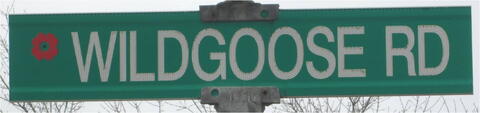
Wildgoose Road
Location
Off of Hamilton Road
in Canada
Yes
GPS Coordinates
42.9705621, -81.1558375
Inscription

Wildgoose Rd

Image
Photo Credit
Richard Turcotte
Caption
Photo- Wildgoose Road- street sign (photo by R. Turcotte)
War or Conflict Term
Province
!4v1629466572165!6m8!1m7!1s9HOGMQ_DS4zVr7HcImubLQ!2m2!1d42.97056213039855!2d-81.15583753950992!3f244.62660286512818!4f2.340066863702262!5f3.0074431491927562"
Body Content

This street is named in memory of Captain Richard Wildgoose


Richard Wildgoose was born on 16 September 1916 in Derbyshire, England. His family moved to Canada and established themselves in London, ON where Richard worked as a newspaperman for the London Advertiser. Enlisting soon after the start of the Second World War, Richard Wildgoose joined the 1st Hussars.

Due to the limited number of tanks available in the UK, the 1st Hussars initially trained in Canada at Camp Borden. The Regiment finally sailed for England in October 1941 where they trained on Lee and Ram tanks until re-equipped with Sherman tanks in April 1944, in preparation for the D-Day invasion.

At 07:15 on 6 June 1944, tanks of the 1st Hussars were launched from their landing crafts onto Courseulles-sur-Mer. After clearing this town, the Regiment made its way inland and by 9 June they were supporting the Canadian Scottish in their capture of Putot-en-Bessin.

On 12 June, the 1st Hussars were to lead an attack to capture Le Mesnil-Patry however the attack was advanced to 11 June to conform with a planned attack by a neighbouring formation. As a result, the attack led by B Squadron, 1st Hussars went in with limited artillery support. Soon after starting their advance, the tanks and supporting infantry came under heavy mortar and machine-gun fire followed by enemy armour and anti-tank gun action. The order to withdraw was quickly given but evidently not received by B Squadron who were virtually annihilated, suffering 80 casualties of which 59 were fatal.

It is during this attack that Captain Richard Wildgoose, B Squadron Battle Captain, was killed. With no known grave, he is memorialized on the Bayeux Memorial.

City
London
Country
Type Description
Street
Memorial CF Legacy ID
9578
City/Municipality
London
Memorial Number
35042-098
Type
Address
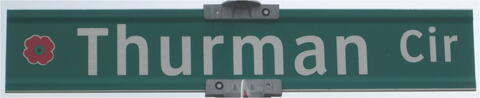
Thurman Circle
Location
Off of Farnsborough Crescent
in Canada
Yes
GPS Coordinates
43.0178659, -81.1975574
Inscription

Thurman Cir

Image
Photo Credit
Richard Turcotte
Caption
Photo- Thurman Circle- street sign (photo by R. Turcotte)
War or Conflict Term
Province
!4v1629466425957!6m8!1m7!1sxUTLFFowviANPmcXJ7lBjQ!2m2!1d43.01786593803666!2d-81.19755737672523!3f187.57162140832085!4f0.5807119360853932!5f3.325193203789971"
Body Content

This street is named in memory of Private Cecil Thurman.


Cecil Thurman was born on 7 December 1919 in London ON. Growing up on Webb Street, he attended Aberdeen Public School and enlisted soon after the start of the Second World War. Assigned to the Calgary Highlanders of the 2nd Canadian Infantry Division, he embarked for England with his battalion in August 1940.

Once overseas, the 2nd Division undertook a vigorous training plan and led the 19 August 1942 raid on Dieppe (OP JUBILEE). With the large losses incurred during this operation, the Division spent a lengthy period rebuilding and landed in Normandy in early July 1944. It went on to fight in the Caen- Falaise area and by end of August, the Division was just west of Rouen. September saw the Canadians advance along the coast of France to capture the channel ports and prepare for the Battle of the Scheldt.

By mid-September, the 2nd Division was occupying positions east of Antwerp and by end September was battling Germans forces to expand a bridgehead along the Antwerp-Turnhout Canal, 10km west of Turnhout. It is during these actions that Private Cecil Thurman was killed on 1 October 1944. He is buried at Bergen-op-Zoom Canadian Military Cemetery about 40km north-west of Antwerp.

City
London
Country
Type Description
Street
Memorial CF Legacy ID
9577
City/Municipality
London
Memorial Number
35042-097
Type
Address
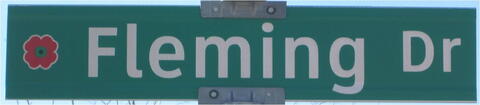
Fleming Drive
Location
Off of Fanshawe College Boulevard
in Canada
Yes
GPS Coordinates
43.0153982, -81.1976335
Inscription

Fleming Dr

Image
Photo Credit
Richard Turcotte
Caption
Photo- Fleming Drive- street sign (photo by R. Turcotte)
War or Conflict Term
Province
!4v1629466250583!6m8!1m7!1sDwdY5-AKKZgdMHRK2KZfQw!2m2!1d43.01539822162688!2d-81.19763354411536!3f330.8028789854368!4f11.666278812247796!5f3.325193203789971"
Body Content

This street is named in memory of Sergeant Peter Morton Fleming, Royal Canadian Engineers.


Peter Morton Fleming was born on 13 January 1920 in Vancouver. The family moved to Toronto sometime before 1929 where Peter attended John Wanless Public School. In September 1933, he entered North Toronto Collegiate before transferring to Lawrence Park Collegiate in 1936. Shortly afterwards, he joined the Royal Canadian Engineers, serving at various Canadian military bases before proceeding overseas with the 1st Canadian Infantry Division. Stationed near London, England, Sergeant Peter Morton Fleming died as the result of an accidental fall on 5 October 1942 and is buried at the Brookwood Military Cemetery, south-west of London.

City
London
Country
Type Description
Street
Memorial CF Legacy ID
9576
City/Municipality
London
Memorial Number
35042-096
Type
Address
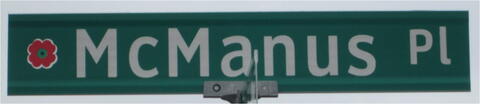
McManus Place
Location
Off of Bonaventure Drive
in Canada
Yes
GPS Coordinates
42.9975591, -81.1538112
Inscription

McManus Pl

Image
Photo Credit
Richard Turcotte
Caption
Photo- McManus Place- street sign (photo by R. Turcotte)
War or Conflict Term
Province
!4v1629465462096!6m8!1m7!1secbXcmRak7fjnZM7d8uLEQ!2m2!1d42.99755914784951!2d-81.15381119158113!3f129.58093627538528!4f5.161247368240481!5f3.3108245202357303"
Body Content

This street is named in memory of Pilot Officer Walter McManus. 


Walter Bartholomew Benedict McManus was born on 11 July 1914 in Muirkirk, ON. He was raised and educated in St. Thomas and went on to study at the University of Western Ontario in London. He pursued law studies, graduating from Osgoode Hall, in Toronto, in 1939. He returned to London to practice in the law firm of the Honourable Arthur M. Lebel but putting aside his law practice, he enlisted in the Royal Canadian Air Force in August 1940. Following the completion of his aircrew training in Canada, he embarked for the UK in June 1941 and undertook fighter pilot training. Assigned to No. 504 Squadron, RAF, he was flying a routine mission from St. Angelo Airfield in County Fermanagh (Northern Ireland) to Ballyhalbert when he crashed near Lurgan, on 7 January 1942. Pilot Officer Walter Bartholomew Benedict McManus is buried at the Ballycranbeg (Mount St. Joseph) Roman Catholic Churchyard, near Ballyhalbert.

City
London
Country
Type Description
Street
Memorial CF Legacy ID
9575
City/Municipality
London
Memorial Number
35042-095
Type
Address
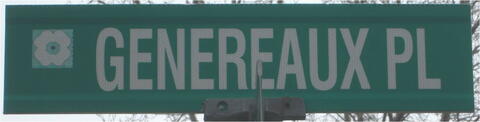
Genereaux Place
Location
Off of Jennifer Road
in Canada
Yes
GPS Coordinates
43.0306424, -81.2714892
Inscription

Genereaux Pl.

Image
Photo Credit
Richard Turcotte
Caption
Photo- Genereaux Place- street sign (photo by R. Turcotte)
War or Conflict Term
Province
!4v1629465132081!6m8!1m7!1sHxtRnmdvyYpvpYEDQN0pKg!2m2!1d43.03064240259145!2d-81.27148917120527!3f116.30496233398628!4f1.9594761927197624!5f3.325193203789971"
Body Content

This street is named in memory of Private John William Genereaux.

John William Genereaux was born on 30 June 1922 in London ON. He attended Tecumseh Public School and H.B. Beal Technical High School before joining the 1st Hussars in November 1942. In January 1943, he transferred to the parachute troops and completed his airborne training that same summer at Shilo, MB. Shortly afterwards, he proceeded overseas and spent the remainder of the year training in England. He parachuted into Normandy on D-Day, 6 June 1944, with the 1st Canadian Parachute Battalion, which was part of the British 3rd Parachute Brigade in the British 6th Airborne Division. The Division was to land in the Caen Canal- Orne River area (the Orne “bridgehead”) centred around Le Mesnil and secure the left flank of the invasion area. After completing their mission and capturing an enemy battery, bridges and the town of Breville-les-Monts, on 07 August the Division received orders to advance east towards the Seine River. It was during the latter operation that Private John William Genereaux died on 11 August 1944. He is buried at the Beny-sur-Mer Canadian War Cemetery.

City
London
Country
Type Description
Street
Memorial CF Legacy ID
9574
City/Municipality
London
Memorial Number
35042-094
Type
Address
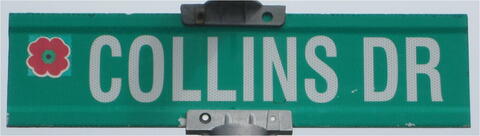
Collins Drive
Location
Off of Schraeder Street
in Canada
Yes
GPS Coordinates
42.9393997, -81.3082708
Inscription

Collins Dr

Image
Photo Credit
Richard Turcotte
Caption
Photo- Collins Drive- street sign (photo by R. Turcotte)
War or Conflict Term
Province
!4v1629463983722!6m8!1m7!1sSQ4hsLrk0N859YCh0CzUAg!2m2!1d42.93939965058393!2d-81.30827082650723!3f175.64501729295085!4f0.15219846711966056!5f3.325193203789971"
Body Content

This street is named in memory of Flight Sergeant Keith Clayton Collins.


Keith Clayton Collins grew up on Kitchener Avenue in London, ON. After completing his schooling, he moved to Toronto for work before enlisting in the Royal Canadian Air Force in 1943. Following the completion of his aircrew training as a Wireless- Air Gunner, he was assigned to No. 78 Squadron, Royal Air Force, flying Halifax bombers. On the night of 4/5 November 1944, his crew was part of a bombing mission to attack Bochum, Germany. During the operation, his plane was hit by a German night fighter and crashed near Margraten, The Netherlands. The rear gunner was the only survivor of the crash and was taken prisoner. Of the remaining crewmembers, only the pilot was found. The others, including Flight Sergeant Keith Clayton Collins, have no known graves and are memorialized at the Runnymede Air Forces Memorial at Englefield Green, just west of Heathrow Airport, England.

City
London
Country
Type Description
Street
Memorial CF Legacy ID
9573