Ontario

Province Code
ON
City/Municipality
London
Memorial Number
35042-012
Type
Address
701 Oxford Street East
Location
Inside the Royal Canadian Regiment Museum
in Canada
Yes
GPS Coordinates
43.0000809, -81.2342582
Inscription

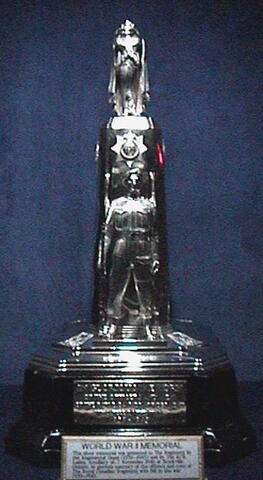
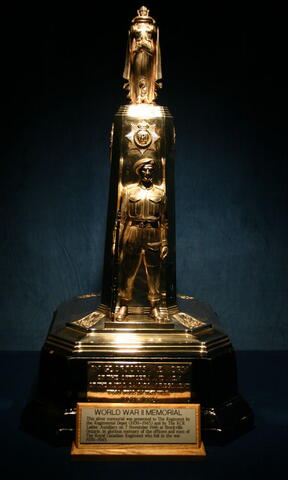
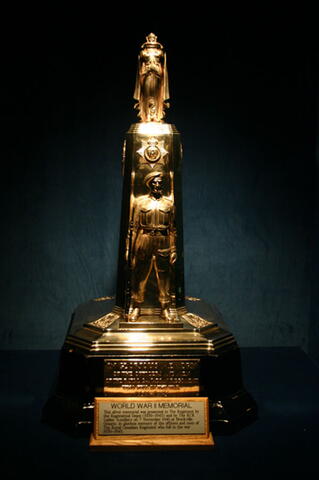
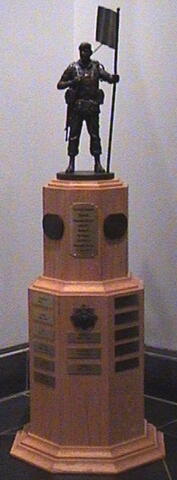
IN GLORIOUS MEMORY
OF THE OFFICERS AND MEN
OF THE ROYAL CANADIAN
REGIMENT
WHO FELL IN THE WAR
1939 - 1945

WORLD WAR II MEMORIAL

[The wording on the bottom plaque is not clear./Le texte de la plaque du bas n’est pas clair.]

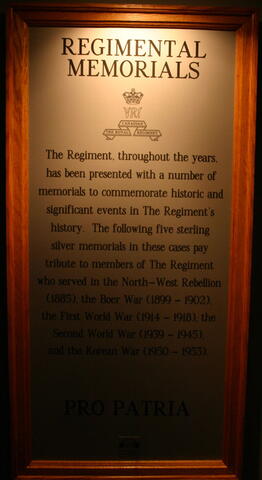
[plaque/plaque]

REGIMENTAL MEMORIALS

THE ROYAL CANADIAN REGIMENT

The Regiment, throughout the years,
has been presented with a number of
memorials to commemorate historic and
significant events in The Regiment's
history. The following five sterling
silver memorials in these cases pay
tribute to members of The Regiment
who served in the North-West Rebellion
(1885), the Boer War (1899 - 1902),
the First World War (1914 - 1918), the
Second World War (1939 - 1945),
and the Korean War (1950 - 1953).

PRO PATRIA

Image
Photo Credit
Patricia Grimshaw; Ken Reynolds
Caption
front view
1 of 4 images
Image
Caption
front view
1 of 4 images
Image
Caption
front view
1 of 4 images
Image
Caption
plaque
1 of 4 images
Province
!4v1626810386083!6m8!1m7!1sjgZHAzzoY-kDV8qG_YR09A!2m2!1d43.00008093339216!2d-81.23425824097922!3f67.73608806856353!4f15.88851259571662!5f0.7820865974627469"
Body Content

This memorial is dedicated to the officers and men of the Royal Canadian Regiment who died in the Second World War. This silver memorial was presented to the Regiment by the Regimental Depot (1939-1945) and by The Ladies' Auxiliary on November 7th, 1946.

City
London
Country
Type Description
Silver and wood statuette/plaque
Memorial CF Legacy ID
6360
City/Municipality
London
Memorial Number
35042-011
Type
Address
701 Oxford Street East
Location
Inside the Royal Canadian Regiment Museum
in Canada
Yes
GPS Coordinates
43.0000809, -81.2342582
Inscription

THE ROYAL CANADIAN
REGIMENT
PEACEKEEPING MEMORIAL
DEDICATED TO
MEMBERS OF
THE REGIMENT
WHO SERVED IN
PEACEKEEPING OPERATIONS
21 MAY 1995

[The balance of the plaques are not clear./Le reste du texte figurant sur les plaques n’est pas clair.]

Image
Photo Credit
Patricia Grimshaw
Caption
front view
Province
!4v1626795328128!6m8!1m7!1sjgZHAzzoY-kDV8qG_YR09A!2m2!1d43.00008093339216!2d-81.23425824097922!3f63.57391452315831!4f16.750322336526835!5f0.7820865974627469"
Body Content

This memorial is dedicated to those who served in the Royal Canadian Regiment and served in peacekeeping operations.

City
London
Country
Type Description
Bronze and wood statuette
Memorial CF Legacy ID
6359
City/Municipality
London
Memorial Number
35042-010
Type
Address
580 Clarence Street
Location
Victoria Park
in Canada
Yes
GPS Coordinates
42.9907228, -81.2491655
Inscription

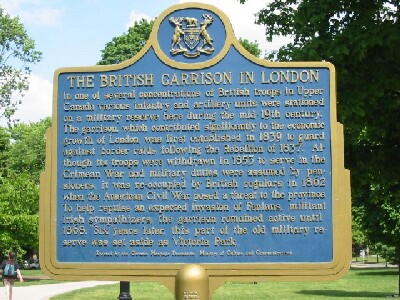
THE BRITISH GARRISON IN LONDON

In one of several concentrations of British troops in Upper
Canada, various infantry and artillery units were stationed
on a military reserve here during the mid-19th century.
The garrison, which contributed significantly to the economic
growth of London, was first established in 1839 to guard
against border raids following the Rebellion of 1837. Al-
though its troops were withdrawn in 1853 to serve in the
Crimean War and military duties were assumed by pen-
sioners, it was re- occupied by British regulars in 1862
when the American Civil War posed a threat to the province.
To help repulse an expected invasion of Fenians, militant
Irish sympathizers, the garrison remained active until
1868. Six years later, this part of the old military re-
serve was set aside as Victoria Park.

Erected by the Ontario Heritage Foundation, Ministry of Culture and Communication

LA GARNISON BRITANNIQUE À LONDON

Au milieu du XIXe siècle, diverses unités d'infanterie et d'artillerie des nombreuses troupes britanniques se trouvant au Haut-Canada tiennent garnison ici dans une réserve militaire. La garnison, qui contribue sensiblement à la croissance économique de London, est établie pour la première fois en 1839 pour protéger la frontière des incursions qui suivent la rébellion de 1837. Les troupes partent en 1853 pour la guerre de Crimée et réoccupent les lieux en 1862 lorsque la guerre civile américaine devient menaçante pour la province
entre temps, les tâches militaires sont assumées par des militaires retraités. La garnison demeure en activité jusqu'en 1868 pour parer à une invasion attendue de Fénians, sympathisants irlandais militants. Six ans plus tard, cette partie de l'ancienne réserve militaire devient le parc Victoria.

Image
Photo Credit
(www.ontarioplaques.com)
Caption
front
Province
!4v1635527417828!6m8!1m7!1sJrlA5grCBJZGPZHLFuYOLw!2m2!1d42.99072275646908!2d-81.24916551588258!3f168.17773495579624!4f1.1308797472974845!5f3.325193203789971"
Body Content

The title of this plaque is British Garrison in London. It was erected in 1957.

City
London
Country
Type Description
Provincial Military Plaque
Memorial CF Legacy ID
4558
City/Municipality
London
Memorial Number
35042-009
Type
Address
701 Oxford Street East
Location
Royal Canadian Regiment Museum
in Canada
Yes
GPS Coordinates
43.0000809, -81.2342582
Inscription

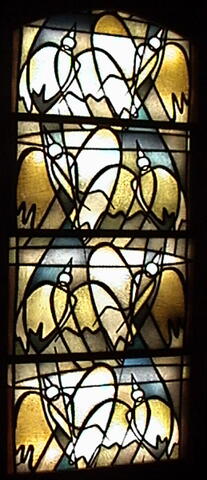
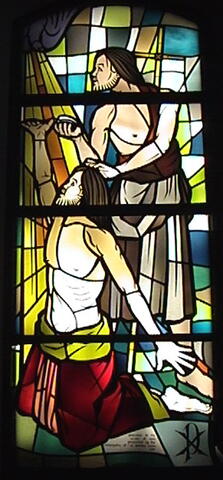
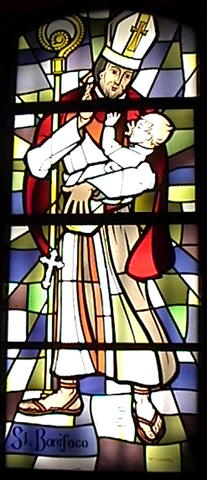
DEDICATED TO THE GLORY OF GOD
IN MEMORY OF THOSE MEMBERS
OF 1 RCR
WHO LOST THEIR LIVES WHILE
SERVING IN GERMANY
1962 - 65

DEDICATED TO THE
GLORY OF GOD
PRESENTED BY THE
CONGREGATION OF ST. BONIFACE CHAPEL

DEDICATED TO THE GLORY OF GOD
IN MEMORY OF THOSE MEMBERS
OF 1 RCR
WHO LOST THEIR LIVES WHILE
SERVING IN GERMANY
1962 - 65

Image
Photo Credit
Patricia Grimshaw
Caption
stained glass window
1 of 4 images
Image
Caption
stained glass window
1 of 4 images
Image
Caption
stained glass window
1 of 4 images
Image
Caption
stained glass window
1 of 4 images
Province
!4v1626794182295!6m8!1m7!1sjgZHAzzoY-kDV8qG_YR09A!2m2!1d43.00008093339216!2d-81.23425824097922!3f63.48515507703045!4f8.380049705181236!5f0.7820865974627469"
Body Content

The windows came from chapels in Fort York Germany and were removed upon the Canadian army moving to south Germany.

City
London
Country
Type Description
Stained glass windows
Memorial CF Legacy ID
6562
City/Municipality
London
Memorial Number
35042-008
Type
Address
701 Oxford Street East
Location
Inside the Royal Canadian Regiment Museum
in Canada
Yes
GPS Coordinates
43.0000809, -81.2342582
Inscription

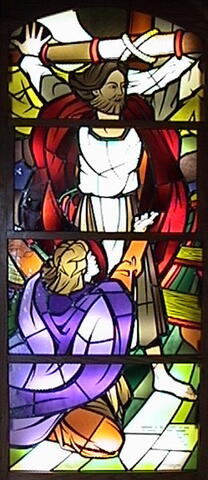
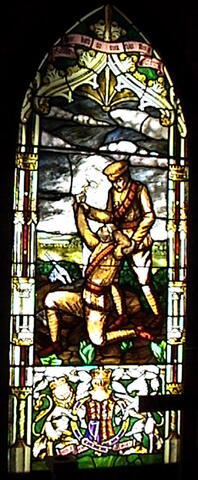
THIS WINDOW WAS ORIGINALLY INSTALLED BY THE
CONGREGATION OF BETHESDA CHURCH, THORNDALE, ONTARIO
IN LOVING MEMORY OF PRIVATE EVERETT FITZGERALD
WHO DIED OF WOUNDS RECEIVED IN SANCTUARY WOOD
MAY 10TH 1916 AND WHO IS BURIED NEAR YPRES.
IT HAS BEEN PLACED IN THIS ROOM BY HIS FAMILY,
THE CHURCH CONGREGATION AND THE RCR ASSN. AS A
TRIBUTE TO AND IN MEMORY OF ALL THE FALLEN OF
THE CANADIAN FORCES
NOVEMBER 9TH 1974

Image
Photo Credit
GW Norman; Patricia Grimshaw; Ken Reynolds
Caption
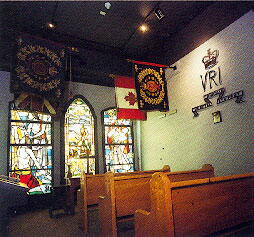
The Memorial Window in the Quiet Room
1 of 3 images
Image
Caption
stained glass window
1 of 3 images
Image
Caption
stained glass window
1 of 3 images
War or Conflict Term
Province
!4v1626793938666!6m8!1m7!1sjgZHAzzoY-kDV8qG_YR09A!2m2!1d43.00008093339216!2d-81.23425824097922!3f69.17571030735887!4f7.940542260161607!5f0.7820865974627469"
Body Content

The windows left and right came from chapels in Fort York Germany and were removed upon the Canadian army moving to south Germany. The window in the centre was donated to the museum by a local rural church (the Bethesda United Church) that was being demolished (in January 1974), it depicts a First World War Canadian soldier in France. This window had been dedicated to the Memory of Private Everett Fitzgerald who was killed in the First World War. The window, originally designed by Hobbs Glass Company of London, Ontario in 1919, is now dedicated to all of the Fallen of the Canadian Forces.

City
London
Country
Type Description
Memorial Window
Memorial CF Legacy ID
4692
City/Municipality
London
Memorial Number
35042-007
Type
Address
701 Oxford Street East
Location
Inside the Royal Canadian Regiment Museum
in Canada
Yes
GPS Coordinates
43.0000809, -81.2342582
Inscription

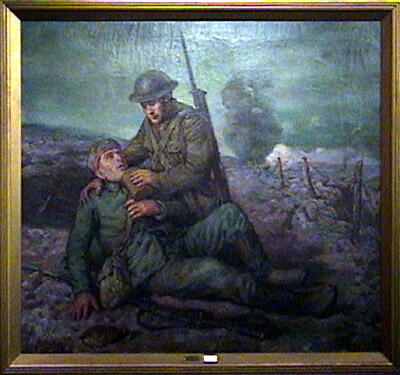
Modern Samaritan
Painted in 1918
by Edward R. Glen

Image
Photo Credit
GW Norman; Patricia Grimshaw
Caption
oil painting
War or Conflict Term
Province
!4v1626793011482!6m8!1m7!1sjgZHAzzoY-kDV8qG_YR09A!2m2!1d43.00008093339216!2d-81.23425824097922!3f63.90290753595657!4f11.702843162535999!5f0.7820865974627469"
Body Content

An original oil painting "The Modern Samaritan" by Mr. Edward Glen of London, Ontario, which was completed in 1918 as a personal memorial to First World War Veterans.

City
London
Country
Type Description
Original oil painting
Memorial CF Legacy ID
4691
City/Municipality
London
Memorial Number
35042-006
Type
Address
701 Oxford Street East
Location
Inside the Royal Canadian Regiment Museum
in Canada
Yes
GPS Coordinates
43.0000809, -81.2342582
Inscription

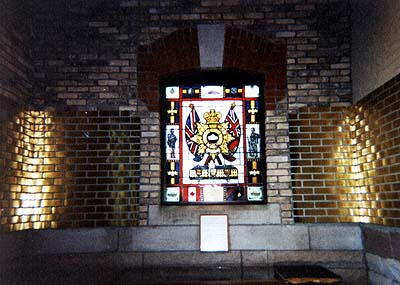
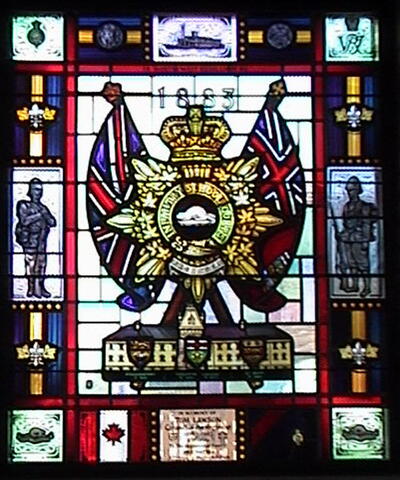
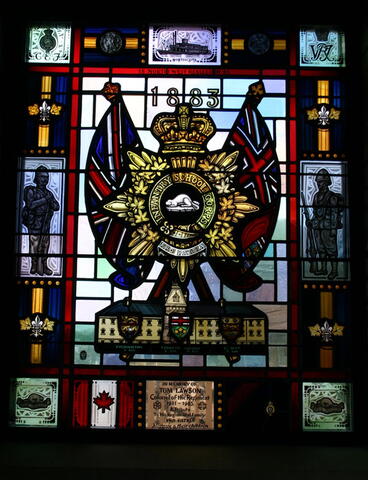
IN MEMORY OF
TOM LAWSON
COLONEL OF THE REGIMENT
1981-1985
A TRIBUTE
TO HIS REGIMENTAL FAMILY
PRO PATRIA
MIGGSIE & THEIR CHILDREN

Image
Photo Credit
GW Norman; Patricia Grimshaw; Ken Reynolds
Caption
Window at entrance of RCR Museum
1 of 3 images
Image
Caption
stained glass window
1 of 3 images
Image
Caption
front view
1 of 3 images
War or Conflict Term
Province
!4v1626792612929!6m8!1m7!1sjgZHAzzoY-kDV8qG_YR09A!2m2!1d43.00008093339216!2d-81.23425824097922!3f73.30421819839411!4f5.21671793011059!5f0.7820865974627469"
Body Content

Royal Canadian Regiment (RCR) memorial dedicated to Brig Lawson killed in Hong Kong in 1941 (December) - An RCR Officer. This window was designed and installed in 1991. The entrance has a gold brick wall in memory of RCR deceased.

City
London
Country
Type Description
Stained Glass Window and Gold Brick Wall
Memorial CF Legacy ID
4687
City/Municipality
London
Memorial Number
35042-005
Type
Address
580 Clarence Street
Location
Victoria Park
in Canada
Yes
GPS Coordinates
42.9903833, -81.2494633
Inscription

[left side/côté gauche]

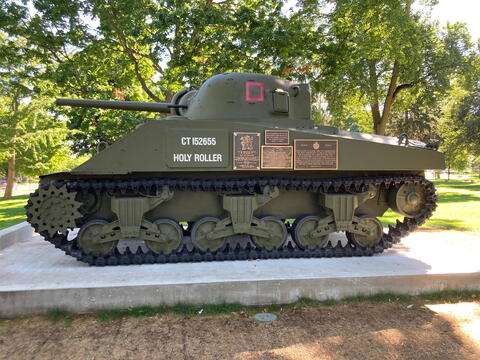
CT 152655
HOLY ROLLER

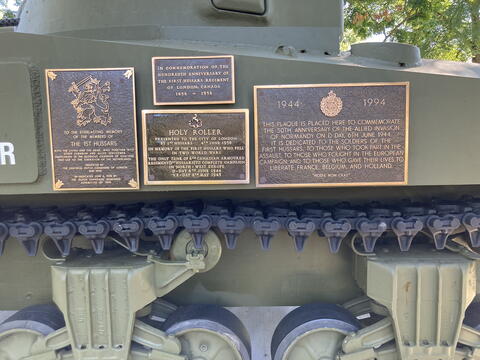
(plaque)
TO THE EVERLASTING MEMORY
OF THE MEMBERS OF
THE 1ST HUSSARS

BOTH THE LIVING AND THE DEAD, WHO TOGETHER WITH
OTHER ALLIED CANADIAN AND ALLIED SERVICEMEN
PARTICIPATED IN THE GLORIOUS CAMPAIGN OF 1944-1945
THE LED TO THE LIBERATION OF THE NETHERLANDS

PRESENTED BY:
THE GRATEFUL DUTCH CANADIANS OF LONDON
MAY 1970

RE-DEDICATED JUNE 6, 1998 BY:
THE DUTCH CANADIANS REMEMBER
COMMITTEE OF 1995

(plaque)
IN COMMEMORATION OF THE
HUNDREDTH ANNIVERSARY OF
THE FIRST HUSSARS REGIMENT
OF LONDON, CANADA
1856 - 1956

(plaque)
HOLY ROLLER
PRESENTED TO THE CITY OF LONDON
BY 1st HUSSARS      4th JUNE 1950
IN MEMORY OF THE FIRST HUSSARS WHO FELL
IN TWO WORLD WARS
THE ONLY TANK OF THE 6th CANADIAN ARMOURED
REGIMENT (1st HUSSARS) TO COMPLETE CAMPAIGN
IN NORTH-WEST EUROPE
D-DAY 6th JUNE 1944
VE-DAY 8th MAY 1945

(plaque)
1944     1994
THIS PLAQUE IS PLACED HERE TO COMMEMORATE
THE 50TH ANNIVERSARY OF THE ALLIED INVASION
OF NORMANDY ON D DAY, 6TH JUNE 1944.
IT IS DEDICATED TO THE SOLDIERS OF THE
FIRST HUSSARS; TO THOSE WHO TOOK PART IN THE
ASSAULT, TO THOSE WHO FOUGHT IN THE EUROPEAN
CAMPAIGN, AND TO THOSE WHO GAVE THEIR LIVES TO
LIBERATE FRANCE, BELGIUM AND HOLLAND.
"HODIE NON CRAS"

[right side/côté droit]

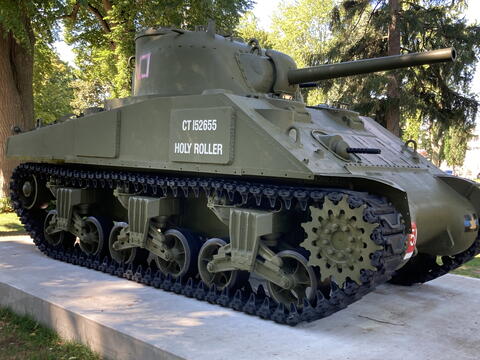
CT 152655
HOLY ROLLER

Image
Photo Credit
Lieutenant Colonel Joe Murray (ret'd)
Caption
1st Hussars Memorial
1 of 4 images
Image
Photo Credit
Lieutenant Colonel Joe Murray (ret'd)
Caption
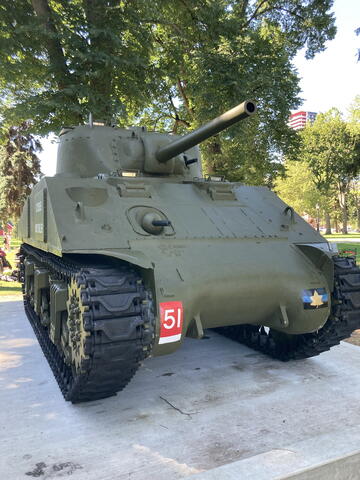
front
1 of 4 images
Image
Photo Credit
Lieutenant Colonel Joe Murray (ret'd)
Caption
right side
1 of 4 images
Image
Photo Credit
Lieutenant Colonel Joe Murray (ret'd)
Caption
plaques on left side
1 of 4 images
Province
!4v1660239213870!6m8!1m7!1sLhzR6uW5c3b7xzc2zbBusg!2m2!1d42.99066208893861!2d-81.24939281626122!3f168.05888927592375!4f-2.8479130030163446!5f1.7970957225041149
Body Content

This memorial was dedicated on 4 June 1950 to the members of the 1st Hussars who died in the Second World War. In 1945, HOLY ROLLER was designated by military authorities as a vehicle with significant historical and sentimental value to the 1st Hussars and as such was authorized to be returned to Canada as a regimental trophy.

HOLY ROLLER is the only tank of the 1st Hussars and one of only two Canadian Army Sherman tanks to have survived the Second World War from D-Day, 6 June 1944, to VE-Day 8 May 1945. During that time the 1st Hussars lost 346 tanks. HOLY ROLLER landed on Juno Beach just 20 minutes behind the initial assault wave. The other tank, named Bomb, was operated by The Sherbrooke Hussars and is on display at William Street Armoury in Sherbrooke, Quebec. 

Plaques added to the memorial include the 100th Anniversary of the First Hussars Plaque, the 1st Hussars Liberation of Netherlands Plaque (placed by the Dutch Canadians Remember Committee) and the 1st Hussars 50th Anniversary of D-Day Plaque.

In May 2017, the city unsealed the tank for the first time since its dedication to assess its state of repair. The Sherman III (M4A2) tank, HOLY ROLLER, was moved from Victoria Park to Fanshawe College on 8 June 2021 to undergo significant repair and preservation work. The work amounted to more than 10,000 hours undertaken by a group of dedicated volunteers with more than 1,000 additional hours of technical and material support from many local businesses. More than $200,000 was raised mainly through individual and group donations with additional grants from the Federal government. Some scarce components used during the repair work had to be sourced in Belgium and France. HOLY ROLLER was returned to Victoria Park on 31 May 2022 and rededicated on 5 June 2022.

On the right of the hull is the unit identifier - a white 51 on a red square that was assigned to the 1st Hussars. Their official title during the war was 6th Canadian Armoured Regiment (1st Hussars), but the unit always referred to themselves as 1st Hussars. The white bar under the red square indicates they were part of an independent Armoured Brigade. The hollow red square on the turret indicates that HOLY ROLLER was a vehicle belonging to B-Squadron. The colour red indicates that the 1st Hussars were the senior regiment out of 3 in the 2nd Armoured Brigade. Holly Roller landed on D-Day as part of the Regimental Headquarters and up until the middle of June 1944 had a red diamond in place of the square. After the disastrous battle of Le Mesnil-Patry on 11 June it was moved to B-Squadron as the commanding officer’s tank during the reorganization of the regiment and remained there for the rest of the war.

The marking on the left of the hull with the maple leaf is the unit identifier for the 2nd Canadian Armoured Brigade which the regiment was part of. 

HOLY ROLLER is an early version of American Medium tank M4A2, known as a Sherman III in British and Commonwealth service. It was built at Fisher Tank Arsenal in Grand Blanc, Michigan, during the last week of September 1942 and in late 1943 underwent a series of modifications at the Lima Tank Depot in Ohio to incorporate several improvements that resulted from battlefield experience. These included additional applique armour over the hull ammunition racks.

HOLY ROLLER was issued new to the 1st Hussars in May of 1944 just weeks prior to departing for France. Under the command of Major Frank White Second in Command of the Regiment (2ic) it landed on Juno Beach 20 minutes behind the first assault wave. Shortly after it was taken over by Regimental Commander Lieutenant Colonel Ray Colwell when his tank was disabled by a mine as it moved off the beach. HOLY ROLLER proceeded inland approximately seven miles to the Regiment’s first harbour in France at Pierrepont before being sidelined with a broken fuel line. Repaired overnight HOLY ROLLER remained in the thick of the action during the intense battle for the beachhead. On June 8 in what has been described as one of the epic battles of the beachhead, HOLY ROLLER, again under the command of the Regimental 2ic Major Frank White, lead the 1st Hussars in support of the Canadian Scottish Regiment during the recapture of Putot-en-Bessin which had been lost earlier that day to a German counter attack. Positioned on the right flank of the attack the Hussars found themselves often engaging enemy targets over the heads of the infantry while eliminating several machine gun and mortar positions.   

On June 11, the Regiment attacked the Germans at Le Mesnil-Patry. HOLY ROLLER, commanded by Major White, was with the Regimental Headquarters a short distance behind the leading squadrons at Norrey-en-Bessin which was under heavy artillery and mortar fire for the entire battle. The Germans handed the 1st Hussars a crushing defeat that day and as the lead squadrons retreated, Major White in HOLY ROLLER, organized a defensive position using the surviving tanks of C Squadron and a troop from A Squadron to cover the withdrawal and block the anticipated German Counter attack. In the reorganization following the battle, HOLY ROLLER was sent to B Squadron as the Squadron Commander’s vehicle and here it remained for the rest of the war.

During the next ten months HOLY ROLLER was hit four times by enemy fire and although damaged protected the crew and remained in the fight. The first hit likely occurred on July 18 in the fighting around Caen with a direct hit on the glacis plate which was fortunately deflected by a section of track welded to the hull as additional armour. This hit required the main gun to be replaced, but it was soon back in action. B Squadron and HOLY ROLLER were in the thick of the fighting and often leading. The second hit probably occurred on July 26 near May-sur-Orne where the B Squadron Commander was wounded. This time the track welded to the hull as additional armour was blown completely off, but both tank and crew survived to fight on. The next day B & C Squadrons were combined due to the heavy losses of the previous day. The third hit in less than a month occurred in the fighting around Bretteville-sur-Laize on August 9. Squadron Commander Major JW Powell was wounded and once again HOLY ROLLER was saved by the add on armour. In September, B Squadron and HOLY ROLLER participated in the capture of the huge cross channel guns at Cape Gris Nez and Calais under truly appalling conditions.    

After traveling an almost record 1500 miles the clutches needed to be replaced. The tank was next engaged at the end of October when the 1st Hussars assisted the Polish Armoured Division in the capture of Breda in Holland. The next action took place in mid-January when both A & B Squadrons were dispatched to aid a British unit in clearing the Germans out of Hemmen Castle and the town of Zetten near Nijmegen Holland. Here for the first time the Hussars were engaged in supporting the infantry in a built-up area and were subjected to intense anti-tank, sniper, and bazooka fire at close range. HOLY ROLLER came through needing no more than new injectors for the engines. On February 8 the tank was in action as B Squadron fired over 1000 rounds in support of Operation Veritable, the allied attack into the Reichswald and Siegfried Line.

Later in February and early March HOLY ROLLER took part in Operation Blockbuster the final drive to the Rhine. During the 9-day period from February 26 through March 7, 1945 the 1st Hussars with a normal strength of 61 tanks lost 82 Shermans. On the final day, the Regiment could muster only 17 operational tanks. HOLY ROLLER answered the call and its next major action was almost the last. Advancing on Apeldoorn Holland, it was hit by an 88mm anti-tank gun and this time luck ran out. The hit knocked out several suspension components on one side rendering the tank immobile. In the words of the Regimental Commander Lieutenant Colonel Frank White “Tanks had been abandoned for less, but HOLY ROLLER was a legend by now and had to be saved”. In a very unusual move, six 1500-pound suspension units were brought forward and installed in record time by members of the Unit’s echelon and #54 Light Aid Detachment attached to the unit under the command of Captain Proctor Neil. The end of the war found HOLY ROLLER at Godensholt Germany. It had advanced some 2500 miles, participated in 14 major Battles, and out lasted 346 other tanks.   

By mid-September 1945, HOLY ROLLER was designated for return to Canada. It left Antwerp, Belgium on 17 March 1946 aboard the SS Hamstead Park. A brief stop in Camp Borden placed the tank in like new condition. It arrived in London and was displayed in front of the Armouries in June of 1946. In 1949, HOLY ROLLER was turned over to the City of London and placed in Queens Park as a war memorial. As part of the Regiment’s 100th Anniversary celebrations in 1956, the tank was moved to its current location in Victoria Park.

City
London
Country
Type Description
Vehicle - Sherman III (M4A2) tank
Memorial CF Legacy ID
4693
City/Municipality
London
Memorial Number
35042-004
Type
Address
701 Oxford Street East
Location
On the grounds of the Royal Canadian Regiment Museum
in Canada
Yes
GPS Coordinates
43.0006122, -81.2345332
Inscription

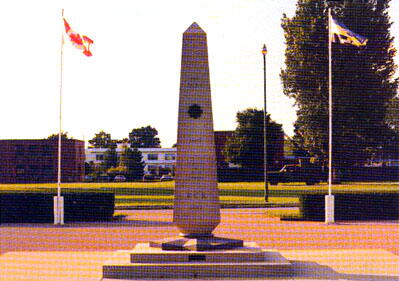
PRO PATRIA
1883
IN MEMORY
OF
FALLEN
COMRADES
THE
RCR
1959

Image
Photo Credit
GW Norman; Patricia Grimshaw
Caption
Presentation of Colours (26 may 1932)
Province
!4v1626790650247!6m8!1m7!1sErPm6DASAG7KLMU8TmyTiA!2m2!1d43.00061221894985!2d-81.23453321115514!3f98.25335144358466!4f2.888532863403057!5f3.325193203789971"
Body Content

This memorial is dedicated to the Royal Canadian Regiment (RCR). The RCR is Canada's senior Regular Force infantry regiment and has served the country continuously since 1883. The Regiment has seen action in the North-West Rebellion of 1885, the South African War, First and Second World Wars, Korea and Gulf War. Battalions of The Regiment have served on NATO duty in Europe and on United Nations Peacekeeping operations in Cyprus and the former Yugoslavia. The Regiment consists of a Regimental Headquarters, three Regular Force battalions, and a Reserve Force battalion. The Home Station is Wolseley Barracks in London, Ontario where Regimental Headquarters and the 4th Battalion are located.

City
London
Country
Type Description
Obelisk
Memorial CF Legacy ID
4689
City/Municipality
London
Memorial Number
35042-003
Type
Address
701 Oxford Street East
Location
Inside the Royal Canadian Regiment Museum
in Canada
Yes
GPS Coordinates
43.0000809, -81.2342582
Inscription

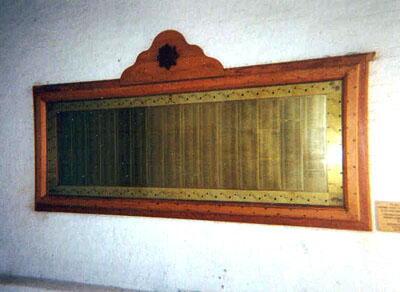
[The names of the fallen since 1883 are inscribed, but are not clear in the phot./Les noms des membres du régiment tombés depuis 1883 sont inscrits, mais ils ne sont pas clairs sur la photo.]

Image
Photo Credit
GW Norman; Patricia Grimshaw
Caption
Regiment's Roll of Honour
Province
!4v1626789803280!6m8!1m7!1sjgZHAzzoY-kDV8qG_YR09A!2m2!1d43.00008093339216!2d-81.23425824097922!3f70.05160114263451!4f15.275395989435268!5f0.8271550139048903"
Body Content

This memorial is dedicated to the Royal Canadian Regiment killed in NW Rebellion, First and Second World Wars, Korean War and UN Peacekeeping. It was erected by the Royal Canadian Regiment Association on June 30, 1983. The RCR is Canada's senior Regular Force infantry regiment and has served the country continuously since 1883. The Regiment has seen action in the North-West Rebellion of 1885, the South African War, First and Second World Wars, Korea and Gulf War. Battalions of The Regiment have served on NATO duty in Europe and on United Nations Peacekeeping operations in Cyprus and the former Yugoslavia. The Regiment consists of a Regimental Headquarters, three Regular Force battalions, and a Reserve Force battalion. The Home Station is Wolseley Barracks in London, Ontario where Regimental Headquarters and the 4th Battalion are located.

City
London
Country
Type Description
Roll of Honour
Memorial CF Legacy ID
4688