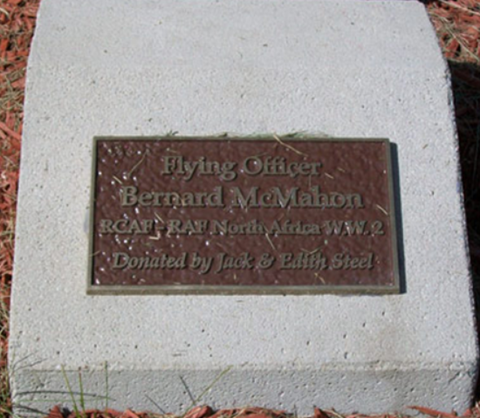
The Flying Officer Bernard McMahon Memorial consists of a bronze plaque and tree along Veterans Way.
Flying Officer Bernard McMahon Memorial
Flying Officer
Bernard McMahon
RCAF - RAF North Africa W.W.2
Donated by Jack & Edith Steel
Sign in to My VAC Account
Sign in to My VAC AccountFlying Officer
Bernard McMahon
RCAF - RAF North Africa W.W.2
Donated by Jack & Edith Steel
The Flying Officer Bernard McMahon Memorial consists of a bronze plaque and tree along Veterans Way.
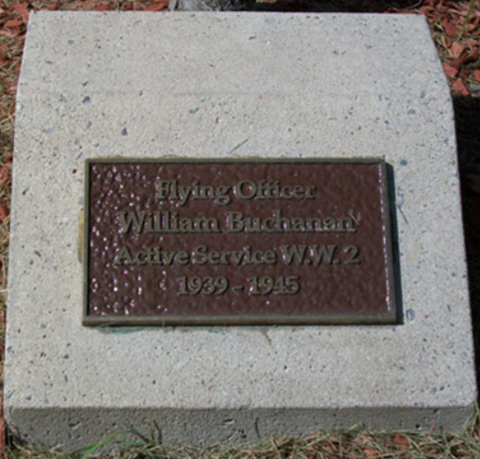
Flying Officer
William Buchanan
Active Service W.W.2
1939 - 1945
The Flying Officer William Buchanan Memorial consists of a bronze plaque and tree along Veterans Way.
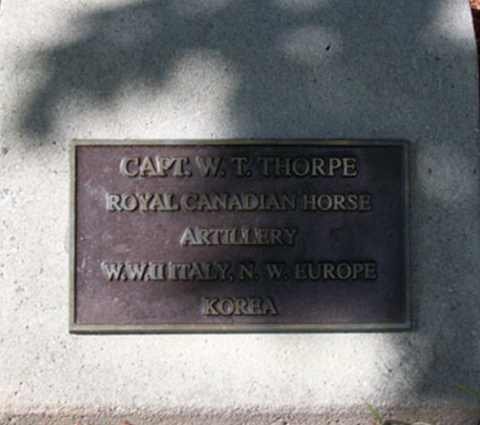
CAPT. W.T. THORPE
ROYAL CANADIAN HORSE
ARTILLERY
W.W.II ITALY, N.W. EUROPE
KOREA
The Captain W.T. Thorpe Memorial consists of a bronze plaque and tree along Veterans Way.
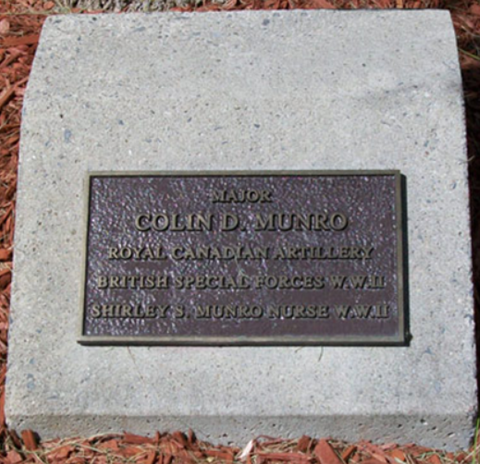
MAJOR
COLIN D. MUNRO
ROYAL CANADIAN ARTILLERY
BRITISH SPECIAL FORCES W.W.II
SHIRLEY S. MUNRO NURSE W.W.II
The Munro Memorial consists of a bronze plaque and tree along Veterans Way.
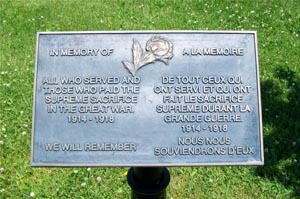
| IN MEMORY OF ALL WHO SERVED AND THOSE WHO PAID THE SUPREME SACRIFICE IN THE GREAT WAR 1914-1918 WE WILL REMEMBER |
À LA MÉMOIRE DE TOUT CEUX QUI ONT SERVI ET QUI ONT FAIT LE SACRIFICE SUPRÊME DURANT LA GRANDE GUERRE 1914-1918 NOUS NOUS SOUVIENDRONS D'EUX |
On May 25, 2002, at the official opening of Veterans Way, this plaque dedicated to military personnel who served in the First World War was unveiled.
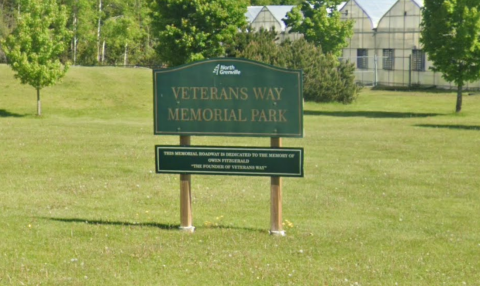
[sign/enseigne]
North
Grenville
VETERANS WAY
MEMORIAL PARK
THIS MEMORIAL ROADWAY IS DEDICATED TO THE MEMORY OF
OWEN FITZGERALD
"THE FOUNDER OF VETERANS WAY"
Veterans Way Memorial Park was dedicated on September 27, 2015 and began with a field concert performed by the Central Band of the Canadian Armed Forces. The ceremony was well attended by local dignitaries, special guests and Veterans representing the Army Navy and Air Force Veterans in Canada, Provincial and Zone Command officers of the Royal Canadian Legion and the NATO Veterans Organization of Canada along with retired and serving members of the Canadian Armed Forces, their families and friends.
The park is a special site of remembrance and reflection that was created to honour all those that served and continue to serve in the Canadian, British and United States of America Armed Forces. The concept for a Veterans Way Memorial Park was brought to the attention of North Grenville Municipal Council through a site and business plan that was developed by the Veterans Way Memorial Committee comprised of Chairman Owen Fitz'Gerald, Communications Officer Roy Brown, Councillor Tim Sutton and Douglas Brunton. It was unanimously approved and adopted by Council on August 8, 2011.
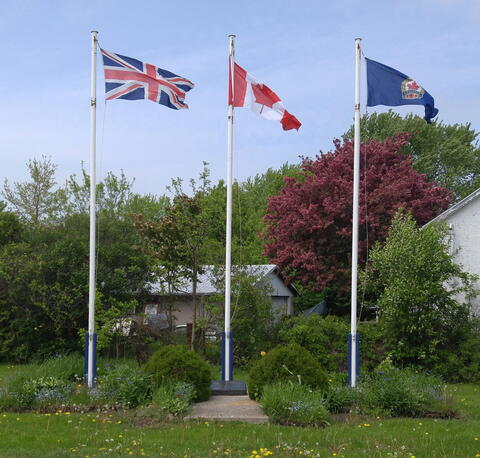
During the years that followed, three flagpoles flying the Canadian, Royal Union (Union Jack) and United States of America flags were added to the site along with park identification signage, two steel park benches and finally an M109A4+ Self-Propelled Howitzer Memorial Monument.
needs further research/recherche incomplète
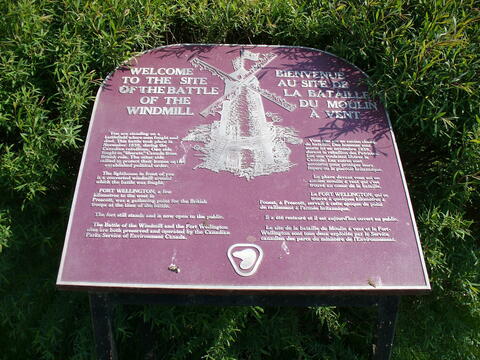
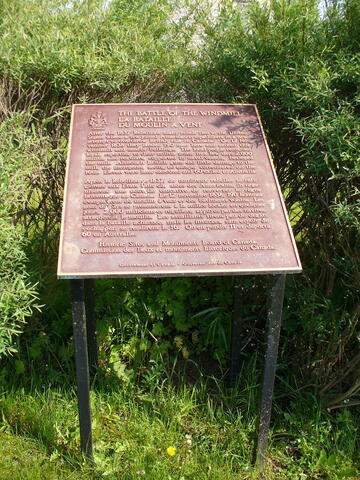
The Battle of the Windmill in 1838 was a bloody event in the complex struggle between the Family Compact and the Reformers for control of the British colony of Upper Canada. The turning point in the struggle in Upper Canada was the election for members of the Legislative Assembly in 1836. With the support of the Lieutenant-Governor, Sir Francis Bond Head, the backers of the Family Compact successfully turned the campaign into a choice between loyalty and disloyalty to the crown. The election went against the Reformers and their defeat convinced William Lyon Mackenzie and his radical followers that the time had come for armed rebellion. The stage was set for the events of 1837 - 1838 which endangered the survival of Upper Canada as a British colony.
Mackenzie and his followers fled across the border into New York State and their escape produced a more serious danger to the colony than their attempt at rebellion. Many Americans were convinced that the Canadian colonists were a downtrodden people anxious to overthrow British rule and create a republic modelled after their own. They focused on this anti-British sentiment and the Canadian presence became the catalyst for the creation of a secret organization whose members were known as Hunters, which sprang up along the border from Maine to Ohio. It is estimated that, in New York State alone, 283 Hunters lodges were established with over 20,000 members.
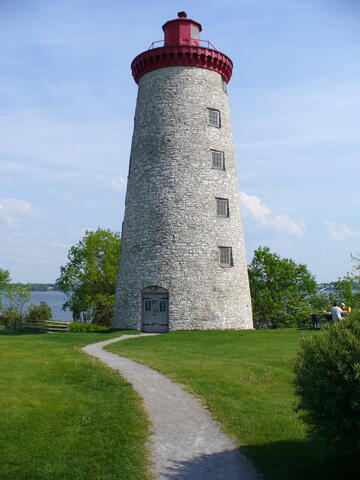
The stone windmill that became the focus of the Battle of the Windmill in November 1838 still stands. Sixty feet in height with thick rubble stone walls, the windmill itself is at the top of a steep slope that rises thirty feet above the river. In the early morning hours of November 12, vessels were spotted heading to the shore and the alarm bell sounded to defend the town. The events that unfolded were bloody and tragic. The Hunters, numbered about 250 men, expected they would be joined by countless discontented Canadians when they landed at Windmill Point. Their newly-elected commander, Nils von Schoultz, seemed an ideal leader for their enterprise.
On November 13, at about 9 o'clock, the British troops numbering nearly 600, were on the move. The fighting went on for five hours, at which time the British withdrew, leaving the Hunters still in control of the windmill site. A later report stated that 13 British soldiers were killed and 78 wounded, while the Hunters were thought to have lost 18 killed, 20 wounded and 26 taken prisoner.
At 3:30 in the afternoon on November 16, the British artillery, 1000 strong, started bombarding the windmill. The fighting was over by 6 o'clock with the surviving Hunters either laying down their arms or fleeing the battle field under the cover of darkness.

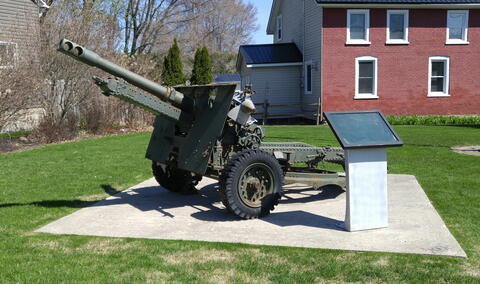
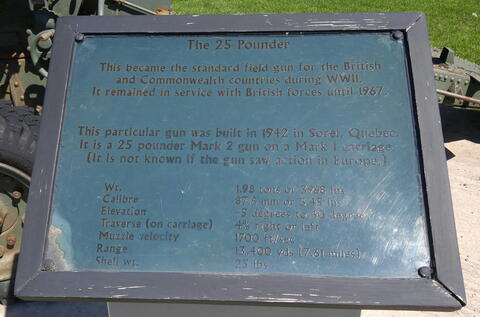
The 25 Pounder
This became the standard field gun for the British
and Commonwealth countries during WWII.
It remained in service with British forces until 1967.
This particular gun was built in 1942 in Sorel, Quebec.
It is a 25 pounder Mark 2 gun on a Mark 1 carriage.
(It is not known if the gun saw action in Europe.)
Wt. 1.98 tons or 3968 lbs
Calibre 87.6mm or 3.45 ins
Elevation -5 degrees to 40 degrees
Traverse (on carriage) %4 right or left
Muzzle velocity 1700 ft/sec
Range 13,400 yds (7.61 miles)
Shell wt. 25 lbs
The 25 Pounder became the standard field gun for the British and Commonwealth countries during the Second World War. It remained in service with British forces until 1967. This particular gun was built in 1942 in Sorel, Quebec. It is a 25 pounder Mark 2 gun on a Mark 1 carriage. It is not known if the gun saw action in Europe.
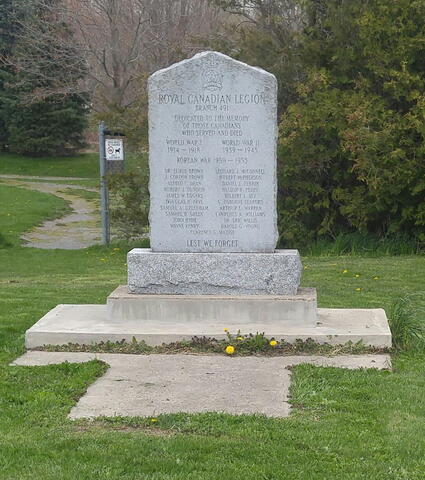
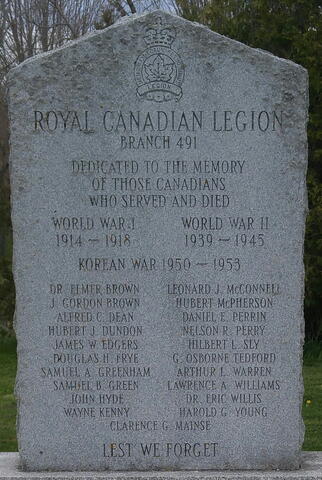
ROYAL CANADIAN LEGION
BRANCH 491
DEDICATED TO THE MEMORY
OF THOSE CANADIANS
WHO SERVED AND DIED
WORLD WAR I
1914 - 1918
WORLD WAR II
1939 - 1945
KOREAN WAR 1950 - 1953
LEST WE FORGET
[stone/pierre]
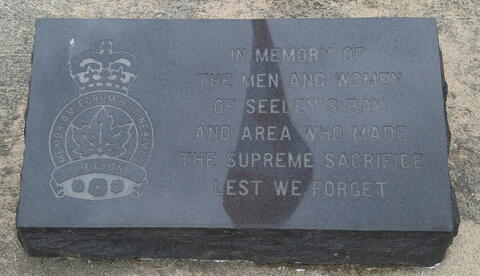
IN MEMORY OF
THE MEN AND WOMEN
OF SEELY'S BAY
AND AREA WHO MADE
THE SUPREME SACRIFICE
LEST WE FORGET
needs further research
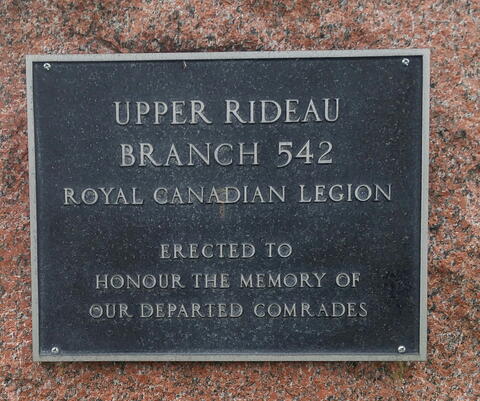
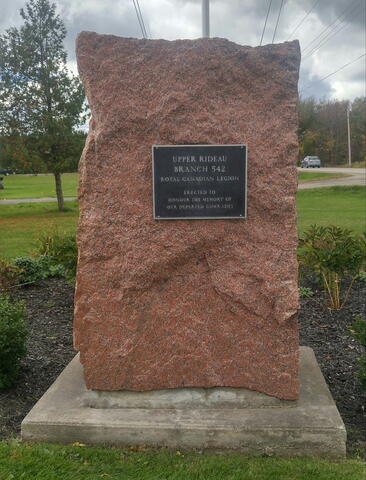
UPPER RIDEAU
BRANCH 542
ROYAL CANADIAN LEGION
ERECTED TO
HONOUR THE MEMORY OF
OUR DEPARTED COMRADES
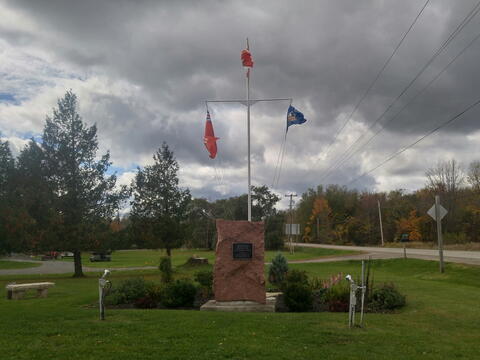
Upper Rideau Royal Canadian Legion Veterans Memorial