Ontario

Province Code
ON
City/Municipality
Kingston
Memorial Number
35036-014
Type
Address
214 Ontario Street
Location
Confederation Park
in Canada
Yes
GPS Coordinates
44.229645, -76.480343
Inscription

[front/devant]

THE KING'S ROYAL REGIMENT OF NEW YORK

The largest Loyalist corps in the Northern Department
during the American Revolution, the King's Royal Regiment
of New York was raised on June 19, 1776 under the com-
mand of Sir John Johnson. Originally composed of one
battalion with ten companies, it was authorized to add a
second battalion in 1780. The regiment, known as
the "Royal Yorkers", participated in the bitter war fought on
the colonial frontier. It conducted raids against settlements
in New York and was also employed in garrison duty.
When active campaigning ceased in 1783, the regiment as-
sumed various responsibilities, notably the establishment of
a base here, in preparation for the settlement of the Loyal-
ists. It was then fully disbanded, its officers and men settling
near New Johnstown (Cornwall) and in the Cataraqui townships.

Erected by the Ontario Heritage Foundation, Ministry of Citizenship and Culture.

[back/arrière]

Le plus important corps de Loyalistes dans le nord lors de la révolutionaméricane, le King's Royal Regiment of New York, est formé le 19 juin 1776 et commandé par Sir John Johnson. Composé à l'origine d'un bataillon de dix compagnies, il reçoit l'autorisation, en 1780, d'en ajouter au autre. Connu sous le nom de <>, il participe à la guerre frontalière des colonies. Le régiment effectue des raids contre les établissements coloniaux de New York et tient garnison. Lorsque la campagne prend fin, en 1783, le régiment assume diverses responsabilités, notamment la construction d'installations, ici même, en vue de l'arrivée des Loyalistes. Puis le régiment est dispersé
officiers et soldats s'établissent alors près de New Johnstown (Cornwall) et dans les cantons de Cataraqui.

Image
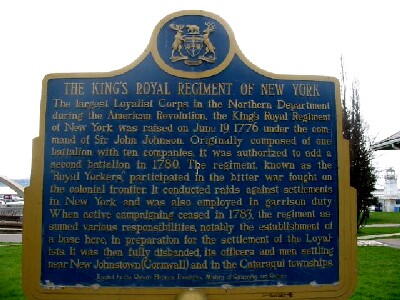
Photo Credit
(www.ontarioplaques.com)
Caption
front
Province
!4v1626282738755!6m8!1m7!1saTK--FpZV-r8um-HcbGgXg!2m2!1d44.22964500056023!2d-76.48034304472273!3f139.5335745771015!4f-2.7086843259801725!5f3.325193203789971"
Body Content

This plaque was erected in 1987.

City
Kingston
Country
Type Description
Provincial Military Plaque
Memorial CF Legacy ID
4577
City/Municipality
Kingston
Memorial Number
35036-013
Type
Address
74 Bagot Street
Location
City Park
in Canada
Yes
GPS Coordinates
44.22659, -76.4884561
Inscription

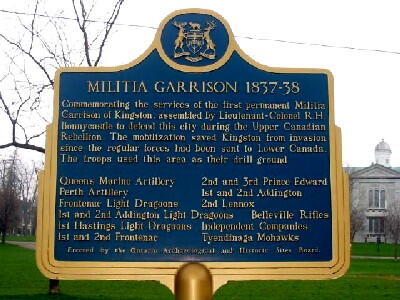
MILITIA GARRISON 1837-38

Commemorating the services of the first permanent Militia Garrison of Kingston, assembled by Lieutenant-Colonel R.H. Bonnycastle to defend this city during the Upper Canadian Rebellion. The mobilization saved Kingston from invasion since the regular troops had been sent to Lower Canada. The troops used this area as their drill ground.

  • Queen's Marine Artillery
  • 2nd and 3rd Prince Edward
  • Perth Artillery
  • 1st and 2nd Addington
  • Frontenac Light Dragoons
  • 2nd Lennox
  • 1st Hastings Light Dragoons
  • Belleville Rifles
  • 1st and 2nd Addington Light Dragoons
  • Independent Companies
  • 1st and 2nd Frontenac
  • Tyendinaga Mohawks

Erected by the Ontario Archaeological and Historic Sites Board.

Image
Photo Credit
(www.ontarioplaques.com)
Caption
front
Province
!4v1626282437599!6m8!1m7!1s2Y0krGb9Kqf2yvaTywMzBA!2m2!1d44.22659003373171!2d-76.48845609295681!3f107.08214746125002!4f-9.987560538181114!5f2.0276512874352006"
Body Content

This plaque was erected in 1958.

City
Kingston
Country
Type Description
Provincial Military Plaque
Memorial CF Legacy ID
4578
City/Municipality
Kingston
Memorial Number
35036-012
Type
Address
13 General Crerar Crescent
Location
Royal Military College of Canada campus
in Canada
Yes
GPS Coordinates
44.22969, -76.46677
Inscription

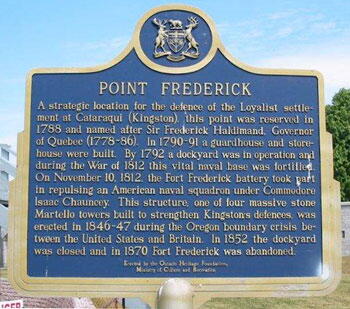
POINT FREDERICK

A strategic location for the defence of the loyalist settlement at Cataraqui (Kingston), this point was reserved in 1788 and named after Sir Frederick Haldimand, Governor of Quebec (1778-86). In 1790-91 a guardhouse and storehouse were built. By 1792 a dockyard was in operation and during the War of 1812 this vital naval base was fortified. On November 10, 1812, The Fort Frederick battery took part in repulsing an American naval squadron under Commodore Isaac Chauncey. This structure, on four massive stone Martello towers built to strengthen Kingston's defences, was erected in 1846-47 during the Oregon Boundary crisis between the United States and Britain. In 1852 the dockyard was closed and in 1870 Fort Frederick was abandoned.

Erected by the Ontario Heritage Foundation,
Ministry of Culture and Recreation

Cette pointe, lieu stratégique de défense de Cataraqui (Kingston) est réservée en 1788 pour usage militaire et nommée en mémoire de Sir Frederick Haldimand, gouverneur du Québec (1778-1786). Un poste de garde et un dépôt y sont construits en 1790-1791 et, vers 1792, un arsenal est en activité. Cette base navale est ensuite fortifiée pendant la guerre de 1812 et le 10 novembre 1812, la batterie de Fort Frederic prend part au refoulement d'une escadre américaine commandé par Isaac Chauncey. Ce bâtiment de quatre tours Martello est construit en 1846-1847 pour la défense de Kingston pendant l'affaire de l'Oregon entre les Étas-Unis et la Grande-Bretagne. En 1852, l'arsenal est fermé et en 1870, le Fort Frederick abandonné.

Image
Photo Credit
(www.ontarioplaques.com). RMC Museum
Caption
English written text side
1 of 2 images
Image
Caption
French written text side
1 of 2 images
Province
Body Content

This plaque was erected in 1982.

City
Kingston
Country
Type Description
Provincial Military Plaque
Memorial CF Legacy ID
4583
City/Municipality
Kingston
Memorial Number
35036-011
Type
Address
1 Fort Henry Drive
Location
Fort Henry National Historic Site
in Canada
Yes
GPS Coordinates
44.2302157, -76.4598827
Inscription

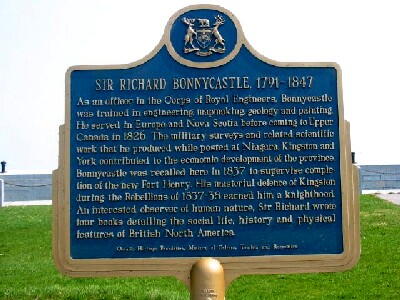
SIR RICHARD BONNYCASTLE 1791-1847

As an officer in the Corps of Royal Engineers, Bonnycastle
was trained in engineering, mapmaking, geology and painting.
He served in Europe and Nova Scotia before coming to Upper
Canada in 1826. The military surveys and related scientific
work that he produced while posted at Niagara, Kingston and
York contributed to the economic development of the province.
Bonnycastle was recalled here in 1837 to supervise comple-
tion of the new Fort Henry. His masterful defence of Kingston
during the Rebellions of 1837-38 earned him a knighthood.
An interested observer of human nature, Sir Richard wrote
four books detailing the social life, history and physical
features of British North America.

Ontario Heritage Foundation, Ministry of Culture, Tourism and Recreation

SIR RICHARD BONNYCASTLE 1791-1847

En tant qu'officier du Corps royal du Génie, Bonnycastle suit une formation en génie, cartographie, géologie et peinture. Il sert en Europe et en Nouvelle-Écosse avant d'arriver dans le Haut-Canada en 1826. Les levés militaires et autres travaux de nature scientifique qu'il réalise pendant son affectation à Niagara, Kingston et York contribuent à l'essor économique de la province. Bonnycastle revient ici en 1837 pour superviser la fin de la construction du nouveau fort Henry. Sa défense judicieuse de Kingston pendant les insurrections de 1837-1838 lui vaut le titre de chevalier. Observateur enthousiaste de la nature humaine, Sir Richard écrit quatre livres décrivant les moeurs, l'histoire et les particularités géographiques de l'Amérique du Nord britannique.

Fondation du patrimoine ontarien, ministère de la Culture et des Loisirs

Image
Photo Credit
(www.ontarioplaques.com)
Caption
front
Province
!4v1626279827881!6m8!1m7!1sCAoSLEFGMVFpcE1kWllTTE8zRDAwS3B5aV83dVQtMnFGTnpWNlVBMENaS1VpbEFN!2m2!1d44.2302157!2d-76.4598827!3f10.559800141234518!4f2.3069630500199025!5f2.7398636928446116"
Body Content

The Sir Richard Bonnycastle Plaque was erected in 1957.

City
Kingston
Country
Type Description
Provincial Military Plaque
Memorial CF Legacy ID
4597
City/Municipality
Kingston
Memorial Number
35036-010
Type
Address
13 General Crerar Crescent
Location
Royal Military College of Canada campus, in front of the Stone Frigate
in Canada
Yes
GPS Coordinates
44.22954, -76.46666
Inscription

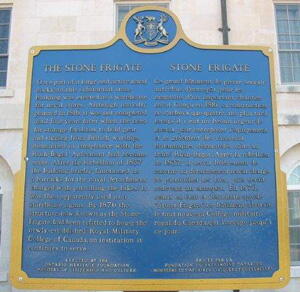
THE STONE FRIGATE

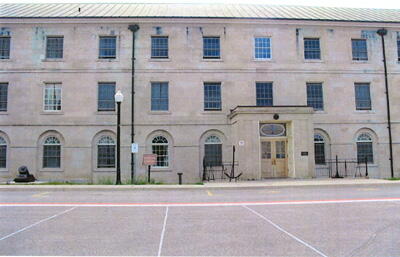
Once part of a large and active naval dockyard, this substantial stone building was erected as a warehouse for naval stores. Although initially planned in 1816, it was not completed until four years later when the need for storage facilities to hold gear and rigging from British warships dismantled in compliance with the Rush-Bagot Agreement had become acute. After the Rebellion of 1837 the building briefly functioned as a barracks for the naval detachment charged with patrolling the lakes. It was then apparently used as a storehouse again. By 1876 the structure, now known as the Stone Frigate, had been refitted to house the newly-established Royal Military College of Canada, an institution it continues to serve.

STONE FRIGATE

Ce grand bâtiment de pierre servait autrefois d'entrepôt pour les magasins d'un important chantier naval. Conçu en 1816, sa construction ne s'acheva que quatre ans plus tard lorsqu'il y eut un besoin urgent de locaux pour entreposer l'équipement et le gréement des vaisseaux britanniques démantelés suite au traité Rush-Bagot. Après la rébellion de 1837, il servit brièvement de caserne au détachement naval chargé de patrouiller les lacs, puis serait redevenu un entrepôt. En 1876, remis en état et désormais appelé "Stone Frigate", ce bâtiment abritait le tout nouveau Collège militaire royal du Canada, qui l'occupe jusqu'à ce jour.

Image
Photo Credit
(www.ontarioplaques.com)
Caption
Plaque
1 of 2 images
Image
Caption
Building
1 of 2 images
Province
Body Content

This plaque was erected in 1957.

City
Kingston
Country
Type Description
Plaque
Memorial CF Legacy ID
4596
City/Municipality
Kingston
Memorial Number
35036-009
Type
Address
13 General Crerar Crescent
Location
Royal Military College of Canada campus, near Frederick Drive
in Canada
Yes
GPS Coordinates
44.22959, -76.46682
Inscription

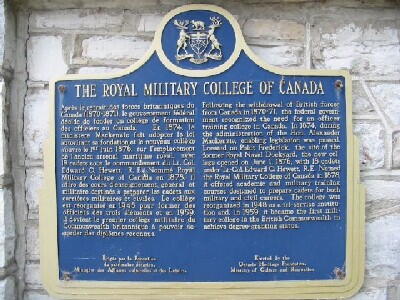
THE ROYAL MILITARY COLLEGE OF CANADA

[left column/colonne de gauche]

Après le retrait des forces britanniques du
Canada (1870-1871), le gouvernement fédéral
décide de fonder un collège de formation
des officiers au Canada. En 1874, le
ministère Mackenzie fait adopter la loi
authorisant sa fondation et le nouveau collège
s'ouvre le ler juin 1876, sur l'emplacement
de l'ancien arsenal maritime royal, avec
18 cadets sous le 1er commandement du Lt. Col.
Edward O. Hewett, R.E. Nommé Royal
Military College of Canada en 1878, il
offre les cours d'enseignement général et
militaire destinés à préparer les cadets aux
carrières militaires et civiles. Le collège
est réorganisé en 1948 pour former des
officiers des trois éléments et en 1959,
il devient le premier collège militaire du
Commonwealth britannique à pouvoir ac-
corder des diplômes reconnus.

Érigée par la Fondation
du patrimoine ontarien,
Ministère de la Culture et des Loisirs
[right column/colonne de droite]

Following the withdrawal of British forces
from Canada in 1870-71, the federal govern-
ment recognized the need for an officer
training college in Canada. In 1874, during
the administration of the Hon. Alexander
Mackenzie, enabling legislation was passed.
Located on Point Frederick, the site of the
former Royal Naval Dockyard, th new col-
lege opened on June 1, 1876, with 18 cadets
under Lt.-Col. Edward O. Hewett, R.E.
Named the Royal Military College of Canada in 1878,
it offered academic and military training
courses designed to prepare cadets for both
military and civil careers. The college was
reorganized in 1948 as a tri-service institu-
tion and, in 1959, it became the first mili-
tary college in the British Commonwealth to
achieve degree-granting status.

Erected by the
Ontario Heritage Foundation,
Ministry of Culture and Recreation


Image
Photo Credit
(www.ontarioplaques.com)
Caption
front
Province
Body Content

The title of this plaque is The Royal Military College of Canada.

City
Kingston
Country
Type Description
Provincial Military Plaque
Memorial CF Legacy ID
4595
City/Municipality
Kingston
Memorial Number
35036-008
Type
Address
Highway 2 & Niagara Park
Location
CFB Kingston, McNaughton Barracks
in Canada
Yes
GPS Coordinates
44.2400464, -76.4555483
Inscription

[plaque]

TO THE MEMORY OF ALL RANKS OF THE CORPS OF ROYAL CANADIAN ELECTRICAL AND MECHANICAL ENGINEERS WHO DIED IN THE SERVICE OF CANADA.

DEDICATED OCTOBER 1961 BY GENERAL A.G.L. McNAUGHTON, HONORARY COLONEL COMMANDANT.

A LA MÉMOIRE DES MILITAIRES DE TOUS GRADES DU CORPS ROYAL CANADIEN DU GÉNIE ÉLECTRIQUE ET MÉCANIQUE TOMBÉS AU SERVICE DU CANADA

[plaque on 25-Pounder gun/plaque sur le canon de 25 livres]

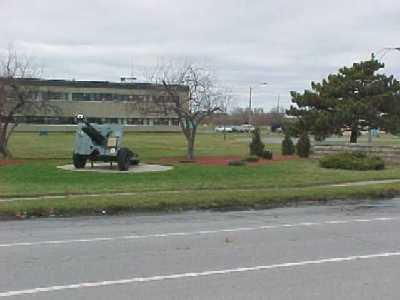
25-Pounder guns were the standard field artillery guns when RCEME was formed on May 15, 1944. For many years this gun was used in the training of Craftsmen at the RCEME School here in Barriefield, Ontario. It wears the tactical signs of 13th Field Regiment RCA which used 25-Pounder guns during World War Two.

Les canons de 25 livres étaient les pièces d'artillerie qu'on utilisait couramment lorsque le GEMRC fut créé le 15 mai 1944. Pendant de nombreuses années, ce canon a servi à l'entraînement des artisans de l'École du GEMRC ici, à Barriefield, en Ontario. Il porte les insignes tactiques du 13e Régiment de campagne de l'ARC qui s'est servi de canons de ce genre pendant la Deuxième Guerre mondiale.


Image
Caption
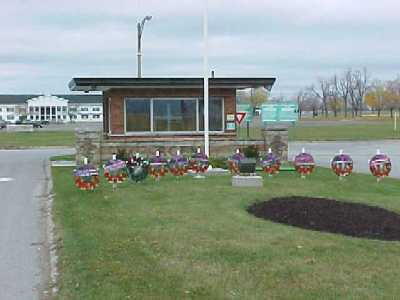
former gate house
1 of 4 images
Image
Caption
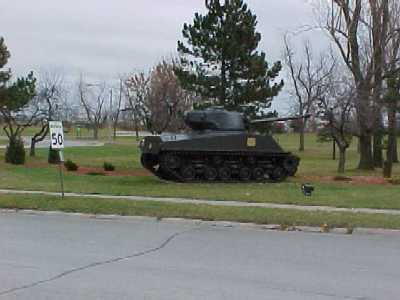
Sherman tank
1 of 4 images
Image
Caption
25-pounder gun
1 of 4 images
Image
Caption
left wall
1 of 4 images
War or Conflict Term
Province
!4v1626277792971!6m8!1m7!1s16Vy92xKW58KwjLBkPzLow!2m2!1d44.24004637544766!2d-76.45554832399868!3f13.313640824815788!4f1.9105234518270038!5f2.8771611644822217"
Body Content

Excerpts from the EM Branch history, "Canada's Craftsmen at 50!", published in 1998. Written by Colonel Murray Johnston, the EME Colonel Commandant:

The Corps of Royal Canadian Electrical and Mechanical Engineers (RCEME) Memorial Gates originated as part of a master plan for the RCEME School in 1950. A competition was announced, but no winners were declared. The Corps Association then stepped in and helped. The gates cost nearly $9,000 to build. Funds came from members and former members of RCEME, regular and militia, officers and other ranks, as well as families and friends.

The gates were built at the entrance to the RCEME School and were dedicated to the "memory of all ranks of the Corps of Royal Canadian Electrical and Mechanical Engineers who died in the service of Canada" in October 1961 by General A.G.L. McNaughton, the Honorary Colonel Commandant. The gates were later extended, and were dedicated by the Commandant of the School, Colonel A.L. Maclean, on 12 May 1968 as part of the ceremonies marking the twenty-fourth Corps birthday.

Having the RCEME Gates at the RCEME School brought their message of commemoration to the attention of new generations of Craftsmen. This advantage was lost in 1970 when the School was moved to Borden. Every Remembrance Day, however, Base Maintenance Kingston and after its formation, the RCEME Association, jointly conducted memorial ceremonies at the RCEME Gates under the aegis of the Base Commander Kingston.

On November 11th, 1991 the Colonel Commandant, Colonel M.C. Johnston, and the Branch Chief Warrant Officer, Chief Warrant Officer A.E. Rest, jointly laid a wreath on behalf of the LEME Branch at the Gates as part of the Remembrance Day ceremonies. At their recommendation the LEME Senate subsequently declared the RCEME gates to be the LEME Branch Memorial. At a stroke the memories of Craftsmen from all eras from RCOC through to LEME had been melded into one memorial.

At the same time action was started to move a 25-Pounder Gun from Borden to Kingston and have it mounted on the West side of the entrance opposite the Sherman tank. This was done and the gun was temporarily installed for the Remembrance Day services in 1992. The entire LEME Senate attended this service. The gun was lovingly refurbished by the Base Maintenance Section of CFB Kingston. Several parts, e.g. the muzzle brake, were chrome plated. The gun layer's seats are aluminum. These "modifications" enhanced the look of the gun but were done to minimize the future maintenance effort required. The gun wears the tactical signs of the 13th Field Regiment RCA which, as part of 3 Canadian Infantry Division, landed in Normandy on D-Day in the first assault wave.

There are two Tactical signs, one on the upper left of the shield and the other on the upper right. Each sign is 9½" wide and 8½" high. Details are: Upper Left-Bisected horizontally Red over Blue (the Field Artillery tactical sign) surmounted by a white 43 (the Regiment's number); Upper Right-French Grey (the division's colour). Prior to using these signs the Colonel Commandant secured the permission of the Commanding Officer of the Regiment at the time of the D-Day landings, Lieutenant-Colonel F. Clifford, and the concurrence of the Regiment's LAD officer just prior to the landings and one who landed with the first assault waves, Captain A. Mendelsohn.

It is interesting to note that this gun was one of two which were used for many years at the Armament Company of the RCEME School as training aids for the training of gun mechanics and officer-cadets. Both guns were moved to Borden with the School in the early 1970s. Later, when the 25-Pounder was taken out of service and no longer used, one of the guns was placed in Worthington Park in CFB Borden. The other languished behind the Range Shack until rescued and returned to Kingston to be mounted at the RCEME Memorial Gates. What a fitting end for a gun on which many of Canada's Craftsmen trained!

The Base Commander was so impressed with what the Branch had done with the Gates that he declared the Gates an attention area. A Canadian flag now flies permanently over the gates. It is spot-lighted at night. Troops are required to march to attention and salute when entering them. It is now a regimental memorial on the same status as Vimy Ridge and regimental memorials of combat arms units. The Branch, i.e. the RCEME Association, the LEME Association, the LEME Officers' fund and the Chief Warrant Officers' Fund bought the flag pole, which is about thirty feet high and is placed to the left of and in front of the gatehouse.

The Base Construction Engineering staff installed the gun, flag pole and lights. Base Maintenance has taken responsibility for the maintenance. As Colonel Johnston has noted, "We now have a national Branch Memorial which gives a feeling of quiet dignity in memory of Canada's Craftsman from RCOC, RCOC(E), RCEME, LORE and LEME who fell in war and during peacekeeping operations. Over and above this what we have achieved at the Gates is the melding together of all eras of our Branch from RCOC to LEME. That's how regiments are made!" Today at Remembrance Day ceremonies and during its Annual Reunion in June, the RCEME Association and representatives of widows and children lay wreaths in honour of members of the Corps and the Branch who made the supreme sacrifice.

City
Kingston
Country
Type Description
Former gate house (brick), three low walls (stone), 25-pounder gun, Sherman tank
Photo Credit
Colonel Murray Johnston; F.S. (Jim) Wilkins
Memorial CF Legacy ID
5826
City/Municipality
Kingston
Memorial Number
35036-007
Type
Address
13 General Crerar Crescent
Location
Royal Military College of Canada campus
in Canada
Yes
GPS Coordinates
44.23213, -76.46822
Inscription


(No inscription on the memorial/Aucune inscription sur le mémorial)

Image
Photo Credit
Hellmut Shade
Caption
front view
1 of 2 images
Image
Caption
upper part
1 of 2 images
Province
Body Content

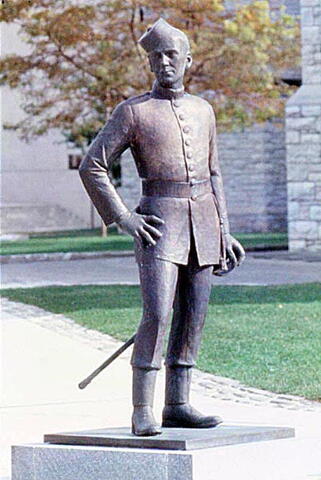
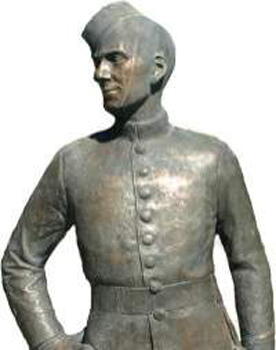
The memorial is a gift of the Royal Military Colleges Club of Canada. It was unveiled in 1976, and is dedicated to Alumni of the Royal Military College of Canada. The bronze statue known affectionately as `Brucie` depicts a standing figure of a cadet named `Truth, Duty, Valour` by Elizabeth Bradford Holbrook.

City
Kingston
Country
Type Description
Statue
Memorial CF Legacy ID
4325
City/Municipality
Kingston
Memorial Number
35036-006
Type
Address
65 Barrie Street
Location
City Park
in Canada
Yes
GPS Coordinates
44.2249891, -76.4905227
Inscription

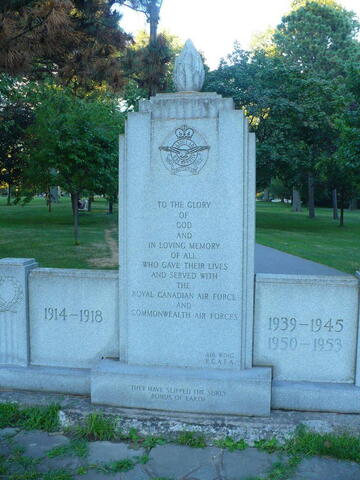
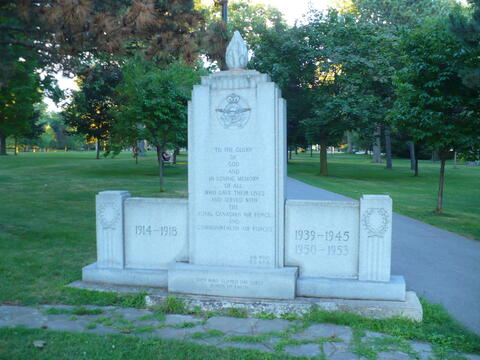
1914 – 1918

PER ARDUA AD ASTRA

ROYAL CANADIAN AIR FORCE

TO THE GLORY
OF
GOD
AND
IN LOVING MEMORY
OF ALL
WHO GAVE THEIR LIVES
AND SERVED WITH
THE
ROYAL CANADIAN AIR FORCE
AND
COMMONWEALTH AIR FORCES

416 WING
R.C.A.F.

THEY HAVE SLIPPED THE SURLY
BONDS OF EARTH

1939 – 1945
1950 – 1953

Image
Caption
inscription
1 of 2 images
Image
Caption
416 Wing RCAFA Air Force Memorial
1 of 2 images
War or Conflict Term
Province
!4v1679420017326!6m8!1m7!1s4NsqHVIzfM7bth7CDCUEDg!2m2!1d44.22498914349792!2d-76.4905227360887!3f79.90744521688418!4f1.324002535666395!5f2.056551663802082
Body Content

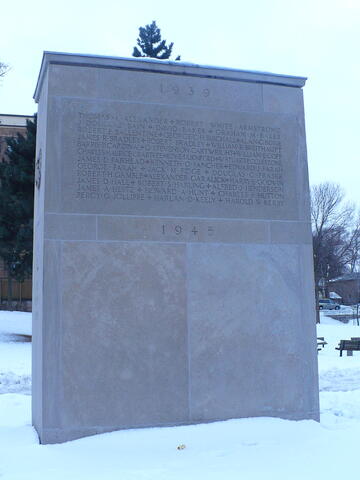
The 416 Wing RCAFA Air Force Memorial was erected by 416 Wing, Royal Canadian Air Force Association around 1967. Dates commemorating the Korean War were added after it was first inaugurated.

City
Kingston
Country
Type Description
Stele
Photo Credit
Tim Laye, Ontario War Memorials
Memorial CF Legacy ID
4324
City/Municipality
Kingston
Memorial Number
35036-004
Type
Address
64 West Street
Location
City Park
in Canada
Yes
GPS Coordinates
44.2259087, -76.4870949
Inscription

[front/devant]

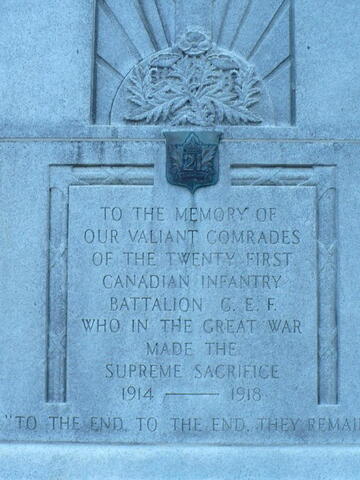
(Crest of the 21st Battalion/Armoiries du 21e Bataillon au-dessus)

TO THE MEMORY OF
OUR VALIANT COMRADES
OF THE TWENTY FIRST
CANADIAN INFANTRY
BATTALION C.E.F.
WHO IN THE GREAT WAR
MADE THE
SUPREME SACRIFICE
1914 - 1918
"TO THE END, TO THE END, THEY REMAIN"

[right side/côté droit]

ARRAS
VIMY RIDGE
HILL 70

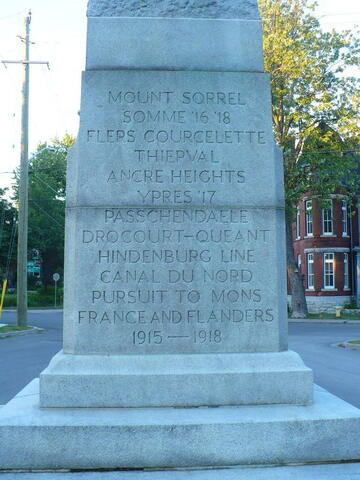
[back/arrière]

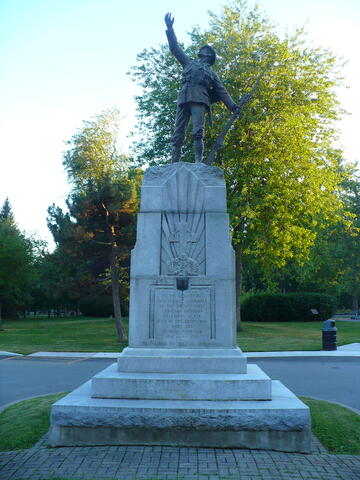
MOUNT SORREL
SOMME '16 '18
FLERS COURCELETTE
THIEPVAL
ANCRE HEIGHTS
YPRES '17
PASSCHENDAELE
DROCOURT-QUEANT
HINDENBURG LINE
CANAL DU NORD
PURSUIT TO MONS
FRANCE AND FLANDERS
1915-1918

[left side/côté gauche]

AMIENS
SCARPE '18
CAMBRAI '18

Image
Caption
left side
1 of 6 images
Image
Caption
front inscription
1 of 6 images
Image
Caption
21st Battalion Memorial
1 of 6 images
Image
Caption
right side
1 of 6 images
Image
Caption
back inscription
1 of 6 images
Image
Caption
back
1 of 6 images
Province
!4v1626271978383!6m8!1m7!1sMurQRPOGATA94tvtMAxomg!2m2!1d44.22590917937295!2d-76.48709590181842!3f214.80314843222206!4f3.1486746994574304!5f2.969026623727147
Body Content

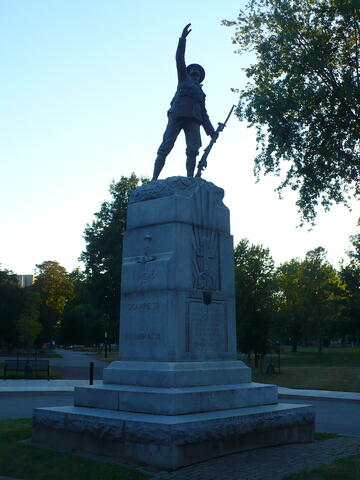
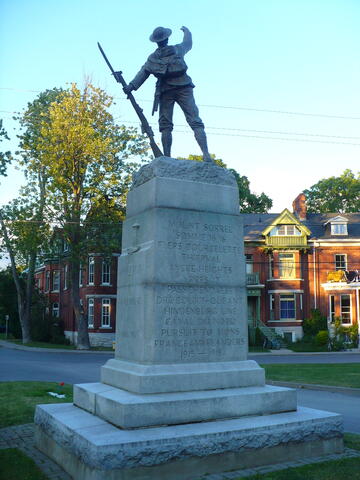
This 21st Battalion Memorial was erected in 1931 and is dedicated to the 21st Canadian Infantry Battalion of the Canadian Expeditionary Force who died in the First World War. In May of 1915, 1,013 men left Kingston with the Battalion, but when they marched into Germany at war’s end, only 103 remained.

The imagery above the front inscription includes a cross, poppies over a sunrise and the battalion crest. A statue of a soldier stands atop the memorial. Battles in which the battalion participated are listed on the other three sides of the memorial. The reference to 1915-1918 marks the years the battalion were in France and Flanders.

The 21st Battalion, which was authorized on 7 November 1914 as the 21st Battalion, Canadian Expeditionary Force, embarked for Britain on 6 May 1915. It disembarked in France on 15 September 1915, where it fought as part of the 4th Infantry Brigade, 2nd Canadian Division in France and Flanders until the end of the war. The battalion was disbanded on 30 August 1920.

On May 24, 1919, the 21st Battalion was demobilized in Kingston and the men discharged from the Canadian Expeditionary Force. An Association was formed from their numbers, and reunions were held annually until 1976 when their numbers dwindled to a handful of surviving members. The 21st Battalion is perpetuated in today’s military by the Princess of Wales’ Own Regiment, a Kingston Militia unit. Each year on Remembrance Day the Regiment parades to the 21st Battalion Memorial, to honour their memory.

City
Kingston
Country
Type Description
Shaft, statue
Photo Credit
Tim Laye, Ontario War Memorials
Memorial CF Legacy ID
4311