Ontario

Province Code
ON
City/Municipality
Hamilton
Memorial Number
35031-039
Type
Address
116 MacNab Street South
Location
MacNab Street Presbyterian Church
in Canada
Yes
GPS Coordinates
43.2538228, -79.8719749
Inscription

[front/devant]

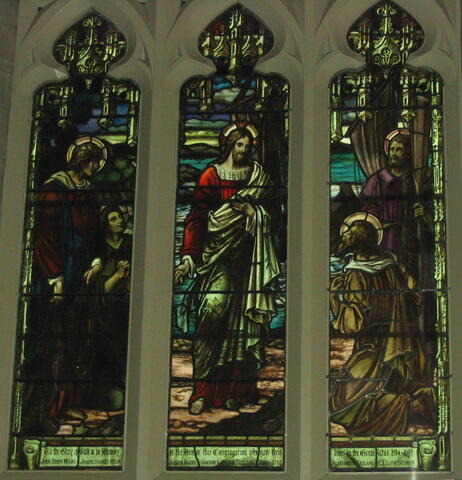
*Window #1, depicts one standing female angel and one kneeling female angel

To the Glory of God and in Memory
John Henry McCoy, Joseph Stanley McCoy 

[front/devant]

*Window #2, depicts standing Jesus

of the members of this Congregation who gave their
Joseph Berry, Gordon Cameron Freeland, Harry Lyle 

[front/devant]

*Window #3, one standing soldier and one kneeling soldier, dressed as Roman soldiers

lives in the Great War 1914-1919.
Alexander Farlane, C.E. Loyd Skedden 

Image
War or Conflict Term
Province
!4v1625768703440!6m8!1m7!1sweqBv9VARxlpGdxsCgQSUQ!2m2!1d43.25382279780495!2d-79.87197490693428!3f262.2710953130034!4f10.728795338354132!5f1.0869757352926164"
Body Content

The stained glass windows were dedicated in 1921 to commemorate the fallen of the First World War. The congregation of MacNab Street Presbyterian Church erected the memorial, which was created by Robert McCausland Limited. There are three windows.

The inscription is meant to be read as the top line across all 3 windows, with the names of the fallen on the second line. It reads "To the Glory of God and in Memory of the members of this Congregation who gave their lives in the Great War 1914-1919."

City
Hamilton
Country
Type Description
windows; stained glass
Memorial CF Legacy ID
8590
City/Municipality
Hamilton
Memorial Number
35031-038
Type
Address
170 Parkdale Avenue North
Location
Inside the Ukrainian National Federation Of Hamilton
in Canada
Yes
GPS Coordinates
43.2411702, -79.7900665
Inscription

[front/devant]

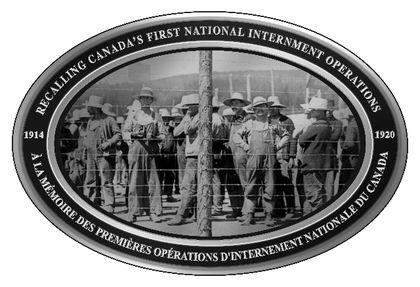
Recalling Canada's First National Internment Operations 1914-1920

A la mémoire des premières opérations d’internement nationale du Canada 1914-1920

Image
Province
!4v1625768154895!6m8!1m7!1sIQhUfnN4Ms8A4QheGksYBg!2m2!1d43.24117021719483!2d-79.7900664874495!3f121.51464429170812!4f5.078239446315479!5f2.299968626952992"
Body Content

This memorial recalls a historic injustice Canadians should pause to remember, as we recall the First World War and the valour of all those Canadian men, and some women, who served. It is a tribute to mark the memory of the thousands of "enemy aliens" who had their civil rights stripped, and were subsequently imprisoned during Canada's first national internment operations of 1914-1920, following the implementation of the War Measures Act. 2014 marks the 100th anniversary of the War Measures Act - adopted on August 22, 1914 during the First World War. It was used to imprison Ukrainian-Canadians, and other ethnic groups, including German, Hungarian, Serbian, Croatian, and Armenian communities, into one of Canada's 24 internment camps.

Dr. Lubomyr Luciuk, a professor at the Royal Military College of Canada and former chair of the Ukrainian Canadian Civil Liberties Association (UCCLA), had taken it upon himself to lead the way and organize the memorial. In the CTO ("One Hundred") project, 100 aluminum plaques were simultaneously unveiled at 100 different locations across the country at 11:00am local time on August 22, 2014. The first plaque was unveiled in Amherst, Nova Scotia, followed by a wave of plaque unveilings moved west, from province to province, culminating in Nanaimo, British Columbia. The plaques, which cost $1,000 to make, were funded by the generosity of the Endowment Council of the Canadian First World War Interment Recognition Fund.

Each plaque features a photo of internment prisoners confined behind a wire fence at the Castle Mountain Internment Camp in Banff, Alberta. The Castle Camp, which was built in 1915 at the base of Castle Mountain, was a Canadian internment camp which held immigrant prisoners of Ukrainian, Austrian, Hungarian, and German descent.

City
Hamilton
Country
Type Description
Plaque, aluminum
Memorial CF Legacy ID
8738
City/Municipality
Hamilton
Memorial Number
35031-037
Type
Address
1883 King Street East
Location
Inside the Croatian Parish Hall
in Canada
Yes
GPS Coordinates
43.2317917, -79.8082838
Inscription

[front/devant]

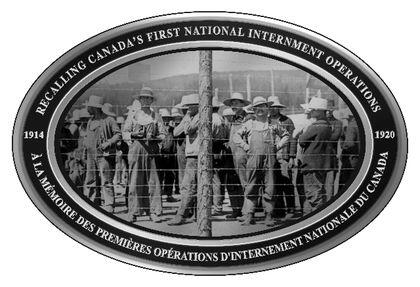
Recalling Canada's First National Internment Operations 1914-1920

A la mémoire des premières opérations d’internement nationale du Canada 1914-1920

Image
War or Conflict Term
Province
!4v1625767730028!6m8!1m7!1sI3nfhqw9cBxMnbUw6K60Og!2m2!1d43.23179166728635!2d-79.8082837685455!3f46.73585073783175!4f7.014196204394068!5f1.0759969313355833"
Body Content

This memorial recalls a historic injustice Canadians should pause to remember, as we recall the First World War and the valour of all those Canadian men, and some women, who served. It is a tribute to mark the memory of the thousands of "enemy aliens" who had their civil rights stripped, and were subsequently imprisoned during Canada's first national internment operations of 1914-1920, following the implementation of the War Measures Act. 2014 marks the 100th anniversary of the War Measures Act - adopted on August 22, 1914 during the First World War. It was used to imprison Ukrainian-Canadians, and other ethnic groups, including German, Hungarian, Serbian, Croatian, and Armenian communities, into one of Canada's 24 internment camps.

Dr. Lubomyr Luciuk, a professor at the Royal Military College of Canada and former chair of the Ukrainian Canadian Civil Liberties Association (UCCLA), had taken it upon himself to lead the way and organize the memorial. In the CTO ("One Hundred") project, 100 aluminum plaques were simultaneously unveiled at 100 different locations across the country at 11:00am local time on August 22, 2014. The first plaque was unveiled in Amherst, Nova Scotia, followed by a wave of plaque unveilings moved west, from province to province, culminating in Nanaimo, British Columbia. The plaques, which cost $1,000 to make, were funded by the generosity of the Endowment Council of the Canadian First World War Interment Recognition Fund.

Each plaque features a photo of internment prisoners confined behind a wire fence at the Castle Mountain Internment Camp in Banff, Alberta. The Castle Camp, which was built in 1915 at the base of Castle Mountain, was a Canadian internment camp which held immigrant prisoners of Ukrainian, Austrian, Hungarian, and German descent.

City
Hamilton
Country
Type Description
Plaque, aluminum
Memorial CF Legacy ID
8737
City/Municipality
Hamilton
Memorial Number
35031-036
Type
Address
1925A Barton Street East
Location
Inside the Croatian National Home
in Canada
Yes
GPS Coordinates
43.2434649, -79.7821287
Inscription

[front/devant]

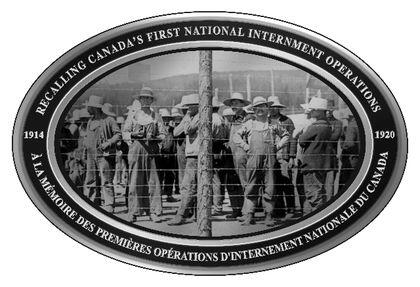
Recalling Canada's First National Internment Operations 1914-1920

A la mémoire des premières opérations d’internement nationale du Canada 1914-1920

Image
War or Conflict Term
Province
!4v1625767493029!6m8!1m7!1sNEfdpqThYYFtMAs2WimhCw!2m2!1d43.24346492892656!2d-79.78212872502208!3f7.8558002194811625!4f2.0266717550996844!5f2.593245485518702"
Body Content

This memorial recalls a historic injustice Canadians should pause to remember, as we recall the First World War and the valour of all those Canadian men, and some women, who served. It is a tribute to mark the memory of the thousands of "enemy aliens" who had their civil rights stripped, and were subsequently imprisoned during Canada's first national internment operations of 1914-1920, following the implementation of the War Measures Act. 2014 marks the 100th anniversary of the War Measures Act - adopted on August 22, 1914 during the First World War. It was used to imprison Ukrainian-Canadians, and other ethnic groups, including German, Hungarian, Serbian, Croatian, and Armenian communities, into one of Canada's 24 internment camps.

Dr. Lubomyr Luciuk, a professor at the Royal Military College of Canada and former chair of the Ukrainian Canadian Civil Liberties Association (UCCLA), had taken it upon himself to lead the way and organize the memorial. In the CTO ("One Hundred") project, 100 aluminum plaques were simultaneously unveiled at 100 different locations across the country at 11:00am local time on August 22, 2014. The first plaque was unveiled in Amherst, Nova Scotia, followed by a wave of plaque unveilings moved west, from province to province, culminating in Nanaimo, British Columbia. The plaques, which cost $1,000 to make, were funded by the generosity of the Endowment Council of the Canadian First World War Interment Recognition Fund.

Each plaque features a photo of internment prisoners confined behind a wire fence at the Castle Mountain Internment Camp in Banff, Alberta. The Castle Camp, which was built in 1915 at the base of Castle Mountain, was a Canadian internment camp which held immigrant prisoners of Ukrainian, Austrian, Hungarian, and German descent.

City
Hamilton
Country
Type Description
Plaque, aluminum
Memorial CF Legacy ID
8736
City/Municipality
Hamilton
Memorial Number
35031-035
Type
Address
150 Mountbatten Drive
Location
Captain Cornelius Park
in Canada
Yes
GPS Coordinates
43.224628, -79.8912907
Inscription

[front/devant]

Captain Cornelius Park

Image
War or Conflict Term
Province
!4v1636114941850!6m8!1m7!1sJzfR3gMm_oMGeCiOwFmBdA!2m2!1d43.22462802606357!2d-79.89129069651646!3f194.00251928735884!4f-0.21889525163150836!5f2.299968626952992"
Body Content

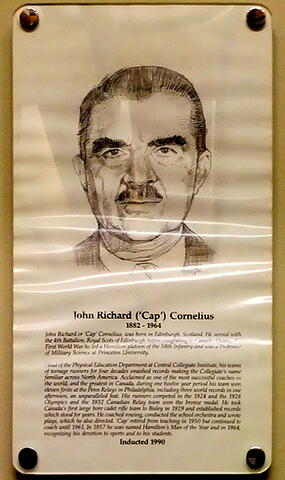
The Captain Cornelius Park is named in honour of Captain John Richard Cornelius.

John Richard Cornelius was born in Edinburgh, Scotland in March 1884. As a young man he served with the 4th Battlion, Royal Scots. He immigrated to Canada with his family and in October 1915, at the age of 31, he enlisted in the 58th Battalion, Canadian Expeditionary Force. His Battalion set sail for Europe in November 1915 and after a few months of training in England, landed in France in February 1916. At the end of the war, Captain Cornelius joined the staff of the Hamilton Collegiate Institute in 1919. He retired from teaching in 1950 but continued to coach the school’s highly successful track and field team until 1961. During his four decade-long coaching tenure, Cornelius formed an astonishing number of Canadian Olympians for the 1924 and 1928 Olympics as well as the Canadian relay team that won the bronze medal at the 1932 Olympics. A world acclaimed coach, Cornelius died in 1964.

City
Hamilton
Country
Type Description
Memorial park
Memorial CF Legacy ID
8932
City/Municipality
Hamilton
Memorial Number
35031-034
Type
Address
9 Lynbrook Drive
Location
Behind Westwood Elementary School
in Canada
Yes
GPS Coordinates
43.22836, -79.8923281
Inscription

[front/devant]

In memory of
Sgt Shawn Allen Eades, CD
1 Combat Engineer Regiment (1 CER)
Killed in Action
August 20, 2008
Zahri District, Afghanistan
Age: 33

“The way of the Sapper is hard and dangerous and lies between friend and foe. It calls for the best and the bravest of any army”

Duty, Loyalty, Integrity, Courage

Image
War or Conflict Term
Province
!4v1625764825977!6m8!1m7!1sKZWVVEbxo36NF0K1d4tqxw!2m2!1d43.22835995924174!2d-79.89232805165784!3f232.7997243167888!4f1.9333646531844977!5f3.325193203789971"
Body Content

This black stone monument is dedicated to the memory of Sergeant Shawn Allen Eades, CD, member of 1 Combat Engineer Regiment, and former student at Westwood Public School, who was killed in action on August 20, 2008 in the Zahri District of Afghanistan.

Excerpt from an article in the Hamilton Spectator, by Stacey Escott, 25 September, 2011:

"Fallen Hamilton soldier Shawn Allen Eades’ wife and two young daughters missed the connecting flight that would get them to his memorial ceremony last week (Friday 23 Sep 11).

The family lives in Edmonton and had to catch a plane from Winnipeg that would fly them to Hamilton. With just half an hour to get in and out of the airport, the plane left without them. Lisa pleaded with airport authorities, and after hearing her story, the pilot turned the plane around and came back for them. The people already on board clapped as Lisa and her daughters Breanna, 10, and Niya, 7, were seated.

They were joined by family and friends, soldiers, teachers, students and politicians as close to 200 people at Westwood Public School remembered the fallen soldier Friday afternoon. Eades was killed on Aug. 20, 2008, while on duty in Afghanistan. He was two weeks away from coming home after his third rotation.

The ceremony took place in the school gymnasium at Westwood where Shawn was a student from grades 3-6 in the ’80s. Students sat patiently as they waited to stand up and sing Canadian Heroes. After the stone was unveiled in the Westwood schoolyard, Breanna and Niya lit the lanterns as the rest of the family laid red roses in front of it."

City
Hamilton
Country
Type Description
Monument; stone
Memorial CF Legacy ID
8931
City/Municipality
Hamilton
Memorial Number
35031-033
Type
Address
85 East 36th Street
Location
Peace Memorial Park
in Canada
Yes
GPS Coordinates
43.2346282, -79.840246
Inscription

[front left plaque/plaque avant gauche]

CITY OF HAMILTON

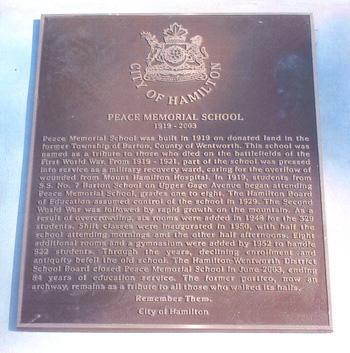
PEACE MEMORIAL SCHOOL
1919 - 2003

Peace Memorial School was built in 1919 on donated land in the
former Township of Barton, County of Wentworth. This school was
named as a tribute to those who died on the battlefields of the
First World War. From 1919 - 1921, part of the school was pressed
into service as a military recovery ward, caring for the overflow of
wounded from Mount Hamilton Hospital. In 1919, students from
S.s. No. 7 Barton School on Upper Gage Avenue began attending
Peace Memorial School, grades one to eight. The Hamilton Board
of Education assumed control of the school in 1929. The Second
World War was followed by rapid growth on the mountain. As a
result of overcrowding, six rooms were added in 1948 for the 329
students. Shift classes were inaugurated in 1950, with half the
school attending mornings and the other half afternoons. Eight
additional rooms and a gymnasium were added by 1952 to handle
922 students. Through the years, declining enrollment and
antiquity befell the old school. The Hamilton-Wentworth District
School Board closed Peace Memorial School in June 2003, ending
84 years of education service. The former portico, now an
archway, remains as a tribute to all those who walked its halls.

Remember Them.

City of Hamilton

[front right plaque/plaque avant droite]

CITY OF HAMILTON

PEACE MEMORIAL PARK

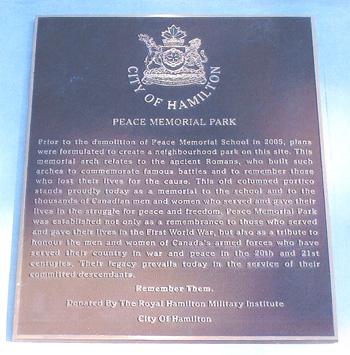
Prior to the demolition of Peace Memorial School in 2005, plans
were formulated to create a neighbourhood park on this site. This
memorial arch relates to ancient Romans, who built such
arches to commemorate famous battles and to remember those
who lost their lives for the cause. This old columned portico
stands proudly today as a memorial to the school and to the
thousands of Canadian men and women who served and gave their
lives in the struggle for peace and freedom. Peace Memorial Park
was established not only as a remembrance to those who served
and gave their lives in the First World War, but also a tribute to
honour the men and women of Canada's armed forces who have
served their country in war and peace in the 20th and 21st
centuries. Their legacy prevails today in the service of their
committed descendants.

Remember Them.

Donated By The Royal Hamilton Military Institute

City Of Hamilton

Image
Caption
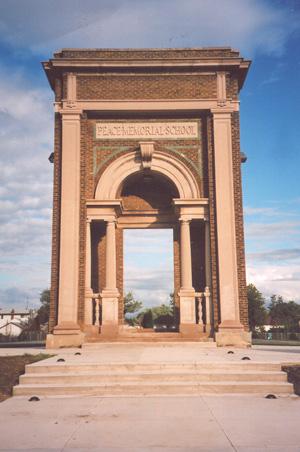
arch - front view
1 of 4 images
Image
Caption
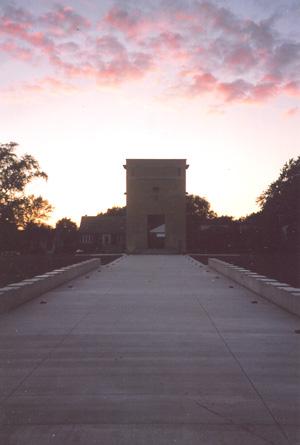
arch - rear view
1 of 4 images
Image
Caption
first plaque
1 of 4 images
Image
Caption
second plaque
1 of 4 images
War or Conflict Term
Province
!4v1625764179199!6m8!1m7!1sm9lyKRjJiKY1gNnRzoVH9g!2m2!1d43.23462823042285!2d-79.84024595045209!3f109.1303301752139!4f7.99019187190261!5f1.5317338517769064"
Body Content

This memorial is located on the site of the former Peace Memorial School which was closed in 2005 and eventually demolished. The huge portico of the school's entrance was saved as a Memorial Peace Arch. It stands as the main entrance to the 7 1/2 acre landscaped park. The sidewalks in the park are configured in the shape of the internationally recognized Peace Symbol very noticeable from the air.

The Peace Arch has a series of wide concrete steps to the promenade surrounding the monolithic structure. To one side there is a large plinth with two bronze plaques affixed. One commemorates the old school which once stood there and the other outlines its military history when it was used temporarily as a recovery hospital for wounded soldiers returning from France in 1918. It also pays tribute to the fallen and those that have served in all Canada's wars. The Arch is from an existing portico of huge dimensions, a rug brick and columned Gothic structure circa 1918.

The long Memorial Walk leading east from the Arch ends at a meditation circle which has a Dove of Peace engraved in granite. A place to sit and meditate. The park is blessed with over 140 trees of various types and the walkways at the Arch and along the Memorial Walk are well lit at night to deter vandals and provide a stunning view of the ornate Arch.  This memorial was dedicated October 20, 2008.

City
Hamilton
Country
Type Description
Park, arch, plaques
Memorial CF Legacy ID
7831
City/Municipality
Hamilton
Memorial Number
35031-032
Type
Address
85 Holton Avenue South
Location
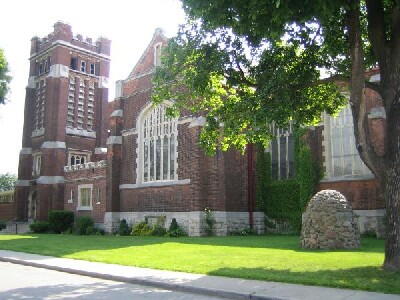
In front of St Giles United Church
in Canada
Yes
GPS Coordinates
43.2486935, -79.8427191
Inscription

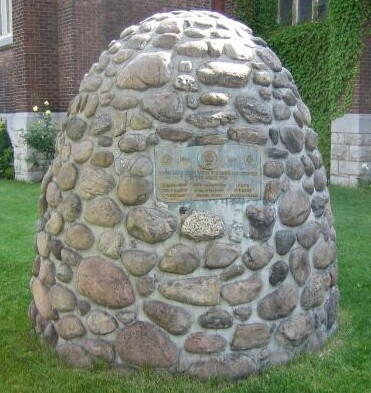
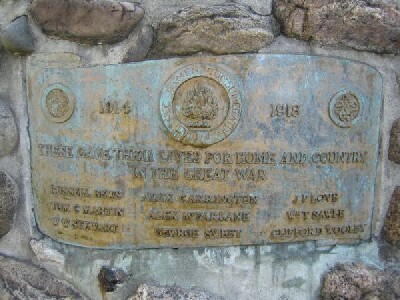
[plaque/plaque]

1914 1918
THESE GAVE THEIR LIVES FOR HOE AND COUNTRY
IN THE GREAT WAR

[left column/colonne de gauche]
RUSSELL BEWS
TOM C. MARTIN
W.W. STEWART

[centre column/colonne du centre]
ALEX CARRINGTON
ALEX McFARLANE
GEORGE SWEET

[right column/colonne de droite]
J.F. LOVE
W.T. SAWLE
CLIFFORD WOOLEY

Image
Photo Credit
Colin Semple
Caption
front
1 of 3 images
Image
Caption
plaque
1 of 3 images
Image
Caption
surroundings
1 of 3 images
War or Conflict Term
Province
!4v1625763459372!6m8!1m7!1sI3zMgmt7-ns5akh-GRcNsw!2m2!1d43.2486934913968!2d-79.84271906220094!3f112.17082948260692!4f-3.005240081744134!5f2.299968626952992"
Body Content

Needs further research

City
Hamilton
Country
Type Description
Cairn
Memorial CF Legacy ID
7343
City/Municipality
Hamilton
Memorial Number
35031-031
Type
Address
900 Woodward Avenue
Location
On the grounds of the Hamilton Museum of Steam & Technology
in Canada
Yes
GPS Coordinates
43.2563868, -79.7725972
Inscription

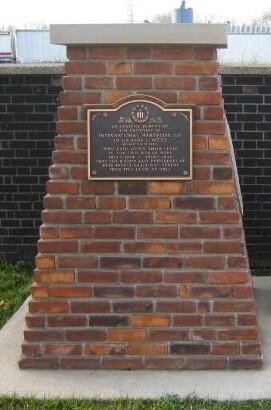
[Plaque/Plaque]

IN GRATEFUL MEMORY OF
THE EMPLOYEES OF
INTERNATIONAL HARVESTER CO.
OF CANADA LIMITED
HAMILTON WORKS
WHO LAID DOWN THEIR LIVES
IN THE TWO WORLD WARS
1914 – 1918 & 1939 – 1945
THAT THE RIGHTS AND PRIVILEDGES OF
FREE PEOPLE SHALL NOT PERISH
FROM THIS LAND OF OURS

Image
Photo Credit
Colin Semple. Derek Pullen
Caption
front
1 of 3 images
Image
Caption
front
1 of 3 images
Image
Caption
front
1 of 3 images
War or Conflict Term
Province
!4v1633367988941!6m8!1m7!1seld4-91hpwd8840MRxtc1w!2m2!1d43.25638678472198!2d-79.772597242378!3f5.894616870943325!4f-0.8708189152776242!5f3.325193203789971"
Body Content

This memorial was erected by CASE International Havester Company to honour employees of International Harvester Co. of Canada Limited who served in the First and Second World Wars. In 1997 a time capsule was found behind the two medallions flanking the main entrance to the 1911 Works Office. The medallions and time capsule were relocated to a cairn erected in front of the new Plant Office. A tribute to International Harvester employees who served in the two World Wars was also mounted on the cairn. In 1999, with the closing of the Hamilton Plant, the cairn was dismantled and rebuilt on this present, permanent site. The 1911 time capsule, materials and additions made in 1997, are sealed herein.

City
Hamilton
Country
Type Description
Cairn and plaque
Memorial CF Legacy ID
7331
City/Municipality
Hamilton
Memorial Number
35031-030
Type
Address
200 James Street N
Location
150 Hamilton Tiger Squadron
in Canada
Yes
GPS Coordinates
43.26196, -79.86641
Province
Body Content

Corporal Darryl Ross was an Electrician from CFB North Bay who was killed in a vehicle accident in the Golan Heights on 3 March 1978 while on peacekeeping duties. Before Corporal Ross joined the Canadian Forces he was an Air Cadet with 150 Hamilton Tiger Squadron, Royal Canadian Air Cadets. When he died, cadets of the squadron raised the money for a trophy in his memory that is awarded annually to the junior cadet in the squadron with the highest academic achievement.

City
Hamilton
Country
Type Description
Trophy
Memorial CF Legacy ID
6970