needs further research
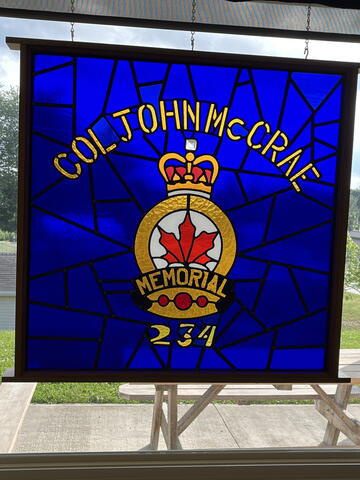
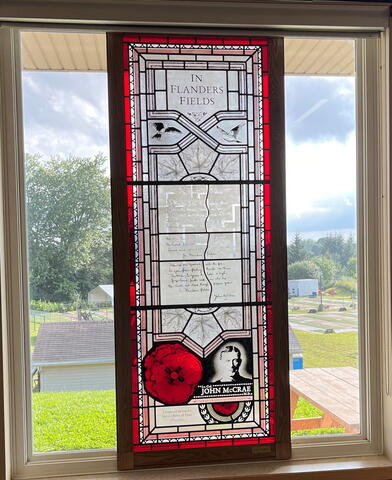
Colonel John McCrae Stained Glass Windows
needs further research/recherche incomplète
Sign in to My VAC Account
Sign in to My VAC Accountneeds further research/recherche incomplète
needs further research
needs further research/recherche incomplète
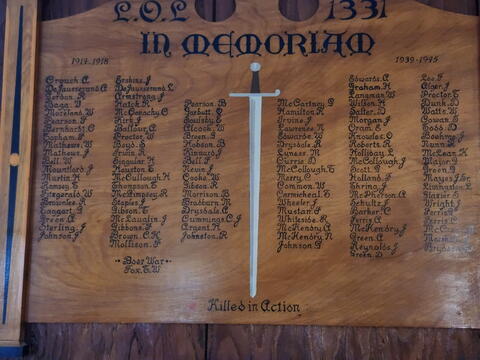
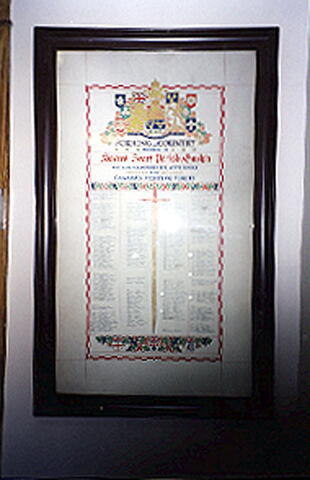
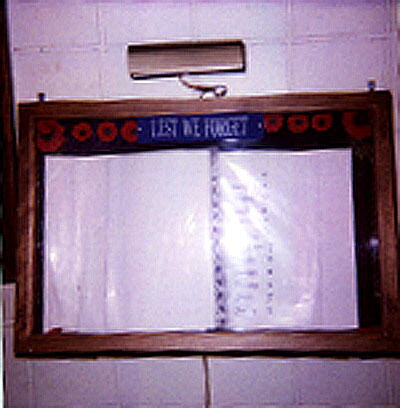
The Guelph Loyal Orange Lodge #1331 Honour Roll hangs in the main hall. It lists the names of their members who served in the Boer War, First World War and Second World War.
2022
JOHN MCCRAE 150TH
JULY 28, 1972
IN FLANDERS FIELDS THE POPPIES BLOW
The Lieutenant-Colonel John McCrae Floral Clock was erected by the City of Guelph in Riverside Park to celebrate the 150th anniversary of his birth. In 1972 there was a previous floral clock designed in his honour and featured the words "In Flanders Fields the poppies blow".
Lieutenant-Colonel John McCrae was the Canadian soldier, a doctor and teacher, who wrote In Flanders Fields during the First World War. Born in Guelph, Ontario in 1872, he served with an artillery battery in the South African War and had a successful civilian medical career. When the First World War broke out in 1914, the patriotic 41-year-old enlisted again and would be appointed as a medical officer with the First Brigade of the Canadian Field Artillery.
During the Second Battle of Ypres in the spring of 1915, McCrae was tending to the wounded in a part of Belgium traditionally called Flanders. On May 2, a close friend was killed in action and this painful loss inspired McCrae to write In Flanders Fields the next day. It would be published in Britain’s Punch magazine and quickly became one of the best-known poems of the war, helping make the poppy an international symbol of remembrance. Sadly, Lieutenant-Colonel McCrae would not survive the conflict, dying of illness in January 1918.
A Vimy Oak was donated in 2019 by the Brydges family to Woodlawn Memorial Park in the Veterans area of the cemetery to commemorate all Veterans of all wars.
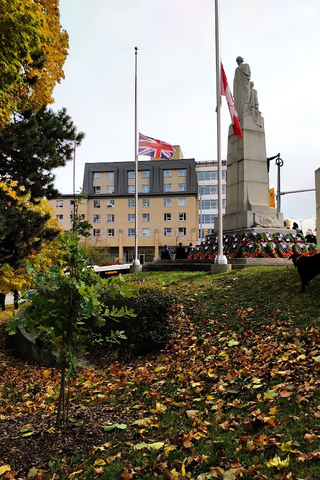
A Vimy Oak that grows behind the Guelph War Memorial was donated in 2019 by the Brydges family in memory of their great-uncle Norman Brydges, who died in France shortly after the battle of Vimy Ridge.
A second Vimy Oak was donated by the Brydges family to Woodlawn Memorial Park in the Veterans area of the Cemetery to commemorate all Veterans of all wars.
The last 44 Vimy Oaks that were grown for the Vimy centennial park project were purchased by Brydges Landscape Architecture, Ground Effects Landscapes and Elements Hardscaping and donated to the Highway of Heroes Project for future Veterans planting projects where deemed appropriate.
The first was planted at Sunnybrook Hospital for the Veterans Commemorative Grove and Reforestation Project.
Veterans Memorial Bridge
In 2017, the City of Guelph's naming committee recommended renaming the Norfolk Street footbridge to Veterans Memorial Bridge. The pedestrian bridge connects Norfolk Street and Northumberland Street, just west of City Hall. The Wilson Street Parking Garage renovation capital budget paid for the new signage.
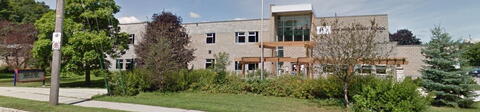
John McCrae Public School
John McCrae Public School was named in honour of John McCrae B.A. M.D. Tor; M.R.C.P. & Lt Col: C.A.M.C. Pathologist, poet, physician and soldier. a man among men. In 1899 he came to McGill University as Governor's Fellow in Pathology and was lecturer in Pathology and later a Lecturer in Medicine. He served with the Artillery in the South African War and in the Great War as M. O. with the 1st B.de C.F.A. as Chief Physician to No 3 C.G.H. McGill & as Consultant in Medicine to First Army. Born at Guelph Ont. 1872. Died on service at Boulogne France 1918. He wrote In Flanders Fields in May, 1915, just after the horrendous second battle of Ypres, in which he lost a close friend.
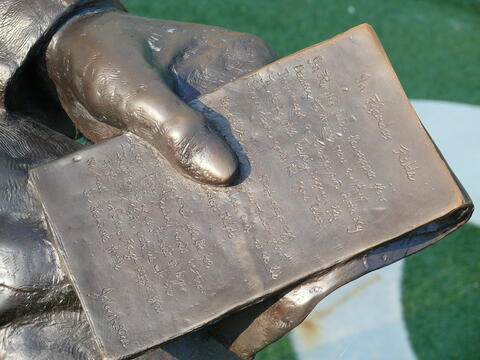
In Flanders Fields
In Flanders fields the poppies blow
Between the crosses, row on row,
That mark our place; and in the sky
The larks, still bravely singing, fly
Scarce heard amid the guns below.
We are the Dead. Short days ago
We lived, felt dawn, saw sunset glow,
Loved, and were loved, and now we lie
In Flanders Fields.
Take up our quarrel with the foe:
To you from failing hands we throw
The torch; be yours to hold it high.
If ye break faith with us who die
We shall not sleep, though poppies grow
In Flanders Fields.
John McCrae
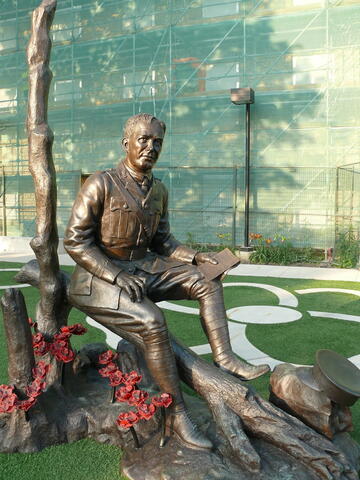
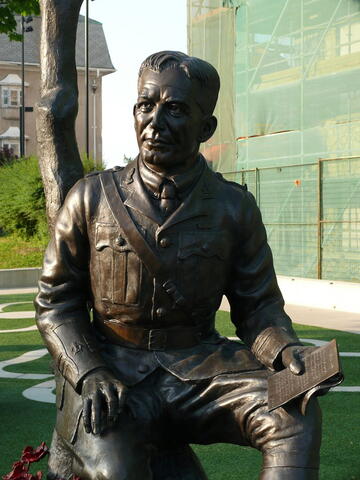
The Remember Flanders memorial in Guelph (and Ottawa) were designed by Canadian sculptor Ruth Abernethy. The hand-sculpted figure and the log on which McCrae is seated were sculpted as one piece. The two ends of the log and the base of rock and dirt were sculpted in another studio. Ruth was assisted by Cassie Koch and Lynette Schlichting who worked on the trees and base.
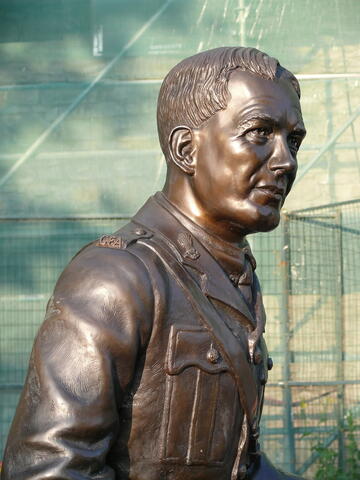
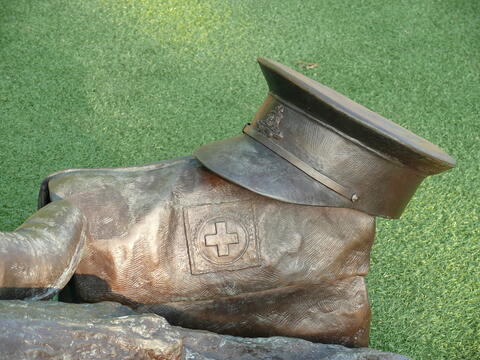
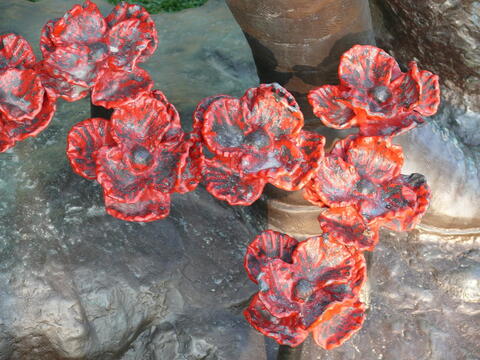
The crested buttons, the cap badge and uniform details are specific to John McCrae, 1915. As he writes with a notepad in hand, his medical bag is nearby and at his feet are poppies representing each of Canada's 23 regiments. In part because of the poem's popularity, the poppy was adopted as the Flower of Remembrance for the war dead of Britain, France, the United States, Canada and other Commonwealth countries.
The statue was promoted by the McCrae Statue Committee fundraising chair Lieutenant-Colonel (Retired) Michael McKay and former Navy veteran Bill Winegard, and produced by the Canadian sculptor Ruth Abernethy. The Campaign Goal of $300,000 was raised through the endorsement and support of community-minded philanthropists, organizations, businesses and citizens. The Rotary Club of Guelph contributed an initial $40,000 (with a $100,000 pledge) for the statue. Contributors included military personnel and Royal Canadian Legion organizations, such as the John McCrae branch 234 in Guelph. It was unveiled on June 25, 2015 and is dedicated to Lieutenant-Colonel John McCrae, celebrating his career as an Artillery Officer and Medical Officer. The memorial commemorates the Centennials of the Second Battle of Ypres, the Saint Julien Gas Attacks, and the writing of In Flanders Fields.
Lieutenant-Colonel John McCrae, one of the important sons of the city of Guelph, born in 1872, was raised in Guelph, and his limestone cottage on Guelph’s Water Street is home to the McCrae House Museum, a part of Guelph Museums, comprising the Guelph Civic Museum. Guelph’s 11th Field Artillery Regiment was once commanded by Capt. David McCrae, John McCrae’s father. Members of this regiment have served since the last world war in various roles, primarily peacekeeping efforts internationally. John McCrae succumbed to complications of pneumonia and meningitis in 1918.
FOR KING AND COUNTRY
MEMBERS OF
SACRED HEART CHURCH
This memorial is dedicated to all Veterans lost in combat. It was erected by Sacred Heart Parish.
LEST WE FORGET
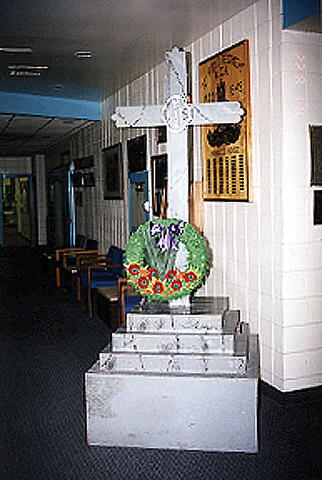
This cross is dedicated to all Veterans of all Wars. It was erected by the Royal Canadian Legion, Branch 234.