Ontario

Province Code
ON
City/Municipality
Ottawa
Memorial Number
24025-015
Type
Location
In storage
in Canada
Yes
GPS Coordinates
0, 0
Inscription

Aboriginal Military Service in the First World War

Between 1914 and 1918, Aboriginal men from all regions of Canada and the Dominion of Newfoundland fought with the Canadian military in the First World War. These men volunteered to serve, even though for many this meant fighting for a government that considered them "wards" of the state and denied their right to vote. Serving side-by-side with other Canadian men, Aboriginal soldiers gained acceptance and respect at levels that contradicted their treatment and status back home, and challenged the racist sentiment that one could not be both Aboriginal and a responsible citizen. At war’s end, Aboriginal veterans and members of Aboriginal communities were inspired to improve the status of Aboriginal peoples in Canada. This was the active force behind the first pan-Canadian Aboriginal organization, the League of Indians of Canada, which gave a national voice to Aboriginal concerns and set the stage for future activism in the fight for Aboriginal rights.

When war broke out, Aboriginal men were among the first to enlist for the Canadian Expeditionary Force (CEF) and were part of the first contingent of Canadians to be sent overseas. During the war, the number of Aboriginal men that volunteered left some reserves nearly depleted of young men. Aboriginal women were also active participants, and raised money, formed committees, and sent comforts from home to the troops at the front. While many Aboriginal men were eager to enlist, not all shared this enthusiasm and some Aboriginal communities discouraged their young men from signing up.

Once overseas, Aboriginal men served throughout the army in the infantry, railway troops, forestry, pioneer, and labour battalions, the veterinary corps, and also the Royal Flying Corps. Some Aboriginal men were recognized for their skills as snipers and scouts, using abilities they had acquired through their civilian roles as hunters and trappers, and Aboriginal men won medals for bravery and honour throughout the CEF. More than 300 Aboriginal men were killed at war, and many others were wounded or died upon their return.

Many Aboriginal veterans felt that little distinction existed between Aboriginal and non-Aboriginal soldiers on the front. Upon their demobilization, however, veterans returned to the same discriminatory environment that had existed prior to the war, and many felt that their status in society did not reflect their wartime achievement and sacrifice. Military service had provided an opportunity for Aboriginal soldiers from different parts of the country to meet and exchange ideas, and this created a sense of shared experience. The League of Indians of Canada was founded in 1919 by a veteran of the war and attracted members from across Canada to lobby for Aboriginal rights until its demise in the 1920s.

Image
Photo Credit
Victoria Edwards
Caption
plaques
Province
Body Content

The Aboriginal Military Service First World War Plaque is currently in storage with Parks Canada. It will be installed eventually near Confederation Park, close to the National Aboriginal Veterans Monument. 

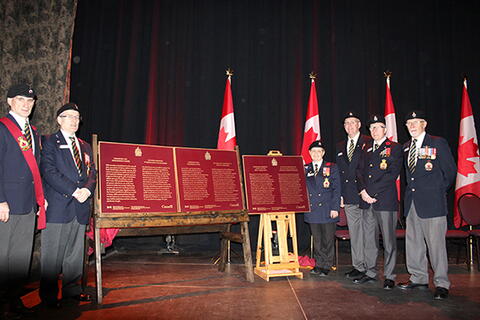
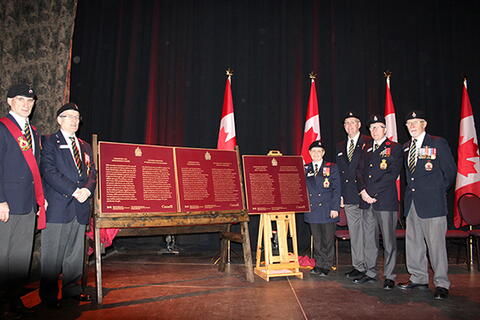
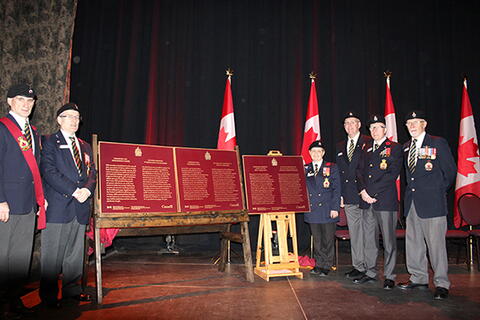
On March 2, 2017 personnel from Department of National Defence supported Parks Canada and the Historic Sites and Monuments Board of Canada at an event commemorating the national historic significance of Voluntary Aid Detachments. The event held in the Barney Danson theatre at the Canadian War Museum. Joining Master of Ceremonies Dr. Brian Always, Chair of the Historic Sites and Monuments Board of Canada, in the unveiling of the three plaques were the Honourable Catherine McKenna (Minister of the Environment and Climate Change and Minister responsible for Parks Canada), Councillor Ron Bernard of the Algonquins of Pikwakanagan First Nation, Dr. Laura Brandon (former Historian, Art and War at the Canadian War Museum), and Dave Mowat, member of the Alderville First Nation, of the Mississaugas.

City
Ottawa
Country
Type Description
Plaque
Memorial CF Legacy ID
9602
City/Municipality
Ottawa
Memorial Number
24025-014
Type
Address
1 Vimy Place
Location
Canadian War Museum
in Canada
Yes
GPS Coordinates
45.4165562, -75.7169158
Inscription

The Canadian War Memorials Fund

The Canadian War Memorials Fund (CWMF) was a charity initiated by Sir William Maxwell Aitken (subsequently Lord Beaverbrook) in November 1916. It was Canada’s first war art program and established the ongoing tradition of using artists to depict Canada at war.

The Fund was an outgrowth of the Canadian War Records Office (CWRO), an organ of the Canadian government founded in February 1916 and directed by Beaverbrook to document the conflict from a Canadian perspective in film, photography and print. The material he collected for the CWRO included official daily reports, maps, photographs and war diaries among other types of documents.

Beaverbrook’s new project of commissioning and collecting original works of war art was prompted in part by a lack of official war photographs, especially after the Second Battle of Ypres and the battles of Festubert, St. Eloi and Givenchy, which went largely unrecorded, at least visually. Post-battle paintings that reconstructed the events were criticized for lacking conviction. Worse, fake photographs and films purporting to depict elements of the battles began to be produced. Beaverbrook also believed that photographs had a maximum lifespan of 25 years. Only paintings, he believed, would survive long enough to convey a message about Canadian activity during the First World War for posterity.

Although Beaverbrook had formidable obstacles to overcome in trying to provide access to the front for artists and reporters, he eventually succeeded in moving artists into the theatre of war. These artists received military commissions and, as employees of the Canadian War Memorials Fund, compensation for materials, studio space and their completed works. In general, Beaverbrook and his partner the art critic P.G. Konody, commissioned oversized works in the tradition of historic battle paintings, with some smaller, more documentary works. Beaverbrook and Konody emphasized fieldwork and insisted that artists spend time on the battlefield making sketches that could later be transformed into canvases.

Nearly 1,000 paintings, photographs, drawings and films by over 100 artists, one-third of them Canadians, were commissioned. The Fund thus contributed to the artistic development of a number of important Canadian artists by providing them with salaries, commissions, supplies and media attention at a time when art production was little valued. The Fund paved the way for the growth of a young Canadian art scene by bringing together artists, curators, archivists, patrons and art institutions.

The hundreds of paintings, drawings, photographs and films produced for the Canadian War Memorials Fund were exhibited in London just after the war, as well as through the 1920s and 1930s, usually to warm public and critical acclaim. The collection was ultimately placed in the National Gallery of Canada. In 1971, most of the works were transferred to the Canadian War Museum, where they remain. The collection of the CWMF illustrates, commemorates and illuminates the Canadian experience of the First World War through the expression of Canadian artists.

Image
Photo Credit
Victoria Edwards
Caption
Canadian War Museum plaques
War or Conflict Term
Province
!4v1624467722215!6m8!1m7!1s7WEA4FaByVKwOu6VI7g5aA!2m2!1d45.41655621361518!2d-75.71691580193155!3f324.9564321006918!4f2.306413855340807!5f0.7820865974627469
Body Content

On March 2, 2017 personnel from Deparment of National Defence (DND) supported Parks Canada and the Historic Sites and Monuments Board of Canada (HSMBC) at an event commemorating the national historic significance of Voluntary Aid Detachments. They paraded the Colours at the event held in the Barney Danson theatre at the Canadian War Museum. Joining Master of Ceremonies Dr. Brian Always, Chair of the Historic Sites and Monuments Board of Canada, in the unveiling of the three plaques were the Honourable Catherine McKenna (Minister of the Environment and Climate Change and Minister responsible for Parks Canada), Councillor Ron Bernard of the Algonquins of Pikwakanagan First Nation, Dr. Laura Brandon (former Historian, Art and War at the Canadian War Museum), and Dave Mowat, member of the Alderville First Nation, of the Mississaugas.

City
Ottawa
Country
Type Description
Plaque
Memorial CF Legacy ID
9601
City/Municipality
Ottawa
Memorial Number
24025-013
Type
Address
321 Chapel Street
in Canada
Yes
GPS Coordinates
45.4268938, -75.6776163
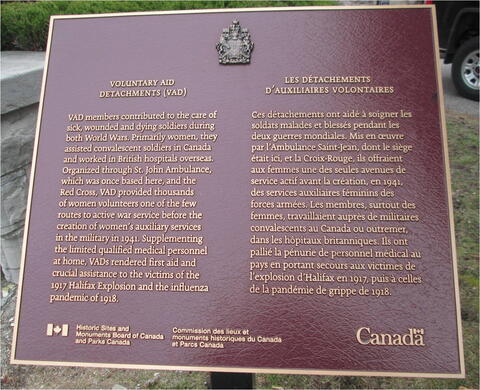
Inscription
  • Voluntary Aid
    Detachments (VAD)
  • VAD members contributed to the care of
    sick, wounded and dying soldiers during
    both World Wars. Primarily women, they
    assisted convalescent soldiers in Canada
    and worked in British hospitals overseas.
    Organized through St. John Ambulance,
    which was once housed here, and the
    Red Cross, VAD provided thousands
    of women volunteers one of the few
    routes to active war service before the
    creation of women’s auxiliary services
    in the military in 1941. Supplementing
    the limited qualified medical personnel
    at home, VADs rendered first aid and
    crucial assistance to the victims of the
    1917 Halifax explosion and the influenza
    pandemic of 1918.
  • Historic Sites and
    Monuments Board of Canada
    and Parks Canada
  • Les Détachements
    d’Auxiliaires Volontaires
  • Ces détachements ont aidé à soigner les
    soldats malades et blessés pendants les
    deux guerres mondiales. Mis en oeuvre
    par l’Ambulance Saint-Jean, dont le siège
    était ici, et la Croix-Rouge, ils offraient
    aux femmes une des seules avenues de
    service actif avant la creation, en 1941,
    des services auxiliaires féminins des
    forces armées. Les members, surtout des
    femmes, travaillaient auprès des militaries
    convalescent au Canada ou outremer,
    dans les hôpitaux britanniques. Ils ont
    pallié la pénurie de personnel medical au
    pays en portant secours aux victimes de
    l’explosion d’Halifax en 1917, puis à celles
    de la pandémie de la grippe en 1918.
  • Commission des lieux
    et monuments historiques du Canada
    et Parcs Canada
Image
Photo Credit
Victoria Edwards
Caption
Voluntary Aid Detachments Plaque unveiling at the Canadian War Museum.
1 of 3 images
Image
Photo Credit
Richard Turcotte
Caption
Voluntary Aid Detachments Plaque
1 of 3 images
Image
Photo Credit
Richard Turcotte
Caption
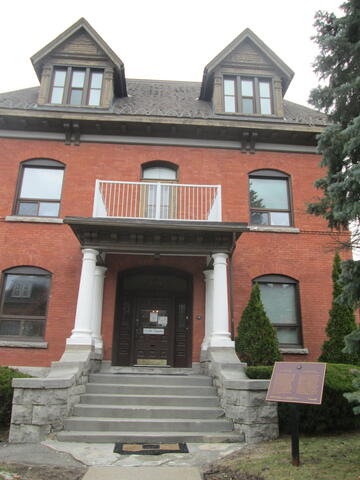
Voluntary Aid Detachments Plaque and former St. John Ambulance building.
1 of 3 images
Province
!4v1730990159954!6m8!1m7!1s4Et9wgqi8usbPLDlz_ilGg!2m2!1d45.42689384331576!2d-75.67761632071945!3f62.565243051198046!4f-4.218280620035387!5f0.7820865974627469
Body Content

On March 2, 2017, the Department of National Defence supported Parks Canada and the Historic Sites and Monuments Board of Canada at an event commemorating Indigenous Military Service in First World War, Canadian War Memorials Fund, and Voluntary Aid Detachments. The event was held in the Barney Danson theatre at the Canadian War Museum. Joining Master of Ceremonies Dr. Brian Always, Chair of the Historic Sites and Monuments Board of Canada, in the unveiling of the three plaques were the Honourable Catherine McKenna, Minister of the Environment and Climate Change and Minister responsible for Parks Canada; Councillor Ron Bernard of the Algonquins of Pikwakanagan First Nation; Dr. Laura Brandon, former Historian, Art and War at the Canadian War Museum; and Dave Mowat, member of the Alderville First Nation of the Mississaugas.

The plaque was subsequently installed at its current location in front of the building formerly housing the offices of the Saint John Ambulance.

Although unable to enlist, over 2,000 Canadian women volunteered and found a way to serve their country during the Great War and during two national emergencies at home -- the Halifax Explosion and the deadly Spanish Flu pandemic. Organized by the Canadian Red Cross and St. John Ambulance, Voluntary Aid Detachments worked as nurses’ aides, ambulance drivers, and clerical staff at convalescent hospitals in Canada and at some hospitals overseas. They assisted overworked medical and nursing staff in caring for thousands of injured and sick servicemen, some facing the same dangers and hardships as soldiers, nurses, and doctors working near the front lines.

Voluntary Aid Detachments first emerged in 1914 as Canada’s Militia Department made preparations at home, in anticipation of war in Europe. They were initially intended to create an emergency reserve of trained men and women who would support military medical services in case of invasion on Canadian soil. Later, following the outbreak of the First World War, the Voluntary Aid Detachments program developed into a female volunteer nursing corps, as male recruits were quickly drawn into the armed forces. Canadian Voluntary Aid Detachments units were modelled on a British system established in 1909, intended to supplement existing army nursing reserves. These reserves consisted of both professional nurses and civilian volunteers trained in first aid. While the British program utilized some 23,000 Voluntary Aid Detachments nurses during the Great War, the Canadian program was more modest. Still, the number of women who enrolled as Canadian Voluntary Aid Detachments members was considerable -- by the war’s end, some 2,000 had trained and qualified as Voluntary Aid Detachments nurses. While the majority were limited to working in military convalescent hospitals on the home front, an estimated 500 Canadian Voluntary Aid Detachments  members served in British military hospitals overseas.

The first Canadian Voluntary Aid Detachments were formed in Halifax, Québec City, and Saint John, because these ports were expected to be the first to receive wounded soldiers returning from overseas. These were later followed by units in Montreal, Ottawa, and Victoria. Initially, Voluntary Aid Detachments members engaged in non-nursing activities distributing comforts such as chocolate bars and cigarettes to departing troops and wishing them a safe return home. As the war progressed, however, they helped to prepare, open, and staff military convalescent hospitals. This role became particularly important as increasing numbers of sick and wounded soldiers returned to Canada in early 1915.

Many were anxious to go overseas where the need was greatest, but it was not until September 1916 that the first contingent of Canadian Voluntary Aid Detachments members left in response to a request from the British Red Cross. Although the Canadian Army Medical Corps refused to use voluntary nurses in its overseas hospitals, Voluntary Aid Detachments nurses were welcomed into British military hospitals. Overall, St. John Ambulance in Canada supplied more than 360 volunteers for overseas postings, while many other Canadian Voluntary Aid Detachments members financed their own passages to England and applied directly to British Voluntary Aid Detachments headquarters in London. Working in the British military medical establishment, Canadian Voluntary Aid Detachments nurses served as probationers (trainees) who were supervised by professional nurses. As was the case in Canadian convalescent hospitals at home, they assisted with various nursing tasks, such as making beds, preparing diets for invalids, and ensuring the overall comfort of soldiers. In some instances, Voluntary Aid Detachments work approached that of trained nurses, as volunteers changed surgical dressings and performed night duty in charge of wards. Like the military nurses under whom they served, Canadian Voluntary Aid Detachments members posted in France, and more distant battle zones were exposed to frontline dangers and hardships. A number of volunteers were recognized for their bravery during enemy attacks.

Both at home and in overseas operations, Voluntary Aid Detachments work varied greatly depending on the location and hospital type. Detachment members performed any number of tasks, working as nurses’ aides, ambulance drivers, clerical staff, and in any other auxiliary capacity required of them during the war. Voluntary Aid Detachments nurses also demonstrated their training and skill in the aftermath of the Halifax explosion in December 1917 and during the "Spanish" influenza pandemic of 1918. They provided crucial medical and nursing assistance during these two national crises. Canadian Voluntary Aid Detachments nurses served for the duration of the Great War and beyond, helping to care for convalescent soldiers well after the Armistice in 1918, and were officially demobilized in October 1920.

City
Ottawa
Country
Type Description
Plaque
Memorial CF Legacy ID
9600
City/Municipality
Trenton
Memorial Number
13006-021
Type
Address
220 RCAF Road
Location
National Air Force Museum of Canada, RCAF Memorial Airpark
in Canada
Yes
GPS Coordinates
44.1150572, -77.5510164
Image
Photo Credit
Paul Ozorak
Caption
aircraft (left side)
War or Conflict Term
Province
!4v1620823833513!6m8!1m7!1sZ95aYdHoF2IdHL2qCDZx2g!2m2!1d44.11505721096301!2d-77.55101641210261!3f60.03099543377409!4f7.805396304625361!5f0.7820865974627469
Body Content

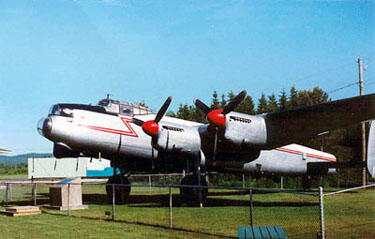
The Avro Lancaster KB882 was built in November 1944 by Victory Aircraft Ltd. in Malton, Ontario.  It was one of 430 Lancasters built in Canada.  In March of 1945, it was ferried to England and taken on strength by the 428 “Ghost” Squadron, 6 Bomber Group. The Lancaster flew 11 combat missions before the end of the Second World War. In June of 1945, it returned to Canada and became part of “Tiger Force”, Canada’s contribution to the air war in the Pacific. The war ended prior to deployment and the Lancaster was placed in storage at MacLeod, Alberta.

In 1956, the Lancaster was modified and delivered to 408 “Goose” Squadron at Royal Canadian Air Force Station in Rockcliffe, Ontario. The most notable modification to the aircraft included a 40-inch extension ahead of the cockpit to house the additional camera and RADAR installations. For the next 8 years, the Lancaster flew photo mapping, intelligence gathering, and photo reconnaissance missions including the surveillance of numerous Soviet ice stations. It was also used for photo and intelligence gathering during the Cuban Missile Crisis in October of 1962.

Struck off strength in 1964, the Lancaster was bought by the City of Edmundston, New Brunswick and placed on display at the local airport. The Lancaster KB882 was moved from Edmundston in October 2017, to the National Air Force Museum in Trenton, Ontario.

City
Trenton
Country
Type Description
Aircraft
Memorial CF Legacy ID
2661
City/Municipality
LaHave
Memorial Number
12009-074
Type
Address
100 Lahave Islands Road
Location
LaHave Islands Marine Museum
in Canada
Yes
GPS Coordinates
44.2329114, -64.3699864
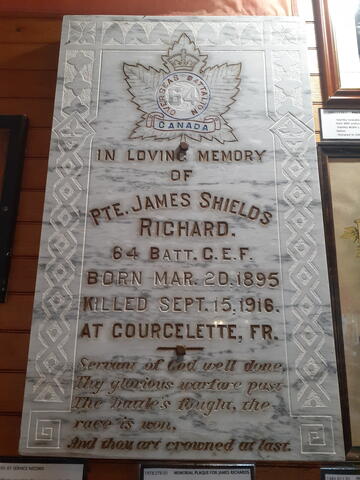
Inscription

OVERSEAS BATTALION
CANADA

IN LOVING MEMORY
OF
PTE. JAMES SHIELDS
RICHARD.
64 BATT. C.E.F.
BORN MAR. 20, 1895
KILLED SEPT. 15, 1916.
AT COURCELETTE, FR.

Servant of God well done,
Thy glorious warfare past
The battle's fought, the
race is won,
And thou are crowned at last.

Image
Caption
Private James Shields Richard Plaque
Province
!4v1723042546924!6m8!1m7!1sV5i_7KrirL7XNZWVAgOf-Q!2m2!1d44.23291141161445!2d-64.36998635016388!3f233.78070626488253!4f-1.5214300631102589!5f0.7820865974627469
Body Content

The Private James Shields Richard Plaque was erected in the United/Methodist Church before the building was turned into a museum.

City
LaHave
Country
Type Description
Plaque
Photo Credit
Veterans Affairs Canada
Memorial CF Legacy ID
12663
City/Municipality
Halifax
Memorial Number
12004-196
Type
Address
165 Coronation Avenue
Location
Freemasons Hall
in Canada
Yes
GPS Coordinates
44.6519972, -63.6458364
Inscription

needs further research/recherche incomplète

Image
Caption
Masonic Lodges of Halifax Great War Plaque
War or Conflict Term
Province
!4v1726503980640!6m8!1m7!1sCq1sHjFRdlf2K8BQt8XUGA!2m2!1d44.65199719228825!2d-63.64583636332146!3f344.8000937787936!4f-10.624787150414704!5f1.0246095402924729
Body Content

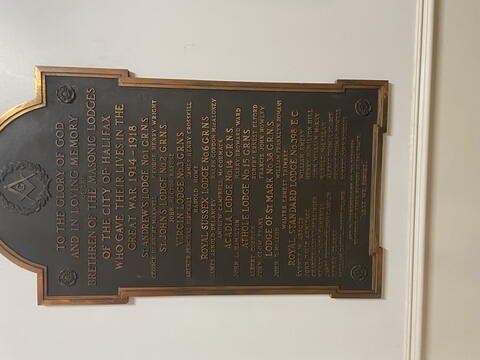
The Great War Plaque was erected on June 10, 1930. It lists the names of those from each Masonic lodge in Halifax who died in the First World War.

City
Halifax
Country
Type Description
Plaque
Photo Credit
Grand Lodge of Nova Scotia
Memorial CF Legacy ID
12735
City/Municipality
Halifax
Memorial Number
12004-131
Type
Address
2729 Gottingen Street
Location
Naval Museum of Halifax
in Canada
Yes
GPS Coordinates
44.6589999, -63.5934688
Province
!4v1635871304343!6m8!1m7!1sGLQ-CpHP86xmG1v_oygQsA!2m2!1d44.65898520639836!2d-63.59345341852039!3f21.74180251721205!4f3.3451767271286883!5f0.7820865974627469"
Body Content

In 2012, a bust of Commander Adelaide Sinclair was unveiled at the Naval Museum of Halifax during the opening of an exhibit marking the 70th anniversary of the Women's Royal Canadian Naval Service. The bust was created by Christian Corbet, the Royal Canadian Navy sculptor-in-residence.

Adelaide Sinclair was born on 16 January 1900 in Toronto. She earned a degree in political science at the University of Toronto in 1922, followed by a master’s degree in economics in 1925. After the Second World War began, she took a position at the Central Volunteer Bureau and became chairman of the Women’s Salvage Committee. In 1942, she moved to Ottawa where she became an economist with the Wartime Prices and Trade Board.

In March 1943, she joined the Women’s Royal Canadian Naval Service. She was sent to England to train with the Women’s Royal Navy Service (WRNS) and was appointed director with the rank of commander of the Women’s Royal Canadian Naval Service on 18 September 1943. She was director until 1946, when the service was disbanded. She was not only the first Canadian director of the service, but also the first woman to earn the rank of captain in the Royal Canadian Navy.

Following the Second World War, Adelaide was the executive assistant to the Deputy Minister of National Health and Welfare (1946–57). In 1945, she became an Officer of the Order of the British Empire for her “untiring zeal and outstanding ability, tact and judgment in organizing the Women’s Royal Canadian Naval Service into a most efficient and well-disciplined unit.” In 1967, Sinclair was named an Officer of the Order of Canada for her contributions to Canada as director of the Women’s Royal Canadian Naval Service and her work with UNICEF.

Christian began working with the Royal Canadian Navy in 2010, which was Canada’s Naval Centennial. He offered to donate a sculpted bust of Admiral Sir Charles Kingsmill, known as the Father of the Royal Canadian Navy. The Royal Canadian Navy’s appreciation of this gift inspired Christian to donate a second bust in 2011. This one was of Chief Petty Officer Max Bernays, a Canadian navy hero from the Second World War

Other works by Christian Corbet include: Rear-Admiral Leonard Warren Murray Bust, Midshipman William A. Palmer Bust, Vice Admiral Ralph Lucien Hennessy Bust and Newfoundland Royal Naval Reserve Bust.

City
Halifax
Country
Type Description
Bust
Memorial CF Legacy ID
12450
City/Municipality
Windsor
Memorial Number
35099-045
Type
Address
Riverside Dr W
Location
Dieppe Gardens
in Canada
Yes
GPS Coordinates
42.3191512, -83.043762
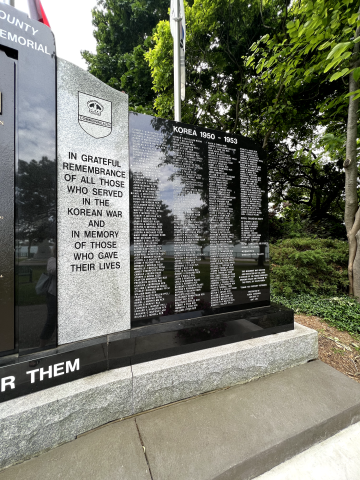
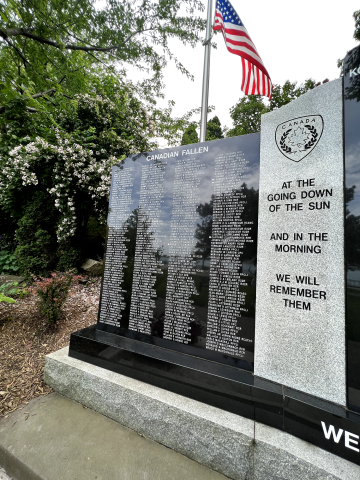
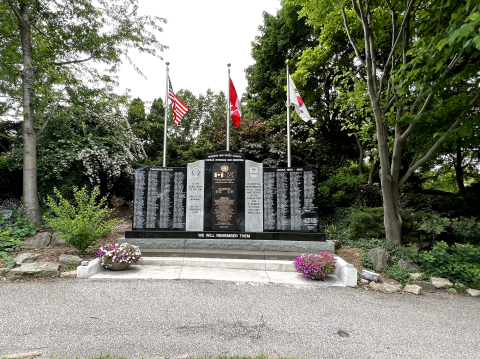
Inscription

[center/centre]

WINDSOR AND ESSEX COUNTY
KOREAN VETERANS WAR MEMORIAL

CANADA

AT THE
GOING DOWN
OF THE SUN

AND IN THE
MORNING

WE WILL
REMEMBER
THEM

CANADIAN FORCES PARTICIPATION
IN THE UNITED NATIONS
OPERATIONS, KOREA, 1950-1953

COMMONWEALTH

IN GRATEFUL
REMEMBRANCE
OF ALL THOSE
WHO SERVED
IN THE
KOREAN WAR
AND
IN MEMORY
OF THOSE
WHO GAVE
THEIR LIVES

[left section/gauche]

CANADIAN FALLEN
 

WILLIAM JOHN AKINAM
CHARLES MILTON ALFORD
JAMES RUSSELL ALLEN
HENRY ALTHOUSE
GREGORY ANAKA
FREDERICK ANDERSEN
NEIL MACDONALD ANDERSON
FRANK AUGUSTUS ANDREWS
LEONARD FREDERICK ANDREWS
HENRY ARD
ROBERT FRANCIS ARDING
ROBERT VICTOR ARNOTT
ARDEN JOSEPH ATCHISON
WILLIAM JAMES LEWIS AUSTIN
ELBURNE ALEXANDER BAIKIE
DOUGLAS WAKELIN BANTON
HAROLD ARTHUR BARKHOUSE
WELDON EUGENE BARKHOUSE
CHARLES BARRIE
JACOB WENSEL BATSCH
CHARLES FREDERICK BAWDEN
MARCEL BEAR
JOSEPH GERARD STANLEY BEARDMORE
JAMES GERALD BEAUDRY
MARCEL BELAND
JOSEPH RAYMOND BELL
EDGARD BERGERON
WILLIAM WALTER GEORGE BEST
WALLACE MACPHERSON BETTS
CARLO ERNESTO BIGNUCOLO
FREDERICK BILYK
JOHN JOSEPH BISHOP
WALTER ALEXANDER BLACK
JOSEPH ROLAND BLANCHARD
DAVID HOGG BOATH
MARC ANDRE BOLDUC
RUSSELL WILBURN BOLTON
JOSEPH MAURICE ROLAND BONNET
CONSTANT BOSSÉ
GILBERT HINO BOSSÉ
JOSEPH VICTORIN BOUDREAU
PAUL EMILE BOUDREAULT
JOSEPH LAURENT BOURDEAU
BENOIT BOUTIN
DONALD FREDERICK BRADSHAW
JAMES SAMUEL BRAYLEY
EARL PATRICK BRODEN
KENNETH SIDNEY BROOKS
BORDEN BRUCE BROWN
ROBERT JOHN BROWN
LEWIS DEAN BROWNLOW
WILLIAM EDWIN BRUCE
PAUL BRUNEAU
HARRY BOWMAN BRYDON
EVERETT CAMERON BUCHANAN
JOHN NICHOLAS BURAK
WALLIS MCBURNIE BURDEN
THOMAS BURGESS
BENEDICT BUTKEVICH
JAMES ALVIN CALKINS
HERBERT PETER CAMPBELL
RONALD DANIEL MACFADYEN CAMPBELL
JOSEPH JEAN MARIE MAURICE CAMPEAU
LAURIE ALBERT CANNING
MAURICE SHERMAN CARR
JOSEPH LOUIS ROLAND CARRIER
NORMAN WILLIAM CARROLL
ROBERT DONALD CASEY
EARL ARTHUR CHAPMAN
MARC CHARPENTIER
MARCEL EUGÉNE HENRI CHARTIER
DONAT CHATIGNY
MICHAEL PAUL CHIASSON
OMER CHIASSON
VIATEUR CHOUINARD
ROBERT ALLAN CHRISTIE
JAMES JOSEPH CHRISTOFF
PAUL ADRIEN CLARK
ROBERT CLARK
BENNIE CLEMENTS
HUGH ROSS CLEVELAND
WILFRED DOUGLAS CLOONEY
THOMAS HENRY COLBOURNE
ARTHUR ROY COLLINS
JOSEPH LOUIS MAXIME COLLINS
RAYMOND LEE COLP
FREDERICK WILLIAM CONWAY
WILLIAM ANDREW COPAGE
ROBERT KEEWATIN COPINACE
GILLES CORBEIL
GORDON MAURICE CORMIER
VICTOR KEITH CORNISH
DOUGLAS EDWARD COTA
JOSEPH RAYMOND IVAN COTE
LLOYD GORDON COUNTRYMAN
LOUIS JOSEPH COURCHAINE
STUART FRANKLIN COWAN
ROBERT ARTHUR CRAIG
KENNETH CROMPTON
RAY WILSON CROWELL
ALBERT EDWIN WINSTON CUMBERBATCH
CLARENCE JOHN CURRIE
FLORIAN WILFRID AUREY CUSSON
ROLAND DALLAIRE
JOSEPH FERNAND LÉOPOLD DANEAU
HOWARD CLARENCE DARRAH
JOSEPH ALEXANDRE LUCIEN DAVID
HENRY GLENWOOD DAVIS
WILLIAM DAWSON
MICHAEL DEBECK
JOSEPH RICHARD ROGER DESCHENES
JOSEPH ARTHUR ALÉLARD FLORENT DESCHESNES
GEORGES DESILETS
JOSEPH ARTHUR GUY DESJARDINS
JOSEPH RENÉ ARMAND ROLAND DESROCHERS
FRANK ALFRED DIEHL
PAUL- ÉMILE DIONNE
GÉRARD DISTEFANO
GEORGE EVERETT DOHERTY
JOSEPH LÉOPOLD YVAN DUBE
GILLES DUCASSE
GEORGES NAPOLEON DUCHARME
LUDOVIC JOSEPH DUGUAY
JEAN LOUIS DUHAIME
JEAN BERCHMANS DUMAS
MICHAEL ALEXANDER DUNPHY
JOSEPH ELPHÉGE ALBERT DUPUIS
YVAN VALMAR JOSEPH DUROCHER
GERALD HUGH DURY
ALBERT CLIFFORD EARHART
HAROLD VICTOR EDGLEY
RONALD ALLAN EDMUNDS
ROY DOUGLAS ELLIOTT
WILLIAM HENRY ELLIOTT
MAURICE EMARD
LORNE AULEY EMERSON
RONALD EUGENE EMERY
RAYMOND CHESTER ENOS
KENNETH IRVINE ERB
GERALD ROBERT EVANS
JAMES KENNETH EVANS
DONALD WALTER EVERINGHAM
BERNARD PAUL JOSEPH FAIRFIELD
JOHN HOWARD FAIRMAN
ROBERT BURNS FAIRSERVICE
CECIL ROBERT ELLSWORTH FANCY
ADÉLARD JOSEPH FARAND
NORMAN PHILIP FERLAND
JOSEPH ALEXANDER FERLATTE
HERVÉ ALPHONSE FERRON
LESLIE THOMAS FIELDING
WILLIE FONG
ALBERT FORTIER
WILLIAM JOHN FOWLER
GASTON FRANCOEUR
JOSEPH LEONARD RAYMOND GAGNIER
JEAN GUY GAGNON
JOSEPH OMER GAGNON
JEAN MOISE GALLANT
PAUL HENRY GALLINGER
JOSEPH EDMOND HENRI GARAND
RUSSELL LEON GARDINER
LEON ARMAND GAUTHIER
ROBERT GENDRON
AUSTIN EMERY GEORGE
ROGER GIGUERE
JOHN FRANCIS GILL
JOHN ROBERT QUINN GILLAN
JAMES FRANCIS GILMORE
HERMEL GIRARD
JACQUES GIRARD
JOSEPH ARTHUR FERNAND GIRARD
ROBERT FREDERICK THOMAS GIRARD
LÉO PAUL GLADU
DOUGLAS CHARLES GOOD
ELWIN HERMAN GOODWIN
JOSEPH PHYDIME LIONEL GOSSELIN
LOUIS JOSEPH GOSSELIN
PHILIP EDWIN GOWER
ALEXANDER LOUIS GRAY
KENNETH ALLEN GRAY
HENRI-LOUIS GRENIER
RAYMOND JOHN GRENNAN
ARTHUR STANLEY GUY
JAMES CASWELL HACKETT
REGINALD ARCHIBALD HALL
JAMES DOUGLAS HAMILTON
ALFRED ERNEST ROY HANSEN
EDWARD JACK HANSPIKER
RUSSELL OSCAR HARALDSON
JOHN FREDERICK HARMON
CYRIL HARRIOTT
HAROLD CARLEN HARRISON
RALPH HAVELOCK HARRISON
DONALD PERKINS HASTINGS
CURTIS ARCHIE HAYES
JOSEPH WILLIAM HEARSEY
JOHN KENNETH HEATH
THOMAS JOSEPH HEDDERSON
CLAYTON CARL HELM
ALLAN JOSEPH HELMAN
ARTHUR GRAHAM HERMAN
HENRY BENHART HIEBERT
HAROLD ELWOOD HIGGINS
JOHN WALTER HILTON
WILLIAM RAYMOND HOWARTH
ANDREW GEORGE HOWSE
ELDON JAMES HUGHES
NORMAN ERNEST HUGHES
DONALD GEORGE HULL
JOSEPH WILFRID ALBERT HUOT
JOSEPH LOUIS PHILIPPE ISABELLE
RUSSELL ARTHUR JODRIE
WILLIAM EDWARD JOHNSTONE
DONALD RALPH JONES
EDWARD JOHN JONES
KENNETH BRYANT JONES
ROBERT JAMES JONES
JAMES ARTHUR JORDAN
EDWARD GORDON KAIN
JOHN PAUL KEATING
JOHN FRANKLIN KEMP
JOHN WILLIAM KENNEDY
JOSEPH EDWARD KILPATRICK
ARTHUR ALLISON KING
ROGER FALCON KING
GEORGE ERNEST KINROSS
EDWARD JOSEPH MICHAEL KNIGHT
GERALD GLENWOOD KNORR
GRAHAM CAMERON KNOTT
GERALD WALTER KOCH
WILLIAM KOSTIUK
JOSEPH ODIAS GÉRARD LABRECQUE
HENRI LACHANCE
JOSEPH GASTON MAURICE LADOUCEUR
LAWRENCE LADOUCEUR
JOSEPH LÉO LÉONARD LAFLAMME
CLIFFORD JOSEPH LAFRAMBOISE
JOSEPH PAUL CLAUDE ROLAND LAFRANCHISE
FRANK RICHARD LAKER
RAYMOND EDOUARD LANDRY
FERNAND LANGLOIS
WILLIAM LAPKA
BERNARD WELLINGTON LARSON
MERVYN EDWARD LATHAM
GERALD DEAN LAURIE
ARSÉNE LAUZIER
HENRY JOSEPH LAVALLEE
WILLIAM HAROLD LAVENE
LEO JAMES LAWLOR
ROGER CONWAY LEACH
HENRI JEAN GUY LEBEAU
JOSEPH GÉRARD ARMAND LEBLANC
JOSEPH ADRIEN JEAN MAURICE LECLERC
CAROL BOYD LECUYER
HUBERT DONALD LEGGE
JEAN-MARIE LEONARD
MALCOLM CHARLES LEONARD
JEAN-CLAUDE LEROUX
JOSEPH MARCEL LEO LESSARD
JULES LÉONARD LETENDRE
THEODORE NORMAN LETKEMAN
URBAIN JOSEPH LEVESQUE
JOSEPH YEHUDI LEVISON
ARLEN CHARLES LEWIS
WILFRED JOSEPH LINDEN
VINCE LISKA
THOMAS EDWARD LITTLE
WILLIAM JOHN LOCKHART
GORDON LESLIE LUCAS
WILLIAM FRANK LUCAS
JOSEPH ALEXIS ROSAIRE LUPIEN
WALLACE ALBERT LUXTON
EARLE MACASKILL
JOSEPH DANIEL MACCORMACK
BERNARD ANCEL MACDONALD
BRUCE MERLIN MACDONALD

HERBERT THOMAS MACDONELL
ROBERT JOHN MOORE
JOHN LOUIS QUINN
ROBIN JENSEN SKAVBERG
IAN THOMAS LANG TORRAVILLE


[right section/droit]

KOREA 1950-1953

  • EVERETT W MACDONALD PPCLI
  • RAYMOND MACDONALD PPCLI
  • LEONARD F MACDOUGALL RCR
  • HARRY B MACEACHRON PPCLI
  • ELLIOTT GORDON MACKAY PPCLI
  • DOUGLAS H R MACLEAN RCR
  • NEIL T. MACLEOD RCR
  • MURDOCH R MACMILLAN RCR
  • STEPHEN H MACPHEE RCR
  • DONALD W MACPHERSON RCR
  • WILLIAM B MADDISON RCCS
  • JOSEPH N J C MADORE R22R
  • JEAN-P MAISONNEUVE R22R
  • • JOSEPH W MAJOR R22R
  • ROBERT W MANLEY RCA
  • WALTER J MARSHALL PPCLI
  • JOSEPH R MARTIN R22R
  • OLIER MATHIEU R22R
  • DERRICK P MAURER R22R
  • JERROLD N J MAXWELL PPCLI
  • JOHN MCHUGH RCR
  • GERALD D. MCINNES PPCLI
  • ANGUS W MCINNIS RCR
  • • EARL A MCINTYRE PPCLI
  • BASIL P MCKEOWN RCA
  • DOUGLAS A MCKINNON PPCLI
  • HUGH I MCKINNON PPCLI
  • ALEXANDER MCNEIL RCE
  • NORMAN G MCNEIL RCR
  • WALTER C MCPHAIL PPCLI
  • ROY F MCPHEE PPCLI
  • ROBERT P MCVICAR RCR
  • JOHN C MEHAN RCR
  • JEAN R MERCIER R22R
  • JOSEPH A MERCIER R22R
  • GERARD B MEYNELL RCR
  • FERNAND MICHAUD R22R
  • JOSEPH N MICHAUD R22R
  • MARC HENRI MICHAUD R22R
  • RENÉ MICHAUD PPCLI
  • ROBERT E MILLAR RCR
  • EDWARD MILLER RCA
  • WALTER E MILMORE RCR
  • ALLAN G MITCHELL RCR
  • KENNETH R MONAGUE PPCLI
  • JEAN-PAUL MONETTE R22R
  • JACK A MONROE RCAMC
  • JOSEPH L A MOODY R22R
  • LORNE R MOONEY RCA
  • HERMAN J MOREAU R22R
  • MAURILLE J MOREAU PPCLI
  • JAMES H MORFORD PPCLI
  • CAMILLE J MORIN R22R
  • JOSEPH A MORIN R22R
  • CLAYTON MORNINGSTAR RCR
  • FREDERICK MORRIS RCE
  • CHARLES J MORRISON RCR
  • WILLIAM E MORRISON RCASC
  • STANLEY RICHARD MUDD PPCLI
  • WILLIAM MUIR RCE
  • FRANCIS AUSTIN MULLIN PPCLI
  • JAMES R MURCAR PPCLI
  • DANIEL J MURPHY, MM RCR
  • RALPH R MURPHY RCA
  • LAWRENCE L MURRRAY PPCLI
  • RICHARD A NANKERVIS RCR
  • LEONARD G NEUFIELD LdSH
  • DOUGLAS L NEWELL RCR
  • NORMAN D NICHOLSON RCEME
  • PETER J NOLAN RCR
  • EMILE NORMAND PPCLI
  • KENNETH W NORTON PPCLI
  • ROY S NYSTEDT RCR
  • KENNETH D O'BRIEN PPCLI
  • PATRICK W O'CONNOR RCR
  • LEONARD J O'DONNELL RCASC
  • LEE HERSCHEL OLIVER PPCLI
  • ALBERT W ORR RCA
  • JAMES O OUELLETTE PPCLI
  • JOSEPH N N OUELLETTE R22R
  • DAVID OWENS RCA
  • ALBERT E PAILLE R22R
  • JOSEPH A J PAQUETTE R22R
  • CHARLES A D PARENT R22R
  • ROSS R PATRICK PPCLI
  • EMERSON E PATTERSON PPCLI
  • GARLAND L PATTERSON PPCLI
  • GERALD PAYTON RCR
  • ROYAL BLAINE PEARSON PPCLI
  • ALBERT PELLETIER R22R
  • ROLLAND PELLETIER RCASC
  • DONALD W PENNEY RCR
  • THOMAS E PERRY R22R
  • LLOYD E PETERS PPCLI
  • JOSEPH S PICHE R22R
  • RÉGIS J PILOTE R22R
  • ROBERT A PLUMB PPCLI
  • JOSEPH H M POIRIER R22R
  • JOSEPH H B POIRIER R22R
  • ADAM E POLNUK PPCLI
  • JAMES D POOLE RCR
  • TREVOR VI POTTER RCASC
  • ALFRED G POUPART PPCLI
  • EDWARD JAMES POWER PPCLI
  • WYCLIFFE L PRESLEY RCR
  • JOSEPH A M P PRIEUR RCR
  • ALBERT F PROULX R22R
  • JOSEPH R R PROVOST R22R
  • JOSEPH H N PRUD'HOMME R22R
  • RAYMOND RACINE R22R
  • IAN N RAEBURN RCR
  • EDGAR J J C RAMAGE R22R
  • WILLIAM A RATHBUN RCAC
  • KENNETH R RAY RCR
  • PATRICK G REDMOND CD RCASC
  • WILLIAM P REGAN RCR
  • ANDRÉ A RÉGIMBALD R22R
  • GEORGE PE REID QOR
  • BERNARD G D RICE RCR
  • IRVINE L RICE RCR
  • CYRIL W RICHARDS RCA
  • ROBERT H RICHARDS RCR
  • JACK F RIDDLE RCA
  • LLOYD S ROACH RCR
  • LESLIE M ROBBINS RCASC
  • LOUIS C ROBERTS RCR
  • RAYMOND C ROBERTS RCASC
  • GEORGE E ROBINSON PPCLI
  • ANTOINE R ROCHON R22R
  • BAPTISTE ROSS RCA
  • ALEXANDER ROWBOTHAM RCR
  • BENOIT ROY R22R
  • MALCOLM R ROYLES RCR
  • ROBERT A RYAN RCR
  • WARWICK C RYAN RCR
  • WILLIAM J RYAN RCR
  • ELVIN S SABEAN RHR
  • JOSEPH E H SANSCARTIER R22R
  • PAUL F L SARE OBE RCD
  • JOHN SAUVE PPCLI
  • ROGER B SCHOULTZ RCR
  • MELVIN HE SCHWENNEKER PPCLI
  • ANTHONY E SCOTT PPCLI
  • CHARLES E SENECHAL R22R
  • BURTON F SHAW RCE
  • HENRY J D SHORE RCR
  • VERNON K SHORTREED RCR
  • TONY SIHA PPCLI
  • ANDRE SIMARD R22R
  • WILLIAM R I SLACK CD RCAMC
  • FREDERICK SLATER RCEME
  • GLEN C SMALL PPCLI
  • HAROLD SMART PPCLI
  • JOHN F SMILLIE LSH
  • LESLIE A SNOW RCA
  • DOUGLAS E SPENCE PPCLI
  • PHILIP C SPENCLEY RCR
  • SAMUEL J SQUIRES RCR
  • JOSEPH V F ST-GERMAIN R22R
  • JEAN R ST-LAURENT R22R
  • RONALD STAINSBY RCR
  • DONALD L STANLEY PPCLI
  • DONALD H STEER RCR
  • ROBERT M STENSETH PPCLI
  • LEONARD A STEWART PPCLI
  • FRANK S STILWELL RCD
  • WILLIAM A STONE RCR
  • ALAN W STOREY PPCLI
  • ARTHUR E STOREY RCR
  • CHARLES L STOWE RCR
  • WILLIAM L STRACHAN RCR
  • ALBERT G STROUD RCA
  • RALPH D STROUD RCR
  • THOMAS P SUTTON RCE
  • RAYMOND R SWEENEY PPCLI
  • HENRY A SZLAHETKA PPCLI
  • TAKASHI TAKEUCHI RCA
  • RONALD H TAYLOR RCEME
  • LEO J TELLIER PPCLI
  • EDWARD E THEOBALD PPCLI
  • JOSEPH THISTLE RCA
  • DONALD E THOMPSON RCA
  • AUBREY F THOMSON RCR
  • JAMES R THOMSON RCASC
  • THOMAS H THOVESON PPCLI
  • ROBERT H G TOLVER PPCLI
  • JOHN RICHARD TOOLE PPCLI
  • WILLIAM J L TOPPING RCR
  • GEORGES TREMBLAY PPCLI
  • JOSEPH G TREMBLAY R22R
  • MARCEL TREMBLAY R22R
  • PAUL EMILE TREMBLAY R22R
  • PAUL-EMILE TREMBLAY R22R
  • GEORGE S TRENTER PPCLI
  • DESMOND J TRUDEAU PPCLI
  • MURRAY A TRUTHWAITE RCA
  • RALPH E TURNBULL RHR
  • JOSEPH L F P VAILLANT R22R
  • MILTON C VIPOND QOR
  • WILLIAM J WALCH PPCLI
  • GORDON H WALDNER LSH
  • DONALD E WALKER PPCLI
  • GORDON W M WALKER RCR
  • ROBERT L WALKER PPCLI
  • STANLEY A WARD RCR
  • JOHN R WARREN PPCLI
  • JOHN E M WATSON RCA
  • LEONARD A WATSON RCE
  • VERNON R WEATHERBEE PPCLI
  • CHARLES D WEBB RCA
  • • CLIFFORD D WEIR RCA
  • DANIEL M WELLINGTON RCR
  • FREDERICK O WELLS PPCLI
  • JAMES M WENKERT RCA
  • JAMES J WHITE RCA
  • RONALD O WHITE RCR
  • FREDERICK J WHITING RCR
  • BENJAMIN E WILLIAMS RCR
  • JOHN H WILLIAMS RCR
  • ROY T WILLIAMS RCR
  • EDWARD H WILSON RCR
  • FREDERICK R WOOD PPCLI
  • JAMES DEANS WOOD DCM PPCLI
  • THOMAS R WOODBURY RCR
  • NORMAN WOODCOCK PPCLI
  • REGINALD F WOODS RCCS
  • FREDERICK G WORKS PPCLI
  • THOMAS B WOTTON PPCLI
  • DEVERNE E WRIGHT PPCLI
  • JOHN O'HARA WRIGHT RCA
  • WILLIAM D WRIGHT RCA
  • LLOYD KEITH WYLIE PPCLI
  • JAMES R ZANTOLAS RCASC
  • CARL J ZIEGLER RCAMC
  •  
  •  
  • ROYAL CANADIAN NAVY
  • AB ELBUREN A BAIKIE
  • AB WALLIS M BURDEN
  • OS LEON A GAUTHIER
  • AB FRANK R. LAKER
  • AB VINCE LISKA
  • AB ROBERT J MOORE
  • LTCDR JOHN LOUIS QUINN
  • AB ROBERT J SKAVBERG
  • AB IAN T L TORRAVILLE
  •  
  • ROYAL CANADIAN AIR FORCE
  • HERBERT T MACDONELL
  •  
  • • DENOTES
    WINDSOR AREA FALLEN
  •  
  •  
  •  
  •  
  •  
  •  
  • THIS MONUMENT WAS ERECTED
    AND DEDICATED MAY 30, 2009
    IN HONOUR OF 516 YOUNG CANADIANS
    BRINGING PEACE AND FREEDOM TO
    THE PEOPLE OF SOUTH KOREA
  •  
  • "THANK YOU FOREVER" VETERANS
  •  
  • PRESENTED BY
    KOREA VETERANS
    HERITAGE #1
    UNIT #29

[base/bas]

WE WILL REMEMBER THEM

Image
Photo Credit
Diane Gilmour
1 of 4 images
Image
Photo Credit
Veterans Affairs Canada
Caption
right section
1 of 4 images
Image
Photo Credit
Veterans Affairs Canada
Caption
left section
1 of 4 images
Image
Photo Credit
Veterans Affairs Canada
Caption
front
1 of 4 images
War or Conflict Term
Province
!4v1654173415675!6m8!1m7!1sCAoSK0FGMVFpcFB4Y0RnRXdpU0pyNnktWTJRVzdjXzJ4bmI2MThLZzdOeDJ1MDQ.!2m2!1d42.3191512!2d-83.043762!3f252.03!4f4.3700000000000045!5f2.979123261084609
Body Content

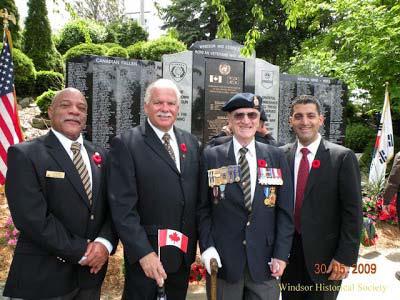
The Korean Veterans War Memorial was unveiled May 30, 2009, in recognition of the sacrifices of Canadian soldiers in the Korean war. It was installed by Hallmark Memorial Co. The granite and bronze monument contains the names of all 516 Canadians killed in the Korean War with the names of the Windsor-Essex casualties specially noted.

It's the result of three years of work by a committee that included Henry Martinak of Windsor who served in Korea with the Princess Patricia's Canadian Light Infantry from 1950 to 1952. Monument to Canadian Fallen, a Korean War memorial, was shipped from Korea to the Windsor Armory, where it was assembled by artist Yu Young Mun. It was temporarily sited in the park adjacent to Windsor City Hall for several months before its intended destination in Ottawa was ready in 2003. After its departure, Martinka felt Windsor should have its own Korean War memorial.

Essex County Korean War Veterans Memorial Committee raised about $47,000 for the project and received funding from the Trillium Foundation, Veterans Affairs Canada and Ceasars Windsor to cover the total cost of $63,000.

City
Windsor
Country
Type Description
Wall, granite
Memorial CF Legacy ID
8042
City/Municipality
Kitchener
Memorial Number
35094-012
Type
Address
350 East Avenue
Location
Kitchener Armoury
in Canada
Yes
GPS Coordinates
43.4482517, -80.4698351
Inscription

[front/devant]

(left plaque/plaque gauche)

C.W.A.C.
1941 - 1945
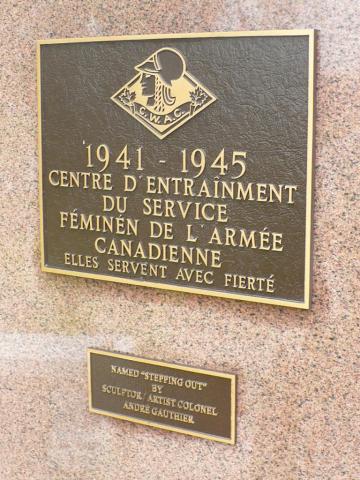
CENTRE D'ENTRAINMENT 
DU SERVICE
FEMINEN DE L'ARMEE
CANADIENNE
ELLES SERVENT AVEC FIERTE

NAMED "STEPPING OUT"
BY
SCULPTOR/ARTIST COLONEL
ANDRE GAUTHIER

(right plaque/plaque droite)

1941 - 1945
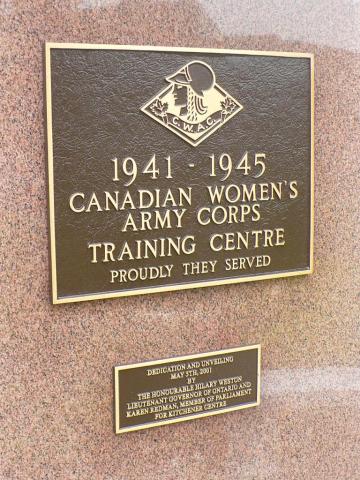
CANADIAN WOMEN'S
ARMY CORPS
TRAINING CENTRE
PROUDLY THEY SERVED

DEDICATION AND UNVEILING
MAY 5TH, 2001
BY
THE HONOURABLE HILARY WESTON
LIEUTENANT GOVERNOR OF ONTARIO AND
KAREN REDMAN, MEMBER OF PARLIAMENT
FOR KITCHENER CENTRE

[back/arrière]

(left plaque/plaque gauche)
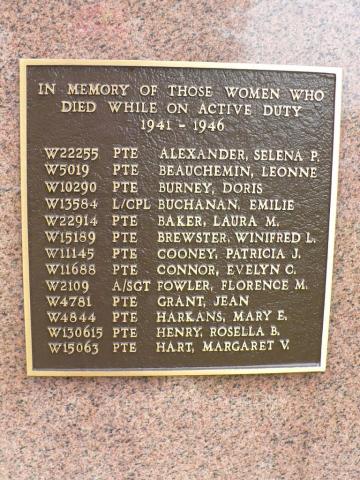
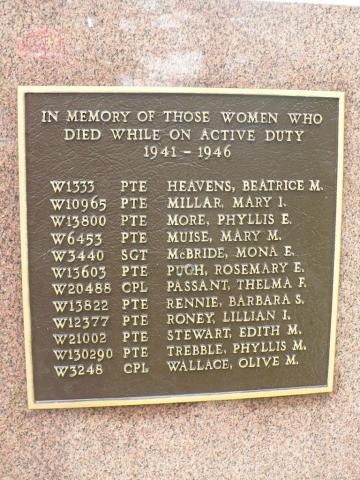
IN MEMORY OF THOSE WOMEN WHO
DIED WHILE ON ACTIVE DUTY
1941 - 1946

W22255  PTE  ALEXANDER, SELENA P.
W5019    PTE  BEAUCHEMIN, LEONNE
W10290  PTE  BURNEY, DORIS
W13584  L/CPL  BUCHANAN, EMILIE
W22914  PTE  BAKER, LAURA M.
W15189  PTE  BREWSTER, WINIFRED L.
W11145  PTE  COONEY, PATRICIA J.
W11688  PTE  CONNOR, EVELYN C.
W2109   A/SGT  FOWLER, FLORENCE M.
W4781   PTE  GRANT, JEAN
W4844   PTE  HARKANS, MARY E.
W130615  PTE  HENRY, ROSELLA B.
W15063  PTE  HART, MARGARET V.

(right plaque/plaque droite)
 IN MEMORY OF THOSE WOMEN WHO
DIED WHILE ON ACTIVE DUTY
1941 - 1946

W1333   PTE  HEAVENS, BEATRICE M.
W10965  PTE  MILLAR, MARY I.
W13800  PTE  MORE, PHYLLIS E.
W6453  PTE  MUISE, MARY M.
W3440  SGT  McBRIDE, MONA E.
W13603  PTE  PUGH, ROSEMARY E.
W20488  CPL  PASSANT, THELMA F.
W13822  PTE  RENNIE, BARBARA S.
W12377  PTE  RONEY, LILLIAN L.
W21002  PTE  STEWART, EDITH M.
W130290  PTE  TREBBLE, PHYLLIS M.
W3248  CPL  WALLACE, OLIVE M.

Image
Caption
back
1 of 6 images
Image
Caption
Stepping Out
1 of 6 images
Image
Caption
front right plaque
1 of 6 images
Image
Caption
front left plaque
1 of 6 images
Image
Caption
back left plaque
1 of 6 images
Image
Caption
back right plaque
1 of 6 images
Province
!4v1713877214184!6m8!1m7!1srU4-ann3id0HMDR5JkQpTA!2m2!1d43.44825170667557!2d-80.46983511337694!3f38.29306296740123!4f-6.153951587963519!5f2.3495561104242304
Body Content

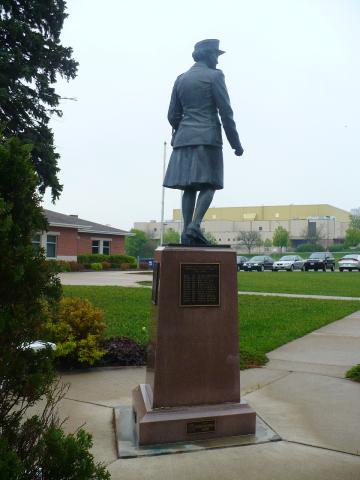
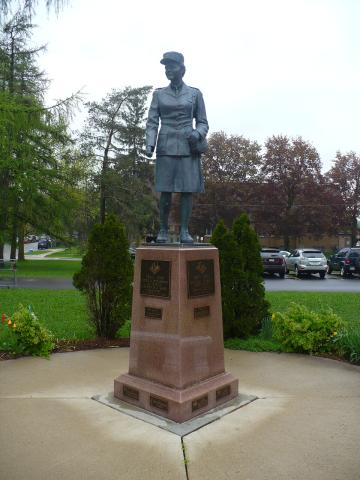
The Stepping Out memorial honours women who served in the Canadian Women's Army Corps between 1941 to 1946. Names of those who died while on service are inscribed on plaques. The monument has a 6' 4" high bronze figure which depicts a young Canadian Women's Army Corps member. The figure depicts how she might have looked when "stepping out" on a pass in town during her basic training course at the wartime Kitchener Training Centre.

The monument was unveiled on May 5, 2001, by the Honourable Hillary Weston, Lieutenant-Governor of Ontario and Karen Redman, Member of Parliament for Kitchener Centre. The unveiling was attended by some 1,500 Canadian Women's Army Corps veterans and relatives, the Mayor of Kitchener, Minister of National Defence representative, Chief of Defence Staff representative, the sculptor (André Gauthier of Orleans, Ontario) and Artcast Inc. Foundry representatives.

City
Kitchener
Country
Type Description
Shaft, statue - bronze
Photo Credit
Tim Laye, Ontario War Memorials
Memorial CF Legacy ID
5507
City/Municipality
Elora
Memorial Number
35094-004
Type
Address
1 Macdonald Square
Location
Wellington Municipal Office
in Canada
Yes
GPS Coordinates
43.6832801, -80.430527
Inscription

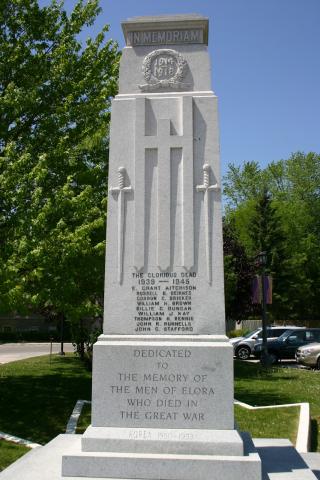
[front/devant]

IN MEMORIAM
1914-1918

THE GLORIOUS DEAD
1939 - 1945
E. GRANT AITCHISON
RUSSELL B. BEIRNES
GORDON C. BRICKER
WILLIAM H. BROWN
BILLIE G. DUNCAN
WILLIAM J. KAY
THOMPSON H. RENNIE
JOHN R. RUNNELLS
JOHN G. STAFFORD

DEDICATED
TO
THE MEMORY OF
THE MEN OF ELORA
WHO DIED IN
THE GREAT WAR

KOREA 1950 - 1953

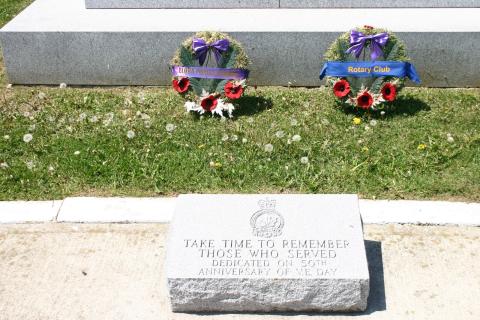
[stone/pierre]

(LEGION CREST)

TAKE TIME TO REMEMBER
THOSE WHO SERVED
DEDICATED ON 50TH
ANNIVERSARY OF D-DAY

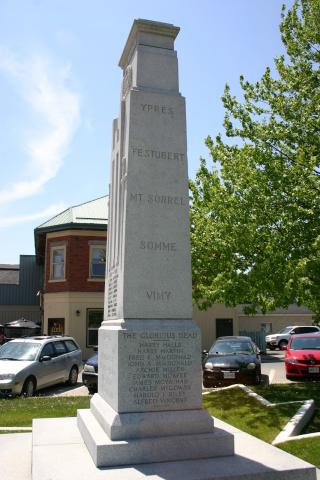
[right side/côté droit]

YPRES
FESTUBERT
MT. SORREL
SOMME
VIMY 

THE GLORIOUS DEAD
HARRY HALLS
HARRY HARPIN
FRED F. MacDONALD
JOHN A. MacDONALD
ARCHIE MILLER
EDWARD MORFEE
JAMES MOYNIHAN
CHARLES McGOWAN
HAROLD J. RILEY
ALFRED VINCENT

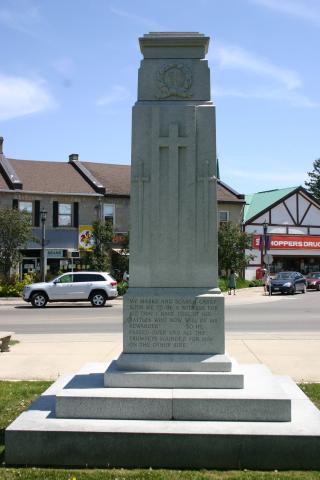
[back/arrière]

1914-1918

"MY MARKS AND SCARS I CARRY
WITH ME TO BE  A WITNESS FOR
ME THAT I HAVE FOUGHT HIS
BATTLES WHO NOW WILL BE MY
REWARDER"                SO HE
PASSED OVER AND ALL THE
TRUMPETS SOUNDED FOR HIM
ON THE OTHER SIDE.

[left side/côté gauche]

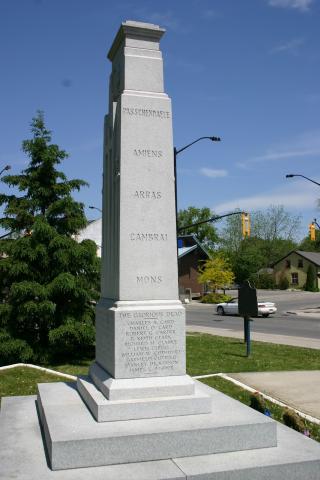
PASSCHENDAELE
AMIENS
ARRAS
CAMBRAI
MONS

THE GLORIOUS DEAD
CHARLES A. CARD
DANIEL O. CARD
ROBERT G. CARTER
F. KEITH CLARK
RICHARD H. CLARK
LEWIS CLEGG
WILLIAM W. CUTHBERT
GARFIELD CUTTING
STANLEY DICKINSON
JAMES C. FISHER

Image
Caption
Elora Cenotaph
1 of 5 images
Image
Caption
right side
1 of 5 images
Image
Caption
back
1 of 5 images
Image
Caption
left side
1 of 5 images
Image
Caption
Stone on the ground in front of the monument.
1 of 5 images
Province
!4v1725905901276!6m8!1m7!1s1o3fKxXNTLKwHAWpiNzzNw!2m2!1d43.68328007993727!2d-80.43052696914124!3f259.304168738978!4f-6.493587495289248!5f0.7820865974627469
Body Content

Eleven years had elapsed from the end of the war until the dedication of the war memorial. The war had affected Elora profoundly, but initially there was no consensus on how or even whether it should be commemorated. For the first few years after the war, a piece of captured German artillery served as a monument to the war.

In the fall of 1928, the Elora War Veterans Association's delegation of Jim Quinn, Gord Duncan and Fred Magnus, took the idea of a war memorial to council and asked for funding. The committee began work early in 1929 under the leadership of grocer E.C. Grimes, who had been a captain in the army. The residents were canvassed to choose a location and over 70% favoured in front of the town hall. Additional money for the cenotaph was raised through fundraisers and donations.

Design proposals were considered during April and May 1929, and the Hunter Granite Works proposal was chosen. Their design was the work of Captain George Hunter of Simcoe. A column 16 feet high column, on a base 9 feet by 10 feet, all made of La Casse granite from southern Quebec. After some minor changes, his plan was adopted. Hunter’s design included the names of the Elora men who died and the major battles in which they took part. The engraving included symbolic elements: two Crusaders’ swords, symbolizing the fight for a just cause; a cross, symbolizing the sacrifice of those who died; and a wreath of maple leaves, to identify the men with the Dominion of Canada.

The Town Council contributed the majority of the funds, with the remainder raised by the Rebekah Lodge through sales of poppies, and by donations that were solicited right up to the last week before the unveiling.

The Elora Cenotaph was dedicated to those who died in the Great War on November 10, 1929. A temporary platform, draped with Union Jacks, was put up in front of the town hall for the dignitaries. The front of the town hall was covered with red, white, and blue bunting. Smaller flags were strung on lines in front of the building, and the monument itself was covered with a large Union Jack. Margaret Fisher, the first mother to lose a son, unveiled the cenotaph.

Bordering the cenotaph is an outline of a maple leaf. The Second World War and Korean War inscriptions were added later. 

City
Elora
Country
Type Description
Column
Photo Credit
Tim Laye, Ontario War Memorials
Memorial CF Legacy ID
5525