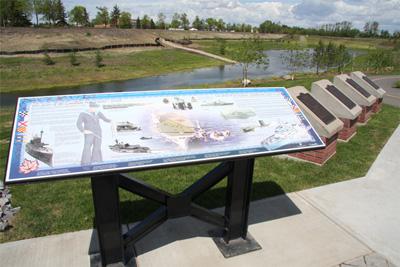
Edmund Wright designed the Great War Veterans Association Memorial Hall 1918-19. The Memorial Hall remembered comrades who gave up their lives during WWI. The building was demolished.
Great War Veterans Association Memorial Hall
My VAC Account
My VAC Account
Edmund Wright designed the Great War Veterans Association Memorial Hall 1918-19. The Memorial Hall remembered comrades who gave up their lives during WWI. The building was demolished.
The Memorial Chapel and hall, 1950-5, commemorates the dead from both World Wars. The stained glass memorial windows in the chapel were made by R. McCausland.
Pilot Officer Allen Stuart MacDonald born 1918, lost at sea, April 1945 erected by his family and in memory of Flight Lt High Munro Hope born 1918 kia Feb 22 1945 and in loving memory of their fallen comrades.
MAJOR GENERAL GRIESBACH SCHOOL
EDMONTON PUBLIC SCHOOLS
Major-General Griesbach School is named in honour of Major-General Griesbach. The school was originally attended by the children of military families stationed at Canadian Forces Base Edmonton, but is now a part of the Edmonton Public School Board. A new school, retaining the name, was opened on September 4, 2012, and is situated near the former school.
William Antrobus Griesbach was born in 1878 in Fort Qu’Appelle, Saskatchewan and moved to Edmonton with his family in 1883, graduating from St. John’s College in Winnipeg in 1895. He enlisted in the Canadian Mounted rifles in 1899 to fight in the Second Boer War and was awarded the Queen’s South Africa Medal with four bars. Upon his return in 1901, he opened a law office and was successfully elected to Edmonton Town Council in 1904. He tried his hand at federal politics in 1905, but returned to municipal politics and was elected mayor of Edmonton in 1906.
In 1906, Griesbach was commissioned as a lieutenant in the 19th Alberta Dragoons. He was promoted to captain in 1907. When the First World War began, the Dragoons volunteered as a unit. In December of that year, Griesbach was promoted to major and assigned to command the 49th Battalion. The unit served in various engagements, including the Battle of Vimy Ridge, the Battle of Arras, the Third Battle of Ypres, and the liberation of Mons. In 1917, Griesbach was promoted to Brigadier-General and assigned command of the 1st Canadian Infantry Brigade of the 1st Canadian Division. He was awarded the Distinguished Service Order twice and the Victorian Decoration for long service. He was also made a Companion of the Order of Bath, and a Companion of the Order of St. Michael and St. George. During the Second World War. He was made Inspector General of the Canadian Army for Western Canada and was promoted to the rank of Major-General. He retired from that position in 1943 and died in 1945.
[plaque]
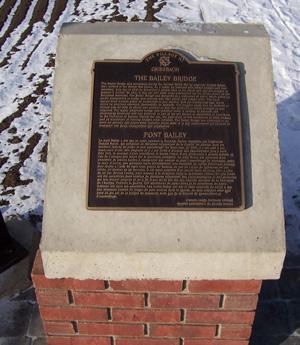
THE BAILEY BRIDGE
The Bailey Bridge was developed during the Second World War By engineer Donald Bailey,
who worked in the British War Office. As a hobby he tinkered with model bridges and their
assembly. One day in 1940 he presented a unique idea to his chiefs and was encouraged to explore it further. By 1941, it was put into large scale production for the Allied attack on the
European mainland. The Bailey Bridge was designed as a collection of parts, which could be
easily transported in trucks and erected with man power and simple tools. The steal
lattice-work trusses could be connected to one another with pin connectin logs, which
could be attached sideways, downwards, or upwards. The trusses could also be doubled or tripled side-by-side or above one another to give the structure as much strength as was required. The highly adaptable bridge was installed under a number of different and challenging situations and was credited as one of the key pieces of equipment to contribute
to the liberation of Europe. During the war, the equivalent to 320 kilometres of fixed bridges
and 64 kilometres of floating bridges were installed. The Bailey Bridge has continued to be
used for military and peace-time ventures world wide, it is still unsurpassed for its ease of transport and quick construction and installation.
PONT BAILEY
Le pont Bailey a /t/ mis au point pendant la Seconde Guerre mondiale par l' ingénieur
Donald Bailey, qui travaillait au ministère britannique de la Guerre. Sa passion était les
modèles réduits de ponts et leur assemblage. Un eau jour, en 1960, il a fait part à ses
supérieurs d`une idée originale et il a été invité a pousser son raisonnement plus à fond.
Dès 1941, le concept s`était concrétisé et faisait l`objet d`une production à grande échelle en
vue de l`attaque des Alliés sur le continent européen. Le pont Bailey est constitué d`un
ensemble de pièces faciles à transporter par camion et dont l`assemblage ne nécessite, outre la main d`ouvre, que quelques outils élémentaires. Les montants en treillis métallique peuvent
être réunis à l`aide de tiges avec pattes de fixation en vue de l`ajout de panneaux sur les
côtés, au-dessus ou en dessous.Il est aussi possible d`en placer deux ou trois, côte à côte
ou un par dessus l`autre, pour assurer à la structure toute la résistance voulue. De tels ponts
ont été assemblés dans nombre de situations présentant des caractéristiques et des obstacles
qui leur étaient propres et on a dit d`eux qu'ils ont été une cheville ouvrière de la libération
de l`Europe. Pendant la guerre, 320 kilomètres de ponts fixes et 64 kilomètres de ponts flottants ont ainsi été assemblés. Les ponts Bailey ont par la suite continue de servir à des
fins militaires comme en temps de paix partout dans le monde. Ils sont toujours sans égal pour ce qui est de la facilité de transport ainsi que de la vitesse de construction et d`assemblage.
Canada Lands Company Limited
Société immobilière du Canada limitée
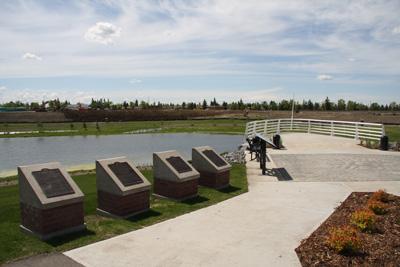
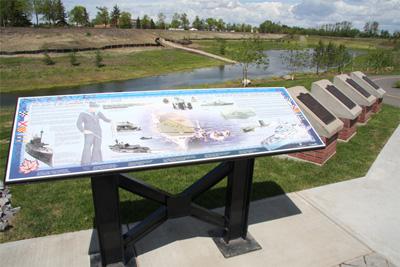
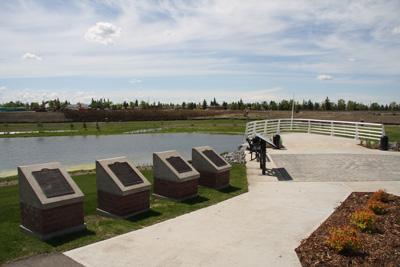
Bailey Bridge was dedicated by the Canada Lands Company as part of their redevelopment of Edmonton’s former Canadian Forces Base (Griesbach Barracks).
The Bailey Bridge was developed during the Second World War by engineer Donald Bailey, who worked in the British War Office. In 1940 Bailey presented a unique idea to his chiefs and was encouraged to explore it further. By 1941, it was put into large-scale production for the Allied attack on the European mainland. The highly adaptable bridge was installed under a number of different and challenging situations and was credited as one of the key pieces of equipment to contribute to the liberation of Europe.
The Royal Canadian Engineers started training on the Bailey Bridge in England in June 1942 and Royal Canadian Engineers field units started receiving their equipment in August 1943. The first Bailey bridge built by Canadians in operations was in Sicily that same month. As the war progressed, the Allies erected some 4,500 Bailey bridges.
Some 50 years after its introduction, the Bailey Bridge was withdrawn from use in the Canadian Forces, to be replaced by the Armoured Vehicle Launched Bridge, the Medium Girder Bridge and the Medium Floating Bridge.
DEWOLD RD
[plaque]
THE VILLAGE AT
GRIESBACH
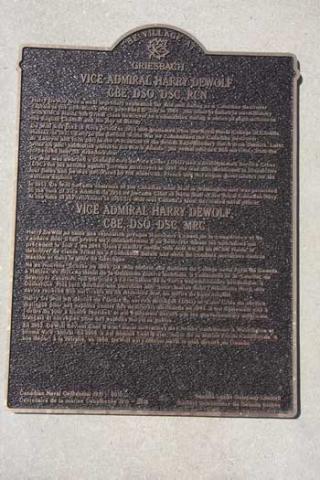
VICE ADMIRAL HARRY DEWOLF,
CBE, DSO, DSC, RCN
Harry DeWolf won a near legendary reputation for skill and daring as a Canadian destroyer
captain in the operations which preceded D-Day in 1944. his name is linked in naval history
with HMCS Haida, the Tribal class destroyer he commanded during a series of might actions in
the English Channel and the Bay of Biscay.
DeWolf was born in Nova Scotia in 1903 and graduated from the Royal Naval College of Canada,
Halifax, in 1921. Early in the Second World War he commanded the Canadian destroyer
St. Laurent and took part in the evacuation of the British Expeditionary Force from Dunkirk. Later,
while on anti-submarine patrol in the North Atlantic, his vessel rescued 859 survivors form the
torpedoed liner SS Aran Dora Star.
DeWolf was awarded a Distinguished Service Order (DSO) and a Distinguished Service Cross
(DSC) for his actions against German destroyers in 1944. He was also Mentioned in Dispatches
four times and he was decorated by the American French and Norwegian governments for his
wartime exploits.
In 1952, DeWolf became chairman of the Canadian Joint Staff in Washington and was promoted
to the rank of Vice Admiral. In 1956 he became Chief of Naval Staff of the Royal Canadian Navy.
At the time of his retirement in 1960 De wolf was Canada's most decorated naval officer.
VICE ADMIRAL HARRY DEWOLF,
CBE, DSO, DSC, MRC
Harry DeWolf se taille une réputation presque légendaire à cause de la compétence et de
l`audace dont il fait preuve au commandement d`un destroyer durant les opérations qui
précèdent le Jour J, en 1944. Dans l`histoire navale, son nom est lié au NCSM Haida, le
destroyer e classe Tribal qu`il commande durant une série de combats nocturnes dans la
manche et dans le golfe de Gascogne.
Né en Nouvelle-Écosse en 1903, DeWolf obtient son diplôme de Collège naval royal du Canada,
à Halifax, en 1921. Au début de la Deuxième Guerre mondiale, il commande le St-Laurent, un
destroyer canadien, qui participe à l`évacuation de la Force expéditionnaire britannique, à
Dunkerque. Plus tard, pendant une patrouille anti-sous-marine dans l`Atlantique Nord, son
navire repêche 859 survivants du SS Arandora Star, un navire de ligne torpillé
Harry DeWolf est décoré de l`Ordre du service distingué (DSO) et d`une Croix du service
distingué pour ses exploits contre des destroyers allemands en 1944. Il est également cité à
l`ordre du jour à quatre reprises, et est également décoré par les gouvernements américain,
français et norvégien pour ses exploits durant la guerre.
En 1952, DeWolf devient Chef d`état-major interarmées de l`Armée canadienne à Washington et
promu Vice-amiral En 1956, il est nommé Chef d`état-major de la Marine royale canadienne. A
son départ à la retraite en 1960, DeWolf est l`officier naval le plus décoré au Canada.
Canadian Naval Centennial 1910-2010
Centenaire de la marine Canadienne 1910-2010
Canada Lands Company Limited
Société immobilière du Canada limitée
DeWolf Road was dedicated to Vice Admiral Harry DeWolf by the Canada Lands Company on January 16, 2008, as part of their redevelopment of Edmonton’s former Canadian Forces Base (Griesbach Barracks).
Vice Admiral DeWolf won a near legendary reputation for skill and daring as a Canadian destroyer captain in the operations which preceded D-Day in 1944. His name is linked in naval history with HMCS Haida, the Tribal class destroyer he commanded during a series of night actions in the English Channel and the Bay of Biscay.
DeWolf was born in Nova Scotia in 1903 and graduated from the Royal Naval College of Canada, Halifax, in 1921. Early in the Second World War he commanded the Canadian destroyer St Laurent and took part in the evacuation of the British Expeditionary Force from Dunkirk. Later, while on anti-submarine patrol in the North Atlantic, his vessel rescued 859 survivors from the torpedoed liner SS Arandora Star. DeWolf was awarded a Distinguished Service Order and a Distinguished Service Cross for his actions against German destroyers in 1944. He was also Mentioned in Despatches four times and he was decorated by the American, French and Norwegian governments for his wartime exploits.
In 1952, DeWolf became chairman of the Canadian Joint Staff in Washington and was promoted to the rank of Vice Admiral. In 1956 he became Chief of Naval Staff of the Royal Canadian Navy. At the time of his retirement in 1960 DeWolf was Canada's most decorated naval officer.
The Vice Admiral Harry DeWolf plaque was unveiled on June 6, 2010.
CORVETTE ST
[plaque]
THE VILLAGE AT
GRIESBACH
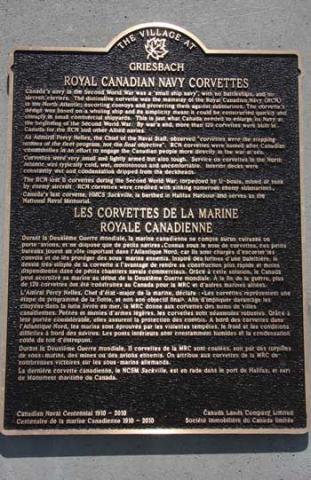
ROYAL CANADIAN NAVY CORVETTES
Canada's navy in the Second World War was a small ship navy, with no battleships, and no
aircraft carriers. The diminutive corvette was the mainstay of the Royal Canadian Navy (RCN)
in the North Atlantic; escorting convoys and protecting them against submarines. The corvette's
design was based on a whaling ship and its simplicity meant it could be constructed quickly and
cheaply in small commercial shipyards. This is just what Canada needed to enlarge its Navy at
the beginning of the Second World War. By war's end, more than 120 corvettes were built in
Canada for the RCN and other Allied navies.
As Admiral Percy Nelles, the Chief of the Naval Staff, observed "corvettes were the stepping
stones of the fleet program, not the final objective". RCN corvettes were named after Canadian
communities in an effort to engage the Canadian people more directly in the war at sea.
corvettes were very small and lightly armed but also tough. Service on corvettes in the North
Atlantic was typically cold, wet, monotonous and uncomfortable. Interior decks were
constantly wet and condensation dripped form the deck heads.
The RCN lost 11 corvettes during the Second World War; torpedoed by U-boats, mined or sunk by enemy aircraft. RCN were credited with sinking numerous enemy submarines.
Canada's last corvette, HMCS Sackville, is berthed in Halifax Harbour and serves as the
National Naval Memorial.
LES CORVETTES DE LA MARINE
ROYALE CANADIENNE
Durant la Deuxième Guerre mondiale, la marine canadienne ne compte aucun cuirasse ou
porte avions, et ne dispose que de petits navires. Connus sous le nom de corvettes, ces petits
bateaux jouent un rôle important dans l`Atlantique Nord, car ils sont chargés d`escorter les
convois et de les protéger des sous marins ennemis. Inspiré des formes d`une baleinière, le
dessin très simple de la corvette a l`avantage de rendre sa construction plus rapide et moins
dispendieuse dans de petits chantiers navals commerciaux. Grâce à cette solution, le Canada
peut accroître sa marine au début de la Deuxième Guerre mondiale. À la fin de la guerre, plus
de 120 corvettes ont été construites au Canada pour la MRC et d`autres marines alliées.
L`amiral Percy Nelles, Chef d`état-major de la marine, déclare: <>Afin d' impliquer davantage les
citoyens dans la lutte livrée en mer, la MRC donne aux corvettes des noms de villes canadiennes. Petites et munies d' armes légères, les corvettes sont néanmoins robustes. Grâce à
leur portée considérable, elles assurent la protection des convois. À bord des corvettes dans
l`Atlantique Nord, les marins sont éprouvés par les violentes tempêtes, le froid et les conditions
difficiles à bord des navires. Les ponts intérieurs sont constamment humide et la cdondensation
coule du toit d`entrepont.
Durant la Deuxième Guerre mondiale, 11 corvettes de la MRC sont coulées, soit par des torpilles
de sous-marins, des mines ou des avions ennemis. On attribue aux corvettes de la MRC de
nombreuses victoires sur les sous-marins allemands.
La dernière corvette canadienne, le NCSM Sackville, est en rade dans le port de Halifax, et sert de Monument maritime du Canada.
Canadian Naval Centennial 1910-2010
Centenaire de la marine Canadienne 1910-2010
Canada Lands Company Limited
Société immobilière du Canada limitée
Corvette Street was dedicated to all the men and women who served on Royal Canadian Navy corvettes by the Canada Lands Company on August 25, 2010, as part of their redevelopment of Edmonton’s former Canadian Forces Base (Griesbach Barracks).
Canada's navy in the Second World War was a small ship navy without battleships or aircraft carriers. The corvette was the mainstay of the Royal Canadian Navy in the North Atlantic; escorting convoys and protecting them against submarines. Corvettes were built in Canada for the Royal Canadian Navy and other Allied navies. The Royal Canadian Navy corvettes were named after Canadian communities in an effort to engage the Canadian people more directly in the war at sea. They were very small and lightly armed, but also tough and with a long range that suited them to convoy protection.
Service on corvettes in the North Atlantic was typically cold, wet, monotonous, uncomfortable and interior decks were constantly wet and condensation dripped from the deckheads. Eleven Royal Canadian Navy corvettes were lost during the Second World War; torpedoed by U-boats, mined or sunk by enemy aircraft. Royal Canadian Navy corvettes were credited with sinking numerous enemy submarines. Canada’s last corvette, HMCS Sackville, is berthed in Halifax Harbour and serves as the National Naval Memorial.
The Royal Canadian Navy Corvettes plaque was unveiled on June 6, 2010.
[street sign/plaque de rue]
ADMIRAL WALTER
HOSE ST
[plaque]
THE VILLAGE AT
GRIESBACH
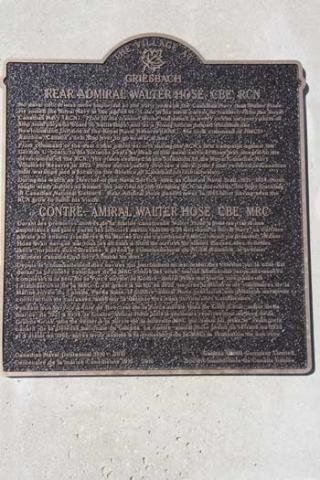
REAR ADMIRAL WALTER HOSE, CBE, RCN
No naval officer was more important to the early year of the Canadian Navy than Walter Hose
He joined the Royal Navy at the age of 14 Later in his naval career he transferred to the Royal
Canadian Navy (RCN). Prior to his transfer, Hose had sailed in every ocean on every class of
ship from torpedo boats to battleships, and as a young officer helped establish the
Newfoundland Division of the Royal Naval Reserve (RNR). He took command of HMCS
Rainbow, Canada's first ship ever to go to war at sea.
From command of the east coast patrol escorts during the RCN`s first campaign against the
German u-boats, to his tortuous years as head of the naval service, Hose was integral to the
development of the RCN. His vision resulted in the formation of the Royal Canadian Navy
Volunteer Reserve in 1923. Hose subsequently oversaw a naval policy that resulted in Canadian
built warships and a focus on the defence of Canadian territorial waters.
During this watch as Director of the Naval Service, then as Chief of Naval Staff, 1921-1934, Hose
fought many battles to ensure the survival of the fledgling RCN, in his words the Ugly Duckling
of Canadian National Defence. Rear Admiral Hose passed away in 1965 after having seen the
RCN grow to fulfill his vision.
CONTRE-AMIRAL WALTER HOSE, CBE, MRC
Durant les premières années de la marine canadienne Walter Hose a joué un rôle d`une
importance inégalée parmi les officiers navals. Enrôlé à 14 ans dans la Royal Navy, sa carrière
navale set ensuite transférée à la Marine royale canadienne (MRC). Avant ce transfert, Walter
Hose avait navigué sur tous les océans à bord de navires de toutes classes, des vedettes
lance-torpilles aux cuirasses. Il prend le commandement du NCSM Rainbow, le premier
bâtiment canadien qui livre combat en mer.
Depuis le commandement des navires qui patrouillent et escortent des convois sur la côte Est
durant la première campagne de la MRC contre les sous-marins allemands, jusqu`aux années
complexes à la tête de la Force navale, le Contre-amiral Hose est partie intégrante de
l`établissement de la MRC. C`est grâce à lui qu`en 1923, on crée la Réserve de volontaires de la
Marine royale du Canada, Par la suite, le Contre-amiral Hose préconise une politique navale de
construction de cuirassés, axée sur la défense des eaux territoriales canadiennes.
Pendant son service à tire de directeur de la Force navale, puis de Chef d`état-major de la
marine, de 1921 à 1934, le Contre-amiral Hose lutte à plusieurs reprises tout au long de la
Grande Crise, afin de veiller à la survie de la nouvelle MRC qui, selon lui, était le `vilain petit
canard` de la Défense nationale du Canada. Le contre=-amiral Hose prend sa retraite en 1933 et s`éteint en 1965, après avoir assisté à la croissance de la MRC, la réalisation de son rêve.
Canadian Naval Centennial 1910-2010
Centenaire de la marine Canadienne 1910-2010
Canada Lands Company Limited
Société immobilière du Canada limitée
Admiral Walter Hose Street was dedicated by the Canada Lands Company on August 25, 2010, as part of their redevelopment of Edmonton’s former Canadian Forces Base (Griesbach Barracks).
No naval officer was more important to the early years of the Canadian Navy than Rear-Admiral Walter Hose. He joined the Royal Navy at the age of 14, and later transferred to the Royal Canadian Navy. He took command of HMCS Rainbow, Canada’s first ship ever to go to war at sea. Rear-Admiral Hose was commandant of the east coast patrol escorts during the Royal Canadian Navy’s first campaign against the German U-boats. His vision resulted in the formation of the Royal Canadian Navy Volunteer Reserve in 1923, and in a naval policy that resulted in Canadian built warships and a focus on the defence of Canadian territorial waters. He later became Director of the Naval Service, and Chief of Naval Staff, 1921-1934. Rear-Admiral Hose fought many battles through the years of the Great Depression to ensure the survival of the fledgling Royal Canadian Navy. He retired in 1933 and passed away in 1965 after having seen the Royal Canadian Navy grow to fulfill his vision.
JUCHLI AV
[plaque]
THE VILLAGE AT
GRIESBACH
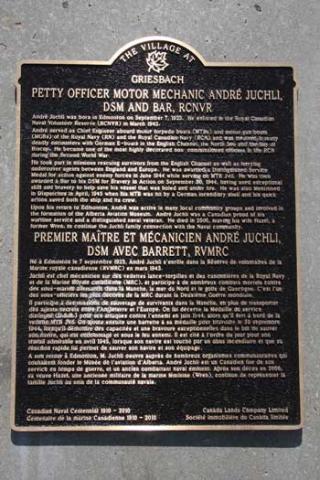
PETTY OFFICER MOTOR MECHANIC ANDRÉ JUCHLI,
DES AND BAR, RCNVR
André Juchli was born in Edmonton on September 7, 1923. He enlisted in the Royal Canadian
Naval Volunteer Reserve (RCNVR) in March 1943.
André served as Chief Engineer aboard motor torpedo boats (MTBs) and motor gun boats
(MGBs) of the Royal Navy (RN) and the Royal Canadian Navy (RCN) and was involved in many
deadly encounters with German E-boats in the English Channel, the North Sea and the Bay of
Biscay. He became one of the most highly decorated non commissioned officers in the RCN
during the Second World War.
He took part in missions rescuing survivors from the English Channel as well as ferrying
undercover agents between England and Europe. He was awarded a Distinguished Service
Medal for action against enemy forces in June 1944 while serving on MTB 246. he was then
awarded a Bar to his DSM for Bravery in Action on September 30, 1944, having used exceptional
skill and bravery to help save his vessel that was holed and under fire. He was also Mentioned
in Dispatches in April, 1945 when his MTB was hit by a German incendiary shell and his quick
action saved both the ship and its crew.
Upon his return to Edmonton, André was active in many local community groups and involved in
the formation of the Alberta Aviation Museum. André Juchli was a Canadian proud of his
wartime service and a distinguished naval veteran. He died in 2006, leaving his wife Hazel, a
former Wren, to continue the Juchli family connection with the Naval community.
PREMIER MAITRE ET MECANICIEN ANDRÉ JUCHLI,
DSM AVEC BARRETT, RVMRC
Né à Edmonton le 7 septembre 1923, André Juchli s`enrôle dans la Réserve de volontaires de la
Marine royale canadienne (RVMRC) en mars 1943.
Juchli est chef mécanicien sur des vedettes lance -torpilles et des canonières de la Royal Navy
et de la Marine Royale canadienne (MRC), et participe à de nombreux combats mortels contre
des sous-marins allemands dans la Manche, la mer du Nord et le golfe de Gascogne. C`est l`un
des sous-officiers les plus décorés de la MRC durant la Deuxième Guerre mondiale.
Il participe à des missions de sauvetage de survivants dans la manche, en plus de transporter
des agents secrets entre l`Angleterre et l`Europe. On lui décerne la Médaille du service
distingué (D.S.M.) pour ses attaques contre l`ennemi en juin 1944, alors qu`il sert à bord de la
vedette MTB 246. On ajoute ensuite une barrette à sa médaille pour bravoure le 30 septembre
1944, lorsqu`il démontre des capacités et une bravoure exceptionnelles dans le but de sauver
son navire, qui est endommagé et sous le feu ennemi. Il est cité à l`ordre du jour pour son
travail admirable en avril 1945, lorsque son navire est touché par un obus incendiaire et que sa
réaction rapide lui permet de sauver son navire et son équipage.
À son retour à Edmonton, M. Juchli oeuvre auprès de nombreux organismes communautaires qui
souhaitent fonder le Musée de l`aviation d`Alberta. André Juchli est un Canadien fier de son
service en temps de guerre, et un ancien combattant naval éminent. Après son décès en 2006,
sa veuve Hazel, une ancienne militaire de la marine féminine (Wren), continue de représenter la
famille Juchli au sein de la communauté navale.
Canadian Naval Centennial 1910-2010
Centenaire de la marine Canadienne 1910-2010
Canada Lands Company Limited
Société immobilière du Canada limitée
Juchli Avenue was dedicated to André Juchli (1923-2006) by the Canada Lands Company on August 25, 2010, as part of their redevelopment of Edmonton’s former Canadian Forces Base (Griesbach Barracks).
Juchli enlisted in the Royal Canadian Naval Volunteer Reserve in March 1943. He served as Chief Engineer aboard motor torpedo boats and motor gun boats of the Royal Navy and the Royal Canadian Navy. He was involved in many deadly encounters with German E-boats in the English Channel, the North Sea and the Bay of Biscay.
He was one of the most highly decorated non-commissioned officers in the Royal Canadian Navy during the Second World War. Juchli took part in missions rescuing survivors from the English Channel as well as ferrying undercover agents between England and Europe. He was awarded a Distinguished Service Medal for action against enemy forces in June 1944 while serving on MTB 246. He was awarded a Bar to his Distinguished Service Medal for bravery in action on September 30, 1944, having used exceptional skill and bravery to help save his vessel that was holed and under fire. Juchli was also Mentioned in Dispatches in April 1945 when his motor torpedo boat was hit by a German incendiary shell and his quick action saved both the ship and its crew.
(needs further research/recherche incomplète)
[plaque]
THE VILLAGE AT
GRIESBACH
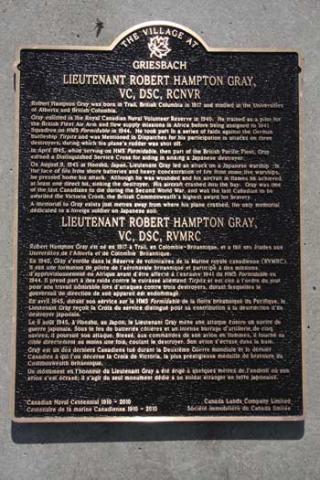
LIEUTENANT ROBERT HAMPTON GRAY,
VC, DSC, RCNVR
Robert Hampton Gray was born in Trail, British Columbia in 1917 and studied at the Universities of Alberta and British Columbia.
Gray enlisted in the royal Canadian Naval Volunteer Reserve in 1940. he trained as a pilot for
the British Fleet Air Arm and flew supply missions in Africa before being assigned to 1841
Squadron on HMS formidable in 1944. He took part in a series of raids against the German
battleship Tirpitz and was Mentioned in Dispatches for his participation in attacks on three
destroyers, during which his plane's rudder was shot off.
In April 1945, while serving on HMS Formidable, then part of the British Pacific Fleet, Gray
earned a Distinguished Service Cross for aiding in sinking a Japanese destroyer.
On August 9, 1945 at Honshu, Japan, Lieutenant Gray led an attack on a Japanese warship. In
the face of tire from shore batteries and heavy concentration of fire from some five warships,
he pressed home his attack. Although he was wounded and his aircraft in flames he achieved
at least one direct hit, sinking the destroyer. His aircraft crashed in to the bay. Gray was one
of the last Canadians to die during the Second World War, and was the last Canadian to be
awarded the Victoria Cross, the British Commonwealth's highest award for bravery.
A memorial to Gray exists just metres away form where his plane crashed, the only memorial dedicated to a foreign soldier on Japanese soil.
LIEUTENANT ROBARET HMAPTOON GRAY,
VC, DESC, RVMRC
Robert Hampton Gray est né en 1917 à Trail, en Colombie-Britannique, et a fait ses études aux
Universités de l`Alberta et de Colombie Britannique.
En 1940, Gray s`enrôle dans la Réserve de volontaires de la Marine royale canadienne (RVMRC)
Il suit une formation de pilote de l`aéronavale britannique et participe à des missions
d`approvisionnement en Afrique avant d`être affecté à l`escadere 1841 du HMS Formidable en
1944. Il prend part à des raids contre le cuirassé allemand Tirpitz et set cité à l`ordre du jour
pour son travail admirable lors d`attaques contre trois destroyers, durant lesquelles le
gouvernail de direction de son appareil est endommagé.
En avril 1945, durant son service sur le HMS Formidable de la flotte britannique du Pacifique, le
Lieutenant Gray reçoit la Croix du service distingué pour sa contribution à la destruction d`un
destroyer japonais.
Le 9 août 1945, à Honshu, au Japon, le Lieutenant Gray mène une attaque ocntr4e un navire de
guerre japonais. Sous le feu de batteries côtières et un intense barrage d`artillerie de cinq
navires, il poursuit son attaque. Blessé, aux commandes de son avion en flammes, il touche sa
cible directement au moins une fois, coulant le destroyer. Son avion s`écrase dans la baie.
Gray est un des derniers Canadiens tué durant la Deuxième Guerre mondiale et le dernier
Canadien à qui l`on décerne la Croix de Victoria, la plus prestigieuse médaille de bravoure du
Commonwealth britannique.
Un monument e l`honneur du Lieutenant Gray a été érigé à quelques mètres de l`endroit où son
avion s`est écrasé; il s`agit du seul monument dédiée à un soldat étranger en terre japonaise.
Canadian Naval Centennial 1910-2010
Centenaire de la marine Canadienne 1910-2010
Canada Lands Company Limited
Société immobilière du Canada limitée
Hampton Gray Avenue was dedicated to Lieutenant Robert Hampton Gray, (1917-1945) by the Canada Lands Company on December 10, 2013, as part of their redevelopment of Edmonton’s former Canadian Forces Base (Griesbach Barracks).
Lieutenant Gray enlisted in the Royal Canadian Naval Volunteer Reserve in 1940, he trained as a pilot for the British Fleet Air Arm and flew supply missions in Africa before being assigned to 1841 Squadron on HMS Formidable in 1944. He took part in a series of raids against the German battleship Tirpitz and was mentioned in dispatches for his participation in attacks on three destroyers, during which his plane's rudder was shot off. In April 1945, while serving on HMS Formidable, then part of the British Pacific Fleet, Gray earned a Distinguished Service Cross for aiding in sinking a Japanese destroyer. On August 9, 1945 at Honsh, Japan, Lieutenant Gray led an attack on a Japanese warship. In the face of fire from shore batteries and heavy concentration of fire from some five warships, he pressed home his attack. Although he was wounded and his aircraft in flames he achieved at least one direct hit, sinking the destroyer, before his aircraft crashed into the bay. Gray was the last Canadian to be awarded the Victoria Cross.
On June 6, 2010, Canada Lands Company unveiled a plaque near the intersection of Hampton Gray Avenue and Merchant Navy Street in recognition of the street being dedicated to Lieutenant Robert Hampton Gray.
CONESTOGA ST
[plaque]
THE VILLAGE AT
GRIESBACH
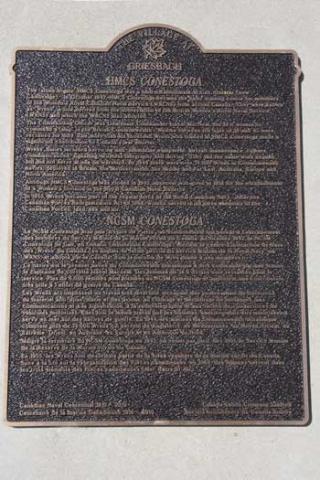
HMCS CONESTOGA
The stone frigate HMCS Conestoga was a land establishment at Galt, Ontario (now
Cambridge). In October 1942, HMCS Conestoga became the basic training centre for members
of the Women's Royal Canadian Naval Service (WRCNS) from across Canada. They were known
as 'Wrens', a title derived form the abbreviation of the British Women's Royal Naval service
(WRNS) and which the WRCNS also adopted.
The Commanding Officer was Lieutenant commander Isabel MacNeill, the first woman to
command s 'ship' in the British Commonwealth. Women between the ages of 18 and 45 were
recruited for duty. The more than six thousand Wrens who trained at HMCS Conestoga made a
significant contribution to Canada's war efforts.
wrens' duties included servicing anti-submarine equipment, aircraft maintenance, ciphers,
communications, signalling, wireless telegraphy and driving. They did the same work as men, but did not serve at sea on warships. by 1944 there were over 74,000 Wrens in Commonwealth
navies, deployed in Britain, the Mediterranean, the Middle and Far East, Australia, Europe and
North America.
Although MMCS Conestoga was closed in 1945, approval was given in 1951 for the establishment
of a Women's Division in the Royal Canadian Naval Reserve.
In 1955, Wrens became part of the regular force of the royal Canadian Navy. after the
Canadian Forces Reorganization Act of 1968, women served in all three elements of the
Canadian Forces,; land, sea and air.
NCSM CONESTOGA
Le NCSM Conestoga était une frégate de Pierre`, un établissement que servait à l`entraînement
des membres du service féminin de la Marine royale du Canada. En octobre 1942, le NCSM
Conestoga de Galt, en Ontario (maintenant Cambridge), devient le centre d`instruction de base
des Wrens` du canada (en anglais, le terme provint du service féminin de la Royal Navy, ou
WRNS, et adopté par le Canada, d`où le surnom de Wren donné à ses membres)
Ce navire est le premier navire du Commonwealth britannique à être commandé par une femme,
le capitaine de corvette Isabel macneill. Des femmes de 18à 45 ans sont recrutées pour le
service. Plus de 6,000 femmes sont formées au NCSM Conestoga et apportent une contribution
très utile à l`effort de guerre du Canada.
Les Wrens accomplissent une travail très diversifié, occupant des postes allant de l`entretien
du matériel anti-sous-marin et des avions, au chiffrage et déchiffrage de messages, aux
communications et à la signalisation, à la radiotélégraphie et aux tâches de conductrices de véhicules motorisés. Elle font le même travail que les hommes, sans toutefois être autorisées à
sExtrême-Orient, en Australie, en Europe et en Amérique du Nord.
Malgré la fermeture du NCSM Conestoga en 1945, on remet sur pied, dès 1951, le Service féminin
de la Réserve de la Marine royale du Canada.
En 1955, les Wrens fort désormais partie de la force régulière de la Marine royale du Canada.
Suite à la Loi sur la réorganisation des forces canadiennes, en 1968, des femmes servent dans
les trois éléments des Forces canadiennes (Mer, Terre et Air).
Canadian Naval Centennial 1910-2010
Centenaire de la marine Canadienne 1910-2010
Canada Lands Company Limited
Société immobilière du Canada limitée
Conestoga Street was dedicated to all the women who served at HMCS Conestoga by the Canada Lands Company on January 16, 2008, as part of their redevelopment of Edmonton’s former Canadian Forces Base (Griesbach Barracks).
Formerly Bytown II, HMCS Conestoga was the basic training establishment for the Women's Royal Canadian Naval Service. It was established for the duration of the Second World War on 31 July 1942 at Galt, Ontario. The establishment of the Women's Royal Canadian Naval Service was the first time that women served in the Canadian Navy in any capacity other than nursing. Their officers were the first women in the Empire and Commonwealth to carry the King’s Commission in naval service, holding the same ranks and entitled to the same salutes and marks of respect as male officers. They were subject to much more stringent standards of conduct than their male peers, expected to remain feminine with exemplary conduct. For example, pregnancy was a dismissible offence.
The Commanding Officer was Lieutenant Commander Isabel Macneill, the first woman to command a ship in the British Commonwealth. More than six thousand trained at HMCS Conestoga. They made a significant contribution to Canada's war efforts, servicing anti-submarine equipment, aircraft maintenance, ciphers, communications, signaling, wireless telegraphy and driving.
HMCS Conestoga was paid off on 31 March 1945, and the Women's Royal Canadian Naval Service was disbanded in August 1946. An invitation was extended to join the Naval Reserve in 1951, something previously denied to women, and many took up the call.
The HMCS Conestoga plaque was unveiled on June 6, 2010.