
Other

City/Municipality
Edmonton
Memorial Number
48011-055
Type
Address
Bonaventure Avenue
Location
Village of Griesbach
in Canada
Yes
GPS Coordinates
53.6008328, -113.504372
Inscription

BONAVENTURE
AV

[plaque]

THE VILLAGE AT
GRIESBACH

HMCS BONAVENTURE

HMCS Bonaventure (the Bonnie) was a Majestic class 19,000 ton light aircraft carrier, originally
laid down for the Royal Navy as HMS Powerful. She was obtained by the Royal Canadian Navy
(RCN) after the aircraft carriers Magnificent (Maggie) and Warrior, and served in the RCN and
Canadian Forces maritime Command from 1957 to 1970. the Bonnie was Canada's last aircraft carrier.
As the Canadian Navy's flagship, the Bonnie carried a crew of 1,200, and a force of Banshee
jet fighters, Tracker anti-submarine warfare aircraft and Sikorsky helicopters. Because of the
hard work and dedication of her crew, the Bonaventure was able to conduct around-the -clock
operations, with anti-submarine aircraft. This made the RCN the only navy in the world at the
time, other than the US Navy, capable of conducting around-the-clock air operations for
sustained periods. The Bonaventure was based in Halifax and served primarily in the North
Atlantic.
In 1964 new Sea King helicopters were added to Bonaventure's complement, enhancing its
anti-submarine capability. The Bonaventure was decommissioned, in Halifax, on 3 July 1970.

NCSM BONAVENTURE

Le NCSM Bonaventure (surnommé le Bonnie) est un porte-avoins de 19,000 tonnes, de classe
Majestic. Il est d`abord construit sous le nom de HMS Powerful pour la Royal Navy britannique
et ensuite acheté par la Marine royale canadienne (MRC) et ce après l`acquisition des
porte-avions Magnificent (Maggie) et Warrior. Le Bonnie est au service de la MRC et du
Commandement maritime des Forces canadiennes de 1957 à 1970. Il est le dernier porte-avions
du Canada.
En tant que Navire amiral de la marine canadienne, le Bonnie est doté d`un équipage de 1,200
marins et d`une force aéronavale composée d`avions de chasse à réaction Banshee, d`avions de
lutte anti-sous-marine Tracker et d`hélicoptères Sikorsky. Grâce au dur travail et à la ténacité
de son équipage, le Bonnie est capable de mener des opérations soutenues 24 heures sur 24
avec ses avions de lutte anti-sous-marine. À l`exception de la US Navy, la MRC est la seule
marine au monde capable de maintenir un porte-avions en opérations 24 heures sur 24 de
façon prolongée. Halifax est le port d`attache du Bonaventure qui est en service surtout dans le nord de l`Atlantique.
En 1964, les nouveaux hélicoptères Sea king viennent améliorer l`arsenal du Bonaventure, ce qui rehausse son efficacité dans la lutte anti-sous-marine. Le 3 juillet 1970, le Bonaventure est
désarmé à Halifax.

Canadian Naval Centennial 1910-2010
Centenaire de la marine Canadienne 1910-2010

Canada Lands Company Limited
Société immobilière du Canada limitée

Image
Photo Credit
Don Stewart
Caption
plaque
1 of 2 images
Image
Caption
surroundings
1 of 2 images
Province
!4v1615390319290!6m8!1m7!1sJIfodWYrZchehV0Qh4vNoA!2m2!1d53.60088155650709!2d-113.5044064786527!3f350.1399099763236!4f-1.1591075189880797!5f3.325193203789971"
Body Content

Bonaventure Avenue was dedicated to the men and women who served on the last Canada's aircraft carrier, HMCS Bonaventure, by the Canada Lands Company on January 16, 2008, as part of their redevelopment of Edmonton’s former Canadian Forces Base (Griesbach Barracks).

The ship was a Majestic class light fleet carrier, originally to have been HMS Powerfulbut the Royal Canadian Navy decided to name her HMCS Bonaventure after the bird sanctuary in the Gulf of St. Lawrence. She served in the Royal Canadian Navy and Canadian Forces Maritime Command from 1957 to 1970. It carried a crew of 1,200, and a force of Banshee jet fighters, Tracker anti-submarine warfare aircraft and Sikorsky helicopters. The Royal Canadian Navy was the only navy in the world at the time, other than the United States Navy, capable of conducting around-the-clock air operations for sustained periods. The Bonaventure was based in Halifax, served primarily in the North Atlantic and was decommissioned in Halifax on 3 July 1970.

The HMCS Bonaventure plaque was unveiled on June 6, 2010.

City
Edmonton
Country
Type Description
Street, plaque
Memorial CF Legacy ID
8220
City/Municipality
Edmonton
Memorial Number
48011-054
Type
Address
Merchant Navy Street
Location
Village of Griesbach
in Canada
Yes
GPS Coordinates
53.6020469, -113.5109305
Inscription

MERCHANT
NAVY ST

[plaque]

THE VILLAGE AT
GRIESBACH

CANADA'S MERCHANT NAVY

In both the First and Second World Wars, the Allied merchant navies faced the daunting task of
supplying vital lifelines between North America and Britain, the notorious Murmansk Run to
northern Russia, as well as facing dangers in the waters off the east coast of North America and
in the Gulf of St Lawrence.
Merchant seamen faced over whelming odds against U-boat attacks, mines, surface raiders, air
attacks and storms while transporting millions of tonnes of food, munitions, petroleum and
troops across the oceans of the world.
The outcome of the war depended on those embattled rust streaked ships sailing through the
long, bitter years. The merchant seamen who sailed them were true heroes. They hung on and
stuck it out during the dark days when they were subjected to fierced attacks against which there
was only the lightest defence.
As stated by Alan Easton, a former merchant captain, in his book 50 North: An Atlantic
Battleground, "Few knew the colossal tasks these unsung heroes achieved. They were
overshadowed by the epics of fighting men who had done no more and probably less. Only their
families really knew . If they came home - which thousands failed to do."
Canadian shipyards contributed to this effort by building hundreds of merchant ships, including
176 'Park' ships, during the Second World War.
More than 2,100 Canadian and Newfoundland men and women gave their lives while serving on
merchant ships, including 1,629 during the Second World War.

LA MARINE MARCHANDE DU CANADA

Durant les deux Guerres mondiales, les marines marchandes des Alliés relèvent l`énorme défi
qui consiste à maintenir les lignes de ravitaillement entre l`Amérique du Nord et l`Angleterre par
le redoutable passage de Murmansk vers le Nord de la Russie, de même que par la dangereuse
navigation sur la côte est de l`Amériq1ue du Nord et dans le golfe du Saint-Laurent.
en plus des féroces tempêtes de l`Atlantique Nord, les marins marchands sont exposés aux
multiples dangers d`attaques des sous-marins, de navires et d`avions, de même que des mines,
alors qu'ils transportent des millions de tonnes de nourriture, de munitions, de pétrole et de
troupes sur plusieurs océans.
Pendant de longues et difficiles années, l`issue de la guerre repose sur ces vieux bâtiments
rouillés que naviguent, malgré tout , grâce à des équipages formés de véritables héros. Les
marins font preuve d`une ténacité inébranlable durant des moments très éprouvants, alors qu'ils
subissent des attaques dévastatrices contre lesquelles ils sont impuissants.
Comme le déclare Alan Easton dans son livre 50 North: An Atlantic Battleground, contribution est /clips/e par les batailles /piques de combattants qui en ont fait presque autant, et probablement moins, qu' eux, Seules leurs familles sont au courant, et cela, seulement
s' ils rentrent au foyer - car des milliers d' entre eux ont péri.>>
Les chantiers navals canadiens contribuent à cet effort en bâtissant des centaines de navires
marchands, y compris 176 navires 'Park' durant la Deuxième Guerre mondiale.
Plus de 2,100 homes et femmes du canada et de Terre-Neuve ont perdu la vie 'a bord de navires marchands, dont 1,629 durant la Deuxième Guerre mondiale.

Canadian Naval Centennial 1910-2010
Centenaire de la marine Canadienne 1910-2010

Canada Lands Company Limited
Société immobilière du Canada limitée

Image
Photo Credit
Don Stewart
Caption
plaque
1 of 2 images
Image
Photo Credit
Don Stewart
Caption
surroundings
1 of 2 images
War or Conflict Term
Province
!4v1615390547835!6m8!1m7!1sNUDcvodrtJrtgDXKNAlxNA!2m2!1d53.60204576085455!2d-113.51093375444!3f62.580689465359505!4f1.9330462099243703!5f3.325193203789971"
Body Content

Merchant Navy Street was dedicated to the Canadian merchant seamen by the Canada Lands Company on August 25, 2010, as part of their redevelopment of Edmonton’s former Canadian Forces Base (Griesbach Barracks).

In both the First and Second World Wars, the Allied merchant navies faced the daunting task of supplying vital lifelines between North America and Britain and Russia, as well as facing dangers in the waters off the east coast of North America and in the Gulf of St Lawrence. Merchant seamen faced overwhelming odds against U-boat attacks, storms, surface raiders, air attacks and mines while transporting millions of tons of food, munitions, petroleum and troops across the oceans of the world. The merchant seamen who sailed them were true heroes. More than 2,200 Canadian and Newfoundland men and women gave their lives while serving on merchant ships, including 1,629 during the Second World War.

The Merchant Navy plaque was unveiled on June 6, 2010.

City
Edmonton
Country
Type Description
Street, plaque
Memorial CF Legacy ID
8219
City/Municipality
Edmonton
Memorial Number
48011-052
Type
Address
Veterans Way
Location
Village of Griesbach
in Canada
Yes
GPS Coordinates
53.6118754, -113.5116379
Inscription

VETERANS WAY

Province
!4v1615389522183!6m8!1m7!1speTUt6J36IK7WTA9l7s2xQ!2m2!1d53.61187775836036!2d-113.5116351975353!3f66.79095886864303!4f2.2227765687538863!5f3.325193203789971"
Body Content

Veterans Way was dedicated to all Canadian Veterans to commemorate their service and sacrifice by the Canada Lands Company on June 23, 2004, as part of their redevelopment of Edmonton’s former Canadian Forces Base (Griesbach Barracks).

City
Edmonton
Country
Type Description
Street
Memorial CF Legacy ID
8217
City/Municipality
Edmonton
Memorial Number
48011-051
Type
Address
Padre Foote Avenue
Location
Village of Griesbach
in Canada
Yes
GPS Coordinates
53.6128947, -113.5102714
Inscription

PADRE FOOTE AV

Province
!4v1615389360624!6m8!1m7!1sq6UlVN6uMoVQ63xhpqrcmg!2m2!1d53.61289824168741!2d-113.5102691638926!3f183.21351957640707!4f2.5804296992048563!5f3.229045836979526"
Body Content

Padre Foote Avenue was dedicated to Honorary Captain John Weir Foote by the Canada Lands Company on June 23, 2004, as part of their redevelopment of Edmonton’s former Canadian Forces Base (Griesbach Barracks).

John Weir Foote was born in Madoc, Ontario on 5 May 1904. A Presbyterian minister, he joined the Canadian Chaplain Service at the beginning of the Second World War.

On 19 August 1942, Honorary Captain Foote was attached to the Royal Hamilton Light Infantry (RHLI), one of the battalions from the 2nd Canadian Infantry Division that participated in the raid on the French port of Dieppe on that day. After landing, Padre Foote assisted the RHLI’s medical officer in caring for the wounded at the regimental aid post. However, he frequently left the relative safety of that location for the open beach where he rendered first aid, and gave injections of morphine to alleviate the suffering of the many wounded who were there. Later, he carried wounded men from the regimental aid post to landing craft waiting to evacuate the survivors of the raiding force. Padre Foote declined the opportunity to embark, preferring to continue to minister to those left behind, and to share their fate as prisoners of war.

At the end of the war, Padre Foote received the Victoria Cross for his conduct at Dieppe, the first ever awarded to a Canadian chaplain. He died in Hamilton, Ontario on 2 May 1988.

City
Edmonton
Country
Type Description
Street
Memorial CF Legacy ID
8216
City/Municipality
Edmonton
Memorial Number
48011-050
Type
Address
Morrison Way
Location
Village of Griesbach
in Canada
Yes
GPS Coordinates
53.6128665, -113.5101529
Inscription

MORRISON WAY

Province
!4v1696335526926!6m8!1m7!1sGOz-wUEf8STBu3NzI8NSnQ!2m2!1d53.61286653358518!2d-113.5101529009991!3f270.74167155002635!4f3.5656718048664544!5f1.973207013999668
Body Content

Morrison Way was dedicated to Lieutenant Nursing Sister Jessie Morrison by the Canada Lands Company on August 15, 2007, as part of their redevelopment of Edmonton’s former Canadian Forces Base (Griesbach Barracks).

Morrison enlisted in the Royal Canadian Army Medical Corps in May 1941, where she served as a Lieutenant Nursing Sister in military hospitals in Halifax, Sydney and Shelburne before being posted to England and Normandy with the No. 10 Canadian General Hospital. She returned to Canada in 1945 for discharge and began working with the Veterans’ hospitals in Edmonton (Colonel Mewburn and the Wells Pavilions) and in Calgary (Colonel Belcher Hospital) under Veterans Affairs Canada. Morrison went to Montreal to assist in setting up the program at the School for Nursing Aides for Veterans Affairs Canada. In 1949, she became Matron/Director of Nursing at the Veterans’ Home located at Government House in Edmonton until she retired in 1967.

City
Edmonton
Country
Type Description
Street, plaque
Memorial CF Legacy ID
8215
City/Municipality
Edmonton
Memorial Number
48011-049
Type
Address
McCrae Avenue
Location
Village of Griesbach
in Canada
Yes
GPS Coordinates
53.6119541, -113.5164505
Inscription
War or Conflict Term
Province
!4v1615389112248!6m8!1m7!1sCklm3rRbgd2O3tCItSg_yA!2m2!1d53.61195489786122!2d-113.5164487988073!3f189.24204999756912!4f-0.4833769659924769!5f3.325193203789971"
Body Content

McCrae Avenue was dedicated to Lieutenant-Colonel John McCrae by the Canada Lands Company on June 23, 2004, as part of their redevelopment of Edmonton’s former Canadian Forces Base (Griesbach Barracks).

Lieutenant-Colonel John McCrae was born in Guelph, Ontario in 1872, he served with an artillery battery in the South African War and had a successful civilian medical career. When the First World War broke out in 1914, the patriotic 41-year-old enlisted again and would be appointed as a medical officer with the First Brigade of the Canadian Field Artillery.

During the Second Battle of Ypres in the spring of 1915, McCrae was tending to the wounded in a part of Belgium traditionally called Flanders. On May 2, a close friend was killed in action and this painful loss inspired McCrae to write In Flanders Fields the next day. It would be published in Britain’s Punch magazine and quickly became one of the best-known poems of the war, helping make the poppy an international symbol of remembrance. Sadly, Lieutenant-Colonel McCrae would not survive the conflict, dying of illness in January 1918.

City
Edmonton
Country
Type Description
Street
Memorial CF Legacy ID
8214
City/Municipality
Edmonton
Memorial Number
48011-048
Type
Address
Martin Avenue
Location
Village of Griesbach
in Canada
Yes
GPS Coordinates
53.6113705, -113.5102226
Inscription

MARTIN AV

War or Conflict Term
Province
!4v1695915518565!6m8!1m7!1sjK5BSJp6cw8aApD58dMhcw!2m2!1d53.61137047627648!2d-113.5102226341564!3f357.85254971733457!4f2.7678963338602074!5f2.049548158670266
Body Content

Martin Avenue was dedicated to Reverend Cyril Edward Martin by the Canada Lands Company on August 15, 2007, as part of their redevelopment of Edmonton’s former Canadian Forces Base (Griesbach Barracks).

During the First World War, after Cyril enlisted at barely 16, he landed in the trenches in Belgium, assigned to the 7th Battalion, Canadian Railway Troops where he laid tracks for running supplies to the front line. He learned all about blood, mud and gas attacks. The war shook his faith, but it did not kill it.

After the war, he attended Toronto Bible College for several years then went to Saskatchewan to preach. He attended St. Andrew’s College in Saskatoon and was ordained as a United Church minister in 1929. When the Second World War broke out in 1939, Cyril re-enlisted in the army, this time as a chaplain assigned to the 7th Field Regiment, Royal Canadian Artillery stationed in England.

After the war, Cyril continued to work in a military hospital in England. Back in Canada, he ministered at several Edmonton churches. In his 90s, he visited Vimy and Passchendaele and received the Legion of Honour from the French people. When he passed away in November 2003 at 103, he was Alberta’s last surviving First World War Veteran.

City
Edmonton
Country
Type Description
Street
Memorial CF Legacy ID
8213
City/Municipality
Edmonton
Memorial Number
48011-047
Type
Location
Griesbach
in Canada
Yes
GPS Coordinates
53.60185, -113.49639
Inscription

(needs further research/recherche incomplète)

Province
!4v1615388818481!6m8!1m7!1sUuqaAlgex1spqiUBZjp9RA!2m2!1d53.6016802993715!2d-113.4963353598474!3f333.95005049683243!4f-2.4748884462642735!5f2.8905247206973663"
Body Content

Canada Lands Company erected this memorial. The Loyal Edmonton Regiment Storyboard is dedicated to all those who served the Loyal Edmonton Regiment.

City
Edmonton
Country
Type Description
Story Board
Memorial CF Legacy ID
8212
City/Municipality
Edmonton
Memorial Number
48011-046
Type
Address
Colonel Mewburn Road
Location
Village of Griesbach
in Canada
Yes
GPS Coordinates
53.6118977, -113.5143667
Inscription

COLONEL
MEWBURN RD

[plaque]
THE VILLAGE AT
GRIESBACH

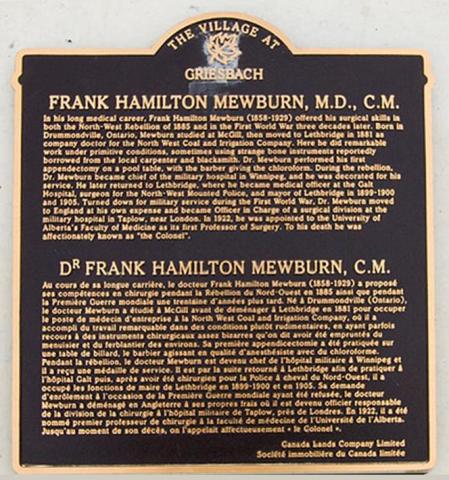
FRANK HAMILTON MEWBURN, M.D., C.M.

In his long medical career, Frank Hamilton, Mewburn (1858-1939) offered his surgical skills in
both the North-West Rebellion of 1885 and in the First World War three decades later. Born in
Drummondville, Ontario, Mewburn studied at McGill, then moved to Lethbridge in 1881 as
company doctor for the North West Coal and Irrigation Company. Here he did remarkable
work under primitive conditions, sometimes using strange bone instruments reportedly
borrowed form the local carpenter and blacksmith. Dr. Mewburn performed his first
appendectomy on a pool table, whit the barber giving the chloroform. During the rebellion,
Dr. Mewburn became chief of the military hospital in Winnipeg, and he was decorated for his
service. he later returned to Lethbridge, where he became medical officer at the Galt
hospital, surgeon for the North-West Mounted Police, and mayor of Lethbridge in 1899-1900
and 1905. Turned down for military service during the First World War, Dr. Mewburn moved
to England at his own expense and became Officer in Charge of surgical division at the
military hospital in Taplow, near London. In 1922, he was appointed to the University of
Alberta's Faculty of Medicine as its first Professor of Surgery. To his death he was
affectionately known as "the Colonel".

Dr FRANK HOMILTON MEWBURN, C.M.

Au cours de sa longue carrière, le docteur Frank Hamilton Mewburn (1858-1929) a proposé
ses compétences en chirurgie pendant la Rébellion du Nord-Ouest en 1885 ainsi que pendant
la Première Guerre mondiale une trentaine d`années plus tard. Né à Drummondville (Ontario),
le docteur Mewburn a étudié à McGill avant d déménager à Lethbridge en 1881 pour occuper
le poste de médecin d`entreprise à la North West Coal and Irrigation Company, où il a
accompli du travail remarquable dans des conditions plutôt rudimentaires, en ayant parfois
recours à des instruments chirurgicaux assez bizarres qu`on dit avoir été empruntés du
menuisier et du ferblantier des environs. Sa première appendicectomie a été pratiquée sur
une table de billard, le barbier agissant en qualité d`anesthésiste avec du chloroforme.
Pendant la rébellion, le docteur Mewburn est devenu chef de l`hôpital militaire à Winnipeg et
il a reçu une médaille de service. Il est par la suite retourné à Lethbridge afin de pratiquer à
l`hôpital Galt puis, après avoir été chirurgien pour la Police à cheval du Nord-Ouest, il a
occupé les fonctions de maire de Lethbridge en 1899-1900 et en 1905. Sa demande
d`enrôlement à l`occasion de la Première Guerre mondiale ayant été refusée, le docteur
Mewburn a déménagé en Angleterre à ses propres frais où il est devenu officier responsable
de al division de la chirurgie à l`Hôpital militaire de Taplow, près de Londres. En 1922, il a été
nommé premier professeur de chirurgie à la faculté de médecine de l`Université de l`Alberta.
Jusqu`au moment de son décès, on l`appelait affectueusement " le Colonel ".

Canada Lands Company Limited
Société immobilière du Canada limitée

Image
Photo Credit
Ryan Davidson, Alfred Zangao
Caption
plaque
Province
!4v1695403174443!6m8!1m7!1sWiIWCz5qxNVoOlTsmmFspg!2m2!1d53.61189773414045!2d-113.5143667351812!3f258.16415405347743!4f-1.2508838603434072!5f3.2863626179797687
Body Content

Colonel Mewburn Road was dedicated to Frank Hamilton Mewburn by the Canada Lands Company on June 23, 2004, as part of their redevelopment of Edmonton’s former Canadian Forces Base (Griesbach Barracks).

In his long medical career, Frank Hamilton Mewburn (1858-1939) offered his surgical skills in both the North-West Rebellion of 1885 and in the First World War three decades later. Born in Drummondville, Ontario, Mewburn studied at McGill, then moved to Lethbridge in 1881 as company doctor for the North West Coal and Irrigation Company. Here he did remarkable work under primitive conditions, sometimes using strange bone instruments reportedly borrowed form the local carpenter and blacksmith. Dr. Mewburn performed his first appendectomy on a pool table, whit the barber giving the chloroform. During the rebellion, Dr. Mewburn became chief of the military hospital in Winnipeg, and he was decorated for his service. he later returned to Lethbridge, where he became medical officer at the Galt hospital, surgeon for the North-West Mounted Police, and mayor of Lethbridge in 1899-1900 and 1905. Turned down for military service during the First World War, Dr. Mewburn moved to England at his own expense and became Officer in Charge of surgical division at the military hospital in Taplow, near London. In 1922, he was appointed to the University of Alberta's Faculty of Medicine as its first Professor of Surgery. To his death he was affectionately known as "the Colonel".

City
Edmonton
Country
Type Description
Street, plaque
Memorial CF Legacy ID
8211
City/Municipality
Edmonton
Memorial Number
48011-045
Type
Location
Griesbach
in Canada
Yes
GPS Coordinates
53.60185, -113.4964
Inscription

(needs further research/recherche incomplète)

Province
!4v1615388576348!6m8!1m7!1sCAoSLEFGMVFpcE0xRE9QaHk0cUY1TWNSTVFNUVVrZkRFeExUbE0xS0MyQmlIcUl0!2m2!1d53.6018392!2d-113.4964256!3f245.46165097447087!4f-4.241809978059649!5f3.3250798551026412"
Body Content

Canada Lands Company erected this memorial. The Princess Patricia’s Canadian Light Infantry Storyboard is dedicated to all those who served, and those who are still serving in the Princess Patricia’s Canadian Light Infantry Regiment.

City
Edmonton
Country
Type Description
Story Board
Memorial CF Legacy ID
8210