Other

City/Municipality
Edmonton
Memorial Number
48010-008
Type
Address
10102 Jasper Avenue
Location
Canadian Imperial Bank of Commerce (CIBC)
in Canada
Yes
GPS Coordinates
53.5409747, -113.4940404
Inscription

IN MEMORY OF 1701 MEN OF
THE CANADIAN BANK OF COMMERCE
WHO SERVED IN THE GREAT WAR
1914-1919

  • PTE S BADLEY
  • PTE C H BAKER
  • LT C T BALDWIN
  • PTE R W BEAIRSTO
  • LT W S BOCVE
  • B C BROOKE
  • LT R W CHIPMAN
  • SGT C M CHRISTIE
  • LT F C COLEMAN
  • CPL A J CRAIG
  • PTE A DAVIDSON
  • 2ND LT E DE WIND V C
  • R S M R T FOWLER
  • SGT C J FOX
  • SGT J H GALBRAITH
  • LT W J GRAY
  • LT R P HUGHES
  • PTE J J A KING
  • LT E C MEE
  • 2ND LT A R MC FARLAN
  • LT J A MC KENZIE
  • GNR J D MC NULTY
  • LT F W PATON
  • PTE A I PONTON
  • CSM C C SAUNDERS
  • LT A C SCOTT M C
  • CPL A C M SHANNON
  • R S M N F SINCLAIR
  • PTE M N SMITH
  • CPL V D SOPER
  • PTE J W THERMAENIVS
  • LT W C TOOMEY
  • CAPT H P WILLIAMS M C
  • PTE E J WRAY

EDMONTON - BRANCH

Image
Photo Credit
Terry MacDonald
Caption
Canadian Bank of Commerce Edmonton Branch First World War Plaque
War or Conflict Term
Province
!4v1731682532429!6m8!1m7!1sKcy0j6qoplU7Vt-pB8cqWw!2m2!1d53.54097469428224!2d-113.4940403522243!3f358.622942801693!4f10.987612591010816!5f0.7820865974627469
Body Content

In addition to the monument at its head office in Toronto, the Canadian Bank of Commerce honoured employees from each branch who served in the First World War. This plaque was commissioned shortly after the war and dedicated to the bank's 1701 employees who served in the war, 321 laid down their lives. The names of 34 employees of the Edmonton Canadian Bank of Commerce who served in the war are listed on the plaque.

The plaque features the caduceus logo of the bank - two snakes winding around a winged staff at the upper left. The Canadian Bank of Commerce went to great lengths to commemorate its staff that served in the war including a two-volume book of staff profiles and accounts of their war experiences.

City
Edmonton
Country
Type Description
Plaque
Memorial CF Legacy ID
5209
City/Municipality
Edmonton
Memorial Number
48010-007
Type
Address
9797 Jasper Avenue
Location
beside the Shaw (Edmonton) Conference Centre
in Canada
Yes
GPS Coordinates
53.54142, -113.48671
Inscription

[first plaque/première plaque]
ANA VETS PEACE PARK

OFFICIALLY OPENED BY

THE HONOURABLE GEORGE HEES, PC, MP
MINISTER OF VETERANS AFFAIRS

HIS WORSHIP LAURENCE G. DECORE
MAYOR OF EDMONTON

K. KARASIN, DOMINION PRESIDENT
ARMY, NAVY & AIRFORCE VETERANS IN CANADA

JULY 18, 1988

[second plaque/deuxième plaque]
“REMEMBER AND LEARN”
THIS MEMORIAL IS DEDICATED TO THE MEMORY
OF THOSE CITIZENS OF EDMONTON WHO GAVE
THEIR LIVES IN WORLD WAR I, WORLD WAR II AND
THE KOREAN CAMPAIGN

“FREEDOM IS A PRIVILEGE”

ARMY, NAVY & AIRFORCE VETERANS IN CANADA
SIR WINSTON CHURCHILL UNIT 3

1988 EXECUTIVE
PRESIDENT W. COOK
1ST VICE PRESIDENT C. BURKE
2ND VICE PRESIDENT K. PLANIDIN
PAST PRESIDENT P.W. THURSTON
SECRETARY-MANAGER J. RYBAK

1988 LADIES AUXILIARY
PRESIDENT J. BENESOCKY
1ST VICE PRESIDENT N. MORRISON
2ND VICE PRESIDENT H. POST
PAST PRESIDENT P. WIGHTMORE

EXECUTIVE MEMBERS
G. HARASIM
J. GERMAIN
D. ARGALL
W. REYNOLDS
D.S. TURNER
A. STEWART

EXECUTIVE MEMBERS
O. HARRIS
J. MC CLELLAND
J. BIGGAR
A. LARSEN
J. BENESOCKY
A. RECHLO

BOARD OF DIRECTORS
CHAIRMAN A. BLANCHINI
VICE CHAIRMAN C.J.G. MC KNIGHT
C. PORTICE
L. WORRELL
D. ANDERSON

ANTHONY T. HUTTON ARCHITECT
JULY 18, 1988

[the lists of names are not clear in the photos/les listes de noms ne sont pas claires sur la photo]

Image
Photo Credit
Terry MacDonald
Caption
surroundings
1 of 4 images
Image
Caption
front view
1 of 4 images
Image
Caption
plaque
1 of 4 images
Image
Caption
plaque
1 of 4 images
Province
!4v1615378668045!6m8!1m7!1sbMdwzTSpZjwI_jRf8l18wg!2m2!1d53.5416340726896!2d-113.4868220894169!3f162.6165823996629!4f1.4400874139794837!5f3.325193203789971"
Body Content

The Edmonton Convention Centre is the site of a special War Memorial and Peace Plaza, constructed in 1987. The Army, Navy and Air Force Veterans' Association constructed the commemorative plaza, complete with stone markers to honour Edmonton and area soldiers, sailors and airmen who died the First and Second World Wars and the Korean War. The principal features of the memorial are an ornamental peace-plaza sign, an eternal flame and bronze commemorative plaques.

City
Edmonton
Country
Type Description
eternal flame and plaques
Memorial CF Legacy ID
5212
City/Municipality
Edmonton
Memorial Number
48010-006
Type
Address
102 A Avenue
Location
Winston Churchill Square
in Canada
Yes
GPS Coordinates
53.5445199, -113.4901361
Inscription

[front/devant]
REMEMBERED

[side/côté]
OUR
GLORIOUS
DEAD

[back/arrière]
1914-1918
1939-1945
KOREA 1950-1953

Image
Photo Credit
Kevin Evans; Reg Horner, M.M.
Caption
front
1 of 5 images
Image
Caption
side
1 of 5 images
Image
Caption
back
1 of 5 images
Image
Caption
1939 Royal visit.
1 of 5 images
Image
Caption
Unveiling 1936.
1 of 5 images
Province
!4v1614946701212!6m8!1m7!1sxaHETE25vVYHQ_8yZOpp2w!2m2!1d53.54452048969117!2d-113.4901361773321!3f6.520469386317304!4f3.8284543735457532!5f1.9587109090973311
Body Content

In 1935, representatives of some 32 organizations formed a Citizens Cenotaph Committee with Mr. A.E. Nightingale as chairman. The Municipal and Westward Ho! Chapters of the Imperial Order of Daughters of the Empire, Women’s Conservative Association, Overseas Nursing Sisters' Association, Edmonton War Widows Association, Red Chevron Club, ex-servicemen's organizations, service clubs and many dedicated citizens participated.

The Edmonton Cenotaph represents the tombs of approximately 3,000 veterans from the Edmonton area who made the supreme sacrifice in the First World War. It was erected during the reign of King Edward VIII and unveiled on August 13, 1936, by Lord Tweedsmuir, then Governor General of Canada. 

The Cenotaph stands 23 feet high and is constructed of concrete, steel and British Columbia marble, with a total weight of more than 100 tons. The base is 18 feet square and 12 feet deep, reinforced with streetcar rails. The platform rests on 12 concrete piles that are eight feet deep, also reinforced with steel rails. Originally located at 102 Street and 100 Avenue, the Cenotaph was moved to the City Hall Plaza in 1978.

A number of dedications have taken place over the years, with additional engravings including the Second World War (dedication 1946), the Korean War (dedication 1956), and Afghanistan (dedication June 13, 2021).

City
Edmonton
Country
Type Description
Shaft
Memorial CF Legacy ID
5217
City/Municipality
Edmonton
Memorial Number
48010-005
Type
in Canada
Yes
GPS Coordinates
0, 0
War or Conflict Term
Province
Body Content

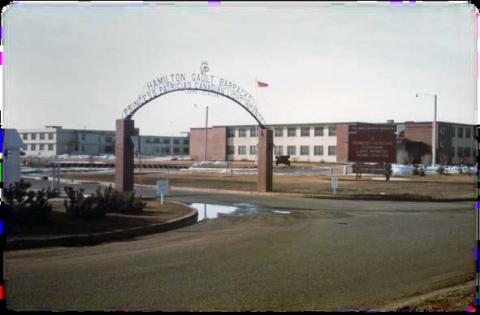
On 10 Dec 1957, it was officially announced the barracks at Canadian Forces Base Edmonton would be named in memory of the Founder of Princess Patricia’s Canadian Light Infantry, Brigadier A. Hamilton Gault, DSO, ED, CD, and was the home station of his Regiment during 1958-1968.

Canada’s quick response to the First World War was partly due to the actions of Hamilton Gault, a wealthy and distinguished Montreal businessman and Captain of the Royal Highlanders of Canada. As a Veteran of the South African War, Gault remained personally involved with the Canadian political responsibility to Britain as part of the Empire. In early August 1914, Hamilton ventured by train to Ottawa with a proposal. He would personally raise and equip a mounted unit of Canadians for the Imperial service. The proposal was set in front of Colonel Sam Hughes, the Canadian Minister of Militia and Defence. Colonel Hughes was attracted to the offer, but thought that an Infantry unit, as opposed to cavalry, would be more useful to Britain.

Lieutenant Colonel Farquhar approached the Duke of Connaught for permission to name the Regiment after his daughter, Her Royal Highness, Princess Patricia of Connaught. Princess Patricia had already become a much-admired figure in Canada because of her appreciation of the country’s vast wilderness and people. The request was made to the Princess, who was delighted. On 6 August 1914 the Canadian Government provisionally accepted Hamilton Gault’s offer.

Authority for the Regiment was granted on 10 August 1914, through a charter embodied in a report of the Committee of the Privy Council of Canada, to raise and equip an infantry battalion. As detailed in the charter, Hamilton Gault would contribute $100,000 to finance and equip the regiment, with the remainder of expenditures being covered by the Department of Militia and Defense.

Hamilton Gault would serve in the Regiment during the First World War, first as the second in command and at wars end as the commanding officer bringing the battalion home to Ottawa. 

He was seriously wounded in the Battle of Frezenberg (1915) and lost a leg at Sanctuary Wood (1916). He was the first Canadian in the war to be awarded the Distinguished Service Order for gallantry in the field. Lieutenant-Colonel Gault brought the regiment home as its commanding officer in March 1919. During the Second World War, he commanded a Canadian Army reinforcement holding unit, was promoted to Colonel in 1940 and to Brigadier-General in 1942. Ill health forced Hamilton to retire, and he returned to Canada in 1944. Gault founded the Princess Patricia’s Canadian Light Infantry Association in 1947 and served as its first national president. He served as the Regiment’s Honorary Lieutenant-Colonel from 1920 to 1948 and then as Honorary Colonel of the Regiment until his death in 1958.

City
Edmonton
Country
Type Description
Building - barracks
Memorial CF Legacy ID
11256
City/Municipality
Edmonton
Memorial Number
48010-004
Type
in Canada
Yes
GPS Coordinates
0, 0
Inscription

HAMILTON GAULT BARRACKS
PRINCESS PATRICIA’S CANADIAN LIGHT INFANTRY
HOME STATION

Image
Photo Credit
Princess Patricia’s Canadian Light Infantry
Caption
Hamilton Gault Barracks Memorial Gate
Province
Body Content

Hamilton Gault Barracks Memorial Gate was officially opened on the evening of 16 September 1964 by Mrs. Dorothy Hamilton Gault, widow of the Founder of Princess Patricia’s Canadian Light Infantry, Brigadier A. Hamilton Gault, DSO, ED, CD. The gate was financed and sponsored by the Princess Patricia’s Canadian Light Infantry Jubilee Wives’ Club.

The gate was damaged in 1968, removed, repaired and shipped to Calgary. It was returned to Edmonton in 1971 and raised back into position by the Canadian Airborne Regiment. The gate was again damaged, this time irreparably and was replaced by the Hamilton Gault Memorial Cairn.

City
Edmonton
Country
Type Description
Gate
Memorial CF Legacy ID
11255
City/Municipality
Edmonton
Memorial Number
48010-003
Type
Address
8513-104th Street
Location
Light Horse Park
in Canada
Yes
GPS Coordinates
53.521267, -113.4975347
Inscription

[front/devant]
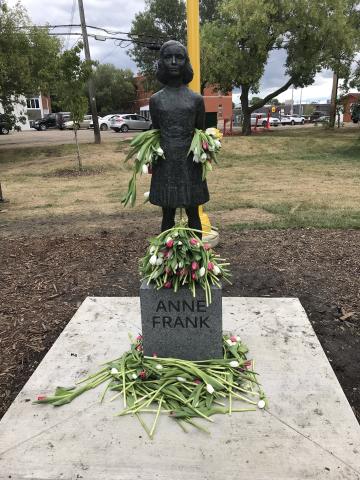
ANNE
FRANK

[back/arrière]
A COMMUNITY PROJECT
by the
DUTCH CANADIAN CLUB
EDMONTON 2020

[educational plaque/plaque éducative]

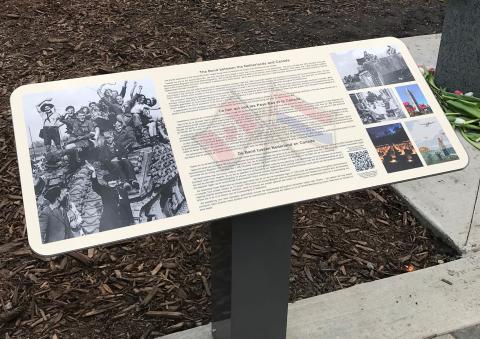
The Bond between the Netherlands and Canada

The shared experience of the Second World War forged strong relations between the people of the Netherlands and Canada.

Towards the end of the Second World War, the First Canadian Army played a major role in the Liberation of the Netherlands. This force included the 29th Canadian Armoured Reconnaissance Regiment (the South Alberta Regiment). One of the key efforts was the Battle of the Scheldt, from October to November 1944, where over 1,800 Canadian soldiers died in this crucial battle that led to the freedom of several million Dutch people. By the end of the war, more than 7,600 Canadian soldiers lost their lives while helping to free the Netherlands from Nazi occupation.

The Dutch people, who had suffered terribly under Nazi occupation between 1940 and 1945, have never forgotten the sacrifices of Canadians and the First Canadian Army. The role they played in the Liberation of the Netherlands is recognized annually on the May 4th Remembrance Day and May 5th Liberation Day Ceremonies. And each year, on Christmas Eve, Dutch school children place candles on the graves of the Canadian soldiers buried in the various Commonwealth cemeteries throughout the Netherlands.

The connection between the Netherlands and Canada extends beyond the role played by the Canadian military. In 1940, the Dutch royal family sought sanctuary in Canada. When Princess Juliana gave birth to Princess Margriet on January 19, 1943, part of the maternity ward of the Ottawa Civic Hospital was temporarily declared to be extraterritorial by the Canadian government so the Princess would be born with only Dutch citizenship. It was a symbolic gesture of kindness to these royal war guests, and it allowed Princess Margriet to remain eligible in the line of succession to the throne in the Netherlands.

In appreciation for this Canadian hospitality, the Dutch royal family sent thousands of tulips to Ottawa in 1945, and this act of gratitude continues to this day. These blooms are a symbol of the international friendship that blossomed between the Netherlands and Canada during and after the Second World War.

Le lien qui unit les Pays-Bas et le Canada 

L’expérience commune de la Seconde Guerre mondiale a forgé des relations solides entre la population des Pays-Bas et celle du Canada.

Vers la fin de la Seconde Guerre mondiale, la Première Armée canadienne a joué un rôle majeur dans la libération des Pays-Bas. Cette force comprenait le 29e Régiment de reconnaissance blindé canadien (le South Alberta Regiment). L’un des principaux efforts menés a été la bataille de l’Escaut, d’octobre à novembre 1944. Plus de 1 800 militaires du Canada ont perdu la vie dans cet affrontement décisif qui a permis la libération de millions de Néerlandais et de Néerlandaises. Au terme de la guerre, c’est plus de 7 600 militaires du Canada qui ont perdu la vie en aidant à libérer les Pays-Bas de l’occupation nazie.

La population néerlandaise, qui a terriblement souffert de l’occupation nazie entre 1940 et 1945, n’a jamais oublié les sacrifices de la population du Canada et de la Première Armée canadienne. Le rôle qu’elles ont joué dans la libération des Pays-Bas est reconnu chaque année lors des cérémonies du jour du Souvenir, le 4 mai, et du jour de la Libération, le 5 mai. Et chaque année, la veille de Noël, des élèves vont déposer des bougies sur les tombes de militaires du Canada dans les cimetières du Commonwealth à travers les Pays-Bas.

Le lien unissant les Pays-Bas et le Canada va aussi au-delà du contexte militaire. En 1940, la famille royale néerlandaise a cherché refuge au Canada. Lorsque la princesse Juliana a donné naissance à la princesse Margriet, le 19 janvier 1943, une partie du département de la maternité de l’hôpital Civic d’Ottawa a été temporairement déclaré extraterritorial par le gouvernement canadien, afin que la princesse puisse naître avec la citoyenneté néerlandaise uniquement. Il s’agissait là d’un geste symbolique bienveillant à l’égard d’une famille royale en temps de guerre, qui permettait à la princesse Margriet d’être et de demeurer éligible dans la ligne de succession au trône des Pays-Bas.

En remerciement de cette hospitalité canadienne, la famille royale néerlandaise a envoyé des milliers de tulipes à Ottawa, en 1945. Ce geste de gratitude perdure jusqu’à ce jour. Ces fleurs sont un symbole de l’amitié internationale qui a fleuri entre les Pays-Bas et le Canada pendant et après la Seconde Guerre mondiale.

De Band tussen Nederland en Canada

Tijdens en na de Tweede Wereldoorlog ontstond een sterke band tussen de Nederlanders en Canada.

Tegen het einde van de Tweede Wereldoorlog speelde het Eerste Canadese Leger een grote rol bij de Bevrijding van Nederland. Deze eenheid omvatte het 29th Canadian Armoured Reconnaissance Regiment (het South Alberta Regiment). Een van de belangrijkste acties was de Slag om de Schelde, waarbij meer dan 1.800 Canadese soldaten sneuvelden. Tegenhet einde van de oorlog verloren meer dan 7.600 Canadese soldaten het leven terwijl ze hielpen om Nederland te bevrijden van de nazi-bezetting.

Het Nederlandse volk, dat tussen 1940 en 1945 verschrikkelijk heeft geleden onder de nazi-bezetting, is de opofferingen van de Canadezen en het Eerste Canadese Leger nooit vergeten. De rol die zij speelden in de Bevrijding van Nederland wordt jaarlijks erkend op 4 mei met de Dodenherdenking en op 5 mei met de vieringen van Bevrijdingsdag. En elk jaar, op kerstavond, plaatsen Nederlandse schoolkinderen kaarsen op de graven van de Canadese soldaten die begraven liggen op de verschillende Commonwealth Grave Cemeterys door heel Nederland.

De verbinding tussen Nederland en Canada gaat verder dan de rol van het Canadese leger. In 1940 zocht het Nederlandse koningshuis toevluchtsoord in Canada. Toen prinses Juliana op 19 januari 1943 beviel van prinses Margriet, werd de kraamafdeling van het Ottawa Civic Hospital door de Canadese regering tijdelijk extraterritoriaal verklaard, zodat de prinses zou worden geboren met alleen het Nederlandse staatsburgerschap en in aanmerking zou blijven om in de rij te blijven voor de troonopvolging in Nederland.

Als waardering voor deze Canadese gastvrijheid stuurde het Nederlandse koningshuis duizenden tulpen naar Ottawa – een gebaar dat nog steeds voortduurt. Deze bloemen staan symbool voor de internationale vriendschap die tijdens en na de Tweede Wereldoorlog tussen Nederland en Canada tot bloei kwam.

[educational plaque/plaque éducative]

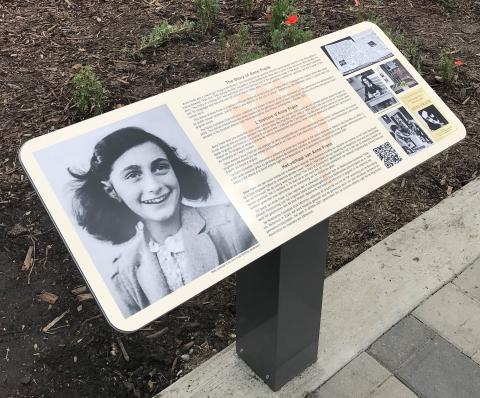
The Story of Anne Frank
Anne Frank was a Jewish girl living in Amsterdam. She documented her positive attitude toward people and life in her diary while in hiding between 1942 and 1944 during the Nazi occupation of the Netherlands. Anne was a victim of the Holocaust. After the Second World War, her story, “The Diary of a Young Girl” was published and it has become one of the best-known books in the world. It has been translated into 70 languages and has sold over 30 million copies. Today, Anne Frank has become a symbol for optimism and the triumph of the human spirit.

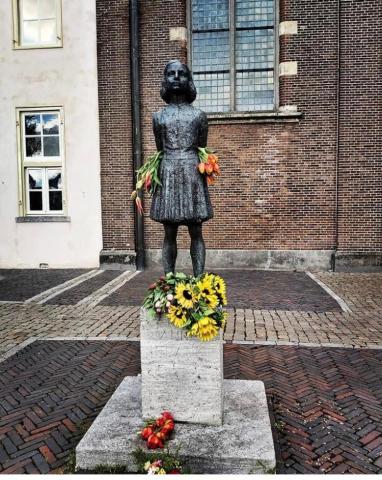
This statue of Anne Frank is a replica of the original, designed and created by the Dutch artist Pieter D’Hont. Funding for the first statue was raised by Dutch school children, and in 1960 it was donated to the city of Utrecht, The Netherlands. The Edmonton statue is cast from the original mould.

The Dutch Canadian Club Edmonton undertook this project in honour of the 75th Anniversary of the Liberation of the Netherlands in 2020. It was made possible by the generous support of many individuals, donors, and community groups. The statue was donated to the South Alberta Light Horse Regimental Association and citizens of Edmonton in October 2021.

L'histoire d'Anne Frank
Anne Frank était une jeune fille juive vivant à Amsterdam. Dans son journal, elle a consigné son attitude positive envers les gens et la vie, alors qu’elle se cachait pendant l’occupation nazie des Pays-Bas, entre 1942 et 1944. Anne a été une victime de l’Holocauste. Après la Seconde Guerre mondiale, son histoire, « Le journal d’une jeune fille », a été publiée. C’est devenu l’un des livres les plus connus au monde, étant traduit en 70 langues et vendu à plus de 30 millions d’exemplaires. Aujourd’hui, Anne Frank est devenue le symbole de l’optimisme et du triomphe de l’esprit humain.

Cette statue d’Anne Frank est une réplique de celle conçue et créée par l’artiste néerlandais Pieter D’Hont. Le financement de la statue originale a été assuré par des élèves des Pays-Bas et, en 1960, elle a été offerte à la ville d’Utrecht. La statue d’Edmonton a été coulée à partir du moule d’origine.

Le Dutch Canadian Club Edmonton a entrepris ce projet pour souligner le 75e anniversaire de la libération des Pays-Bas, en 2020. Il a été rendu possible grâce au généreux soutien de nombreux individus, de donateurs, de donatrices et de groupes communautaires. La statue a été offerte à la South Alberta Light Horse Regimental Association et à la population d’Edmonton en octobre 2021.

Het verhaal van Anne Frank
Anne Frank was een joods meisje dat in Amsterdam woonde. Haar positieve houding ten opzichte van mensen en het leven beschreef zij in haar dagboek tijdens de onderduik periode tussen 1942 en 1944 tijdens de nazi-bezetting van Nederland. Anne was een slachtoffer van de Holocaust. Na de Tweede Wereldoorlog haar verhaal "The Diary of a Young Girl" gepubliceerd en het is een van de bekendste boeken ter wereld geworden. Het is vertaald in 70 talen en er zijn meer dan 30 miljoen exemplaren van verkocht. Tegenwoordig is Anne Frank een symbool geworden voor optimisme en de overwinning van de menselijke geest.

Dit beeld van Anne Frank is een replica dat is ontworpen en gemaakt door de Nederlandse kunstenaar Pieter d'Hondt. Financiering voor het originele beeld werd bijeengebracht door Nederlandse schoolkinderen en in 1960 werd het geschonken aan de stad Utrecht, Nederland. Het beeld van Edmonton is gegoten uit de originele mal.

De Nederlands-Canadese Club Edmonton ondernam dit project ter ere van de 75e verjaardag van de Bevrijding van Nederland in 2020. Het werd mogelijk gemaakt door de genereuze steun van vele individuen, donateurs en gemeenschapsgroepen. Het werd in oktober 2021 geschonken aan de Southern Alberta Light Horse Regimental ssociation en inwoners van Edmonton.

Image
Photo Credit
John Stobbe
Caption
Anne Frank Statue with 200 tulips at the unveiling
1 of 6 images
Image
Photo Credit
John Stobbe
Caption
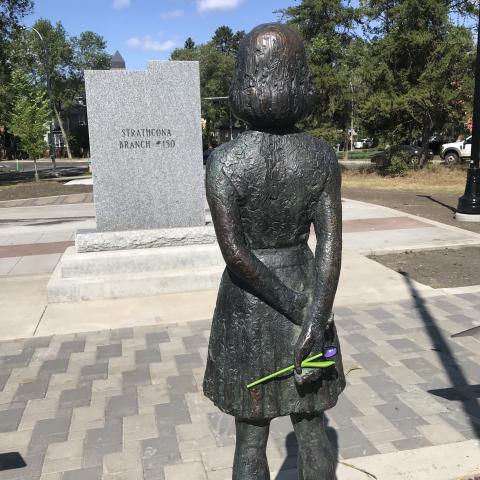
back of statue
1 of 6 images
Image
Photo Credit
John Stobbe
Caption
back of statue
1 of 6 images
Image
Photo Credit
John Stobbe
Caption
Story of Anne Frank educational plaque.
1 of 6 images
Image
Photo Credit
John Stobbe
Caption
Bond between the Netherlands and Canada educational plaque.
1 of 6 images
Image
Photo Credit
Marco van der Werf
Caption
Anne Frank statue, Utrecht, Netherlands.
1 of 6 images
Province
!4v1643728733611!6m8!1m7!1smVXuqTpNiGGvrOS1AjaTiA!2m2!1d53.52126704297707!2d-113.4975347176246!3f85.14085635905161!4f-12.182812274620971!5f0.6613434550049755
Body Content

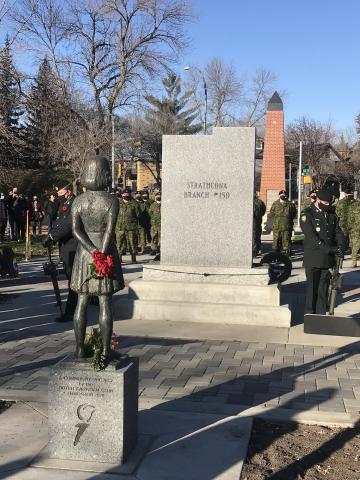
The Anne Frank Statue was unveiled in Light Horse Park on August 8, 2021, as part of the 75th Liberation Project of the Dutch Canadian Club Edmonton. On this same August weekend, 77 years ago, Nazis raided 263 Prisengracht in Amsterdam, where Frank, her family and four others had been hiding for nearly two years. The eight people from the hiding place were sent to transit camp Westerbork and then sent on the very last train to Auschwitz. Later Anne and her sister Margo were transferred to Bergen-Belson where they died in early 1945 of typhoid.

Anne's diary was found and published after the war and has sold over 40 million copies worldwide. Anne has become a symbol of hope and optimism around the world.

This amazing bronze statue of the world-famous diary-writer stands atop a marble plinth and was made with the same cast that Dutch sculptor Pieter d’Hont used to create an Anne Frank statue in 1960 for the city of Utrecht, Netherlands. This is only the second copy to be in a public place. There are two educational plaques beside the statue: one explaining the history of Anne Frank and the other describing the bond between the Netherlands and Canada. Both plaques have QR codes allowing people to obtain more information and are in English, French, and Dutch. Visitors are encouraged to leave flowers at the base of the statue.

Installed in part to thank the Canadian military for its role in freeing the Netherlands from Nazi occupation during the Second World War, it also explains the connection between the Netherlands and Canada. John Stobbe worked on the project with Dutch Hon. Consul Jerry Bouma and Edmonton Dutch Canadian Club president Frank Stolk. An Edmonton Journal column significantly helped launch their fundraising campaign in February 2020. Support for the project came from near and far.

At the unveiling, John spoke about seeing the statue in Utrecht while vacationing. He met the son of Pieter d’Hont, the Dutch artist and creator/sculptor of the statue and they came to an agreement to have another cast made of the statue especially for the Dutch Canadian Club to present to the City of Edmonton in honour of the Canadian troops’ role in Liberating the Netherlands during the Second World War.

City
Edmonton
Country
Type Description
Statue - bronze
Memorial CF Legacy ID
10751
City/Municipality
Edmonton
Memorial Number
48010-002
Type
Address
11150 - 82 Street NW
Location
Royal Canadian Legion No. 178
in Canada
Yes
GPS Coordinates
53.5611645, -113.467967
Inscription

[plaque]
(English translation of Ukrainian text/traduction anglaise du texte cen ukrainien)

DEDICATED TO
ALL OF OUR UKRAINIAN PIONEERS
WHO WITH COURAGE AND PERSEVERANCE
HELPED TO BUILD ALBERTA INTO A GREAT SOCIETY

[slab/dalle]
IN MEMORY
OF
THOSE WHO SERVED
THEIR COUNTRY

[plaque]
WORLD
WAR I
1914
TO
1918

[plaque]
WORLD
WAR II
1939
TO
1945

[plaque]
PEACE SUPPORT
OPERATIONS
1948
TO
PRESENT

(list of Ukrainian Pioneers who helped build Alberta/une liste des pionniers ukrainiens qui ont aidé à bâtir l’Alberta)

(list of donors/une liste des donateurs)

Image
Caption
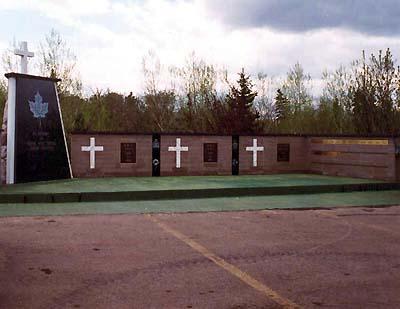
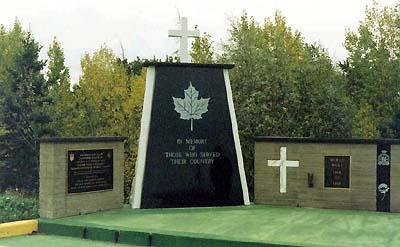
Norwood Cenotaph
1 of 4 images
Image
Caption
Norwood Cenotaph
1 of 4 images
Image
Caption
Norwood Cenotaph
1 of 4 images
Image
Caption
Norwood Cenotaph
1 of 4 images
Province
!4v1719340689449!6m8!1m7!1sgNJZUH80tTthUq1GMC11VA!2m2!1d53.56116445842872!2d-113.4679670438327!3f174.87812329445057!4f-0.05555748148428563!5f2.3040380754836356
Body Content

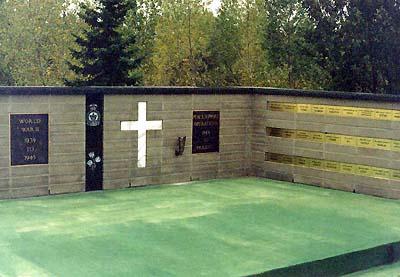
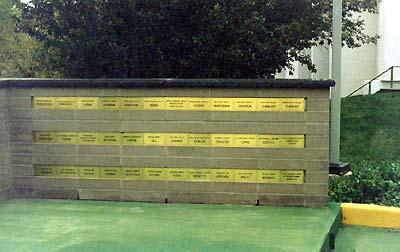
The first section of the Norwood Cenotaph represents the timeframe of the First World War with a divider of black marble and a crest of the British Empire Service League. The second section is the timeframe of the Second World War with a divider of black marble and a crest of the Royal Canadian Legion. The third section is for all Peacekeeping operations from 1948 to the present.

The east wing wall pays tribute to the Ukrainian Pioneers who helped build Alberta into the great society it is today. The west wall acknowledges the donors who made this project possible. The Norwood Cenotaph was erected by the Norwood Monument Society and completed in May 2000. Norwood Monument Society Committee Members: Walter Marcenuik, President Walter Fedoruk, Vice President Dennis Strilchuk, Secretary Brenton Chmiliar, Treasurer John Boychuk, Executive Member Carl Lukasiewich, Executive Member Max Podluzny, Executive Member.

In August 2021, the Norwood Cenotaph was vandalized. Two bronze plaques were removed and taken from the monument. One plaque thanked community members who donated to help support building the cenotaph over 60 years ago. The other plaque honoured the sacrifices of soldiers from the First World War. 

City
Edmonton
Country
Type Description
Wall, slab, cross - Terrazzo, granite and marble, plaques - brass
Photo Credit
Brenton Chmiliar and Keith Inches
Memorial CF Legacy ID
5208
City/Municipality
Beverly
Memorial Number
48010-001
Type
Address
Corner of 40 Street and 118 Avenue
in Canada
Yes
GPS Coordinates
53.57015, -113.40336
Inscription

[front/devant]

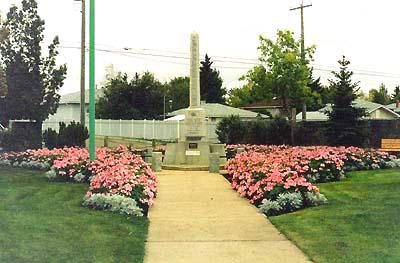
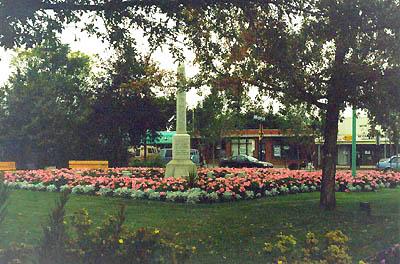
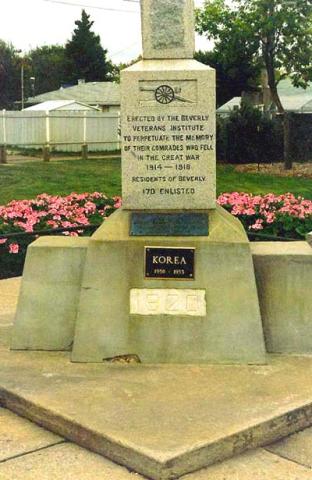
ERECTED BY THE BEVERLY VETERANS INSTITUTE TO PERPETUATE THE MEMORY OF THEIR COMRADES WHO FELL IN THE GREAT WAR
1914 - 1918
RESIDENTS OF BEVERLY
170 ENLISTED

1939 - 1945

GEORGE HARKER
CECIL HIGHTOWER
ERNIE RHIND
GEORGE STEVENS
ALEXANDER SEREDIAK

KOREA
1950 - 1953

1920

[side/côté]

(needs further research/recherche incomplète)

[back/arrière]

REGINALD D. PARRISH
EDWARD PHILLIP
EDWARD PEARSON
PERCY RICHARD
WILLIAM ROMERIL
ERNEST S. SAULT
JACK THOMAS
ROBERT THOMPSON
JAMES W. WALKER

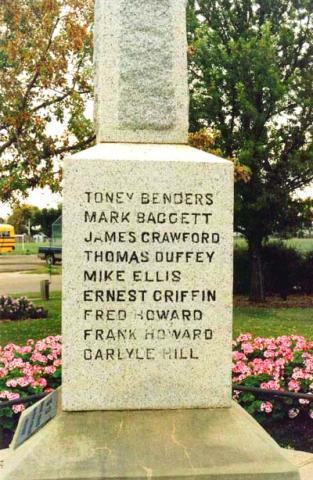
[side/côté]

TONEY BENDERS
MARK BAGGETT
JAMES CRAWFORD
THOMAS DUFFEY
MIKE ELLIS
ERNEST GRIFFIN
FRED HOWARD
FRANK HOWARD
CARLYLE HILL

Image
Photo Credit
Keith Inches
Caption
obelisk (front)
1 of 4 images
Image
Caption
obelisk (back)
1 of 4 images
Image
Caption
obelisk (front details)
1 of 4 images
Image
Caption
obelisk (side)
1 of 4 images
Province
!4v1615377911222!6m8!1m7!1sPVZ54TuBgZfpQIJNw70AFg!2m2!1d53.57032921184262!2d-113.4030382135878!3f229.2014051825691!4f-0.5419954624046284!5f3.325193203789971"
Body Content

The small mining community of Beverly was incorporated as a town in 1914 and, that same year, nobly responded to the call for men in the First World War. Evidence of this response is shown on the Town's Honour Roll and the names inscribed on the Memorial Stone. With the war over in 1919, the survivors returned to Beverly determined to build a better community. It is in this state of mind that a group of veterans founded an association based on brotherly love and endeavoured to assist the returned soldiers to adjust themselves to civilian life. Thus was the humble beginning of the Beverly Veterans' Association, which was registered under the Companies Act, April 9, 1920. During the first months of the organization, it was decided to lay plans to erect a fitting Memorial in tribute to the comrades who gave their lives for King and Country. A memorial fund was opened and subscription lists were circulated to raise enough money for the project. One of the Charter Members, Thomas R. Dando, generously provided two lots for a Memorial Park on which to erect a Cenotaph. Later, the lease was issued to the Beverly Veterans' Association for a period of 99 years and renewable as long as the land was used for the original purpose. The rental was free. Due to the generosity of Mr. Dando, the project got started. The response for funds from the Community was most gratifying and months of work brought the Memorial Park and Cenotaph into reality. On October 17th, 1920, the Lieutenant Governor of Alberta, Honourable G. Brett unveiled the Cenotaph and dedicated the grounds, in a colourful ceremony. After WWII, the Town doubled the size of the Memorial Park with the addition of two adjoining lots. The Cenotaph was moved to a more central location and the names of the men who gave their lives in the Second World War were inscribed on a tablet and attached to the monument. On October 5th, 1958, there was a re-dedication of the Beverly War Memorial. After the Invocation, offered by Reverend Knoppers, His Worship, Mayor Johnny Sehn, unveiled a tablet in honour of the Beverly men "who gave their lives so that we might enjoy freedom". In 1961, the City of Edmonton annexed the Town of Beverly, and the maintenance of the park and Cenotaph became the responsibility of the Parks and Recreation Department. Annual flower beds are planted at the site, which is intensively landscaped with shrub beds and several park benches. Plaques were later added to honour the fallen of the Second World War and the Korean War.

City
Beverly
Country
Type Description
Granite obelisk
Memorial CF Legacy ID
3041
City/Municipality
Camrose
Memorial Number
48009-062
Type
Address
6002 50 Ave T4V 0J9
Location
Camrose Royal Canadian Legion
in Canada
Yes
GPS Coordinates
53.023082686528, -112.84320037851
Image
Photo Credit
www.canadianfallenheroes.ca
Caption
Camrose Legion Display of fallen heroes
Province
Body Content

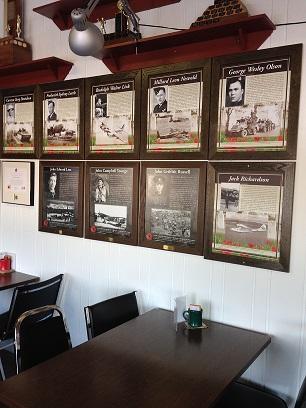
The Camrose Royal Canadian Legion completed a display in 2017 in their main hall of memorial prints in commemoration of their local fallen heroes.

City
Camrose
Country
Type Description
Display
Memorial CF Legacy ID
10096
City/Municipality
Wainwright
Memorial Number
48009-061
Type
Address
Needs further research
Location
Sapper Hill
in Canada
Yes
GPS Coordinates
0, 0
Inscription

(needs further research/recherche incomplète)

Province
Body Content

There are several Canadian geographical names that honour the ‘sapper’.

City
Wainwright
Country
Type Description
Landmark (hill)
Memorial CF Legacy ID
6850