Other

City/Municipality
Vancouver
Memorial Number
59027-011
Type
Address
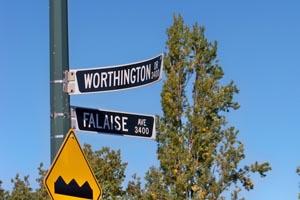
Falaise Place
Location
Grandview Heights
in Canada
Yes
GPS Coordinates
49.2560179, -123.0287302
Inscription

FALAISE PL

Image
Photo Credit
Jeff Oldfield
Caption
Falaise Place street sign
War or Conflict Term
Province
!4v1721843327460!6m8!1m7!1sgd0mmab5-ZgnEswwhnwh7g!2m2!1d49.2560178764194!2d-123.028730243363!3f59.76874033089306!4f-0.5167398670802328!5f3.307978153195307
Body Content

In 1948, Grandview Heights in northeast Vancouver was developed as a sub-division to provide low rental housing for Veterans after the Second World War. Initially the streets were to be named after wildlife, but this was changed and the streets were named after personalities, battles and events from the two World Wars. The Chair of the Street Naming Sub-Committee was Alderman Halford Hal Wilson, who served as a Major during the Second World War.

This street commemorates those who fought at Falaise in the Second World War and was named on March 23, 1948. Lieutenant General Guy Simonds developed an innovative plan to break through to the critical road junction at Falaise. Using radio beams, searchlights, and tracer fire to steer them, the Canadians would attack at night in conjunction with an immense air bombardment. To help nullify the German anti-tank defences, Simonds instructed his men to convert some of their self-propelled artillery into armoured personnel carriers the first of their kind. With the infantry riding in relative safety inside what were soon dubbed "Kangaroos," with the enemy blasted from above by American bombers, and using darkness as a screen, Simonds intended to puncture the enemy line.

City
Vancouver
Country
Type Description
Street
Memorial CF Legacy ID
7713
City/Municipality
Vancouver
Memorial Number
59027-010
Type
Address
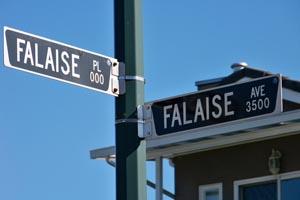
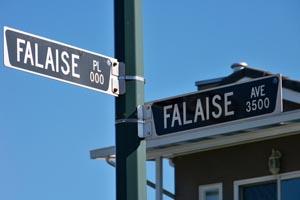
Falaise Avenue
Location
Grandview Heights
in Canada
Yes
GPS Coordinates
49.2555522, -123.0294862
Inscription

FALAISE AVE

Image
Caption
Falaise Avenue street sign
1 of 2 images
Image
Caption
Falaise Avenue street sign
1 of 2 images
War or Conflict Term
Province
!4v1721842518378!6m8!1m7!1sGGK2LOR6mcHB_5jWiuTPew!2m2!1d49.25555224266611!2d-123.0294862044085!3f91.80605270272719!4f-2.144581303828474!5f2.688538366723933
Body Content

In 1948, Grandview Heights in northeast Vancouver was developed as a sub-division to provide low rental housing for Veterans after the Second World War. Initially the streets were to be named after wildlife, but this was changed and the streets were named after personalities, battles and events from the two World Wars. The Chair of the Street Naming Sub-Committee was Alderman Halford Hal Wilson, who served as a Major during the Second World War.

This street commemorates those who fought at Falaise in the Second World War and was named on March 23, 1948. Lieutenant General Guy Simonds developed an innovative plan to break through to the critical road junction at Falaise. Using radio beams, searchlights, and tracer fire to steer them, the Canadians would attack at night in conjunction with an immense air bombardment. To help nullify the German anti-tank defences, Simonds instructed his men to convert some of their self-propelled artillery into armoured personnel carriers the first of their kind. With the infantry riding in relative safety inside what were soon dubbed "Kangaroos," with the enemy blasted from above by American bombers, and using darkness as a screen, Simonds intended to puncture the enemy line.

City
Vancouver
Country
Type Description
Street
Photo Credit
Jeff Oldfield
Memorial CF Legacy ID
7712
City/Municipality
Vancouver
Memorial Number
59027-009
Type
Address
Dieppe Place
Location
Grandview Heights
in Canada
Yes
GPS Coordinates
49.256259, -123.0264108
Inscription

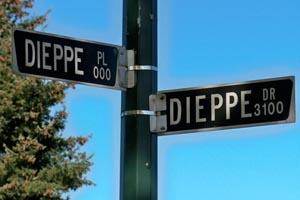
DIEPPE PL

Image
Photo Credit
Jeff Oldfield
Caption
Dieppe Place street sign
War or Conflict Term
Province
!4v1622570743716!6m8!1m7!1syM2-DmSLFBepQ28V0dpTdw!2m2!1d49.25625551609718!2d-123.0264155120063!3f352.41438311561063!4f-0.17493543160072988!5f1.767084986100243
Body Content

In 1948, Grandview Heights in northeast Vancouver was developed as a sub-division to provide low rental housing for Veterans after the Second World War. Initially the streets were to be named after wildlife, but this was changed and the streets were named after personalities, battles and events from the two World Wars. The Chair of the Street Naming Sub-Committee was Alderman Halford Hal Wilson, who served as a Major during the Second World War.

Although extremely valuable lessons were learned in the Raid on Dieppe, a steep price was paid. Of the 4,963 Canadians who embarked for the operation, only 2,210 returned to England, and many of these were wounded. There were 3,367 casualties, including 1,946 prisoners of war; 916 Canadians lost their lives. This street was named in their honour on March 23, 1948.

City
Vancouver
Country
Type Description
Street
Memorial CF Legacy ID
7711
City/Municipality
Vancouver
Memorial Number
59027-008
Type
Address
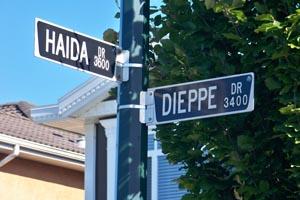
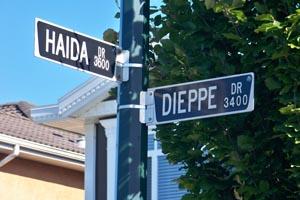
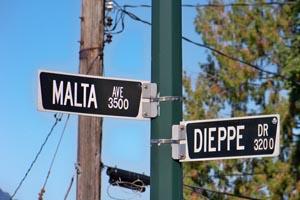
Dieppe Drive
Location
Grandview Heights
in Canada
Yes
GPS Coordinates
49.2557715, -123.0256632
Inscription

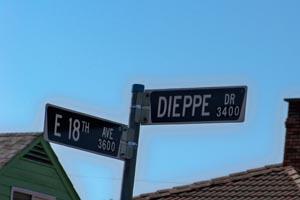
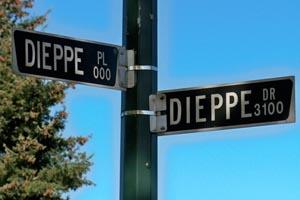
DIEPPE DR

Image
Caption
Dieppe Drive street sign
1 of 4 images
Image
Photo Credit
Jeff Oldfield
Caption
Dieppe Drive street sign
1 of 4 images
Image
Caption
Dieppe Drive street sign
1 of 4 images
Image
Caption
Dieppe Drive street sign
1 of 4 images
War or Conflict Term
Province
!4v1721842184743!6m8!1m7!1sQtbNcn18aZ7nQIYwiZGffg!2m2!1d49.25577154252106!2d-123.0256631646581!3f45.844815065505486!4f-6.6249598160036385!5f0.7820865974627469
Body Content

In 1948, Grandview Heights in northeast Vancouver was developed as a sub-division to provide low rental housing for Veterans after the Second World War. Initially the streets were to be named after wildlife, but this was changed and the streets were named after personalities, battles and events from the two World Wars. The Chair of the Street Naming Sub-Committee was Alderman Halford Hal Wilson, who served as a Major during the Second World War.

Although extremely valuable lessons were learned in the Raid on Dieppe, a steep price was paid. Of the 4,963 Canadians who embarked for the operation, only 2,210 returned to England, and many of these were wounded. There were 3,367 casualties, including 1,946 prisoners of war; 916 Canadians lost their lives. This street was named in their honour on March 23, 1948.

City
Vancouver
Country
Type Description
Street
Photo Credit
Jeff Oldfield
Memorial CF Legacy ID
7710
City/Municipality
Vancouver
Memorial Number
59027-007
Type
Address
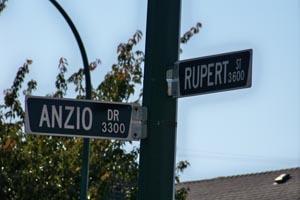
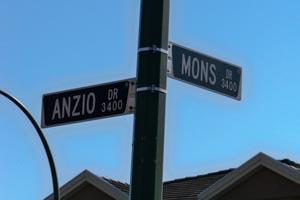
Anzio Drive
Location
Grandview Heights
in Canada
Yes
GPS Coordinates
49.2523112, -123.0310861
Inscription

ANZIO DR

Image
Photo Credit
Jeff Oldfield
Caption
Anzio Drive street sign
1 of 2 images
Image
Caption
Anzio Drive street sign
1 of 2 images
War or Conflict Term
Province
!4v1721841212063!6m8!1m7!1sakngPbEWfPxLppAQ7uJYRg!2m2!1d49.25231123256807!2d-123.0310860501917!3f18.0108612269631!4f-5.120253905807829!5f3.31299128801055
Body Content

In 1948, Grandview Heights in northeast Vancouver was developed as a sub-division to provide low rental housing for Veterans after the Second World War. Initially the streets were to be named after wildlife, but this was changed and the streets were named after personalities, battles and events from the two World Wars. The Chair of the Street Naming Sub-Committee was Alderman Halford Hal Wilson, who served as a Major during the Second World War.

The 1st Canadian Special Service Battalion was the Canadian component of a joint Canadian-American organization called the First Special Service Force. Organized as part of the United States Army, and using American equipment, the Force, as it was known, comprised three regiments each of two battalions plus a Service Battalion or echelon. Canadians commanded five of the six battalions and made up roughly one third of the unit’s strength. After six weeks of arduous service in the Italian mountains, the Force was deployed into the Anzio bridgehead, southwest of Rome.

On 1 February 1944 the Force was landed at Anzio where it took over roughly a quarter of the defensive perimeter, a front that extended about seven miles. This was held for 14 weeks until the Force was pulled back into the center of the bridgehead to prepare for the breakout battle in May that would eventually lead to the fall of Rome. Anzio Drive was named in their honour on March 23, 1948.

City
Vancouver
Country
Type Description
Street
Memorial CF Legacy ID
7709
City/Municipality
Vancouver
Memorial Number
59027-004
Type
Address
236 E Cordova Street
Location
Vancouver Police Department
in Canada
Yes
GPS Coordinates
49.2822567, -123.0986755
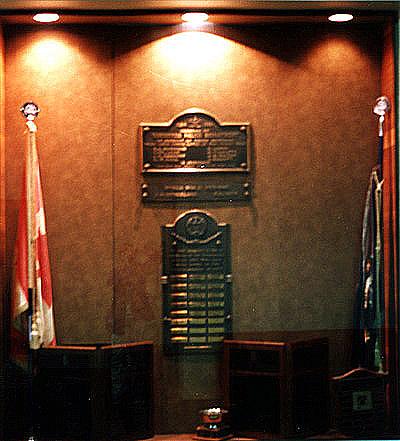
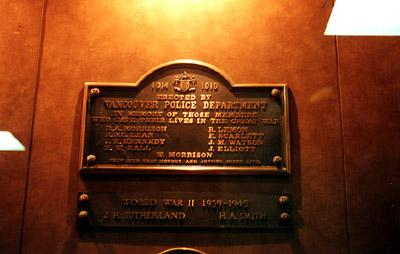
Inscription

[top plaque/plaque du haut]
1914-1919
ERECTED BY
VANCOUVER POLICE DEPARTMENT
IN MEMORY OF THOSE MEMBERS
WHO GAVE THEIR LIVES IN THE GREAT WAR

[left column/colonne de gauche]
D.A. MORRISON
R. MC. LEAN
J.K. KENNEDY
H.W. HALL

[right column/colonne de droite]
R. LEMON
E. SCARLETT
J.M. WATSON
J. ELLIOTT

[bottom/en bas]
W. MORRISON
THEY DIED THAT HONOUR AND JUSTICE MIGHT LIVE.

[middle plaque/plaque du milieu]
WORLD WAR II 1939-1945
J.H. SUTHERLAND H.A. SMITH

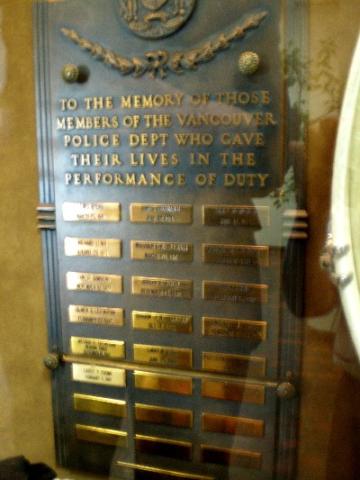
[bottom plaque/plaque en bas]
TO THE MEMORY OF THOSE
MEMBERS OF THE VANCOUVER
POLICE DEPT WHO GAVE
THEIR LIVES IN THE
PERFORMANCE OF DUTY

[left column/colonne de gauche]
LEWIS BYERS
MARCH 25, 1912.
RICHARD LEVIS
AUGUST 29, 1914.
ERNEST SARGENT
NOVEMBER 10, 1927.
OLIVER G. LEDINGHAM
FEBRUARY 26, 1947.
ARTHUR S. TRENTHAM
RESERVE FORCE
SEPTEMBER 16, 1963
LARRY T. YOUNG
FEBRUARY 2, 1987

[centre column/colonne du centre]
JAMES ARCHIBALD
MAY 28, 1913.
MALCOLM B. MACLENNAN
MARCH 20, 1917.
JOSEPH A. REILLY
DECEMBER 23, 1932
GORDON F.F. SINCLAIR
DEC 7, 1955
LARRY W. ESAU
JUNE 29, 1966.

[right column/colonne de droite]
JOHN L. MCMENOMY
JUNE 13, 1913.
ROBERT G. MACBEATH, V.C.
OCTOBER 9, 1922
CHARLES BOYES
FEBRUARY 26, 1947.
LAWRENCE W. SHORT
FEBRUARY 9, 1962.
PIRTHIPAUL S. SANCHERA
JAN 8, 1982.

Image
Photo Credit
Terry MacDonald; Julie Clements
Caption
front view
1 of 4 images
Image
Caption
details
1 of 4 images
Image
Caption
front
1 of 4 images
Image
Caption
bottom plaque
1 of 4 images
War or Conflict Term
Province
!4v1622566846905!6m8!1m7!1shsecgfpjJQniKhfZ5ITF9A!2m2!1d49.28226296335832!2d-123.0990920177808!3f188.68494638197032!4f14.543811862807984!5f0.4000000000000002
Body Content

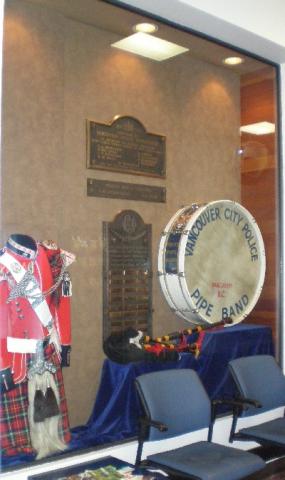
This memorial is dedicated to the Vancouver Police Department members who gave their lives in the First and Second World Wars. It was erected by the Vancouver Police Department. Below the two plaques is a third plaque listing the Vancouver Police Department members killed in the line of duty in Vancouver. Included in this list is a Victoria Cross Winner.

City
Vancouver
Country
Type Description
Plaques
Memorial CF Legacy ID
5135
City/Municipality
Vancouver
Memorial Number
59027-003
Type
Address
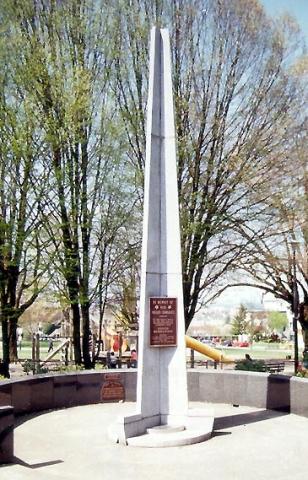
1657 Charles Street
Location
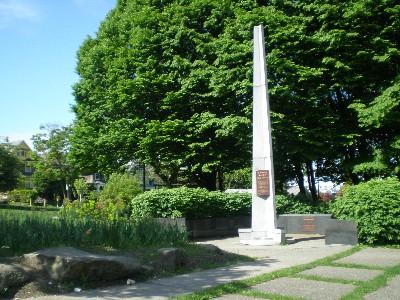
Grandview Park
in Canada
Yes
GPS Coordinates
49.273527, -123.0695897
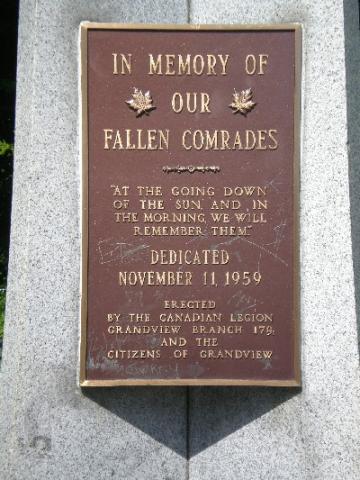
Inscription

[plaque/plaque]

IN MEMORY
OF
OUR FALLEN COMRADES
"AT THE GOING DOWN
OF THE SUN, AND IN
THE MORNING WE WILL
REMEMBER THEM"
DEDICATED
NOVEMBER 11, 1959
ERECTED
BY THE CANADIAN LEGION
GRANDVIEW BRANCH 179,
AND THE
CITIZENS OF GRANDVIEW

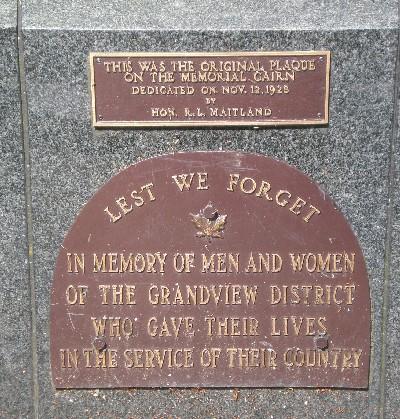
[top wall plaque/mur, plaque du haut]

THIS WAS THE ORIGINAL PLAQUE
ON THE MEMORIAL CAIRN
DEDICATED ON NOV. 12, 1928
BY
HON. R.L. MAITLAND

[bottom wall plaque/mur, plaque en bas]

LEST WE FORGET
IN MEMORY OF MEN AND WOMEN
OF THE GRANDVIEW DISTRICT
WHO GAVE THEIR LIVES
IN THE SERVICE OF THEIR COUNTRY

Image
Photo Credit
Thomas Donovan; Julie Clements
Caption
front view
1 of 4 images
Image
Caption
plaque
1 of 4 images
Image
Caption
plaque
1 of 4 images
Image
Caption
surroundings
1 of 4 images
Province
!4v1622565025641!6m8!1m7!1sZYbr_qxyS5PEbglEoAw1ng!2m2!1d49.27352698641522!2d-123.0695896561412!3f257.9983228007274!4f0.9326267770266838!5f1.7746219656821362
Body Content

This shaft was dedicated on 11 November 1959, in memory of "Our Fallen Comrades". Located behind the shaft on the wall is the original plaque that was located on the cairn that was replaced by the shaft. The original cairn was dedicated on 12 November 1928.

City
Vancouver
Country
Type Description
Shaft and granite arc wall
Memorial CF Legacy ID
4218
City/Municipality
Vancouver
Memorial Number
59027-002
Type
Address
2901 E Hastings Street
Location
Pacific National Exhibition grounds
in Canada
Yes
GPS Coordinates
49.2827301, -123.0430136
Inscription

[front/devant]

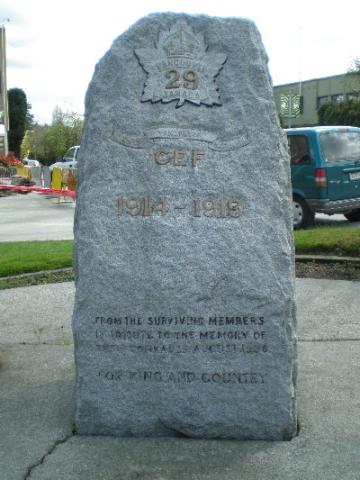
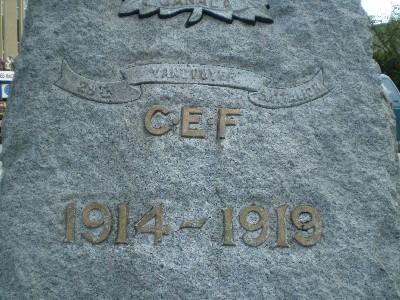
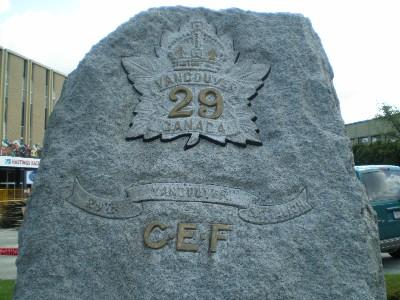
29th VANCOUVER BATTALION
C.E.F
1914 - 1918
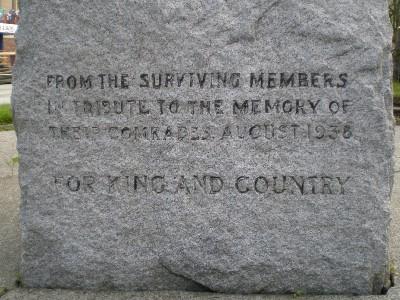
FROM THE SURVIVING MEMBERS
IN TRIBUTE TO THE MEMORY OF
THEIR COMRADES AUGUST 1938
FOR KING AND COUNTRY

Image
Photo Credit
Julie Clements
Caption
front
1 of 4 images
Image
Caption
detail
1 of 4 images
Image
Caption
detail
1 of 4 images
Image
Caption
detail
1 of 4 images
Province
!4v1622564614440!6m8!1m7!1s_oGD-biTszO--f6SgqQHeQ!2m2!1d49.28292343996399!2d-123.0440112803575!3f88.47525224350147!4f2.691195736410549!5f0.7820865974627469
Body Content

This memorial is dedicated the 29th (Tobin's Tigers) Canadian Infantry Battalion, CEF. The 29th Battalion, formerly perpetuated by the Irish Fusiliers of Canada (The Vancouver Regiment) is now perpetuated by The British Columbia Regiment (DCO) since the merger of the two Regiments.

City
Vancouver
Country
Type Description
Stone cairn
Memorial CF Legacy ID
7642
City/Municipality
Vancouver
Memorial Number
59027-001
Type
Address
5955 Ross Street
Location
Memorial South Park
in Canada
Yes
GPS Coordinates
49.2312935, -123.0852063
Inscription

To the memory of the Men and Women who served in the defense of their Country.

Image
Photo Credit
Thomas Donovan
Caption
front view
War or Conflict Term
Province
!4v1622560351228!6m8!1m7!1sMvhrH9RGuoay9id1JwCX4Q!2m2!1d49.23129346924036!2d-123.0852063202558!3f155.9382592853432!4f2.754339938096024!5f1.5842681318742628
Body Content

The Memorial South Cenotaph was erected on May 22, 1926, in memory of the soldiers who died in World War I. The Memorial was later rededicated on November 11, 1939. (Refer to memorial number 59027-022)

City
Vancouver
Country
Type Description
Granite cenotaph
Memorial CF Legacy ID
4207
City/Municipality
Vancouver
Memorial Number
59026-063
Type
Address
2690 Larch Street
Location
Kitsilano War Memorial Community Centre
in Canada
Yes
GPS Coordinates
49.2615535, -123.1625269
Inscription

[mural/murale]

HABITAT
KOOLAID
CENTRE for DIALOGUE
HEADLINES THEATRE

YOU
ARE
HERE

AROUND THE
NEIGHBOURHOOD
PEOPLE WAGE
PEACE

SIMON HELPS A
REFUGEE CHILD
PUT SOLDIERING
BEHIND HER

COEXIST

AMNESTY

UNIFICATION

LE CANADA
50 and au
service de la
PAIX

peace unto us

ARMISTICE

"Those
who survived war understand
the meaning of
peace"

ABE LOSES RADIO
CONTACT WITH THE
HALIFAX

ELSEWHERE, DR. HAVIN
WONDERS HOW YUSSEF
IS MANAGING

[storyboard/scénarimage]

A Path To Peace
COMMUNITY MURAL PROJECT

The mural contains many images and symbols, focusing on our Centre's presence as a war memorial site and of the Kitsilano community as a centre for peace activism. It was designed by artist-in-residence Ruth Jones, and painted by thirty members of the community with Ruth as facilitator.

The design was inspired by a memory journal made by community members in collaboration with Community Artists Dorothy Wolf and Lizanne Fisher, by the peace mosaics made by artist Dan Hill and KCC community groups, and by Ruth's interaction with residents of Kitsilano who shared their memories, beliefs and hopes with her.

Nature embodies peace; a living peace. Protecting nature is peace-making. The public water, sky and beaches of Kitsilano should remind us that, in a peaceful world, nature belongs to everyone (custodianship) and to no one. The earth is its own miracle which should not be fought over out of greed.

A navigation beacon on Spanish Banks becomes a candle of hope to guide us.

Many societies dedicated to peace-making and conflict resolution have sprung up in our midst, many started right here in Kitsilano. They form an important part of growing global effort.

A local newspaper blowing on breeze carries a headline we hope to see more often: "Accord: Pact of Non-Violence Holds".

This is a Japanese Peace monument. Its mystery and beauty inspire thoughts of peace in people of all nations. A gateway to spiritual values.

The rainbow is an ancient sign for peace in many cultures. For example, in China, it is often drawn as a symbol of the sky dragon, connecting heaven and earth. It embodies peoples' hope for a better world.

This figure represents Amnesty, which is the state's version of forgiveness. Without forgiving and forgetting, the peace process gets bogged down. So she is here to help heal wounds and soothe tempers, old grudges, and attitudes of self-righteousness. She holds an olive branch, symbol of peace-time, in front of her, and lets the chains of imprisonment fall away behind her.

Bombers are transforming into doves as the sky shifts from night time on the right to daytime on the left. This is a mythic representation of how human thought is transforming to grasp a new global harmony.

A peace march, winds its way through the central mural. It represents our communities relentless marching for peace over many decades, and links us to peace marches and vigils around the world. It is also a sign that the majority is seeking a new way of relating between nations. As musician Ben Harper sings: "If the people lead, the leaders will have to follow".

At the mural centre, the theme starts to shift from war and it consequences to one of conflict resolution and a search for a new way of dialogue between nations. Two soldiers are shown laying down their weapons with good intent, trusting that they won't ambush one another in the process... a metaphor for any two people attempting a reconciliation.

The F18 is Canada's contemporary bomber. It opens the skies on military missions.

Crosses march up the hill as a symbol of the loss of Canada through military action. On the ridge is the Vimy Memorial which commemorates the battles when many Canadian dies in a very short time - a virtual massacre. We hope that in showing it in the light of dawn, we can express how loss from war continues to motivate us to work for peace and no take it for granted. The inclusion of the red ensign (our original flag) points to the history of Canada and her growth as a nation, due to the bravery of those who fought so that today we may live in freedom and peace.

Kitty Hawks were the "Little Friends" of big bombers like the Halifax. They would accompany them on missions and attempt to gun down any attacking fighter planes. Rumours suggest that a squadron of Kitty Hawks, being ferried by Canadian women pilots to bases in Alaska during WWII, froze up over the Rockies and were lost without a trace. Department of National Defense may have buried the evidence, but stories by those who remember hearing news still circulate.

A woman stands in rags on a bombed-out building, she is in no immediate danger and sings defiantly out, thus serving as a symbol of the inextinguishable strength of the human spirit in adversity. She plays the role of the story teller, motioning with her outstretched arm towards the path through war that leads to peace. A sea battle takes place above, and is shown to honour Canadian troops who served in the Royal Navy. Our local Veteran's Legion motto is "Those who experienced war understand the meaning of peace". Visit Billy Bishop Branch #176, 1407 Laburnum Street, to talk with a veteran.

Since the 1950's Canadians have led the world in numbers of troops deployed in peacekeeping missions. Here, a peacekeeper is depicted in the original 1950's uniform to remind us of the long history and experience we are building on to achieve more effective results and more lasting peace. His name is Simon, and his individual identity should remind us of the personal contribution that all peacekeepers make.

In this scenario, we see a relaxed trust possible due to the respect that peacekeepers have earned from civilian populations worldwide. Behind Simon is a small girl who has been trained to use an assault rifle. This is one of thousands of scenarios peacekeepers come up against, in this case child soldiers who have been hardened to a lifestyle of warfare. Successful programmers are springing up to help these children find a new place in society. More needs to be done.

Originating in Kitsilano, Greenpeace continues its work worldwide to suppress nuclear and other threats to the environment and humanity. Its philosophy is based on the Quaker belief in being present and witnessing conflict. This vessel is one of a growing fleet of thirteen, and named after the original Rainbow Warrior, which was sunk by the French Secret Service in 1985, while it was attempting to stop nuclear testing in the South Pacific.

A pre-schooler here at KCC was asked to draw a picture that symbolized peace. She showed four people holding hands and said "I think peace means love". Thanks, Miaoli, for the inspiration for the kids on the sea-wall.

The Peace March culminates in Kitsilano near the beach, an original rallying point of earlier peace marches. The marchers, dressed for wind and weather, look on as hands build the Unity mosaic.

Unification. Since the institution of the Olympic Games thousands of years ago, sports have been played to symbolize peace between nations. They also act as a (mostly) playful and nonviolent outlet for competitiveness and rivalry. This soccer player takes his place in the mural as the fulfillment of peace through sport. He has a flag draped around him, but instead of a flag of nationalism, it is a flag of peace. Its one star suggests unity between nations and states — a global empathetic community — and its colours are those of the United Nations.

In 2002, the community created a mosaic which graces the grass around the flag pole in front of you. The participatory process, of many people making a Work of Art together, acts as a symbol of every person's efforts towards peace creating the greater goal of World Peace. One family feud resolved, one set of international Peace Talks organised, or one anger management workshop completed, all these efforts contribute toward a more peaceful planet.

Poppies are the flowers of remembrance. They spill from the remembrance ceremony into the central image to suggest that the significance of our loss from war lives on to contribute to our daily understanding of, and efforts on behalf of, peace.

When a dancer was asked to express the word Peace she formed this pose - an embodiment of the yearning towards an ideal that seems to require the will of the Beyond. She is present as the allegorical figure "Armistice": a peace that is negotiated and signed by opposing sides. We see, between her outstretched arms, surrendering troops. They are an important part of the path to peace. It takes great bravery to surrender, as one must put one's trust in the enemy.

This is the transition area of the mural. It is the place of grief and remembrance for those who suffered or died in wartime, both civilian and military. Symbols combine to suggest loss and cherished memories. A piper playing suggest solemnity and ritual. The laying of a wreath is common to all funeral processions and to ceremonies marking the anniversary of death. The cenotaph honours those that have departed due to conflicts around the globe. The four soldiers honour recent troops lost in battle in Afghanistan. They are echoed (four soldiers shown facing toward the lost brothers) to suggest that when the living honour the dead, the dead live on through their memory.

A field doctor, at a medical outpost near a war zone, is concerned over the health of a landmine victim. But the most tragic landmine casualties are the thousands of children worldwide who are injured every year. Medical groups, such as Doctors Without Borders, are organized to treat these victims with great care while pointing out the need to ban production of weapons such as landmines and cluster bombs which, in peace time ? to claim innocent victims. A nurse imagines the best for a young survivor who, although awaiting fitting for an artificial leg, is still able to join in the game.

Abe, a name given to emphasize the humanity and personal experience of individuals in war, is shown in uniform as a ranking officer in charge of soldiers in air combat. He is concerned over the loss of communication with one plane under his command. It is hard for us to imagine the grief and remorse that responsible officers must have experienced in losing men and women in combat. This image expresses that war is more than societal evil. Many precious individuals relationships are built and lost.

needs further research/recherche incomplète

Image
Caption
A Path to Peace storyboard
1 of 5 images
Image
Caption
A Path to Peace
1 of 5 images
Image
Caption
A Path to Peace
1 of 5 images
Image
Caption
A Path to Peace
1 of 5 images
Image
Caption
A Path to Peace
1 of 5 images
Province
!4v1719336684865!6m8!1m7!1sCjXtgOyBWqU7LCjfgBjCTg!2m2!1d49.26155354750299!2d-123.162526873413!3f93.2661837847078!4f4.29134849333235!5f2.1627690956993737
Body Content

A Path to Peace was erected by Ruth Jones and volunteers from the Kitsilano Community in the summer of 2003. The mural contains many images and symbols, focusing on the Kitsilano War Memorial Community Centre's presence as a war memorial site and of the Kitsilano community as a centre for peace activism. It was designed by artist-in-residence Ruth Jones, and painted by thirty members of the community with Ruth as facilitator.

The design was inspired by a memory journal made by community members in collaboration with Community Artists Dorothy Wolf and Lizanne Fisher, by the peace mosaics made by artist Dan Hill and KCC community groups, and by Ruth's interaction with residents of Kitsilano who shared their memories, beliefs and hopes with her.

Images depicted in the mural are:

  • The water, sky and beaches of Kitsilano remind us that, in a peaceful world, nature belongs to everyone (custodianship) and to no one. The earth is its own miracle which should not be fought over out of greed.
  • A navigation beacon on Spanish Banks becomes a candle of hope to guide us.
  • Images of Kitsilano buildings, many societies dedicated to peace-making and conflict resolution started right here in Kitsilano.
  • A peacekeeper in the original 1950's uniform reminds us of the long history to achieve lasting peace. His name is Simon, and his individual identity reminds us of the personal contribution that all peacekeepers make.
  • Behind Simon is a small girl who has been trained to use an assault rifle. This is one of thousands of scenarios peacekeepers come up against, in this case child soldiers who have been hardened to a lifestyle of warfare.
  • A local newspaper blowing on breeze carries a headline: "Accord: Pact of Non-Violence Holds".
  • A preschooler, Miaoli, inspired the image of kids on the sea-wall to symbolize peace.
  • The Japanese Peace monument, its mystery and beauty inspire thoughts of peace in people of all nations. A gateway to spiritual values.
  • The rainbow is an ancient sign for peace in many cultures.
  • A Peace March in Kitsilano near the beach, an original rallying point of earlier peace marches. The marchers, dressed for wind and weather, look on as hands build the Unity mosaic.
  • The soccer player fulfills peace through sport. He has a flag of peace draped around him. Its one star suggests unity between nations and states — a global empathetic community — and its colours are those of the United Nations.
  • A figure represents Amnesty, which is the state's version of forgiveness. She holds an olive branch, symbol of peace-time, in front of her, and lets the chains of imprisonment fall away behind her.
  • Bombers are transforming into doves as the sky shifts from night time on the right to daytime on the left. This is a mythic representation of how human thought is transforming to grasp a new global harmony.
  • A peace march, winds its way through the central mural. It represents our communities relentless marching for peace over many decades, and links us to peace marches and vigils around the world. It is also a sign that the majority is seeking a new way of relating between nations. As musician Ben Harper sings: "If the people lead, the leaders will have to follow".
  • At the mural center, the theme starts to shift from war and it consequences to one of conflict resolution and a search for a new way of dialogue between nations. Two soldiers are shown laying down their weapons with good intent, trusting that they won't ambush one another in the process... a metaphor for any two people attempting a reconciliation.
  • In 2002, the community created a mosaic around the flag pole. The participatory process, of many people making a Work of Art together, acts as a symbol of every person's efforts towards peace creating the greater goal of World Peace.
  • Poppies are the flowers of remembrance.
  • The F18 is Canada's contemporary bomber. It opens the skies on military missions.
  • A dancer inspired the allegorical figure "Armistice": a peace that is negotiated and signed by opposing sides. Surrendering troops are between her outstretched arms. It takes great bravery to surrender, as one must put one's trust in the enemy.
  • Crosses march up the hill, as a symbol of the loss of Canada through military action, to the Vimy National Memorial. The red ensign (our original flag) points to the history of Canada and her growth as a nation, due to the bravery of those who fought so that today we may live in freedom and peace.
  • Symbols combine to suggest loss and cherished memories. A piper playing suggest solemnity and ritual. The laying of a wreath is common to all funeral processions and to ceremonies marking the anniversary of death. The cenotaph honours those that have departed due to conflicts around the globe. The four soldiers honour recent troops lost in battle in Afghanistan. They are echoed (four soldiers shown facing toward the lost brothers) to suggest that when the living honour the dead, the dead live on through their memory.
  • A field doctor, at a medical outpost near a war zone, is concerned over the health of a landmine victim. A nurse imagines the best for a young survivor who, although awaiting fitting for an artificial leg, is still able to join in the soccer game.
  • Kitty Hawks were the "Little Friends" of big bombers like the Halifax. They would accompany them on missions and attempt to gun down any attacking fighter planes.
  • A ranking officer, shown in uniform in charge of soldiers in air combat, is concerned over the loss of communication with one plane under his command.
  • A woman stands in rags on a bombed-out building and sings defiantly out, thus serving as a symbol of the inextinguishable strength of the human spirit in adversity. She plays the role of the story teller, motioning with her outstretched arm towards the path through war that leads to peace. A sea battle takes place above, and is shown to honour Canadian troops who served in the Royal Navy.
City
Vancouver
Country
Type Description
Mural
Photo Credit
Kitsilano War Memorial Community Centre
Memorial CF Legacy ID
12615