Other

City/Municipality
Vancouver
Memorial Number
59026-041
Type
Address
Burrard Street and W 15th Avenue
Location
Canadian Memorial United Church
in Canada
Yes
GPS Coordinates
49.2580818, -123.1459623
Inscription

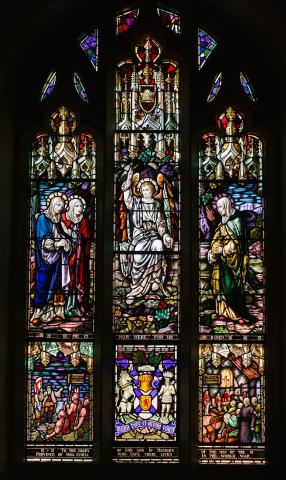
HE IS NOT HERE: FOR HE IS RISEN."

Landing of
CABOT 1497

Decree of
Expulsion to the
Acadians 1755

MUNIT HAEC ET ALTERA VINCIT

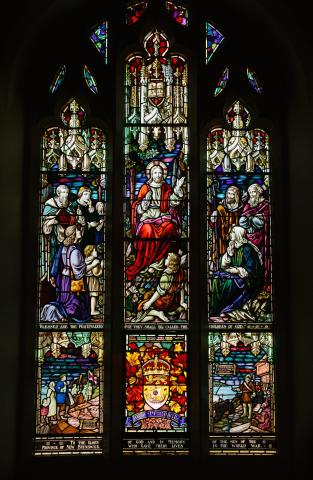
TO THE GLORY OF GOD AND IN MEMORY OF THE MEN OF THE
PROVINCE OF NOVA SCOTIA WHO GAVE THEIR LIVES IN THE WORLD WAR.

Image
Photo Credit
Canadian Memorial United Church and Centre for Peace
Caption
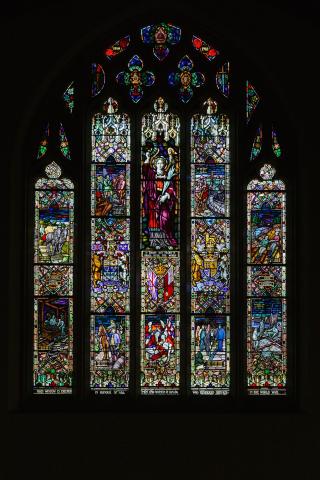
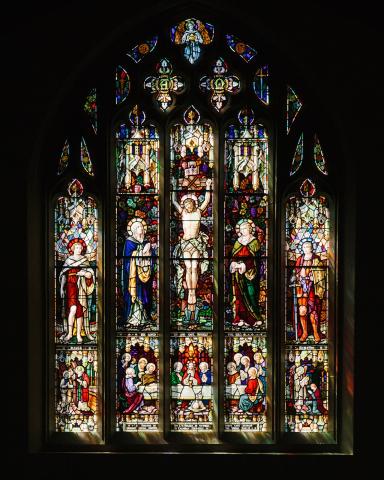
Nova Scotia Window
War or Conflict Term
Province
!4v1622487793072!6m8!1m7!1sBhTo-GoGMRoV-vQ0me-CTw!2m2!1d49.25808175008721!2d-123.1459623271083!3f226.2479404422196!4f8.907012790348716!5f1.4499580245881227
Body Content

Canadian Memorial Chapel was born in the hearts of private soldiers in the First World War who, guided by a sergeant, formed a working party to bury six of Canada's war dead. On a November night of 1915, in the Ypres Salient, France, one of the soldiers said to Reverend Lieutenant-Colonel (Lt.-Col.) George Fallis, CBEEDDD: "Padre, after the war is over some chaplain should build a memorial in Canada in memory of fellows like these who have given their all." From that moment on, he would never lay away their beloved dead without the idea of a memorial chapel in his mind.

On his return to Canada he was advised by Reverend S.D. Chown, DD, General Superintendent of the Methodist Church, to go to Vancouver and choose a site in Shaughnessy Heights facing the eternal hills to erect the chapel of his dreams. He arrived in Vancouver in May 1920, to a willing congregation and plans were quickly laid. 

Lt.-Col. Fallis' friend Chris Spencer, CBE, advised him that in order for there to be national significance to the chapel, he should go across Canada and interview lieutenant governors, premiers, statesmen and leaders of each province, asking them to underwrite the windows. Nova Scotia was the third province he visited.

At Halifax Lieutenant Governor, the Honourable James Tory, referred Lt.-Col. Fallis to the Premier, the Honourable Edgar M. Rhodes, who gave his blessing and submitted a list of citizens to be interviewed. Colonel Oxley arranged the introductions. Lt.-Col. Fallis visited Yarmouth, Kentville and Truro. In Yarmouth Eric H. Spinney, grandson of one of the Fathers of Confederation, said he called it one of the privileges of his life to help with the Nova Scotia Window.

Depicted in the Nova Scotia Window - “Immortality,” symbolized by the empty tomb of the risen Christ, is often a source of comfort to many grieving the loss of loved ones. The Gospel teaches that love triumphs over death. The historical panels depict the Landing of Cabot in 1497, and the Decree of Expulsion of the Acadians in 1755.

City
Vancouver
Country
Type Description
Stained glass window
Photo Credit
Canadian Memorial United Church and Centre for Peace
Memorial CF Legacy ID
11097
City/Municipality
Vancouver
Memorial Number
59026-040
Type
Address
Burrard Street and W 15th Avenue
Location
Canadian Memorial United Church
in Canada
Yes
GPS Coordinates
49.2580818, -123.1459623
Inscription

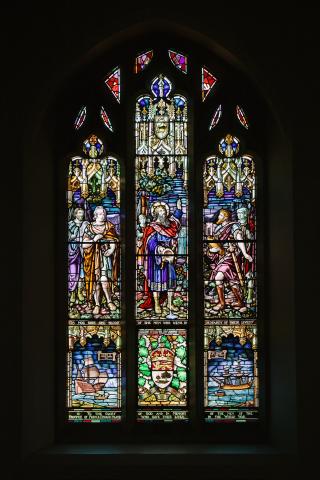
"IS NOT THIS THE BLOOD OF THE MEN WHO WENT IN JEOPARDY OF THEIR LIVES?"

Landing of
JACQUES CARTIER
1534

The Coming
of LORD ROLLO
1758.

Parva sub ingenti

TO THE GLORY OF GOD AND IN MEMORY OF THE MEN OF THE
PROVINCE OF PRINCE EDWARD ISLAND WHO GAVE THEIR LIVES IN THE WORLD WAR.

Image
Caption
Prince Edward Island Window
War or Conflict Term
Province
!4v1622487793072!6m8!1m7!1sBhTo-GoGMRoV-vQ0me-CTw!2m2!1d49.25808175008721!2d-123.1459623271083!3f226.2479404422196!4f8.907012790348716!5f1.4499580245881227
Body Content

Canadian Memorial Chapel was born in the hearts of private soldiers who, guided by a sergeant, formed a working party to bury six of Canada's war dead. On a November night of 1915, in the Ypres Salient, France, one of the soldiers said to Reverend Lieutenant-Colonel (Lt.-Col.) George Fallis, CBEEDDD: "Padre, after the war is over some chaplain should build a memorial in Canada in memory of fellows like these who have given their all." From that moment on, he would never lay away their beloved dead without the idea of a memorial chapel in his mind.

On his return to Canada he was advised by Reverend S.D. Chown, DD, General Superintendent of the Methodist Church, to go to Vancouver and choose a site in Shaughnessy Heights facing the eternal hills to erect the chapel of his dreams. He arrived in Vancouver in May 1920, to a willing congregation and plans were quickly laid. 

Lt.-Col. Fallis' friend Chris Spencer, CBE, advised him that in order for there to be national significance to the chapel, he should go across Canada and interview lieutenant governors, premiers, statesmen and leaders of each province, asking them to underwrite the windows.

The first visit was to Victoria and after securing subscription for the British Columbia Window, Honourable Walter Nichol  said: "Now that you have finished British Columbia, I should advise you to go to Prince Edward Island and if you get the support of the far West and the far East, I am sure the provinces in between will respond."

In winter 1928, Lt.-Col. Fallis left Vancouver for Charlottetown, Prince Edward Island. No one even knew he was on his way. Judge Shaw of Vancouver gave him a letter of introduction to his brother-in-law, Captain McLeod, who was the skipper on board the ice-breaker between the mainland and Prince Edward Island. Captain McLeod’s kind hospitality led him to believe that Islanders would understand his mission. He landed in Prince Edward Island on a Saturday, preached to a congregation in the First United Church on Sunday, spoke on Sunday night over the radio, and Monday contacted Lieutenant-Colonel Dan MacKinnon, a friend of war days. Lieutenant-Colonel MacKinnon made sure he saw Lieutenant Governor, the Honourable Frank R. Heartz, who called together a group of leading citizens as a general committee.

By Wednesday he was on the boat returning to the mainland with a very happy heart. Prince Edward Islanders were thrilled with a Canadian Memorial Chapel and eager to be the second province to subscribe for their window.

Depicted in the Prince Edward Island Window - “David and his Valiant Soldiers” symbolizes the sacrifice made by Canada’s servicemen. The story referenced here is of David’s elite troop of Three who break through the Philistine lines and obtain the water from the well for their King.

The Kings of both France and England also wanted to claim the “fairest land that may possibly be seen” and sent their explorers and soldiers to obtain it for them. The historical panels show images of great ships sailing forth into the unknown carrying Lord Rollo and Jacques Cartier, who brought new technology, goods and war to the “new world.” Their arrival also brought illness, death and the loss of land and status to the Acadians and Mi'kmaq.

City
Vancouver
Country
Type Description
Stained glass window
Photo Credit
Canadian Memorial United Church and Centre for Peace
Memorial CF Legacy ID
11096
City/Municipality
Vancouver
Memorial Number
59026-039
Type
Address
Burrard Street and W 15th Avenue
Location
Canadian Memorial United Church
in Canada
Yes
GPS Coordinates
49.2580818, -123.1459623
Inscription

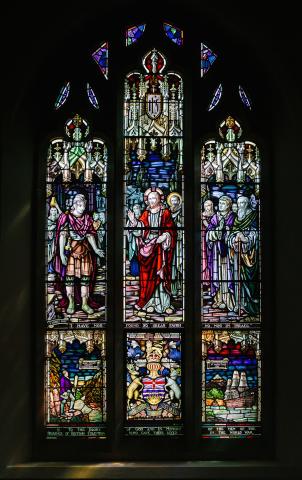
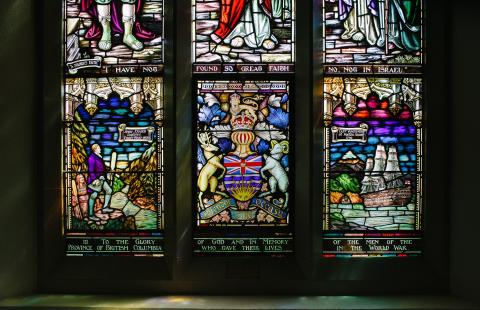
"A SOLDIERS FAITH." "IHAVE NOT FOUND SO GREAT FAITH NO, NOT IN ISRAEL."

SIMON FRASER
Explores
Fraser River 1808

CAPT VANCOUVER
at Nootka Sound
1792

Splendor sine occasu

TO THE GLORY OF GOD AND IN MEMORY OF THE MEN OF THE
PROVINCE OF BRITISH COLUMBIA WHO GAVE THEIR LIVES IN THE WORLD WAR.

Image
Caption
British Columbia Window
1 of 2 images
Image
Caption
inscription
1 of 2 images
War or Conflict Term
Province
!4v1622487793072!6m8!1m7!1sBhTo-GoGMRoV-vQ0me-CTw!2m2!1d49.25808175008721!2d-123.1459623271083!3f226.2479404422196!4f8.907012790348716!5f1.4499580245881227
Body Content

Canadian Memorial Chapel was born in the hearts of private soldiers in the First World War who, guided by a sergeant, formed a working party to bury six of Canada's war dead. On a November night of 1915, in the Ypres Salient, France, one of the soldiers said to Reverend Lieutenant-Colonel (Lt.-Col.) George Fallis, CBEEDDD: "Padre, after the war is over some chaplain should build a memorial in Canada in memory of fellows like these who have given their all." From that moment on, he would never lay away their beloved dead without the idea of a memorial chapel in his mind.

On his return to Canada he was advised by Reverend S.D. Chown, DD, General Superintendent of the Methodist Church, to go to Vancouver and choose a site in Shaughnessy Heights facing the eternal hills to erect the chapel of his dreams. He arrived in Vancouver in May 1920, to a willing congregation and plans were quickly laid. 

Lt.-Col. Fallis' friend Chris Spencer, CBE, advised him that in order for there to be national significance to the chapel, he should go across Canada and interview lieutenant governors, premiers, statesmen and leaders of each province, asking them to underwrite the windows.

The first visit was to Victoria where Lieutenant Governor, the Honourable Walter C. Nichol was out of the capital for a few days. The Premier, the Honourable John Oliver, unreservedly commended the movement. He said, "I am a poor man, but I should like to subscribe the first hundred dollars towards the British Columbia window." Lt.-Col. Fallis interviewed several other men in public life and was met with cordial reception.

When the Honourable Walter Nichol returned he required twelve hundred dollars more to underwrite the window. He said: "You are going to be a very busy person visiting all the Provinces. I will underwrite the balance for the British Columbia Window." He added, "Now that you have finished British Columbia, I should advise you to go to Prince Edward Island and if you get the support of the far West and the far East, I am sure the provinces in between will respond."

Mr. Nichol became ill and eventually died. Lt.-Col. Fallis received a letter from a trust company asking for the balance on the British Columbia. Mr. Nichol had left instructions that it was to be paid out of his estate - one of the most touching moments in building the Chapel.

Depicted in the British Columbia Window - “A Soldier’s Faith” portrays a majestic Christ meeting the Roman centurion who pleads on behalf of his palsied servant. Disease and war wounds suffered by the troops were responded to by medical staff who played an essential role during the war. The historic panels show Simon Fraser in 1808 and Captain Vancouver at Nootka Sound.

City
Vancouver
Country
Type Description
Stained glass window
Photo Credit
Canadian Memorial United Church and Centre for Peace
Memorial CF Legacy ID
11095
City/Municipality
Vancouver
Memorial Number
59026-038
Type
Address
Burrard Street and W 15th Avenue
Location
Canadian Memorial United Church
in Canada
Yes
GPS Coordinates
49.2580818, -123.1459623
Inscription

FARMING

YPRES
SOMME

COAL MINING

RIGHT NOT MIGHT
SHALL RULE THE WORLD

DIEU ET MON DROIT

VIMY
CAMBRAI

FISHING

THIS WINDOW IS ERECTED IN HONOUR OF ALL MEN AND WOMEN OF CANADA WHO ENDURED SERVICE IN THE WORLD WAR.

Image
Photo Credit
Canadian Memorial United Church and Centre for Peace
Caption
All Canada Window
War or Conflict Term
Province
!4v1622487793072!6m8!1m7!1sBhTo-GoGMRoV-vQ0me-CTw!2m2!1d49.25808175008721!2d-123.1459623271083!3f226.2479404422196!4f8.907012790348716!5f1.4499580245881227
Body Content

Canadian Memorial Chapel was born in the hearts of private soldiers in the First World War who, guided by a sergeant, formed a working party to bury six of Canada's war dead. On a November night of 1915, in the Ypres Salient, France, one of the soldiers said to Reverend Lieutenant-Colonel (Lt.-Col.) George Fallis, CBEEDDD: "Padre, after the war is over some chaplain should build a memorial in Canada in memory of fellows like these who have given their all." From that moment on, he would never lay away their beloved dead without the idea of a memorial chapel in his mind.

On his return to Canada he was advised by Reverend S.D. Chown, DD, General Superintendent of the Methodist Church, to go to Vancouver and choose a site in Shaughnessy Heights facing the eternal hills to erect the chapel of his dreams. He arrived in Vancouver in May 1920, to a willing congregation and plans were quickly laid. 

The window depicting services rendered by all men and women of Canada throughout the war was made possible through the generosity of leading statesmen and other men and women in the public life of Canada. The Building Committee thought it was wise for Lt.-Col. Fallis to go to Ottawa as Parliament was in session, and interview the leaders of Canadian life. Through the kindness of the Honourable H.H. Stevens, PC, and the Honourable Layton Ralston, he was able to interview Prime Minister Mackenzie King and three cabinet ministers in one afternoon, who were all most gracious and responsive.

In a few days the story of Canadian Memorial Chapel was a topic of conversation among parliamentarians who ate in the Parliamentary Club. The Right Honourable Arthur Meighen thought the idea was worthy of the support of all Canadians. Lt-Col. Fallis was greeted in the hall by the Honourable Robert Manion, a devout Catholic and a friend in the war days. At lunch when Lt-Col. Fallis unfolded his napkin he found a cheque for one hundred dollars from his friend. While still at lunch, General A. D. McRae, CB, came over and said: "Padre, I must do my bit for Canadian Memorial Chapel," and handed over a cheque for one thousand dollars. Nearly twenty years later Senator General McRae was buried from Canadian Memorial Chapel.

The Honourable R.B. Bennett, afterwards Viscount Bennett, was Leader of the Opposition and Lt-Col. Fallis' cousin, Reverend Dr. Samuel Fallis was his minister in Central Church, Calgary. When Parliament was idle, Lt-Col. Fallis went to his suite and told him the story of Canadian Memorial Chapel and asked him to subscribe to the All Canada Window. Mr. Bennett was a great Canadian and a great patriot. He was delighted with the idea of Canadian Memorial Chapel and immediately wrote a very ample cheque.

Located over the main entrance to Canadian Memorial United Church, the All Canada Window represents a vision of the coming together of Canada as a nation throughout its history, including the First World War. The window contains Canada’s discovery by Cartier, its birth by fire under Wolfe, its place as a safe haven for the Loyalists, its struggle for democracy through rebellion and negotiation at Fort Garry, and its joining together into a great nation connected by the Canadian Pacific Railway. Within the windows are four of the great battles fought by Canadians in the First World War: Ypres, Cambrai, Vimy and the Somme. “Right, not Might, shall rule the world” instructs the central figure, an angelic visitor, Miss Canada, who holds the symbol of peace in her right hand: a laurel wreath.

The All Canada Window was dedicated at the evening service on 2 December 1928 by the Honourable H. H. Stevens, PC, LLD.

City
Vancouver
Country
Type Description
Stained glass window
Memorial CF Legacy ID
11093
City/Municipality
Vancouver
Memorial Number
59026-037
Type
Address
1825 W 16th Avenue
Location
Canadian Memorial United Church
in Canada
Yes
GPS Coordinates
49.2572049, -123.1467808
Inscription

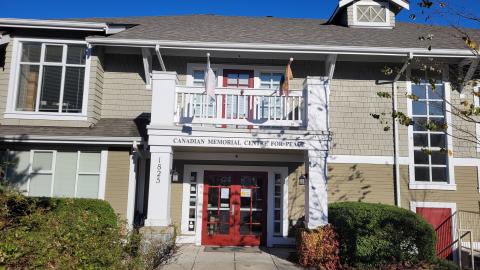
CANADIAN MEMORIAL CENTRE FOR PEACE

Image
Photo Credit
Canadian Memorial United Church and Centre for Peace
Caption
Canadian Memorial United Church and Centre for Peace
1 of 2 images
Image
Photo Credit
Canadian Memorial United Church and Centre for Peace
Caption
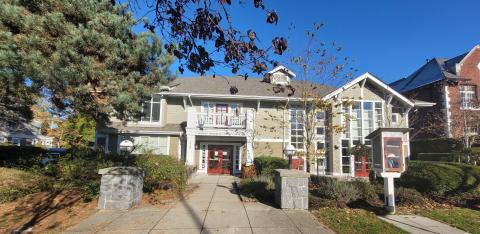
Canadian Memorial United Church and Centre for Peace
1 of 2 images
War or Conflict Term
Province
!4v1667844165416!6m8!1m7!1s5GF0l2pMYLBcuckQceKp6g!2m2!1d49.25720494022967!2d-123.1467808152055!3f353.5917097276755!4f6.938869348058461!5f1.1476978130216184
Body Content

Canadian Memorial Chapel was born in the hearts of private soldiers who, guided by a sergeant, formed a working party to bury six of Canada's war dead. On a November night of 1915, in the Ypres Salient, France, one of the soldiers said to Reverend Lieutenant-Colonel (Lt.-Col.) George Fallis, CBEEDDD: "Padre, after the war is over some chaplain should build a memorial in Canada in memory of fellows like these who have given their all." From that moment on, he would never lay away their beloved dead without the idea of a memorial chapel in his mind.

On his return to Canada he was advised by Reverend S.D. Chown, DD, General Superintendent of the Methodist Church, to go to Vancouver and choose a site in Shaughnessy Heights facing the eternal hills to erect the chapel of his dreams. He arrived in Vancouver in May 1920, to a willing congregation and plans were quickly laid. The first project was Memorial Hall and all plans were sent to Professor C.H.C. Wright, Head of the Department of Architecture in the University of Toronto, for judging. He awarded the project to McCarter & Nairn. 

Memorial Hall was opened on 18 February 1923 and Sunday services were held in the gymnasium until Memorial Church was built in 1928. The corner-stone of Canadian Memorial Hall was laid by Mrs. Christopher Spencer and the address was given by Corporal J. A. Paton, MLA. The spirit operating in Canadian Memorial Hall is the same spirit of fellowship that existed in the trenches in France among Canadian soldiers—all men were brothers, irrespective of creed or colour.

A new addition was built in 1962 and was replaced by the Centre for Peace in 1997. Canadian Memorial United Church and the Centre for Peace remain committed to being a memorial for peace.

City
Vancouver
Country
Type Description
Building
Memorial CF Legacy ID
11092
City/Municipality
Vancouver
Memorial Number
59026-036
Type
Address
845 Cambie Street
Location
Between the elevators on the ground floor of the Law Society building
in Canada
Yes
GPS Coordinates
49.2776477, -123.1158519
Inscription

                                              (The Law Society of British Columbia Crest)


                               AND HOW CAN MAN DIE BETTER, THAN FACING FEARFUL ODDS

                             FOR THE ASHES OF HIS FATHERS, AND THE TEMPLES OF HIS GODS


                                                                  WORLD WAR I

                                                                     MEMBERS

Austin, John Henry                                    Kitto, Alex John                             Powell, Roberts Branks

Buchanon, Leo                                          Knowling, Albert James                  Scale, George Devereux Basset

Carss, Adair                                              Martin, John Joeseph                     Sheffield, Lancelot Hull

Clark, Hebert Cameron Russell                   Milligan, Alexander Wilson              Spinks, Richard Copland

Cook, John                                               Montgomery, Nevell                       Sweet, John Hayes

Gwillim, Frank Llewellyn                            Mowatt, John MacDonald                Temple, Anthony

Hay, John Gillmour                                    Hart-McHarg, William                     Van Kleeck, Stuart Bruce

Jones, Elmer Watson                                 McKane, Robert                             Warton, Robert Innys Baker

Kennedy, John Keefer                                McMurrich, John Dewar                  Wood, Arthur Vincet


                                                                            STUDENTS

Ambery, George Edward Foster                   Drost, John Woodsworth                 McRae, Kennth Norman

Atkens, Basil Elmo                                     Dunn, Eric George Johnston            Nation, Geroge Walter

Boggs, Herberet Beaumont                         Galliher, Frank Townsend                Pilkington, William Frederick Longlay

Bowser, William James                               Grant, James Henry                        Peto, Oswald Koelle

Chaffery, Walter Frances                             Hilton, Ronald Hume                       Raeburn, James Wylies

Clark, Ronald Arthur Ronaldson                   Lane, William Stanley                      Risteen, Clifford Fraser

Corridon, Edmund Daniel Patrick                 Margetson, Philip Reginald                Rutherford, Maurice Colvin Montgomery

Creighton, Arthur Ramsay                          Munro, David Henry C.                      Savage, Cuthbert Farrar

Crummy, William Taylor                              Munro, John MacKay                         Stacey, Frank Wendell

Daunt, Conrad O'Neill                                 Mutch, John Thomas                         Wilson, Joseph Harold

Davidson, Freeman Alexander                     Myers, Kenneth                                Wooler, Geroge Richard Davidson

Davis, Irwin                                               McDiarmid, Benjamin                        Yardley, Frederick George

Downer, Harry Albert                                  McDonald, John William


                                                                       WORLD WAR II

                                                                           MEMBERS

Bull, Armour MacKenney                               Hyland, Thomas Vincent                   Robinson, Arthur Leslie

Hall, Francis Constant                                   Lane, Stuart Clark                            Salter Leonard Leigh

Hutton, Walter Lloyd                                     McMullen, James Edward Temple       Vance, Thomas Cullen Brown


                                                                            STUDENTS

Barrett-Lennard, Dacro Lowthor                      Maitland, William John                     Morrison, Roy Gordon

Logan, John Elmo Murray                                Morrison, Roy Buckley                     McIntyre, Douglas Neil

Image
Photo Credit
Shelly Krueger
Caption
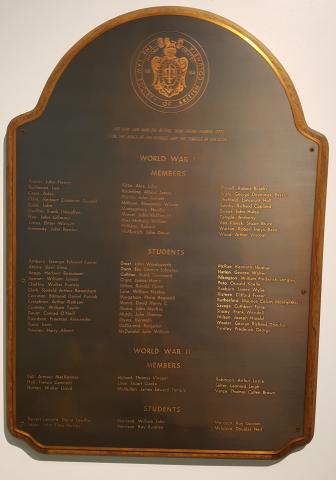
Bonze plaque
War or Conflict Term
Province
!4v1622559424298!6m8!1m7!1s5Vx78fzn8HacFnYwjmhwrw!2m2!1d49.27764767501567!2d-123.115851876021!3f292.61439850438665!4f10.869269641467312!5f1.1682883285857088
Body Content

On Nov 9, 2018 the Law Society of British Columbia rededicated a plaque honoring Law Society members and students who made the ultimate sacrifice serving our country in the First World War and the Second World War. The bronze "Honor Roll" plaque was originally commissioned in 1961 and lists each lawyer and student killed during the two wars. It was moved to it's present and more prominent location in Nov 2018.

City
Vancouver
Country
Type Description
Plaque
Photo Credit
Shelly Krueger
Memorial CF Legacy ID
10150
City/Municipality
Vancouver
Memorial Number
59026-035
Type
Address
1650 Burrard Street
Location
Seaforth Armouries
in Canada
Yes
GPS Coordinates
49.2708602, -123.1454417
Inscription

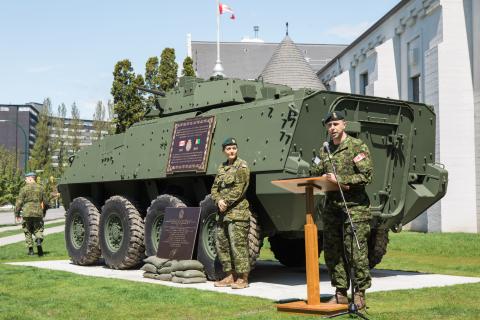
In recognition and memory of the efforts of approximately 40,000 Canadian Armed Forces personnel who served and the 162 Canadians who died in the cause of bringing peace and freedom to the people of Afghanistan.

Canada Company 2015


Image
Photo Credit
Rod Hoffmeister
Caption
Dedication Ceremony
War or Conflict Term
Province
!4v1622558937115!6m8!1m7!1sW7f-ezGUTxm-9T6soplumQ!2m2!1d49.27086021438655!2d-123.1454417233818!3f85.66101686379133!4f1.5610550851552034!5f1.5265194391476422
Body Content

The Seaforth Highlanders of Canada are Vancouver's Infantry Regiment and the Seaforth Armouries has served as their home since the mid 1930's.

On May 6, 2017, the Commander of 39 Canadian Brigade, Colonel Dave Awalt, hosted the dedication ceremony of the LAV III Monument. The monument serves as special recognition of approximately 500 members of 39 Brigade who served in Afghanistan and in particular to the two members who died in that conflict.


City
Vancouver
Country
Type Description
Canada Company LAV III Monument
Memorial CF Legacy ID
9613
City/Municipality
Vancouver
Memorial Number
59026-034
Type
Address
Burrard Street and W 15th Avenue
Location
Canadian Memorial United Church
in Canada
Yes
GPS Coordinates
49.2580818, -123.1459623
Inscription

"HE LOVED US AND GAVE HIMSELF FOR US."

DAVID

TIMOTHY

ERECTED BY Mrs C.W.ROGERS, OF VICTORIA. WHOSE LATE HUSBAND
BROUGHT LOVING SERVICE TO CANADIAN SOLDIERS IN THE WORLD WAR.

Image
Photo Credit
Canadian Memorial United Church and Centre for Peace
Caption
Chancel Window
War or Conflict Term
Province
!4v1622487793072!6m8!1m7!1sBhTo-GoGMRoV-vQ0me-CTw!2m2!1d49.25808175008721!2d-123.1459623271083!3f226.2479404422196!4f8.907012790348716!5f1.4499580245881227
Body Content

Canadian Memorial Chapel was born in the hearts of private soldiers in the First World War who, guided by a sergeant, formed a working party to bury six of Canada's war dead. On a November night of 1915, in the Ypres Salient, France, one of the soldiers said to Reverend Lieutenant-Colonel (Lt.-Col.) George Fallis, CBEEDDD: "Padre, after the war is over some chaplain should build a memorial in Canada in memory of fellows like these who have given their all." From that moment on, he would never lay away their beloved dead without the idea of a memorial chapel in his mind.

On his return to Canada he was advised by Reverend S.D. Chown, DD, General Superintendent of the Methodist Church, to go to Vancouver and choose a site in Shaughnessy Heights facing the eternal hills to erect the chapel of his dreams. He arrived in Vancouver in May 1920, to a willing congregation and plans were quickly laid. 

After Lt.-Col. Fallis travelled across Canada to secure subscriptions for each Provincial Window, he was invited by the Honourable John Oliver, Premier of British Columbia, to take prayers at the opening of Parliament in Victoria. After the speech from the throne was read by the Lieutenant-Governor, the house adjourned and everyone proceeded to the Empress Hotel for tea. An old friend of Lt.-Col. Fallis, a leading business man from Vancouver, was pushing his way through the crowd. Lt.-Col. Fallis was his Padre in 1915. He was very drunk, shouted to the crowd and made an embarrassing speech. Whispering, Lt.-Col. Fallis asked if there would be a drink for him back in his hotel room and once inside he insisted his friend sleep off the intoxication. This incident would have a sequence of great importance.

Lt.-Col. Fallis was asked to have dinner with Mrs. Leah Rogers. She had observed the way Lt.-Col. Fallis had treated the drunken man in the lobby and wanted to make his acquaintance. At dinner, he discovered she was the wife of Charles Rogers, who had made himself well-known in the manufacture of chocolates from a secret recipe. Her husband sent thousands of pounds of his choice candy to British Columbia soldiers overseas. He told Mrs. Rogers, a loyal Presbyterian, of his dream about Canadian Memorial Chapel. The next evening Mrs. Rogers called from Victoria, asking if she flew to Vancouver could she see the progress of the Chapel. In the morning he met her at the airport then had her to his home for breakfast.

Mrs. Rogers said: "My husband was so deeply interested in soldiers. I feel I should like to do something to help you." Up to this time no provision had been made for the erection of the Chancel Window which was to be the supreme motif of the chapel, depicting the sacrifices made by those who had laid down their lives in the war. Furthermore, the pulpit, which was to be hand carved oak, had not been underwritten. Lt.-Col. Fallis suggested that she might be responsible for the pulpit. She answered: "I think I would rather donate the Chancel Window."

Chancel Window focuses on sacrifice and young adulthood. The central figure is Christ on the cross with a grapevine in the background, both being symbols of sacrifice. On the immediate left is the figure of Mary, Mother of Jesus, and on the right is the disciple John. On the extreme left with a sling in his hand is David, the shepherd boy, and on the extreme right, Timothy in full armour, symbolic of the armour of God. The bottom panels depict Samuel being anointed by Eli, and Stephen, the first Christian martyr, being crowned. Between these two panels is the Last Supper.

City
Vancouver
Country
Type Description
Stained Glass Window
Memorial CF Legacy ID
9612
City/Municipality
Vancouver
Memorial Number
59026-032
Type
Address
Burrard Street and W 15th Avenue
Location
Canadian Memorial United Church
in Canada
Yes
GPS Coordinates
49.2580818, -123.1459623
Inscription

[memorial tablet/tablette]
THEY SHALL NOT GROW OLD, AS
WE WHO ARE LEFT GROW OLD.
AGE SHALL NOT WITHER THEM
NOR THE YEARS CONDEMN.
WITH THE COME DOWN OF THE
SUN AND IN THE MORNING
WE WILL REMEMBER THEM.

1914         1918

Erected by the Hon. and Mrs. S.L. Howe.

Image
Photo Credit
Canadian Memorial United Church and Centre for Peace
Caption
First World War Book of Remembrance, 1917
1 of 6 images
Image
Photo Credit
Canadian Memorial United Church and Centre for Peace
Caption
First World War Book of Remembrance, 1914 - 1916
1 of 6 images
Image
Photo Credit
Canadian Memorial United Church and Centre for Peace
Caption
Books of Remembrance and Memorial Tablet
1 of 6 images
Image
Photo Credit
Canadian Memorial United Church and Centre for Peace
Caption
First and Second World Wars Books of Remembrance
1 of 6 images
Image
Photo Credit
Canadian Memorial United Church and Centre for Peace
Caption
First World War Book of Remembrance, 1918 - 1922
1 of 6 images
Image
Photo Credit
Canadian Memorial United Church and Centre for Peace
Caption
Books of Remembrance
1 of 6 images
Province
!4v1622487793072!6m8!1m7!1sBhTo-GoGMRoV-vQ0me-CTw!2m2!1d49.25808175008721!2d-123.1459623271083!3f226.2479404422196!4f8.907012790348716!5f1.4499580245881227
Body Content

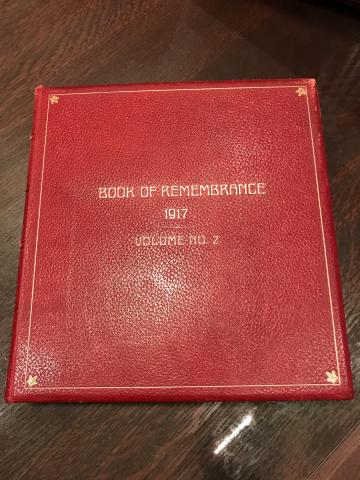
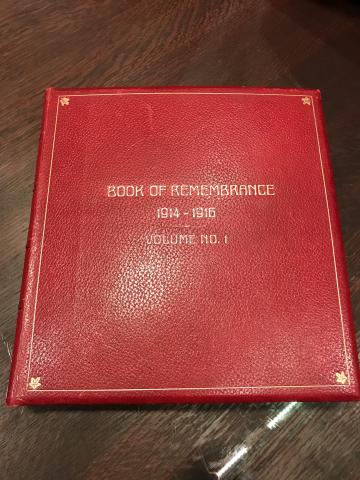
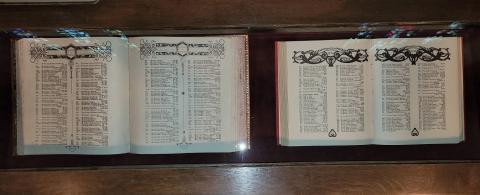
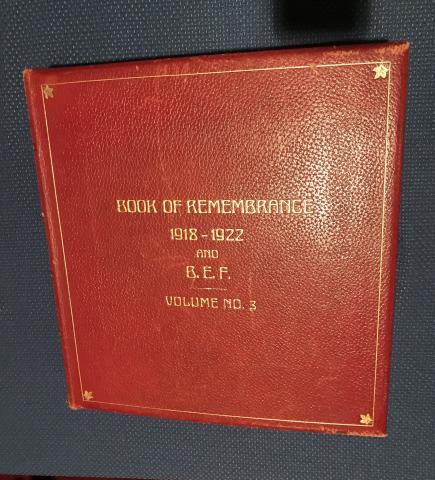
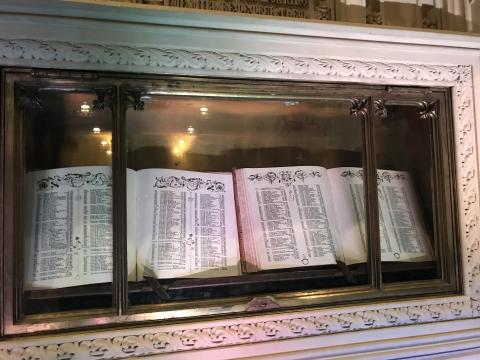
On display in Canadian Memorial United Church are the only replicas of the Books of Remembrance outside of those housed in the Peace Tower in Ottawa. The books contain the names of all Canadians who made the supreme sacrifice in the First and Second World Wars, Korean War and include a book for Newfoundland and a book for Merchant Marines. 

A large decorative tablet was to contain the niche to enclose the Book of Remembrance, architect R.P. Twizell had put a great deal of time and thought into the design. It would contain the Book of Remembrance upon the pages of which would be inscribed the names of those who lost their lives with the Canadian Forces in the First World War. Reverend Lieutenant-Colonel George Fallis, CBE, ED, DD, interviewed the Honourable Samuel L. Howe, one of the great public-spirited pioneers of British Columbia, to see if he would erect the tablet. With the architect’s drawings in hand they stood in the chancel where the decorative tablet would be erected. Honourable Howe revealed the greatness of his manhood when he said: "Do you think I am worthy to do this?" Finally he said: "I shall be honoured to do as you request, but I make one stipulation, that it shall be beautiful, and worthily done." Reverend Lieutenant-Colonel Fallis’ notes state that the Honourable Samuel Howe had a son that died in the war, but no evidence can be found to support this.

The Book of Remembrance for the First World War was presented at a service on November 1, 1946, by the Honourable Douglas Abbott, then Minister for National Defence. E.R. McTaggart and Matthew Sutton received the treasured volume on behalf of the Board of Trustees, and Reverend G. Harrison Villett, BA, DD, placed it on the High Altar. The Books for the Second World War were presented on March 8, 1959, by the Honourable George Pearkes, VC.

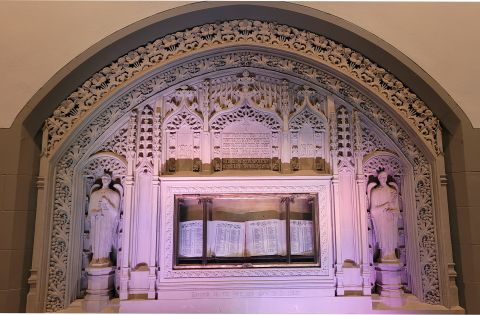
The Books are on view at all times in the carved Memorial Tablet at the front of the church. More of these books are housed in the table in either the east or west transept. The tablet was carved from a block of Caen stone - a stone used in many cathedrals - by Thomas Garrow. On either side of The Books, as if guarding them, appear the angels Michael and Gabriel, angels of Justice and Peace. The outer border interweaves the maple leaf and the poppy. The inner border is a grape vine, representing sacrifice. Behind the angels of Peace and Justice are a rose, thistle, shamrock, and fleur-de-lis, representative of Canada’s settlers.

City
Vancouver
Country
Type Description
Books of Remembrance, tablet
Photo Credit
Canadian Memorial United Church and Centre for Peace
Memorial CF Legacy ID
9136
City/Municipality
Vancouver
Memorial Number
59026-031
Type
Address
2896 West 6th Avenue
Location
Corner of West 6th Avenue and Bayswater Street
in Canada
Yes
GPS Coordinates
49.2662577, -123.1711739
Inscription

[sign/signe]

General Gordon School

Image
1 of 3 images
Image
1 of 3 images
Image
1 of 3 images
Province
!4v1622556237581!6m8!1m7!1sK0wLQm6_nsRkDgkA6F3K3A!2m2!1d49.26625774406894!2d-123.1711738845183!3f87.61844264658381!4f3.138979091998962!5f1.180763587039448
Body Content

This school, General Gordon Elementary School, is named in honour of Major-General Charles George Gordon, CB. The school was built in 1912 on the corner of West 6th Avenue and Bayswater Street in Vancouver.

Major-General Charles George Gordon, CB (January 1833 – January 1885) was born in England and commissioned into the Royal Engineers in 1852. Upon completion of his training, he was assigned to oversee the construction of fortifications in Wales but soon saw service in the Crimean War, returning to England in 1858. In 1860, he volunteered for service in China where he and his men were instrumental in putting down the Taiping Rebellion, regularly defeating much larger forces. For these accomplishments, he was appointed a Companion of the Order of the Bath (CB) and promoted to Lieutenant-Colonel before returning to England in 1864. With British Government approval, in 1873 he entered service with the Egyptian Army and returned to Europe in 1880. In the early 1880’s a serious revolt broke out in the Sudan and Gordon was sent to Khartoum in 1884 to secure the evacuation of loyal soldiers and civilians, and depart with them. After evacuating about 2,500 British civilians he retained a smaller group of soldiers and non-military men. Besieged by the rebel forces, Gordon organized a city-wide defense lasting almost a year that gained him the admiration of the British public, though not the government, which had not wished to become involved. Only when public pressure to act had become too great was a relief force, known as the Nile Expedition, reluctantly sent. It arrived two days after the city had fallen and Gordon had been beheaded.

City
Vancouver
Country
Type Description
Building; school
Memorial CF Legacy ID
9185