Other

City/Municipality
Aurora
Memorial Number
35092-009
Type
Address
14659 Yonge Street
Location
Aurora War Memorial Peace Park
in Canada
Yes
GPS Coordinates
43.9854224, -79.4640745
Inscription

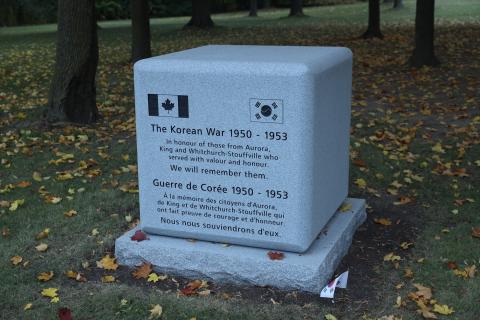
The Korean War 1950 - 1953

In honour of those from Aurora,
King and Whitchurch-Stouffville who
served with valour and honour.

We will remember them.

Guerre de Corée 1950 1953

À la mémoire des citoyens d’Aurora,
de King et de Whitchurch-Stouffville qui
ont fait preuve de courage et d’honneur.

Nous nous souviendrons d’eux.

Image
Caption
Korean War Memorial
War or Conflict Term
Province
!4v1706035249302!6m8!1m7!1sL_DF-cQ3u9D4soh1rGxGUQ!2m2!1d43.98542236699287!2d-79.46407446464013!3f106.71467597532762!4f-5.097794690880988!5f3.325193203789971
Body Content

The Korean War Memorial was erected on March 5, 2023 as a collaborative effort between the Towns of Aurora and Stouffville, and the Township of King. It was designed by Alex Theaker, an Aurora resident who won the contest held to select the memorial's design.

The solidity and stability of the granite reflects the longstanding commitment that the Canadian Armed Forces has observed in its defense of those in need. Its permanence also reflects the desire to communicate the sacrifice that was made for future generations, however many years removed. The dual flags, represented in their true ratios, placed equally, show the mutual respect that Canada and South Korea share, as well as our shared responsibility to preserve the memory of those lost.

Lake Wilcox (Oak Ridges) and Whitchurch-Stouffville responded to the call and volunteered for service in Korea. A total of 20 local boys served in the war. Of the 20 identified, 11 were from Aurora, 4 from King, 4 from Lake Wilcox and 1 from Newmarket. Two from Lake Wilcox were wounded in action. Four from the Whitchurch-Stouffville area served in the war, three returned home but sadly, one did not. Trooper Joseph Raymond Bell, age 20 of Stouffville, died of wounds incurred during battle on June 6, 1953. 

City
Aurora
Country
Type Description
Slab - granite
Photo Credit
Town of Aurora
Memorial CF Legacy ID
12214
City/Municipality
Aurora
Memorial Number
35092-008
Type
Address
14659 Yonge Street
Location
Aurora War Memorial Peace Park
in Canada
Yes
GPS Coordinates
43.9854085, -79.4636631
Inscription

[front/devant]
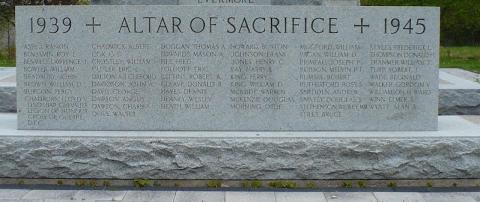
1939 + ALTAR OF SACRIFICE + 1945

  • (column 1/colonne 1)
  • ASH, J. RANKIN
  • BENJAMIN, ROY E.
  • BENVILLE, LAWRENCE J.
  • BOWLER, WILLIAM
  • BRADBURY, JOHN
  • BROWN, WILLIAM D.
  • BURGON, PERCY
  • CHADBURN, LLOYD V.
  • DSO/BAR CHEVALIER
  • LEGION OF HONOUR
  • CROIX DE GUERRE,
  • D. F. C.
  • (column 2/colonne 2)
  • CHADWICK, ALBERT
  • COX, G. D.
  • CROSSLEY, WILLIAM
  • CUTLER, ERIC E.
  • DALTON, A. B. CLIFFORD
  • DAVIDSON, JOHN A.
  • DAVIS, GEORGE
  • DAWSON, ANGUS
  • DAWSON, CHARLES
  • DOVE, WALTER
  •  
  •  
  • (column 3/colonne 3)
  • DUGGAN, THOMAS A.
  • EDWARDS, MASON A.
  • FIFE, FRED
  • FOLLIOTT, ERIC
  • GITTINS, ROBERT B.
  • GLEAVE, DONALD R.
  • HAYES, DENNIS
  • HEANEY, WESLEY
  • HEATH, WILLIAM
  •  
  •  
  •  
  • (column 4/colonne 4)
  • HOWARD, BURTON
  • JOHNSON, FRANK
  • JONES, HENRY C.
  • KAY, HARRY L.
  • KING, PERRY
  • KING, WILLIAM D.
  • MCBRIDE, WARREN
  • MCKENZIE, DOUGLAS
  • MORNING ORLIE
  •  
  •  
  •  
  • (column 5/colonne 5)
  • MUGFORD, WILLIAM
  • PAGAN, WILLIAM D.
  • PRIMEAU, JOSEPH P.
  • ROBSON, MELVIN P. F.
  • RUMBLE, ROBERT
  • RUTHERFORD, ROSS S.
  • SNEDDEN, ANDREW
  • SNIVELY, DOUGLAS S.
  • STEPHENSON, WESLEY, MM
  • STILES, BRUCE
  • (column 6/colonne 6)
  • STYLES, FREDERICK L.
  • THOMPSON, DONALD H.
  • TRANMER, WILLIAM T.
  • TURP, ROBERT J.
  • WADE, REGINALD
  • WALKER, GORDON V.
  • WILLIAMSON, H. WARD
  • WINN, ELMER S.
  • WYATT, ALAN A.

[right side/côté droit]
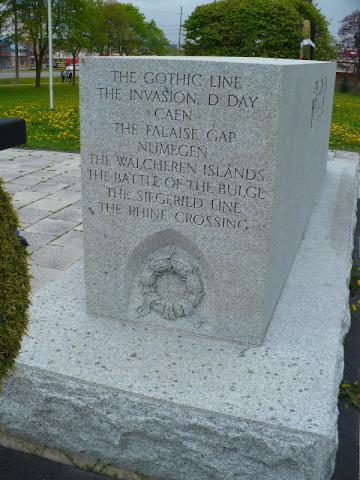
THE GOTHIC LINE
THE INVASION, D DAY
CAEN
THE FALAISE GAP
NIJMEGEN
THE WALCHERN ISLANDS
THE BATTLE OF THE BULGE
THE SIEGFRIED LINE
THE RHINE CROSSING

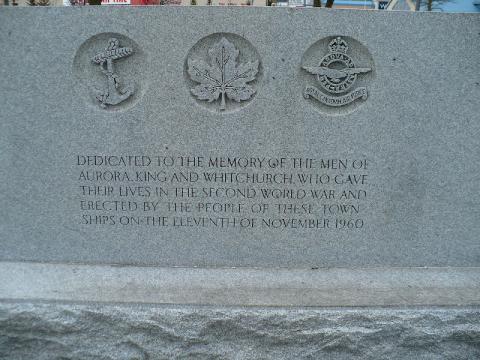
[back/arrière]
DEDICATED TO THE MEMORY OF THE MEN OF
AURORA, KING AND WHITCHURCH, WHO GAVE
THEIR LIVES IN THE SECOND WORLD WAR AND
ERECTED BY THE PEOPLE OF THESE TOWN-
SHIPS ON THE ELEVENTH OF NOVEMBER 1960

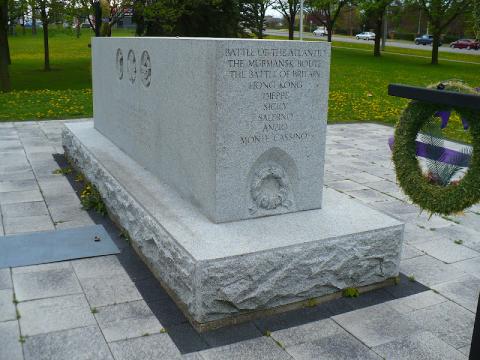
[left side/côté gauche]
BATTLE OF THE ATLANTIC
THE MURMANSK ROUTE
THE BATTLE OF BRITAIN
HONG KONG
DIEPPE
SICILY
SALERNO
ANZIO
MONTE CASSINO

Image
Photo Credit
Tim Laye, Ontario War Memorials
Caption
Altar of Sacrifice
1 of 4 images
Image
Photo Credit
Tim Laye, Ontario War Memorials
Caption
left side
1 of 4 images
Image
Photo Credit
Tim Laye, Ontario War Memorials
Caption
back
1 of 4 images
Image
Photo Credit
Tim Laye, Ontario War Memorials
Caption
right side
1 of 4 images
War or Conflict Term
Province
!4v1644939121071!6m8!1m7!1sCAoSK0FGMVFpcE1yb2RZMC05SmlSdjJOcWRFSU5jSXdTNnpPcVp2U05pd1B2anM.!2m2!1d43.98540851130075!2d-79.46366306394339!3f57.50489445482103!4f0!5f0.7820865974627469
Body Content

On November 9, 1960, Lieutenant-Governor J. Keiller Mackay, DSO, unveiled the granite Altar of Sacrifice which was erected to salute those 55 men who died during the Second World War.

The Aurora War Memorial Board, a non-profit organization which was incorporated in 1925 takes full responsibility for the upkeep, financial records and promotion of the Aurora War Memorial and Altar of Sacrifice.

City
Aurora
Country
Type Description
Altar
Memorial CF Legacy ID
10770
City/Municipality
Aurora
Memorial Number
35092-005
Type
Address
15800 Yonge Street
Location
St. Andrew's College Chapel
in Canada
Yes
GPS Coordinates
44.0115201, -79.4763423
Inscription

At the entrance of the Memorial Chapel:

AD MAIOREM DEI GLORIAM

Image
Photo Credit
David D. Stewart
Caption
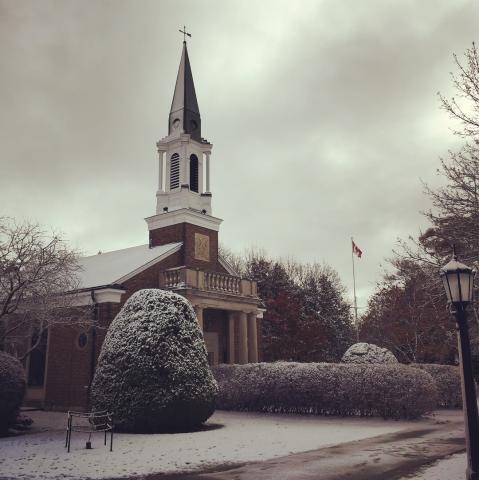
The Memorial Chapel, First Snow, Fall 2017
1 of 6 images
Image
Photo Credit
David D. Stewart
Caption
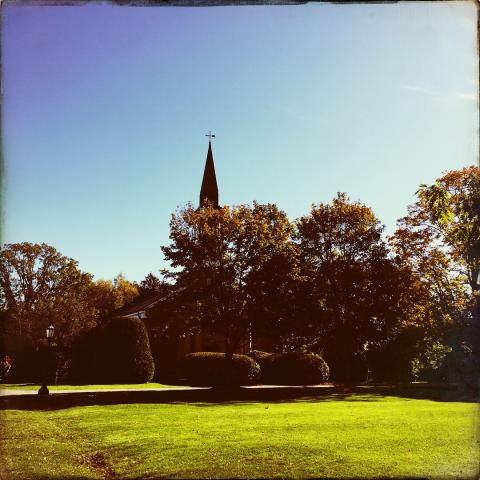
The Memorial Chapel, Spring 2017
1 of 6 images
Image
Photo Credit
David D. Stewart
Caption
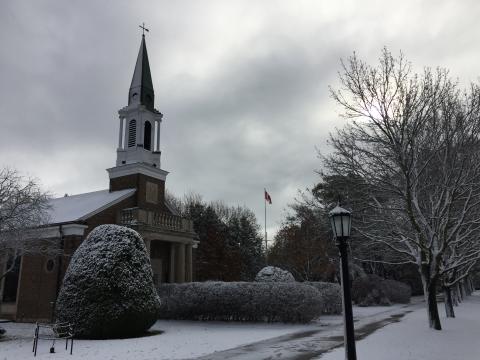
The Memorial Chapel First Snow, November 2017
1 of 6 images
Image
Photo Credit
Paul Mosey
Caption
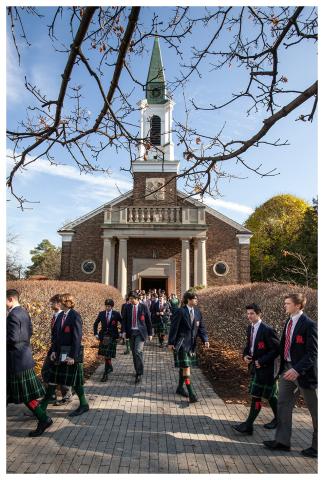
St. Andrew's College students departing from the Memorial Chapel Remembrance Day, 2014
1 of 6 images
Image
Photo Credit
David D. Stewart
Caption
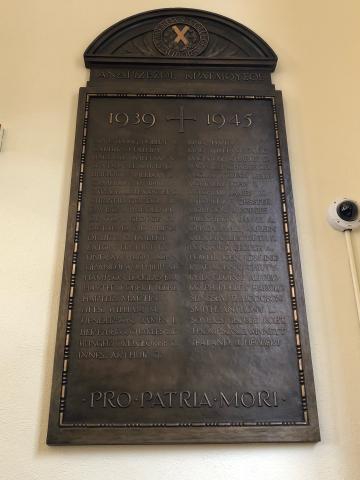
Second World War Plaque
1 of 6 images
Image
Photo Credit
David D. Stewart
Caption
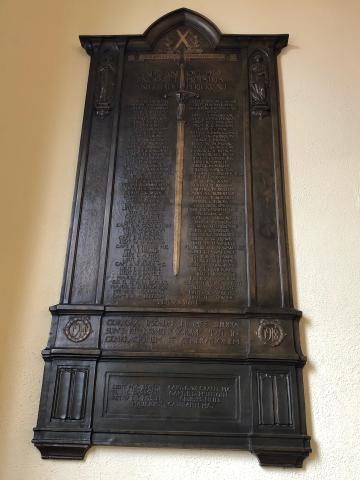
Fierst World War Plaque
1 of 6 images
Province
!4v1622826277675!6m8!1m7!1sCAoSLEFGMVFpcFBZN1ZfSTZlUVlwSTg1YndYZkZsT0JxajdQZGJVLXh5VHhZbXlx!2m2!1d44.01152009747607!2d-79.47634232547045!3f73.77032824286057!4f18.957433158027925!5f0.6602751988028404"
Body Content
Chapel services have been central to community life at St. Andrew's College since its founding in 1899. Founded by Presbyterian clergy and laymen, St. Andrew’s is dedicated to offering a solid education “in a manly spirit of Christianity” developing “the complete man, the well-rounded citizen” by “encouraging a healthy balance in mind, body, heart, and spirit.”

When the Rev. D. Bruce Macdonald became Principal (later Headmaster) in 1900, he began to build the School with the philosophy of the Thomas Arnold of Rugby School, that character development was the objective of all education. Accordingly, his idea of education consisted of the study of the classics, along with sport, the Prefectorial system, and “religion, to provide an ethical system for life as a muscular Christian.”

Dr. Macdonald carried the pastoral responsibilities of Chaplain himself. He conducted morning services with readings from Scripture and prayers. “Evening prayers took place after the evening meal. He conducted a Bible Class on Sunday afternoons. All the boarders were expected to attend the church of the denomination to which their parents belonged.” There was a Sunday Chapel service at night where Dr. Macdonald preached.

Over the decades, religious life at St. Andrew's has changed. There has been a succession of Chaplains of various denominations, and the services have become more responsive to changes in society, becoming less formal and including debates, discussions, concerts, and student sermons.

Today, as the student body has become more religiously diverse, elements from other faiths, prayers, and readings have been added. Efforts have been made to make the time more inclusive of the whole community, by encouraging involvement by both students and teachers.

Throughout the history of St. Andrew’s, Chapel services have been conducted in a variety of venues, including the billiards room of the original Chestnut Hall in Toronto. When the move from Rosedale to Aurora was being planned, the construction of a Chapel was included in the original plans. However, the Memorial Chapel was not completed until 1931, five years after the School opened. Services were held for five years in a section of the library, which was set up like a meeting hall.

Sir Joseph Flavelle, then Chairman of the Board, contributed $70,000 toward the building of the Chapel. It was designed by E. H. Paisley, formally of Marani and Paisley, the School's original architects. It is in the Georgian style and modelled on the churches of Sir Christopher Wren with a twisted red brick steeple, 94-feet in height. A portico with heavy stone pillars stands at the west front. The entrance is framed in plain stone with the Jesuit motto, "Ad Maiorem Dei Gloriam" ("To the greater glory of God") above the door. It seats approximately 300 people. The interior is simple and dignified, with large windows providing an abundance of light. The chancel is panelled with walnut and gum-wood. It is called the Memorial Chapel in memory of the 106 Andreans who gave their lives in the First World War – 104 Old Boys and two Masters. A commemorative tablet bearing their names was originally placed in the chancel close to the communion table.

The foundations of the Chapel were laid in March 1930, and it was consecrated on Sunday, May 10, 1931, before it was completely finished. Canon Henry John Cody took the first service and dedicated the Chapel. Master Percy Robinson read the names of those who had died. The Headmaster, the Rev. D. Bruce Macdonald, preached about common responsibilities to which the ideals of the Chapel point.

Following the Second World War, another commemorative tablet was added to the Chapel with the names of the 45 Andreans who died in that war. The First World War tablet was moved from the chancel so that the two tablets were on either side of the chancel. Later, during the tenure of Headmaster Tom Hockin, a large fabric hanging, which included stylized figures reaching up to God and the decussate cross of St. Andrew's in the background, was hung over the communion table.

At the back of the Chapel are flags representing the various countries from which Andreans have come from over the years. In the corner is the flag of the #142 St. Andrew’s College Highland Cadet Corps. Throughout the Chapel are plaques memorializing people who have contributed significantly to the Andrean community, along with memorabilia from the First World War.

Excerpts taken from “Not an Ordinary Place,” the historical account of St. Andrew’s College (1999).

City
Aurora
Country
Type Description
Building
Photo Credit
David Stewart
Memorial CF Legacy ID
10073
City/Municipality
Aurora
Memorial Number
35092-004
Type
Address
14659 Yonge Street
Location
Aurora Peace Park
in Canada
Yes
GPS Coordinates
43.9854627, -79.4640451
Inscription

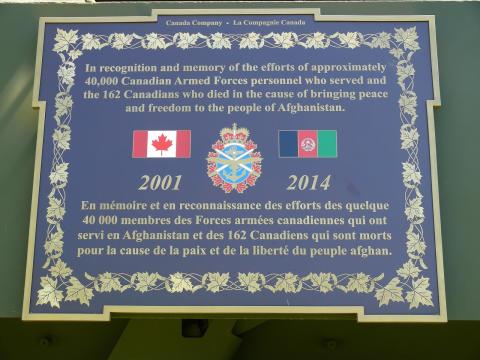
[plaque]

Canada Company •  La Compagnie Canada

In recognition and memory of the efforts of approximately
40,000 Canadian Armed Forces personnel who served and
the 162 Canadians who died in the cause of bringing peace
and freedom to the people of Afghanistan.

2001     2014

En mémoire et en reconnaissance des efforts des quelque
40 000 membres des Forces armées canadiennes qui ont
servi en Afghanistan et des 162 Canadiens qui sont morts
pour la cause de la paix et de la liberté du peuple afghan.

[plaque]

We, the citizens of the Town of Aurora, in gratitude for their service and sacrifice, dedicate this memorial to the members of all branches of the Canadian Armed Forces and especially to our own Queen’s York Rangers (1st American Regiment) (RCAC).

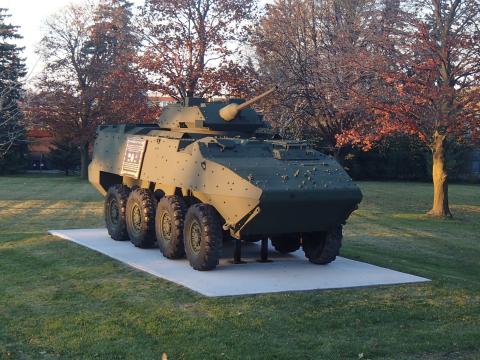
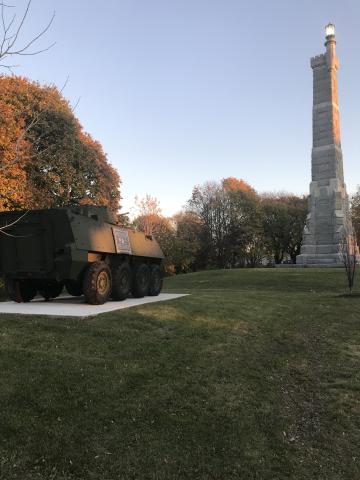
The LAV III (Light Armoured Vehicle) was of the type used by Canadian Forces troops in Afghanistan until the completion of their mission in 2014. It symbolizes their efforts in Afghanistan and in other peacekeeping missions for which Canadian troops have become renowned.

The Queen’s York Rangers were granted a Battle Honour by the Government of Canada in 2014 for their efforts and contributions in Afghanistan. The Regiment is based in Toronto and Aurora.

Image
Photo Credit
Jim Kyle
Caption
surroundings
1 of 4 images
Image
Photo Credit
Jim Kyle
Caption
LAV III Memorial
1 of 4 images
Image
Photo Credit
Jim Kyle
Caption
surroundings
1 of 4 images
Image
Photo Credit
Tim Laye, Ontario War Memorials
Caption
plaque
1 of 4 images
War or Conflict Term
Province
!4v1622825971013!6m8!1m7!1sambr5NxA4bsdHJbljj-XtA!2m2!1d43.9854519348659!2d-79.46404218772423!3f63.300279416885296!4f1.1539842590772196!5f3.325193203789971
Body Content

The Town of Aurora, with support of the Queen's York Rangers (1st American Regiment, RCAC) and Royal Canadian Legion Branch 385 recognized the completion of the Canadian Armed Forces longest conflict in Afghanistan, on Remembrance Day 2017, with the dedication of a Light Armoured Vehicle (LAV) memorial

Light Armoured Vehicle (LAV) III were originally manufactured by Canadians at General Dynamics Land Systems Canada in London, Ontario and were instrumental to troops in carrying out their missions while in Afghanistan. The monuments were created from decommissioned LAV III hulls, donated by the Government of Canada and built by Militex Coating Inc. and Fanshawe College students in London, Ontario.

On November 5, 2014, the Canada Company Light Armoured Vehicle (LAV) lll Monument Program was launched to recognize the 40,000 Canadians Armed Forces who served in Afghanistan and to commemorate the 162 Canadians who lost their lives. The program closed after awarding 33 monuments to communities across Canada.

The monument complements the existing Aurora War Memorial and Altar of Sacrifice by commemorating the efforts in Afghanistan, for which the Queen's York Rangers were granted a Battle Honour.

City
Aurora
Country
Type Description
Vehicle - LAV III
Memorial CF Legacy ID
9724
City/Municipality
Aurora
Memorial Number
35092-003
Type
Address
89 Mosley Street
Location
In front of the Aurora Armoury
in Canada
Yes
GPS Coordinates
43.999111, -79.4617542
Inscription

[Plaque/Plaque]

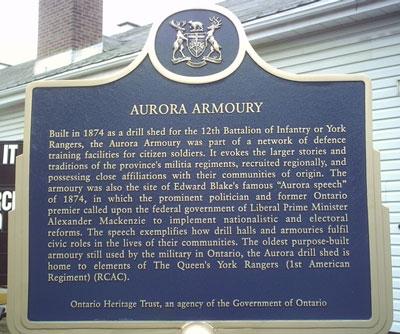
AURORA ARMOURY

Built in 1874 as a drill shed for the 12th Battalion or Infantry or York
Rangers, the Aurora Armoury was part of a network of defence
training facilities for citizen soldiers. It evokes the larger stories and
traditions of the province's militia regiments, recruited regionally, and
possessing close affiliations with their communities of origin. The
armoury was also the site of Edward Blake's famous "Aurora speech"
of 1874, in which the prominent politician and former Ontario
premier called upon the federal government of Liberal Prime Minister
Alexander Mackenzie to implement nationalistic and electoral
reforms. The speech exemplifies how drill halls and armouries fulfil
civic roles in the lives of their communities. The oldest purpose-built
armoury still used by the military in Ontario, the Aurora drill shed is
home to elements of The Queen's York Rangers (1st American
Regiment)(RCAC).

Ontario Heritage Trust, an agency of the Government of Ontario

Image
Photo Credit
and Lauren Roberts (www.ontarioplaques.com)
Caption
Building and plaque
1 of 2 images
Image
Caption
Plaque
1 of 2 images
Province
!4v1622825631644!6m8!1m7!1sglXDMW6VL5cTaY72GFemYg!2m2!1d43.99911104455847!2d-79.46175423692497!3f239.60726016427375!4f-4.8983536166603585!5f3.325193203789971"
Body Content

This memorial commemorates the history of the Aurora Armoury site. The plaque was erected by the Ontario Heritage Trust, an agency of the Government of Ontario. Please read the plaque inscription for more details.

City
Aurora
Country
Type Description
Building and provincial plaque
Photo Credit
and Lauren Roberts (www.ontarioplaques.com)
Memorial CF Legacy ID
8350
City/Municipality
Woodbridge
Memorial Number
35092-002
Type
Address
Memorial Hill Drive
Location
Woodbridge War Memorial and Park
in Canada
Yes
GPS Coordinates
43.7825067, -79.593582
Inscription

[front of Tower/façade de la tour]

(plaque)
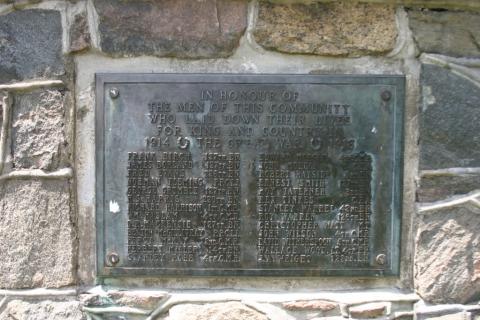
IN HONOUR OF
THE MEN OF THIS COMMUNITY
WHO LAID DOWN THEIR LIVES
FOR KING AND COUNTRY IN
1914  THE GREAT WAR  1918

  • FRANK BIRCH  127th.BN.
  • JAMES BORLAND  127th.BN.
  • FRED EVANS  226th.BN.
  • NORMAN FLEMING  P.P.C.L.I.
  • GEORGE GRUMBLE   127th.BN.
  • H.S. HARRIS  220th.BN.
  • RICHARD HARRISON  1st. C.M.R.
  • WM. HASLAM  4th C.M.R.
  • D.R. MACKENZIE   127th.BN.
  • BEATON McGILLIVRAY  P.P.C.L.I.
  • PERCY McKAY  2nd C.M.R.
  • HERBERT MILLER  14th.BN.
  • STANLEY ROBB  4th C.M.R.
  • EDWARD MORGAN  4th C.M.R.
  • JOHN MORGAN  C.F.A.
  • ROBERT RAYSIDE  3rd.BN.
  • ERNEST SMITH   127th.BN.
  • ROY TAVERNER  3rd.BN.
  • REX TINKES  C.F.A.
  • STANLEY WARREL  42nd.BN.
  • ROY WARREN  126th.BN.
  • CHRISTOPHER WATT  M.T.
  • JOHN WILSON  4th C.M.R.
  • DAVID WITHERSPOON  5th C.M.R.
  • WALLACE WOOD, LT.  4th.BN.
  • J.A. WRIGHT  123rd.BN.

(carved in the stone/gravée dans la pierre)

This tower is erected in grateful memory of the men who gave their lives in the Great War,
and also of those who, daring to die, were spared to return to the native land.
We shall remember with pride, Ypres, Festubert, Lens, Sanctuary Wood, The Somme,
Vimy Ridge, Passchendaele, Amiens, Arras, Cambria-Drocourt, Queant Line,
Bourlon Wood, Valenciennes, and Mons.

[back of Tower]
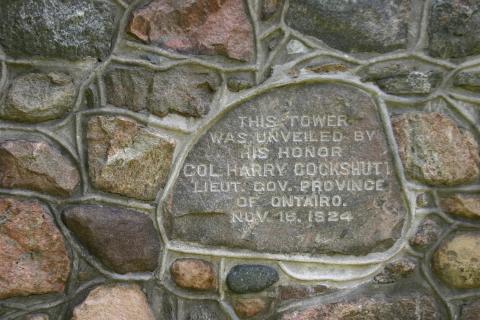
THIS TOWER
WAS UNVEILED BY
HIS HONOR
COL. HARRY COCKSHUTT
LIEUT. GOV. PROVINCE
OF ONTARIO
NOV. 16, 1924

[stele/stèle]

(front/devant)
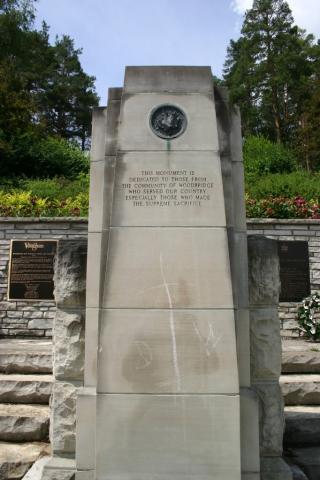
THIS MONUMENT IS
DEDICATED TO THOSE FROM
THE COMMUNITY OF WOODBRIDGE
WHO SERVED OUR COUNTRY.
ESPECIALLY THOSE WHO MADE
THE SUPREME SACRIFICE

(back/arrière)
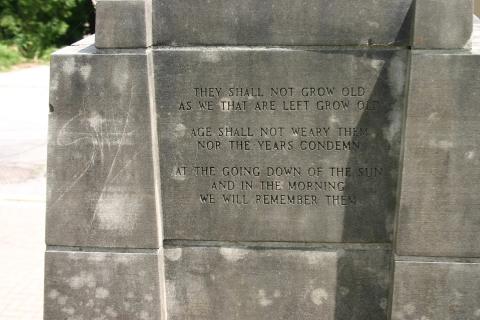
THEY SHALL NOT GROW OLD
AS WE THAT ARE LEFT GROW OLD

AGE SHALL NOT WEARY THEM
NOR THE YEARS CONDEMN

AND AT THE GOING DOWN OF THE SUN
AND IN THE MORNING
WE WILL REMEMBER THEM

[wall/mur]

(plaque)
City of
Vaughan

WOODBRIDGE WAR MEMORIAL TOWER AND PARK SITE
1924
Designated under the Ontario Heritage Act

The Woodbridge War Memorial Tower was constructed in 1924 by
volunteer members of the community in honour of the supreme
sacrifice made by the 26 men from the Woodbridge area killed in the
First World War (1914-1918).

The site is designed in four stepped levels; the highest level is
occupied by the Tower. A dome beacon light is located at the apex
of the Tower and German field guns are found in close proximity to
the Tower.

The Tower was officially unveiled by His Honour Colonel Harry
Cockshutt, Lieutenant-Governor of the Province of Ontario, on
November 16, 1924.

In 1995, the City of Vaughan Council approved funds for landscaping
improvements to the park area surrounding the Tower. The addiion
of stairs and ramp access to a centre-level area facilitates greater
accessibility to the park. The firm of Edwin Rowse Architect Inc.
was contracted to direct the project.

On October 19, 1996, the newly Designated park was rededicated
by the city of Vaughan Council:
Mayor Lorna D. Jackson
Regional Councillors
Micheal Di Blase
Joyce Frustagllo
Councillors
Peter Meffe, Ward 1
Tony Carella, Ward 2
Bernie DiVona, Ward 3
Mario G. Racco, Ward 4
Bernie Green, Ward 5

(plaque)
1867 1967
CENTENNIAL OF CONFEDERATION

ERECTEC BY THE
VILLAGE OF WOODBRIDGE
IN PERMANENT COMMEMORATION OF
THE CENTENNIAL
OF CONFEDERATION IN CANADA
IN 1967
CONSTRUCTION WAS MADE POSSIBLE
THROUGH THE CO-OPERATION OF
THE PROVINCE OF ONTARIO AND
THE GOVERNMENT OF CANADA
BRANCH 414 ROYAL CANADIAN
LEGION, SERVICE CLUBS, AND THE
CITIZENS OF WOODRIDGE

Image
Caption
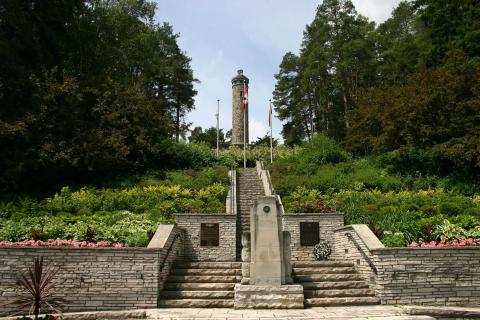
Woodbridge War Memorial Tower and Park Site
1 of 6 images
Image
Caption
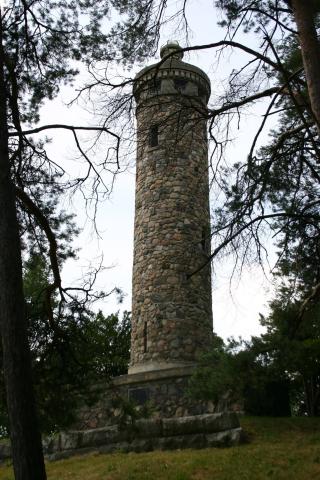
Woodbridge War Memorial Tower
1 of 6 images
Image
Caption
back stele inscription
1 of 6 images
Image
Caption
front stele inscription
1 of 6 images
Image
Caption
Inscription on back of tower.
1 of 6 images
Image
Caption
First World War Honour Roll
1 of 6 images
War or Conflict Term
Province
!4v1623933070367!6m8!1m7!1sCAoSLEFGMVFpcFB1SUROM2dwSTZYYy1CWFFVb1ZjTVdVeGdaUnA1cm9BR3hRX3Fm!2m2!1d43.78250670147473!2d-79.59358197286889!3f251.37!4f0.9599999999999937!5f0.7820865974627469
Body Content

The Woodbridge War Memorial Tower was constructed in 1924 by volunteer members of the community in honour of the supreme sacrifice made by the 26 men from the Woodbridge area killed in the First World War. The Council of Woodbridge secured Major Gibson of The Queen's Own Rifles to design a watch tower. John Johnston of Woodbridge donated the fieldstone for the tower's construction and the gravel and sand was from Robert Huston's pit. Fred Barret, a stone mason from Humbervale, near Weston (south of Woodbridge), built the Tower. It was unveiled by Colonel Harry Cockshutt, the Lieutenant-Governor of Ontario on November 16, 1924.

The site is designed in four stepped levels; the highest level is occupied by the tower. At the apex of the Tower there is a domed beacon light decorated with crenellated stonework and small window openings encircling its base. The beacon light once illuminated the surrounding area at night and could be seen from Highway No. 7. Each level is supported by a retaining wall of cut stone. The cut stone found at the highest level was salvaged from what was known as the old Humber Bridge, demolished with the widening of Highway No. 7 in 1924. The base level consists of a stone gateway and staircase, featuring an engraved stele and two plaques added later, one to commemorate Canada's 1967 Centennial Year, and the other erected by the politicians of the City of Vaughan in 1996 for agreeing to spend the funds to update and landscape the park.

Three field guns are located at the site. Two guns flank the Tower on its north and south sides and the third gun sits on the second stepped-level, next to a flag pole. The Department of Defense donated the "German Whiz Bang." The City of Toronto donated the two 6' Field Guns. These guns were made by "Krupp" in 1901 as Naval Guns and, when the British Navy bottled up the German Navy, the guns were removed from the ships and converted to field use. The council negotiated with the Canadian Pacific Railway to transport these guns to Woodbridge and, with the assistance of Mr. Snider, a local house mover, and a number of local people, enough plank sand timbers were brought to the site to build a ramp for landing the guns. The railroad then hauled the guns to the village on two flat cars.

Mr. Snider erected a ramp at the tracks. The railway company sent an engine to the village and when the tracks were clear, moved the first car to the ramp and, with the aid of Mr. Snider's winch, landed the gun on the ramp. The gun was moved to the top of the cut to clear the ramp so the second gun could be unloaded. Three or four days later another engine arrived and the second gun was moved and installed. 

The British Royal Family, to show their appreciation for the loyalty of the Canadian people, offered Oak saplings from The Green Forest. Major MacKenzie secured five of these Royal Oaks and they were carefully planted along the west boundary line.

Major Alexander A. MacKenzie was born on November 1, 1885, to Donald and Lydia Ann MacKenzie in an area of Woodbridge known as Brownsville. As a young man, Alexander enlisted in the Governor-General's Body Guards. When the war broke out in 1914, he transferred to the Fourth Canadian Rifles and, in 1915, he went overseas. In less than two years, he rose to the rank of Major because of the bravery and leadership he displayed in action at the Somme in 1916 and at the Battle of Vimy Ridge in 1917 where he was severely wounded. The Woodbridge Memorial Tower and the Woodbridge Memorial Arena, built in 1951, were two projects he felt very deeply about. His brother, Donald Ross, died in the First World War.

City
Woodbridge
Country
Type Description
Tower, stele
Photo Credit
Tim Laye, Ontario War Memorials
Memorial CF Legacy ID
5484
City/Municipality
Aurora
Memorial Number
35092-001
Type
Address
14659 Yonge Street
Location
Aurora War Memorial Peace Park
in Canada
Yes
GPS Coordinates
43.9853821, -79.4637604
Inscription

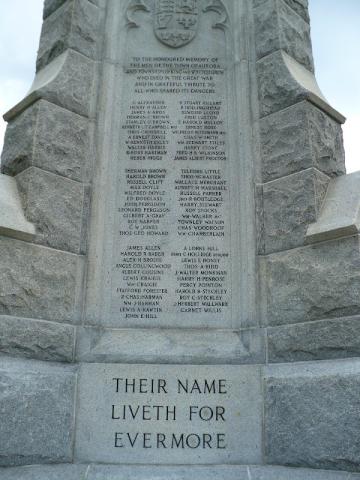
[front/devant]

1914
1919

TO THE HONOURED MEMORY OF
THE MEN OF THE TOWN OF AURORA 
AND TOWNSHIPS OF KING AND WHITCHURCH
WHO DIED IN THE GREAT WAR
AND IN GRATEFUL TRIBUTE TO
ALL WHO SHARED ITS DANGERS

  • G. ALEXANDER
  • HENRY H. ALLEN
  • JAMES A. AMOS
  • HERMAN C. BROWN
  • STANLEY G. BROWN
  • KENNETH L. T. CAMPBELL, M. C.
  • THOS. CROSSKILL
  • A. ERNEST DAVIS
  • W. KENNETH EXLEY
  • WALTER HARRIS
  • R. ROSS HARTMAN
  • HEBER HIGGS
  •  
  • SHERMAN BROWN
  • HAROLD BROWN
  • RUSSELL CLIFT
  • MAX DOYLE
  • WILFRED DOYLE
  • ED DOUGLASS
  • JOHN FERGUSON
  • LEONARD FERGUSON
  • GILBERT A. GRAY
  • ROY HARPER
  • C. W. JONES
  • THOS. GEO. HOWARD
  •  
  • JAMES ALLEN
  • HAROLD R. BABER
  • ALEX H. BRODIE
  • ANGUS COLLINGWOOD
  • ALBERT COUSINS
  • LEWIS CRAIGIE
  • WM. CRAIGIE
  • STAFFORD FORESTER
  • R. CHAS. HARMAN
  • WM. J. HARMAN
  • LEWIS A. HAWTIN
  • JOHN E. HILL
  •  
  • R. STUART HILLARY
  • R. HOLLINGSHEAD
  • ELWOOD LLOYD
  • FRED LUXTON
  • E. HAROLD MULLOY
  • ERNEST ROSE
  • WILFRED F. PETERMANN, M.C.
  • CHAS. W. SMITH
  • WM. STEWART STILES
  • HARRY STONE
  • FRED H. B. WILKINSON
  • JAMES ALBERT PROCTOR
  •  
  • TELFORD LITTLE
  • THOS. MCMASTER
  • WALLACE MERCHANT
  • AUBREY M. MARSHALL
  • RUSSELL PARKER
  • JNO. R. ROUTLEDGE
  • HARRY STEWART
  • ROY STOCKS
  • WM. WALKER, M. C.
  • TOWNLEY WATSON
  • CHAS. WOODROOF
  • WM. CHAMBERLAIN
  •  
  • A. LORNE HILL
  • ROBT. C. HOLLIDGE, D.C.M., M.M.
  • LEWIS E. HONEY
  • THOS. A. KIDD
  • J. WALTER MONKMAN
  • HARRY H. PENROSE
  • PERCY POINTON
  • HAROLD B. STECKLEY
  • ROY C. STECKLEY
  • J. HERBERT WALLWARK
  • GARNET WILLIS
  •  

THEIR NAME
LIVETH FOR
EVERMORE

[right side/côté droit]

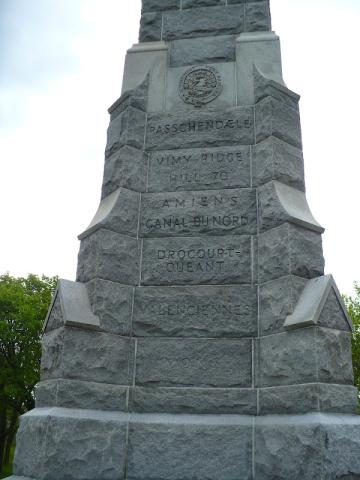
PASSCHENDAELE
VIMY RIDGE
HILL 70
AMIENS
CANAL DUNORD
DROCOURT-
OUEANT
VALENCIENNES
MONS 

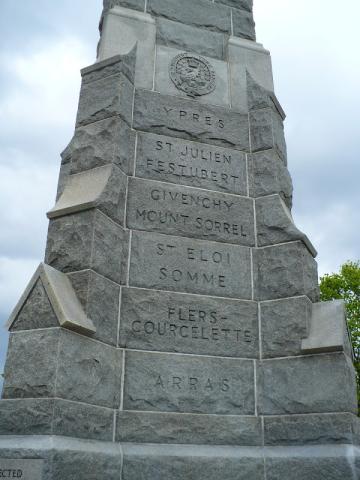
[left side/côté gauche]

YPRES
ST. JULIEN
FESTUBERT
GIVENCHY
MOUNT SORREL
ST. ELOI
SOMME
FLERS-
COURCELETTE
ARRAS


Image
Photo Credit
Ontario Provincial Archives
Caption
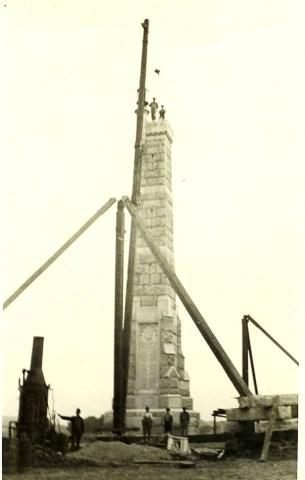
Aurora War Memorial construction, 1925.
1 of 6 images
Image
Photo Credit
Eric McCartney
Caption
Aurora War Memorial
1 of 6 images
Image
Photo Credit
Tim Laye, Ontario War Memorials
Caption
left side
1 of 6 images
Image
Photo Credit
Tim Laye, Ontario War Memorials
Caption
front
1 of 6 images
Image
Photo Credit
Tim Laye, Ontario War Memorials
Caption
front inscription
1 of 6 images
Image
Photo Credit
Tim Laye, Ontario War Memorials
Caption
right side
1 of 6 images
War or Conflict Term
Province
!4v1623932687513!6m8!1m7!1sCAoSLEFGMVFpcFBxdC1MeUQ4UkM3OUVXaTliTUpYeTVHSWczQXd6NVZpZzFyZ3l4!2m2!1d43.98538210090195!2d-79.4637603889267!3f75.63!4f16.519999999999996!5f1.530426777971106
Body Content

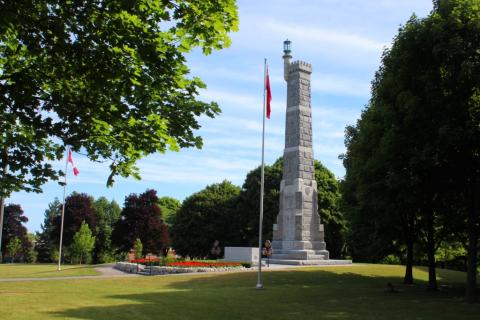
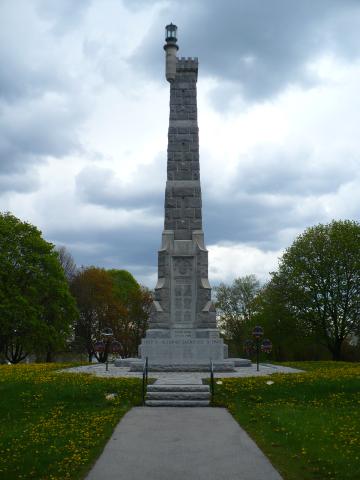
Unveiled on 3 October 1925, this memorial was dedicated to the local war dead and Veterans of the First World War. The Aurora War Memorial, formerly known as the Aurora-Whitchurch-King War Memorial, was provided jointly by three municipalities of King, Whitchurch and Aurora.

The Scottish Baronial base is 30 feet square and sits on a massive concrete foundation. Height to the top of bronze lantern is 73' 5" and the width across the face above base is 12'. It is an overall tapered square tower form with buttresses at each corner of the base and battlement. The battlement at the top is a little over 6' square. It is made of Stanstead grey granite in heavy blocks with solid concrete fill for 20 feet above foundation, and the central shaft 2-1/2' square from this point reaching to the top. The lantern is of solid bronze, carrying four electric lamps of high wattage and the steps leading up to the memorial are also of granite. The names are engraved in lead.

The flagpoles on either side are 20 paces out at an angle from the memorial's terraced north and south sides. On the left is Canada's national flag; on the right is the provincial flag of Ontario, which incorporates the Union Jack under which these men fought. Each November, wreaths are laid at the memorial by the next of kin and the Reeves of the three townships represented. 

The Aurora War Memorial Board, a non-profit organization which was incorporated in 1925 takes full responsibility for the upkeep, financial records and promotion of the Aurora War Memorial and Altar of Sacrifice. The Aurora Hydro and the Aurora Parks Department maintain the grounds and the lantern.

At an early age, Sir William Mulock was influenced by the sight of British regiments marching throughout Ontario. Born at Bond Head and raised in Newmarket, this Grand Old Man of Canada was instrumental in the erection of the memorial to those who fell during the First World War. The cost to erect the memorial was $24,500.00. Sir William contributed $11,500.00. The balance was raised through general subscription by the people of King, Whitchurch and Aurora. The impressive Aurora War Memorial, including the Altar of Sacrifice, was designed and constructed by the McIntosh Granite Co., Toronto, Canada.

On January 2, 2008, the Aurora War Memorial and Peace Park were designated to be of cultural heritage value or interest.

City
Aurora
Country
Type Description
Obelisk - granite, altar - granite
Memorial CF Legacy ID
507
City/Municipality
Toronto
Memorial Number
35091-052
Type
Address
1570 Yonge Street
Location
Christ Church Deer Park
in Canada
Yes
GPS Coordinates
0, 0
Province
Body Content

At Christ Church in Deer Park, Toronto a brass tablet memorial was dedicated to the memory of Corporal Charles Hubert Bligh who had died in the First World War. Bligh was born in Mirzapur, India on 5 October 1881 to William George and Ellen Bligh. Before enlisting in with the Canadian Expeditionary Force on 21 September 1914 he served in South Africa with the South African Military Police. While serving with the Canadian Expeditionary Force in Europe he became a corporal in the 8th Battalion. On 25 April 1915  he was killed after being shot in the head while leading an advance with his company.

City
Toronto
Country
Type Description
Plaque
Memorial CF Legacy ID
11307
City/Municipality
Toronto
Memorial Number
35091-051
Type
Address
1570 Yonge Street
Location
Christ Church Deer Park
in Canada
Yes
GPS Coordinates
43.6905723, -79.395058
Inscription

“Erected by Charles Walker and his wife, Violet Lucy, to the glory of God, and in proud and affectionate memory of their son, Norman Eden, Lieut., 124th Battalion, C.E.F., age 20 years, buried at Villers au Bois.”

Province
!4v1675179006671!6m8!1m7!1s4hiMxW8iLkCk9XkVSAAiCg!2m2!1d43.69057233211808!2d-79.3950579725701!3f259.033660748239!4f-2.2940405870369602!5f0.7820865974627469
Body Content

On 30 September 1923 Reverend Canon H.F.D. Woodcock unveiled and dedicated a stained glass window to honour Lieutenant Norman Eden Walker. Dedicated by Walker’s parents, it is a north facing window made of antique English glass. It depicts an image of Jesus Christ in the center, a youthful soldier on his right, and an angel holding a crown on his left. 

Born on 5 October 1896 in Toronto, Norman worked as a clerk and was member of the Governor General’s Body Guard militia before enlisting on 8 December 1915. He became a Lieutenant in the 124th Battalion before being killed in action at Vimy Ridge on 13 April 1917.

City
Toronto
Country
Type Description
Stained Glass Window
Memorial CF Legacy ID
11303
City/Municipality
Toronto
Memorial Number
35091-050
Type
Address
1570 Yonge Street
Location
Christ Church Deer Park
in Canada
Yes
GPS Coordinates
43.6905723, -79.395058
Inscription

The names listed on the tablet were as follows: Charles Hubert Bligh, George Hugh Cleal, Henry Maurice Corbold, Albert John Jarvis, Fredrick James Blakey, John William Erwood, Albert Edward Elford, Guy Armstrong Beck, Norman Eden Walker, Basil Lancelot Campston, Alfred Irving Hutty, Alan Gurney Minns, Joseph Fredrick Farr, Edgar John Brown, Walter Caleb Gould, Stanley Elford, George Arnold Billings, William Thomas, R. Ernest McCuaig, Erl Macdonnell Jarvis, Donald Whitcombe Morrison, Basil Roy Lepper, Philip Edward Williams, Melville S. Crawford, Wesley Jennings, Evan Edward Price, Alfred John McEldon.

War or Conflict Term
Province
!4v1675179006671!6m8!1m7!1s4hiMxW8iLkCk9XkVSAAiCg!2m2!1d43.69057233211808!2d-79.3950579725701!3f259.033660748239!4f-2.2940405870369602!5f0.7820865974627469
Body Content

On 25 April 1920 Reverend Canon Frederick George Scott conducted a ceremony for the unveiling of a bronze memorial tablet dedicated to the memory of 27 parishioners of Christ Church who died in the First World War. 

City
Toronto
Country
Type Description
Plaque
Memorial CF Legacy ID
11302