At Christ Church in Deer Park, Toronto a bronze flower vase was unveiled to honour the memory of Lieutenant Philip Edward Williams, and was dedicated by Williams’ mother. Philip Edward Williams was born on 9 July 1897 to Roland Williams and Constance Maude Williams in Toronto, Ontario. He was a student at the University of Toronto and a member of the 9th Mississauga Horse militia when he enlisted with the Canadian Expeditionary Force on 30 November 1915. He was placed in the 124th Battalion before being transferred to the Royal Air Force on 25 November 1917. On 22 October 1918 he died after contracting pneumonia.
Other
Flight Lieutenant Alfred I. Hutty Tablet
At Christ Church in Deer Park, Toronto a brass tablet memorial was dedicated to the memory of Sub-Lieutenant Alfred Irving Hutty. Alfred Irving Hutty was born to Alfred and Dinah Lowthian Hutty in Toronto, Ontario on 19 February 1887. He attended Harbord Collegiate and worked as a stock broker with Ryerson & Co. before joining the Royal Naval Air Services branch of the Royal Navy. He was made Sub-Lieutenant in the 2nd Naval Squadron, which was responsible for carrying out reconnaissance and bombing missions on the French and Belgian northern coastline. On 21 August 1917 he was killed in action.
Villiers Island
Major Villiers Sankey was born at Brookeboro, County Fermanagh, Ireland, on October 3, 1854. He was educated at Portora Royal School, Enniskillen, and in 1872 passed his examinations for the India Civil Service. In Canada, he entered the firm of Wadsworth, Unwin & Brown, afterwards becoming a partner. Major Sankey laid out the new rifle ranges in Toronto, was an authority on military matters and supplied the Government with special maps, particularly of the Toronto and Niagara districts.
Major Sankey's military service with The Queen's Own Rifles of Canada:
December 26, 1879 – 2nd Lieutenant (Provisional)
January 28, 1880 – Gazetted 2nd Lieutenant
November 26, 1880 – Lieutenant
1881 – Organized the new regimental Signal Corps
December 22, 1882 – Captain
September 27, 1889 – Major
April 13, 1895 – Retired
On December 24, 1888, he was appointed City Surveyor for Toronto. From 1890 - 91, he served as the President of the Association of Provincial Land Surveyors of Ontario. He resigned as City Surveyor on January 20, 1905, and on July 10 of that year, he drowned during engineering work near Kenora.
Major Sankey had five daughters and two sons. During the First World War, his son Nisbett served in the 32nd Battalion, Canadian Expeditionary Force as a Captain. His youngest son, Lieutenant Colonel Richard H. Sankey commanded the 3rd Battalion (Canadian Active Service Force), The Queen’s Own Rifles during the Second World War.
Villiers Street
Villiers St
Villiers Street was named in honour of Major Villiers Sankey on 15 May 1919. He was born at Brookeboro, County Fermanagh, Ireland, on October 3, 1854, educated at Portora Royal School, Enniskillen, and in 1872 passed his examinations for the India Civil Service. In Canada, he entered the firm of Wadsworth, Unwin & Brown, afterwards becoming a partner. Major Sankey laid out the new rifle ranges in Toronto, was an authority on military matters and supplied the Government with special maps, particularly of the Toronto and Niagara districts.
Major Sankey's military service with The Queen's Own Rifles of Canada:
December 26, 1879 – 2nd Lieutenant (Provisional)
January 28, 1880 – Gazetted 2nd Lieutenant
November 26, 1880 – Lieutenant
1881 – Organized the new regimental Signal Corps
December 22, 1882 – Captain
September 27, 1889 – Major
April 13, 1895 – Retired
On December 24, 1888, he was appointed City Surveyor for Toronto. From 1890 - 91, he served as the President of the Association of Provincial Land Surveyors of Ontario. He resigned as City Surveyor on January 20, 1905, and on July 10 of that year, he drowned during engineering work near Kenora.
Major Sankey had five daughters and two sons. During the First World War, his son Nisbett served in the 32nd Battalion, Canadian Expeditionary Force as a Captain. His youngest son, Lieutenant Colonel Richard H. Sankey commanded the 3rd Battalion (Canadian Active Service Force), The Queen’s Own Rifles during the Second World War.
Memorial 35091-045 Toronto, ON
[front/devant]
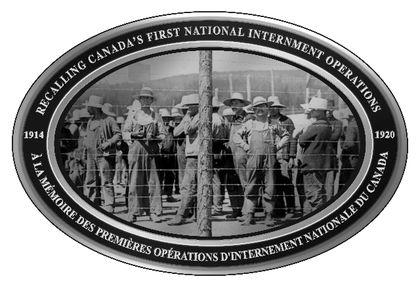
Recalling Canada's First National Internment Operations 1914-1920
A la mémoire des premières opérations d’internement nationale du Canada 1914-1920
This memorial recalls a historic injustice Canadians should pause to remember, as we recall the First World War and the valour of all those Canadian men, and some women, who served. It is a tribute to mark the memory of the thousands of "enemy aliens" who had their civil rights stripped, and were subsequently imprisoned during Canada's first national internment operations of 1914-1920, following the implementation of the War Measures Act. 2014 marks the 100th anniversary of the War Measures Act - adopted on August 22, 1914 during the First World War. It was used to imprison Ukrainian-Canadians, and other ethnic groups, including German, Hungarian, Serbian, Croatian, and Armenian communities, into one of Canada's 24 internment camps.
Dr. Lubomyr Luciuk, a professor at the Royal Military College of Canada and former chair of the Ukrainian Canadian Civil Liberties Association (UCCLA), had taken it upon himself to lead the way and organize the memorial. In the CTO ("One Hundred") project, 100 aluminum plaques were simultaneously unveiled at 100 different locations across the country at 11:00am local time on August 22, 2014. The first plaque was unveiled in Amherst, Nova Scotia, followed by a wave of plaque unveilings moved west, from province to province, culminating in Nanaimo, British Columbia. The plaques, which cost $1,000 to make, were funded by the generosity of the Endowment Council of the Canadian First World War Interment Recognition Fund.
Each plaque features a photo of internment prisoners confined behind a wire fence at the Castle Mountain Internment Camp in Banff, Alberta. The Castle Camp, which was built in 1915 at the base of Castle Mountain, was a Canadian internment camp which held immigrant prisoners of Ukrainian, Austrian, Hungarian, and German descent.
Memorial 35091-044 Toronto, ON
[front/devant]
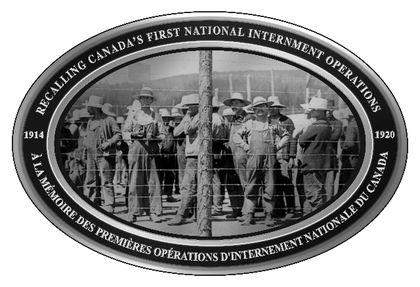
Recalling Canada's First National Internment Operations 1914-1920
A la mémoire des premières opérations d’internement nationale du Canada 1914-1920
This memorial recalls a historic injustice Canadians should pause to remember, as we recall the First World War and the valour of all those Canadian men, and some women, who served. It is a tribute to mark the memory of the thousands of "enemy aliens" who had their civil rights stripped, and were subsequently imprisoned during Canada's first national internment operations of 1914-1920, following the implementation of the War Measures Act. 2014 marks the 100th anniversary of the War Measures Act - adopted on August 22, 1914 during the First World War. It was used to imprison Ukrainian-Canadians, and other ethnic groups, including German, Hungarian, Serbian, Croatian, and Armenian communities, into one of Canada's 24 internment camps.
Dr. Lubomyr Luciuk, a professor at the Royal Military College of Canada and former chair of the Ukrainian Canadian Civil Liberties Association (UCCLA), had taken it upon himself to lead the way and organize the memorial. In the CTO ("One Hundred") project, 100 aluminum plaques were simultaneously unveiled at 100 different locations across the country at 11:00am local time on August 22, 2014. The first plaque was unveiled in Amherst, Nova Scotia, followed by a wave of plaque unveilings moved west, from province to province, culminating in Nanaimo, British Columbia. The plaques, which cost $1,000 to make, were funded by the generosity of the Endowment Council of the Canadian First World War Interment Recognition Fund.
Each plaque features a photo of internment prisoners confined behind a wire fence at the Castle Mountain Internment Camp in Banff, Alberta. The Castle Camp, which was built in 1915 at the base of Castle Mountain, was a Canadian internment camp which held immigrant prisoners of Ukrainian, Austrian, Hungarian, and German descent.
Memorial 35091-043 Toronto, ON
[Plaque/Plaque ]
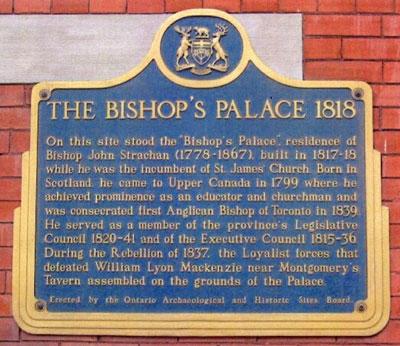
THE BISHOP'S PALACE 1818
On this site stood the "Bishop's palace", residence of
Bishop John Strachan (1778-1867), built in 1817-18
while he was the incumbent of St. James Church. Born in
Scotland, he came to Upper Canada in 1799 where he
achieved prominence as an educator and churchman and
was consecrated first Anglican Bishop of Toronto in 1839.
He served as a member of the province's Legislative
Council 1820-41 and of the Executive Council 1815-36.
During the Rebellion of 1837, the Loyalist forces that
defeated William Lyon Mackenzie near Montgomery's
Tavern assembled on the grounds of the Palace.
Erected by the Ontario Archaeological and Historic Sites Board.
This plaque commemorates the residence of Bishop John Strachan (1778-1867). The Bishop's Palace is the site where assembled the Loyalist forces that defeated William Lyon Mackenzie during the Rebellion of 1837. See the plaque inscription for more details.
Memorial 35091-042 Toronto, ON
[Plaque/Plaque ]
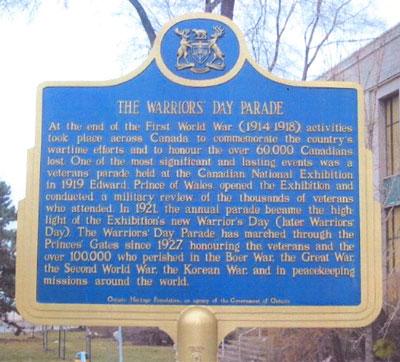
THE WARRIORS` DAY PARADE
At the end of the First World War (1914-1918) activities
took place across Canada to commemorate the country's
wartime efforts and to honour the over 60,000 Canadians
lost. One of the most significant and lasting events was a
veterans parade held at the Canadian National Exhibition
in 1919 Edward, Prince of Wales, opened the Exhibition and
conducted a military review of the thousands of veterans
who attended. In 1921, the annual parade became the high-
light of the Exhibition's new Warrior's Day (later Warriors'
Day). The Warriors' Day Parade has marched through the
Princes' Gates since 1927, honouring the veterans and the
over 100,000 who perished in the Boer War, the Great War,
the Second World War, the Korean War, and in peacekeeping
missions around the world.
Ontario Heritage Foundation, an agency of the Government of Ontario.
This plaque is dedicated to the veterans and the over 100,000 who perished in the Boer War, the Great War, the Second World War, the Korean War, and in peacekeeping missions around the world. See the plaque inscription for more details.
Ontario Veterans' Memorial
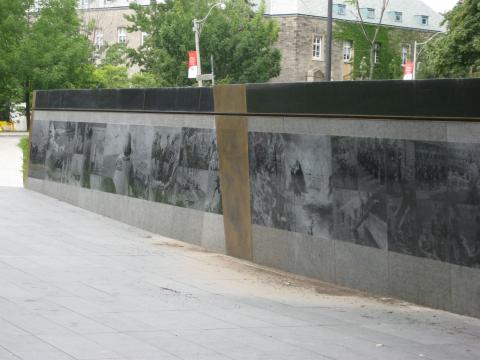
The Ontario Veterans' Memorial commemorates the sacrifices of Canada's veterans who served in war and peace and was unveiled on September 17, 2006, by the province, veterans, and the military. It was fitting that this significant memorial was unveiled on the front lawn of Queen's Park to coincide with the anniversary date of the first parliament in Ontario.
Following one of the largest military parades in Toronto's history, the memorial was unveiled by numerous veterans and dignitaries including the Honourable James K. Bartleman, Lieutenant-Governor of Ontario, Premier Dalton McGuinty and the Honourable Michael A. Brown, Speaker of the Legislative Assembly. "This memorial wall will be a lasting tribute to the sacrifice, courage and dedication of our Veterans," said Major-General Richard Rohmer, Co-Chair of the Veterans' Memorial Advisory Committee, which is responsible for the overall planning of the project. "We are pleased that the military, our veterans, the province, and the Crown will jointly dedicate this new monument to those who have given so much."
Allan Harding MacKay and landscape architectural firm Phillips Farevaag Smallenberg designed the granite wall, etched with scenes and inscriptions of Canada’s military involvement in conflicts since 1867. It is approximately 100 feet long and eight feet six inches tall. The memorial is also inscribed with text written by poet Jane Urquhart. Major-General Richard Rohmer (Ret.), co-chair of the committee, said one of the great Canadian historians, Dr. Jack Granatstein, helped with the scenes. Other features include a stone-paved gathering area, seating area, paths and a gently sloping lawn.
In 2020, the Ontario Afghanistan Memorial was added to this location.
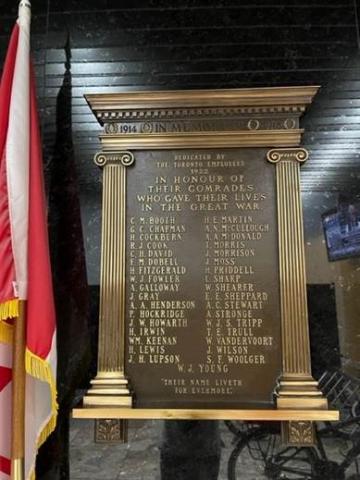
First World War Tablet
This tablet was dedicated by Toronto employees of the Bell Telephone Company of Canada in honour of their comrades who gave their lives in the First World War.