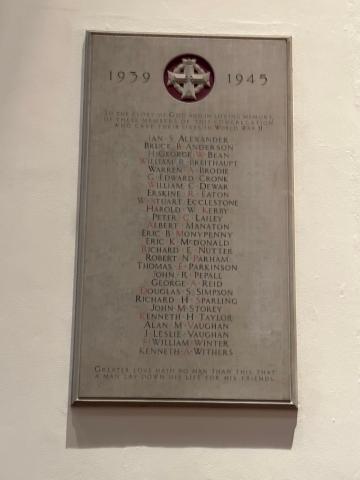
This plaque was erected in memory of members of the Timothy Eaton Memorial Church congregation who gave their lives in the Second World War.
Second World War Plaque
My VAC Account
My VAC Account
This plaque was erected in memory of members of the Timothy Eaton Memorial Church congregation who gave their lives in the Second World War.
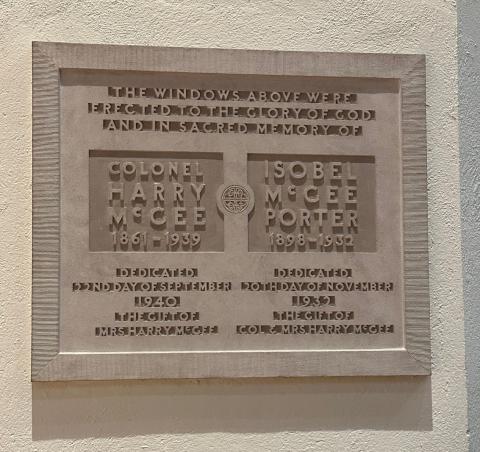
Harry McGee was born in Kilcooley, Tipperary, Ireland in 1861. He attended a business college and completed his apprenticeship in Ireland before coming to Canada in 1882. He spent a year with family in Huron and Bruce counties before moving to Toronto. In August 1883, he secured a position at Eaton’s Department Store where within a few months he became a department head, and then the supervisor of several departments. He was made a director in 1906, Second Vice President in 1907, and later First Vice President.
In 1930, Harry was made an Honorary Colonel of the Irish Regiment of Canada. He donated a large amount of money to equip the regiment during the First World War and was affectionately known as “the father of the regiment”.
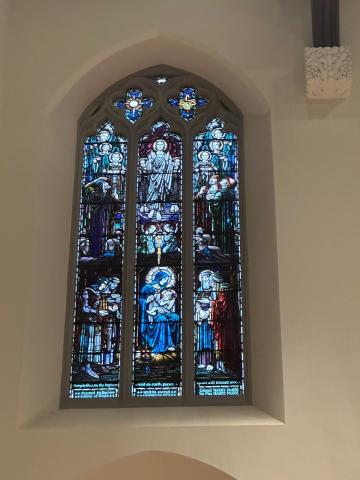
The upper part of the window depicts the angels of the Lord and the heavenly host as they appeared to the shepherds in the fields. The Adoration of the Magi (the three wise men) is the theme running through the lower prat of the window. In the center light is Mary, seated within the door of the shed with the Holy Baby in her arms. The start of Bethlehem rests directly overhead, between two baby angles. Above is the angle of the Lord proclaiming the birth of the Messiah to the shepherds in the fields, with the heavenly host in the background. The Virgin's crown occupies the head of light. To the left of Mary, two of the wise men are bearing gifts. To the right is Joseph, and with him the third wise man, bearing the gift of a crown. In the tracery are the sun, emblem of immortality, and an interlaced triangle, emblem of the Trinity.
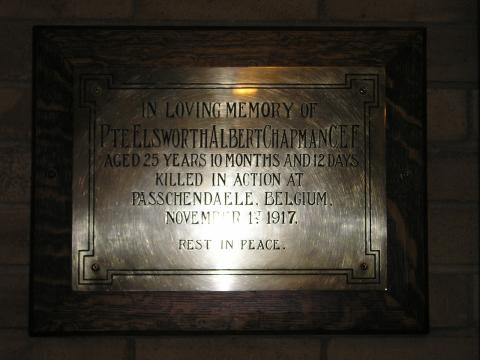
The Private Elsworth Albert Chapman Plaque was erected in the Newtonbrook Wesleyan Methodist Church after his death in the First World War. He was killed in action at Passchendaele, Belgium on November 1, 1917.
Newtonbrook Wesleyan Methodist Church was located at 1 East Yonge Street. In 1925, the congregation joined the United Church and moved to a new larger church in 1962 located on Cummer Avenue and became Newtonbrook United Church. The church is now known as Cummer Avenue United Church. The plaque is currently in storage at the church.
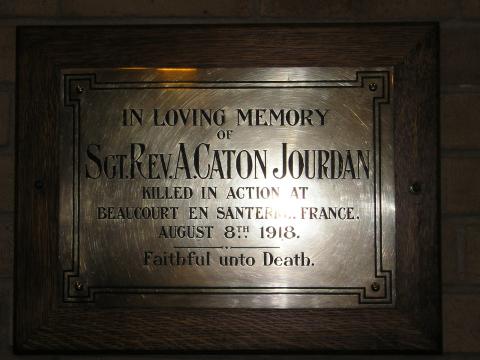
The Sergeant Reverend A. Caton Jourdain Plaque was erected in the Newtonbrook Wesleyan Methodist Church after his death in the First World War. He was killed in action in France on August 8, 1918.
Newtonbrook Wesleyan Methodist Church was located at 1 East Yonge Street. In 1925, the congregation joined the United Church and moved to a new larger church in 1962 located on Cummer Avenue and became Newtonbrook United Church. The church is now known as Cummer Avenue United Church. The plaque is currently in storage at the church.
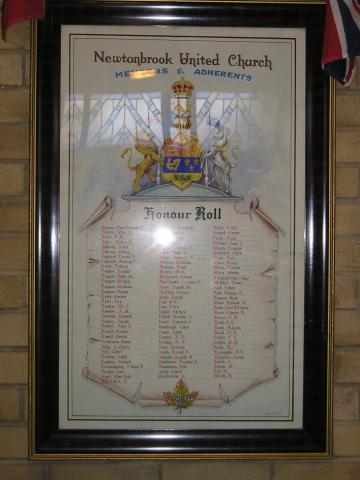
The Newtonbrook United Church Second World War Honour Roll is currently in storage.
The church, formerly known as Newtonbrook Wesleyan Methodist Church was located at 1 East Yonge Street. In 1925, the congregation joined the United Church and moved to a new larger church in 1962 located on Cummer Avenue and became Newtonbrook United Church. The church is now known as Cummer Avenue United Church.
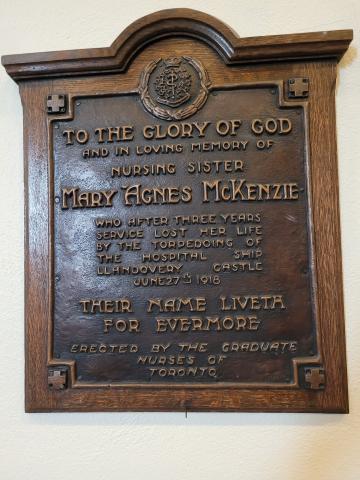
TO THE GLORY OF GOD
AND IN LOVING MEMORY OF
NURSING SISTER
MARY AGNES MCKENZIE
WHO AFTER THREE YEARS
SERVICE LOST HER LIFE
BY THE TORPEDOING OF
THE HOSPITAL SHIP
LLANDOVERY CASTLE
JUNE 27 1918
THEIR NAME LIVETH
FOR EVERMORE
ERECTED BY THE GRADUATE
NURSES OF
TORONTO
A bronze tablet in honour of Nursing Sister Mary Agnes McKenzie was unveiled in the Avenue Road Presbyterian Church on June 27, 1920. Nursing Sister McKenzie lost her life on June 27, 1918, when the hospital ship Llandovery Castle was torpedoed. The dedication ceremony was conducted by Reverend Dr. Alfred Hall, Senior Chaplain for Canada to the Institutes of the Naval and Merchant Marine Services. A naval Veteran lowered the naval flag and Mrs. Mill Pellatt unveiled the tablet.
The Presbyterian congregation joined the United Church of Canada in 1925, thus the church became the Avenue Road United Church. In the mid-1970s, the building was sold and the plaque was moved to Calvin Presbyterian Church.
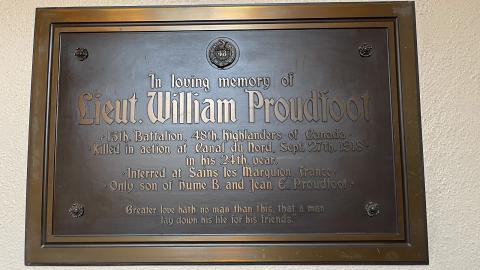
In loving memory of
Lieut. William Proudfoot
15th Battalion 48th Highlanders of Canada
Killed in action at Canal du Nord, Sept. 27th 1918
in his 24th year
Interred at Sains les Marquion, France
Only son of Hume B. and Jean E. Proudfoot
"Greater love hath no man than this, that a man
lay down his life for his friends."
A plaque in honour of Lieutenant William Proudfoot of the 15th Battalion was unveiled by Captain Grant in the Avenue Road Presbyterian Church on February 22, 1920. Captain Grant served with Lieutenant Proudfoot who was killed in action on September 27, 1918.
Avenue Road United Church at 243 Avenue Road closed in 1930 and amalgamated with St. Paul’s United Church to form St. Paul’s Avenue Road United Church in the St. Paul’s building. In 1980, St. Paul’s Avenue Road United Church closed and amalgamated with Trinity United Church on Bloor Street in the Trinity building to form Trinity-St. Paul’s United Church.
Bloor Street United is being torn down. In its place will rise a condominium tower that includes space for the Bloor Street United congregation. The plaque is currently in storage.
A First World War tablet was donated to Alhambra Avenue Presbyterian Church.
The congregation at 1573 Bloor Street West joined the United Church in 1925. In 1970, Alhambra Avenue United Church united with High Park Avenue Methodist Church to form High Park-Alhambra United Church in the High Park Avenue building. The congregation closed and it is not known what happened to the tablet.
In 1924, the Women’s Association presented an organ honouring Alhambra Avenue Presbyterian Church parishioners who served in the First World War.
The congregation at 1573 Bloor Street West joined the United Church in 1925. In 1970, Alhambra Avenue United Church united with High Park Avenue Methodist Church to form High Park-Alhambra United Church in the High Park Avenue building. The congregation closed and it is not known what happened to the organ.
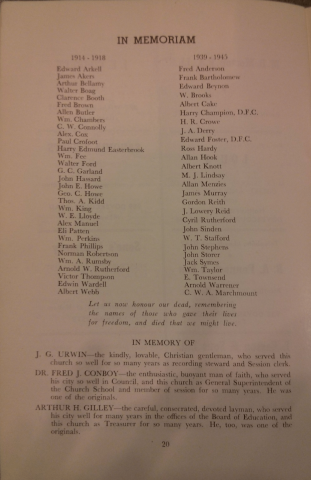
In Memoriam
1914-1918
Edward Arkell
James Akers
Arthur Bellamy
Walter Boag
Clarence Booth
Fred Brown
Allen Butler
Wm. Chambers
C.W. Connolly
Alex. Cox
Paul Crofoot
Harry Edmund Easterbrook
Wm. Fee
Walter Ford
G.C. Garland
John Hassard
John E. Howe
Geo. C. Howe
Thos. A. Kidd
Wm. King
W.E. Lloyde
Alex Manuel
Eli Patten
Wm. Perkins
Frank Phillips
Norman Robertson
Wm. A. Rumsby
Arnold W. Rutherford
Victor Thompson
Edwin Wardell
Albert Webb
1939-1945
Fred Anderson
Frank Bartholomew
Edward Beynon
W. Brooks
Albert Cake
Harry Champion, D.F.C.
H.R. Crowe
J.A. Derry
Edward Foster, D.F.C.
Ross Hardy
Allan Hook
Albert Knott
M.J. Lindsay
Allan Menzies
James Murray
Gordon Reith
J. Lowery Reid
Cyril Rutherford
John Sinden
W.T. Stafford
John Stephens
John Storer
Jack Symes
Wm. Taylor
E. Townsend
Arnold Warrener
C.W.A. Marchmount.
Let us now honour our dead, remembering
the names of those who gave their lives
for freedom, and died that we might live.
IN MEMORY OF J.G. URWIN
–
The kindly, lovable, Christian gentleman, who served this church so well for so many years as recording steward and Session clerk.
Dr. FRED J. CONBOY
–
the enthusiastic, buoyant man of faith, who served his city so well in Council, and this church as General Superintendent of the Church School and member of session for so many years. He was one of the originals.
ARTHUR H. GILLEY
–
the careful, consecrated, devoted layman, who served his city well for many years in the offices of the Board of Education, and this church as Treasurer for so many years. He, too, was one of the originals.
On September 24, 1922, two bronze tablets was unveiled honouring Westmoreland Avenue Methodist Church parishioners who served in the First World War.
The congregation at 228-250 Westmoreland Avenue joined the United Church of Canada in 1925. In 1988, Westmoreland amalgamated with Westley-Grace-Carmen to form Westennial United Church. It closed in 1997. The Westmoreland Avenue Methodist Church building no longer exists and it is not known what happened to the tablets.