This street was named in October 2005 to commemorate those who served in the Korean War.
Korea Road
needs further research/recherche incomplète
My VAC Account
My VAC Accountneeds further research/recherche incomplète
This street was named in October 2005 to commemorate those who served in the Korean War.
needs further research/recherche incomplète
This street was named in June 2000 to commemorate those who fought at the Battle of the Scheldt in the Second World War.
needs further research/recherche incomplète
This street was named in February 1998 to commemorate those who defended Hong Kong in the Second World War.
Normandy DR
This street was named in June 2000 to commemorate those who fought at the Battle of Normandy in the Second World War.
needs further research/recherche incomplète
This street was named in February 1998 to commemorate those who fought at Arras in the First World War.
needs further research/recherche incomplète
This street was named in February 1998 commemorate those who fought at the Battle of Cambrai in the First World War.
needs further research/recherche incomplète
On September 6, 1944, the 2nd Canadian Infantry Division marched eastward with the objective of clearing the entire coastal area east of Calais. Le Havre, Boulogne and Calais were taken by the 3rd Canadian Infantry Division only after massive attacks with combined air and ground assaults. This street was named in September 2006 to commemorate those who fought at Calais.
needs further research/recherche incomplète
This boulevard is named in honour of those who fought at the Battle of Festubert, the second major engagement fought by Canadian troops in the First World War.
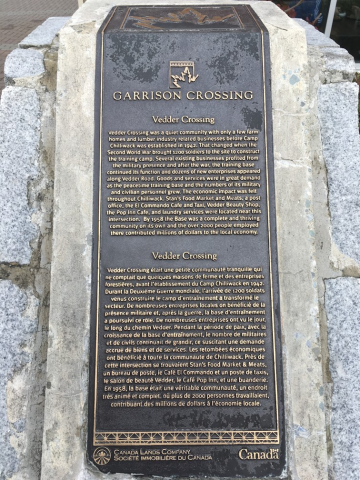
GARRISON CROSSING
Vedder Crossing
Vedder Crossing was a quiet community with only a few farm
homes and lumber industry related businesses before Camp
Chilliwack was established in 1942. That changed when the
Second World War brought 1200 soldiers to the site to construct
the training camp. Several existing businesses profited from
the military presence and after the war, the training base
continued its function and dozens of new enterprises appeared
along Vedder Road. Goods and services were in great demand
as the peacetime training base and the numbers of its military
and civilian personnel grew. The economic impact was felt
throughout Chilliwack. Stan's Food Market and Meats, a post
office, the EI Commando Cafe and Taxi, Vedder Beauty Shop,
the Pop Inn Cafe, and laundry services were located near this
intersection. By 1958 the Base was a complete and thriving
community on its own and the over 2000 people employed
there contributed millions of dollars to the local economy.
Vedder Crossing
Vedder Crossing était une petite communauté tranquille qui
ne comptait que quelques maisons de ferme et des entreprises
forestières, avant l'établissement du Camp Chilliwack en 1942.
Durant la Deuxième Guerre mondiale, l'arrivée de 1200 soldats
venus construire le camp d'entraInement a transformé le
secteur. De nombreuses entreprises locales on bénéficié de la
présence militaire et, après la guerre, la base d'entraInement
a poursuivi ce rôle. De nombreuses entreprises ont vu le jour,
le long du chemin Vedder. Pendant la période de paix, avec la
croissance de la base d'entraInement, le nombre de militaires
et de civils continuit de grandir, ce suscitant une demande
accre de biens et de services. Les retombées économiques
ont bénéficié à toute la communauté de Chilliwack. Près de
cette intersection se touvaient Stan's Food Market & Meats,
un bureau de poste, le Café El Commando et un poste de taxis,
le salon de beauté Vedder, le Café Pop Inn, et une buanderie.
En 1958, la base était une véritable communauté, un endroit
très animé et complet, où plus de 2000 personnes travaillaient,
contribuant des millions de dollars à l'économia locale.
CANADA LANDS COMPANY
SOCIÉTÉ IMMOBILIÈRE DU CANADA
This plaque was installed as part of the Garrison Crossing Legacy Walk.
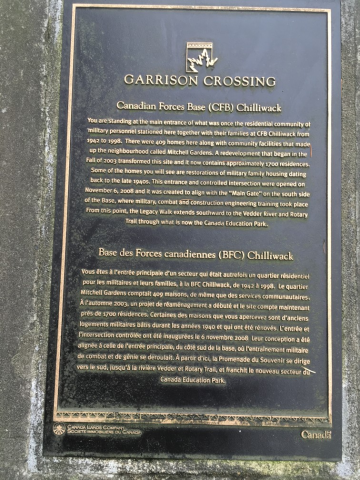
GARRISON CROSSING
Canadian Forces Base (CFB) Chilliwack
You are standing at the main entrance of what was once the residential community of military personnel stationed here together with their families at CFB Chilliwack from 1942 to 1998. There were 409 homes here along with community facilities that made up the neighbouhood called Mitchell Gardens. A redevelopment that began in the Fall of 2003 transformed this site and it now contains approximately 1700 residences. Some of the homes you will see are restorations of military family housing dating back to the late 1940s. This entrance and controlled intersection were opened on November 6, 2008 and it was created to align with the "Main Gate" on the south side of the Base, where military, combat and construction engineering training took place From this point, the Legacy Walk extends southward to the Vedder River and Rotary Trail through what is now the Canada Education Park.
Base des Forces canadiennes (BFC) Chilliwack
Vous êtes à l'entrée principale d'un secteur qui était autrefois un quartier résidentiel pour les militaires et leurs familles, à la BFC Chilliwack, de 1942 à 1998. Le quartier Mitchell Gardens comptait 409 maisons, de même que des services communautaires. À L'automne 2003, un projet de réaménagement a débuté et le site compte maintenant près de 1700 résidences. Certaines des maisons que vous apercevez sont d'anciens logements militaires bàtis durant les années 1940 et qui ont été rénovés. L'entrée et l'intersection contrôlée ont été inaurées le 6 novembre 2008 Leur conception a été alignée à celle de l'entrée principale, du côté sud de la base, où l'entraînement militaire de combat et de génie se déroulait. À partir d'ici, la Promenade du Souvenir se dirige vers le sud, jusqu'à la rivière Vedder et Rotary Trail, et franchit le nouveau secteur du Canada Education Park.
CANADA LANDS COMPANY
SOCIÉTÉ IMMOBILIÈRE DU CANADA
This plaque was installed as part of the Garrison Crossing Legacy Walk.