Attention!
Cette vidéo est disponible en anglais seulement.
Description
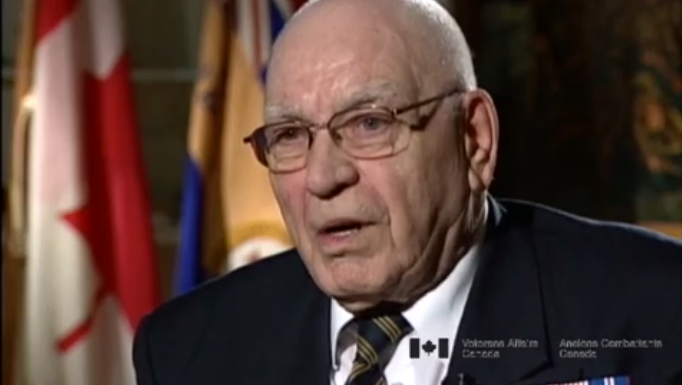
Samuel John Sinclair
Samuel John Sinclair, un ancien combattant autochtone de la Seconde Guerre mondiale, est né le 22 novembre 1926 au Petit lac des Esclaves (Alberta). Son père était trappeur et cultivateur-éleveur en plus d’être bon chasseur. M. Sinclair avait 12 frères et soeurs. Avant de commencer l’école, il ne parlait que le cri, ce qui a rendu ses premières années d’études assez difficiles. Il a cependant travaillé fort, appris à parler anglais et a enfin bien réussi à l’école. Il a continué à fréquenter l’école jusqu’à la dixième année. <br><br> Il s’est engagé dans l’armée à l’âge de 15 ans, encore mineur, sans la permission de ses parents. Il était grand pour son âge, et il a dit avoir 18 ans. Il a été en stationnement à Wainwright (Alberta). Comme premier emploi, il a été laveur de vaisselle. À l’âge de 17 ans, lorsque l’Armée canadienne a eu besoin d’hommes pour l’invasion de l’Europe, il a été envoyé outre-mer comme renforcement après le jour J.
Transcription
One of the guys I was with was a colored man and he wouldn't, he wouldn't when we crawled, we crawled one after the other and the Lance Corporal who was leading us was in front and I thought I would be second because he had said "You follow me" before when we were assembling. And that colored man, "No" he said, "you guys are not going to put me in the back, I want to be in the center". He wanted coverage from each side and his eyes were as big... he was scared to death of everything. So I let him do it, he happened to be a good friend of mine, even here in Edmonton after the war. But we got fired upon and I run away a bit when they started firing and I hit the dirt and I threw my rifle away. And that's a bad thing. You're not ever supposed to throw your rifle or any... and I think they call it something like insubordination or something. But actually I tripped and then I threw it and I didn't look for it, it was dark. And next day, when I laid there, there was nobody around because we scattered and I didn't know if they got killed or taken prisoner and one was taken prisoner, the Lance Corporal.
So I didn't know which way to go because you lose your directions and being in a strange country and I was scared to move. I knew our outfit wasn't that far because we crawled maybe for a couple of hours but you don't walk a little bit and crawl and we probably went 300 yards or something. But on side by side of the other companies was Regiment de Maisonneuve which was a French outfit in Quebec and with the Black Watch. We were in the 5th Brigade of the 2nd Division and the Calgary Highlanders was part of that. So all those things I can remember good but that was the biggest scare, that night thing. Because you don't see what's going on and they fire at you, you don't know which way to go. We were just supposed to go and listen in and get back to our unit and let him report what we seen.
Interviewer: How did you get back, Mr. Sinclair?
Oh, when I, when I said come daylight, I started heading back and listening. I'd walk a few feet and listen. And I thought if I hear any voices...but a lot of it, when they are near, that close to the firing line, nobody talks because voice carries. So finally, I come and I thought I seen some movement. I thought I'll go towards there. But what I went and run into was Regiment de Maisonneuve , which was all French. And I was so scared, I could hardly swallow and my throat was dry and he said "password" he said to me. And I couldn't remember the password, I was so scared. Actually, it was, I was supposed to say "Merry" and then he'd say "Christmas". That was the word, I always remember that because it always cost me my life. Because when I didn't answer for a few seconds there, I heard him cock the gun. I thought I was dead. So I, I went forward and he seen I had a Canadian uniform and pretty soon his officer come there and questioned me and he said where the hell did I pop up from. And I said, well he knew I was from Calgary Highlanders. He says, "You're in the wrong area". So, first thing he asked me is, "Where's your rifle". I told him I lost it, eh. And I almost got charged for that. But under the circumstances, it saved me cause I told the truth, what happened. I didn't, you know, when you figure it out... first thing that went through my head was that I was going to be taken prisoner. And I thought if I have no rifle, maybe they won't shoot me. I don't know. You have to be involved to really know what kind of things you could do on the split second decision you have to make. If it means your life, you're a different person.