Attention!
Cette vidéo est disponible en anglais seulement.
Description
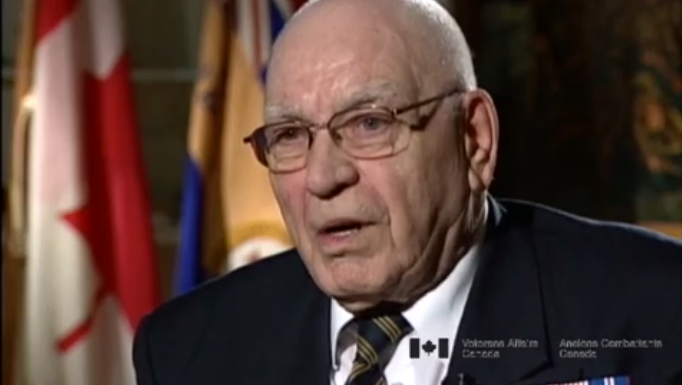
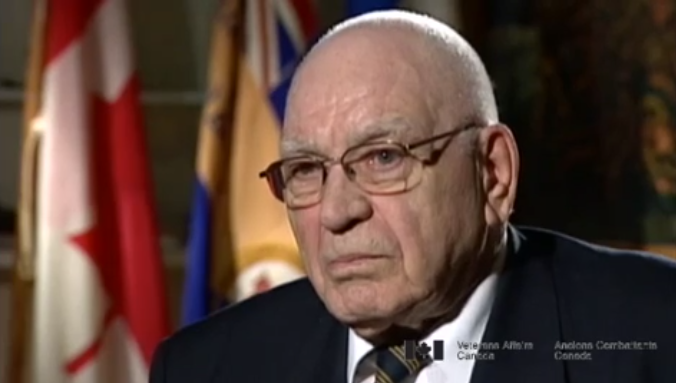
Mr. Roberge describes how flags hoisted on a ship can represent many different messages.
Transcription
The flags represented code groups in the naval signal book and it's a big volume that has hundreds of different signals that are pretty standard; doing, manoeuvring ships, making them take different formations, covering just about every aspect of life at sea. And by hoisting two flags you can send a whole message.
Interviewer: Give me an example, like what two flags would send the message?
Well, I just got a present of some signal flags from Tortola of all places, and one of the signals in the book was splice the main brace which means issue every man on the ship an extra tot of rum and the signal is a A, D, alpha, delta, two, eight, and those four flags mean splice the main brace. You know it's one I'd never forget. I knew most of the book by heart at one point because the ones we used were never ever, very seldom looked in the book to decode them just, you knew them.
Interviewer: So in a group of ships, one ship would hoist the flags?
The Senior Officer would hoist the signal and the other ships would repeat it to make sure they got it, confirm that they got it correct and if the ships were, say in a row or a line the, each ship repeating the signal would run it's way down the line and when the last, the last ship had to acknowledge the signal and indicate that you understood what it was all about. You had to hoist it close up until you understood it you'd hoist it half way up or at the dip, O.K. So if somebody, if I was to, wanted to tell somebody to turn 90 degrees to port, I would hoist a signal, turn 9, and I would hoist it close up as a Senior Officer. The other ships that didn't understand it would hoist it part way up until they did understand it and then close up. And if it was a business of relaying down the line of ships each ship would hoist it at the dip until the guy at the tail end went close up and then they'd all go close up in order so I'd know that everybody had it and understood it.
Interviewer: Give me an example, like what two flags would send the message?
Well, I just got a present of some signal flags from Tortola of all places, and one of the signals in the book was splice the main brace which means issue every man on the ship an extra tot of rum and the signal is a A, D, alpha, delta, two, eight, and those four flags mean splice the main brace. You know it's one I'd never forget. I knew most of the book by heart at one point because the ones we used were never ever, very seldom looked in the book to decode them just, you knew them.
Interviewer: So in a group of ships, one ship would hoist the flags?
The Senior Officer would hoist the signal and the other ships would repeat it to make sure they got it, confirm that they got it correct and if the ships were, say in a row or a line the, each ship repeating the signal would run it's way down the line and when the last, the last ship had to acknowledge the signal and indicate that you understood what it was all about. You had to hoist it close up until you understood it you'd hoist it half way up or at the dip, O.K. So if somebody, if I was to, wanted to tell somebody to turn 90 degrees to port, I would hoist a signal, turn 9, and I would hoist it close up as a Senior Officer. The other ships that didn't understand it would hoist it part way up until they did understand it and then close up. And if it was a business of relaying down the line of ships each ship would hoist it at the dip until the guy at the tail end went close up and then they'd all go close up in order so I'd know that everybody had it and understood it.
Catégories
Signal Flags
Médium
Video
Propriétaire
Veterans Affairs Canada
Campagne
Bataille de l'Atlantique
Personne interviewée
Barney Roberge
Branche
Marine
Unité ou navire
Marine royale du Canada
Military Rank
<em>Boy Seaman 1st Class Chief</em>
Occupation
Communication (Visual)
Durée
02:40