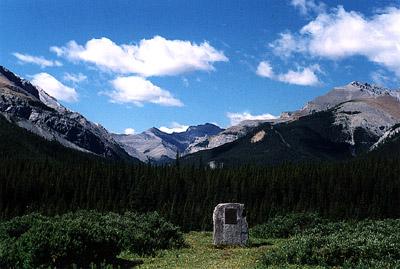
Cette montagne a été nommée en 1918 en l'honneur de sir William Robert Robertson, chef de l'état-major impérial au cours de la Première Guerre mondiale.
Mont Robertson
no inscription/aucune inscription
Mon dossier ACC
Mon dossier ACCno inscription/aucune inscription
Cette montagne a été nommée en 1918 en l'honneur de sir William Robert Robertson, chef de l'état-major impérial au cours de la Première Guerre mondiale.
no inscription/aucune inscription
Cette montagne a été nommée en 1918 en l'honneur du Général sir Horace Lockwood Smith-Dorien, soldat britannique qui a combattu au cours de la guerre des Zoulous et de la guerre d'Afrique du Sud et qui commandait la 2e Armée du Corps expéditionnaire britannique au cours de la Première Guerre mondiale.
no inscription/aucune inscription
Cette montagne a été nommée en 1918 en l'honneur du Lgén sir E.H. Burstall, qui était commandant des troupes canadiennes au cours de la Première Guerre mondiale.
no inscription/aucune inscription
Cette montagne a été nommée en 1918 en l'honneur du Général sir A.G. Murray, qui était chef de l'état-major impérial en 1915 et qui a commandé les forces britanniques en Égypte en 1916-1917.
no inscription/aucune inscription
Cette montagne a été nommée en 1917 en l'honneur du Lcol. F.D. Farquhar, D.S.O., qui était commandant du Princess Patricia's Canadian Light Infantry. Il a été tué alors qu'il supervisait du travail de tranchée le 20 mars 1915.
Commémoré sur le Monument de guerre du Club de golf Royal Ottawa et Vitrail est.
no inscription/aucune inscription
Cette montagne a été nommée en 1918 en l'honneur de H.S. Holcroft, D.L.S, qui travaillait avec le personnel de l'arpenteur général et qui a été tué au cours de la Première Guerre mondiale.
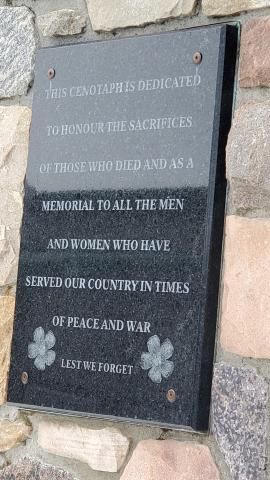
THIS CENOTAPH IS DEDICATED
TO HONOUR THE SACRIFICES
OF THOSE WHO DIED AND AS A
MEMORIAL TO ALL THE MEN
AND WOMEN WHO HAVE
SERVED OUR COUNTRY IN TIMES
OF PEACE AND WAR
LEST WE FORGET
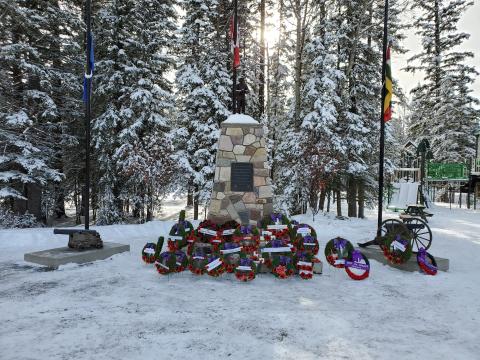
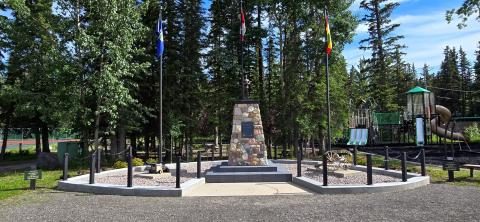
Le cénotaphe de Bragg Creek a été inauguré en 2009. Il a été créé par un comité dirigé par les vétérans de la Seconde Guerre mondiale Tony Iati et Jack Merryfield. Le cénotaphe a été construit par des bénévoles avec le soutien des entreprises et des groupes communautaires de Bragg Creek. Il est recouvert de roches fluviales et est surmonté d’un statue d’un soldat de la Première Guerre mondiale tenant un fusil et montant la garde. Cette statue a été réalisée par le sculpteur Don Begg. Deux canons décoratifs sont installés de chaque côté du cénotaphe.
no inscription/aucune inscription
Cette montagne a été nommée en 1917 en l’honneur du HMS Tipperary, destroyer dont on a perdu la trace lors de la bataille du Jutland pendant la Première Guerre mondiale.
[centre/centre]
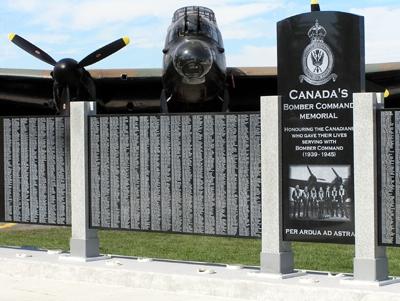
CANADA'S
BOMBER COMMAND
MEMORIAL
HONOURING THE CANADIANS
WHO GAVE THEIR LIVES
SERVING WITH
BOMBER COMMAND
(1939 - 1945)
PER ARDUA AD ASTRA
(list of names, needs further research/une liste de noms suit, recherche incomplète)
[right/droit]
"Three thousand miles across a hunted ocean
they came, wearing on the shoulder of their tunics
the treasure name, 'Canada', telling the world their
origin. Young men and women they were, some still
in their teens, fashioned by their Maker to love, not
to kill, but proud and earnest in their mission to
stand, and if it had to be, to die, for their country
and for freedom.
One day, when the history of the 20th century is
finally written, it will be recorded that when human
society stood at the crossroads of civilization
itself was under siege, the Royal Canadian Air Force
was there to fill the breach and help give humanity
the victory. And all those who had a part in it will
have left to posterity a legacy of honour, of courage,
and of valour that time can never despoil."
-Father J.P. Lardie (Chaplain 419, 428 Squadron RCAF)
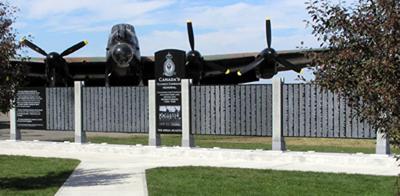
Ce monument a été construit par le Nanton Lancaster Air Museum pendant l’été 2005 et il a été inauguré le 20 août 2005. Il est constitué de cinq panneaux de granite noir. Sur ces panneaux se trouve une liste des noms de tous les Canadiens qui ont été tués au cours de leur service avec le Bomber Command. La liste contient 10 643 noms. http://www.lancastermuseum.ca/memorialgranite.html
[The wording is not clear in the photo./Le texte n’est pas clair sur la photo.]
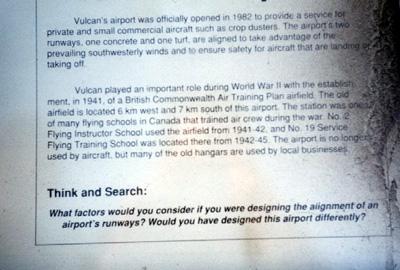
Vulcan's airport was officially opened in 1982 to provide a service for
private and small commercial aircraft such as crop dusters. The airport's two
runways, one concrete and one turf, are aligned to take advantage of the
prevailing southwesterly winds and to ensure safety for aircraft that are landing or
taking off.
Vulcan played an important role during World War II with the establish-
ment, in 1941, of a British Commonwealth Air Training Plan airfield. The old
airfield is located 6km west and 7km south of this airport. The station was one
of many flying schools in Canada that trained air crew during the war. No. 2
Flying Instructor School used the airfield from 1941 - 42, and No. 19 Service
Flying Training School was located there from 1942 - 45. The airport is no longer
used by aircraft, but many of the old hangars are used by local businesses.
Think and Search:
What factors would you consider if you were designing the alignment of an
airport's runways? Would you have designed this airport differently?
Ce mémorial rappelle le rôle qu’a joué l’aéroport de Vulcan pendant la Seconde Guerre mondiale.