Needs further research
Port Moody Cenotaph
My VAC Account
My VAC Account
Needs further research
[side/côté]
1914-1918
GEORGE BATES
J.E. ST. PIERRE
JAMES REDPATH
WALTER WIGMORE
THOMAS MCQUEEN
WALTER L. RAYNES
BENJAMIN SEABORN
ALEXANDER MASSON
"THEIR NAME LIVETH FOREVERMORE"
[side/côté]
DAVID BAIRD
J. MCDONALD
JOHN BRUCE
GEORGE REID
D. MCDONNELL
JAMES TAYLOR
HARRY OATWAY
THOMAS A. SMITH
WILLIAM J. HUNTER
"THEIR NAME LIVETH FOREVERMORE"
[side/côté]
1939-1945
S.W.F. BAKER
H. BARNUM
E.R. BERKEY
D. DAVISON
G. DAVISON
J. EARLAND
W. KRIVAC
R. LONSDALE
H. MCTAVISH
F. MEEHAN
J.G. MILLERSHIP
A.H. SPINKS
C. TRAN
F. TREICHEL
H.J. VANDERRVEEN
J. ZAPPIA
"THEIR NAME LIVETH FOREVERMORE"
KOREA
1950-1953
This memorial is dedicated to the veterans and local war dead of the First and Second World Wars and the Korean War.
[front/devant]
needs further research/recherche incomplète
[large boulder]
(plaque)
WORLD WAR
I
1914 1918
NATIVE VETERANS
(plaque)
WORLD WAR
II
1939 1945
NATIVE VETERANS
(plaque)
KOREA
1950 1953
(plaque)
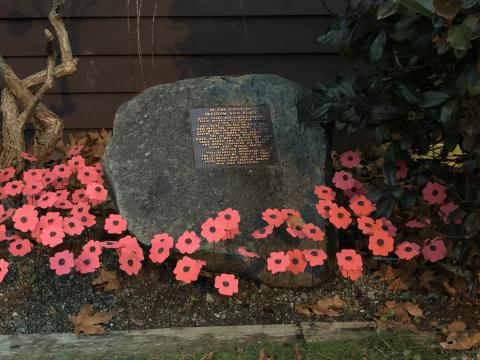
DEDICATED IN MEMORY OF
FIRST NATIONS VETERANS
WHO SERVED
IN THE ARMED FORCES.
NOVEMBER 11, 1994
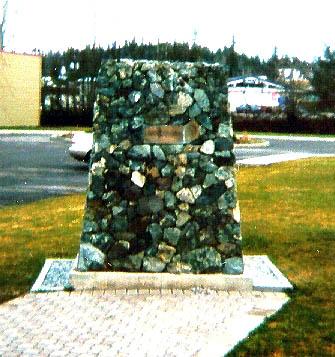
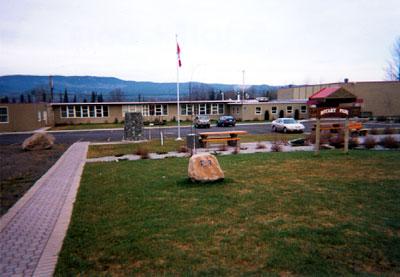
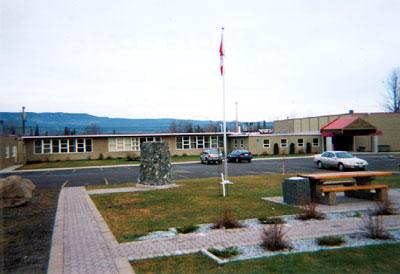
On 28 May 2023, the Nicola Valley First Nations Veterans Association unveiled the finished memorial at the Lower Nicola Indian Band Land (Nicola Mameet - Shulus). Prior to 2005, a group of Veterans and volunteers relocated a large boulder and placed four plaques representing the First World War, Second World War, Korean War, and Vietnam War. A tribute to the late Barney Stirling, the late Paddy Stirling, the late Don Moses, the late John F. Isaac, Percy Joe, Richard Jackson and many other Veterans and volunteers who ensured the First Nations Veterans were remembered, recognized, and respected. The Nicola Valley First Nations Veterans are honoured annually on Remembrance Day.
The original memorial is part of the new monument, which includes three pillars inscribed with the names of 66 First Nations Veterans which includes six who did not make it home and nineteen who recently received a military marker from the Last Post Fund. The back of the monument displays four photos of Veterans who served in either the First World War, Second World War, Vietnam War, or as peacekeepers and artwork, meant to embody freedom, created by a grade 8 Indigenous student from Princeton.
On the site, five steel feathers created by Syilx artist Clint George represent the five local First Nations, and a ceremonial fire pit honours and remembers children with the inscription "Every Child Matters".
This street was named by the Town of Princeton for the Royal Engineers or "Sappers".
1859 1927
IN COMMEMORATION
OF THE WORK OF
HER MAJESTY'S ROYAL ENGINEERS
AND IN RESPECTFUL ADMIRATION OF THE
SKILL AND ENERGY DISPLAYED BY THEM
FROM 1859 TO 1863 IN THE CONSTRUCTION OF
THE ORIGINAL CARIBOO HIGHWAY
THROUGH THE FRASER CANYON
THIS TABLET IS ERECTED AND DEDICATED
BY
THE ENGINEERING INSTITUTE OF CANADA
AND
THE ASSOCIATION OF PROFESSIONAL ENGINEERS
OF BRITISH COLUMBIA
ANNO DOMINI MCMXXVI
The Royal Engineers Memorial was erected in 1926 by the Engineering Institute of Canada and the Association of Professional Engineers of BC in honour of the Royal Engineers who built the original Cariboo Highway. The original plaque was stolen, and the Ministry of Transportation fabricated and installed a replacement plaque.
Laura Johnson was commissioned by the Royal Canadian Legion Okanagan Falls to paint a mural in 2019. The veteran's tribute features waving flags, fighting vehicles and six soldiers' silhouettes.
[front/devant]
Carving in relief of a maple leaf reading - KOOTENAY OVERSEAS BATTALION 54, B.C. CANADA
IN LOVING MEMORY
OF THE
HEDLEY BOYS
WHO FELL IN THE WAR
1914 - 1918
[plaque]
1939 - 1945
CPL. JAMES ANGLIN
CAN. SCOTTISH
CPL ERNEST CLUE
B. C. DRAGOONS
LIEUT. ART. FRENCH
SEARFORTHS
F.O. WALT MATTHEWS
R.C.A.F.
[right side/côté droit]
PTE. CHAS. CHRISTIANA
15TH CAN. INF. BN.
PTE. ARTHUR COLES
2ND C.M.R.
PTE. SYD. EDWARDS
15TH CAN. INF. BN.
PTE. JACK LORENZETTO
25TH CAN. INF. BN.
PTE. THOS. CALVERT
H.Q. STAFF.
PTE. JOHN W. MCLINTOCK
11TH CAN. RR. BN.
[left side/côté gauche]
SGT. A. P. MARTIN
L.CPL. B. W. MILLS
PTE. ROD. MACDOUGALL
PTE. R. W. ROBERTSON
PTE. B. A. SCHUBERT
OF THE 54TH CAN. INF. BN.
KILLED IN ACTION
PTE. E. W. VANS
54TH CAN. INF. BN
DIED ON SERVICE
L.CPL. WM. H. HENDERSON
102ND BN.
The Hedley Cenotaph was built between August and December 1919 and unveiled on December 14, 1919. The local newspaper reported intentions to mount machine guns with the cenotaph, but this never happened. The town of Hedley gave much during the First World War in terms of time, money and lives. The Hedley women knitted socks and other comforts for the men at the front and the work force as a whole, at both the mine and the stamp mill, contributed weekly into a Patriotic Fund that provided additional income for the troops and their dependents. By the war’s end so many Hedley men had been killed or wounded and the money grew into a significant sum. The money was distributed to the surviving Veterans and $1,000 set aside to build a monument to the fallen. A war monument committee was formed, chaired by Lieutenant Tom Knowles, with Captain Alec Jack and Private Joe Rotherham, all from the 54th Kootenay Battalion and part of a group of 17 men who volunteered together from Hedley in August of 1915.
Six of the men on the cenotaph are from the 54th Kootenay Battalion and of those, five were from the original group of 17 who signed up together. When these 17 men left Hedley on August 24, 1915, they gathered at the exact location of the future cenotaph and had a group photo taken. There was a big send-off. All the townspeople gathered, the children were let out of school and the town brass band played. The recruits left Hedley in a caravan of vehicles draped with banners which read, "Recruits from Hedley, the Machine Gun Town."
Through the years the cenotaph has stayed in its same spot. Originally surrounded by railings, these were eventually removed after one too many car crashes endangered the monument, and a sturdy stone wall was built. A bronze plaque was later added at the base of the cenotaph with four names from the Second World War. On August 26, 2017, the Hedley Cenotaph was re-dedicated after restoration work in June 2017, to restore the lead lettering and add the names of two more men from Hedley who were killed in the First World War. Hedley residents, Jennifer Douglass and Andy English, devoted approximately three and a half years researching the names on the cenotaph and discovered the two names that should have been included. Repairs to the cenotaph were completed by stonemason Andrew Swinley.
[on map/sur la carte]
Captain Grant Creek
Captain Grant Creek is named in honour of Captain John Marshall Grant, Royal Engineers. The creek was named on December 15, 1981 by the Government of British Columbia.
Captain John Marshall Grant was born at sea in 1822. He attended the Royal Military Academy Woolwich where he was commissioned into the Royal Engineers in January 1842. By May 1855, he had been promoted to Captain and in September 1858 sailed to Canada as the Senior Captain of the Columbia Detachment under Colonel Moody. Arriving in Esquimalt in November 1858, Grant proceeded to the RE encampment at Fort Langley but by spring 1859 had built a home in Queenborough (which would later be renamed New Westminster). With the Detachment’s mandate to establish order and assist in the settling of the Lower Mainland, Grant soon became involved in numerous projects including the surveying and construction of the Hope Trail and Cariboo Trail, improvements to the Dewdney Trail into an all-weather wagon road, the design and construction of Christ Church Anglican in Hope and Various improvements in New Westminster. The Detachment was disbanded in 1863 and Captain Grant returned to England where he retired as a Colonel in 1882. He died in Bournemouth in April 1902.
Selby Park in Penticton, British Columbia, was named in honour of Eric Selby, who by the luck of a draw was the first veteran to choose a lot in West Bench, Penticton in 1952. With the naming, the tribute included a new wheelchair accessible ramp and stairs to Selby Park, sculptures, pathways and tables, and a map of the original Veterans’ Land Act subdivision of 1952 and 1957. There are bronze plaques in the area that list the approximately 180 names of Veterans of the Second World War who settled in the West Bench community. The community overlooking Penticton was created under the VLA to provide housing and a source of agricultural income to those coming home from the war.
In the park there is a bright yellow sculpture that depicts a soldier holding a gun in one hand and his wife’s hand in the other. The soldier is also shown with a piece missing from his midsection. The sculpture is meant to make people think and consider what life was like for Second World War veterans who settled there with assistance provided under the Veterans’ Land Act.
Sue Gibbons, the daughter of the late Navy veteran Bob Jenkins, set the wheels in motion in 2009 to provide the recognition. She approached the Area F Parks Commission and the Regional District of Okanagan-Similkameen. In 2010, the RDOS applied for and received $18,000 in federal matching grants for park upgrades. The Veterans; Tribute in Selby Park came into being thanks to a grant from Veterans’ Affairs Canada. The park designers were architect Chris Allen, and Cal Meiklejohn. The RDOS received a maximum of $24,520 through the Community War Memorial Program.
[plaque]
Jonathan Sutherland Snyder
Born:
December 1981, Penticton, British Columbia
Attended:
Uplands, O'Connell & Penticton Secondary Schools
Graduated:
Penticton Secondary School 1999
University of Victoria, British Columbia BA 2003
Died:
Afghanistan June 7, 2008
[plaque]
Captain Jonathan Sutherland Snyder UE SMV
Joined Canadian Armed Forces September 1999
Joined 1-Princess Patricia's Canadian Light Infantry
September 2003
Died Afghanistan June 7 2008
Awarded the Star of Military Valour June 2008
Verity
Trusted, Respected, Admired
A Soldier's Soldier
A Good Friend's Friend
Chin Down Moral Courage
Valour Under Fire
Sans Guile, Sans Gall, Sans Per
Be like Jon! - LCol Ian Hope, PPCLIs
This walkway and monument was dedicated on 4 June 2013 in honour of Captain Jonathan Sutherland Snyder, SMV.
Born in Penticton, British Columbia, on 20 December 1981, Jonathan graduated from Penticton Secondary School in 1999. From the age of 12, Jonathan was an army cadet and joined the Army in September 1999 as an Regular Officer Training Plan candidate. Graduating from the University of Victoria in 2003, Jonathan served in the 1st Battalion, Princess Patricia’s Canadian Light Infantry based in Edmonton. He had three overseas deployments, serving as a platoon commander in Afghanistan for eight months in 2006, in Abu Dhabi, United Arab Emirates, for three months in 2007, and again in Afghanistan in 2008 as part of the mentoring program, training troops in the fledgling Afghan National Army.
Just days prior to his death, while on patrol in Kandahar with Canadian and Afghan soldiers, his team was attacked on three sides. Snyder displayed extraordinary courage under fire and managed to battle to safety, saving the lives of dozens of Afghan and Canadians. For his bravery and leadership under fire, he was awarded the Star of Military Valour, Canada’s second highest award. Three days later on 7 June 2008 while on a night patrol in Zhari District, Snyder slipped into an unmarked irrigation well and, due to the weight of his equipment, was unable to stay afloat and drowned.