Ontario

Province Code
ON
City/Municipality
Alvinston
Memorial Number
35039-001
Type
Address
3251 River Street
Location
Alvinston Library
in Canada
Yes
GPS Coordinates
42.8209999, -81.8622468
Inscription

[front/devant]
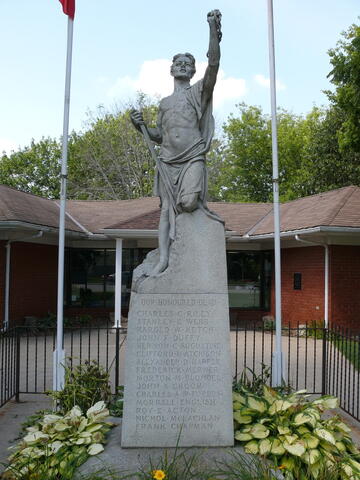
OUR HONOURED DEAD
CHARLES G. RILEY
STANLEY E. WEBB
HAROLD W. KETCH
JOHN F. DUFFY
VERNON C. AUGUSTINE
CLIFFORD H. ATCHISON
ALEXANDER D. HAPPER
FREDERICK MERNER
MORTON M. BLONDEL
JOHN A. GROOMS
CHARLES A.W. FORBES
MORRELL ENGLISH
ROY E. ACTON
NICHOL MCLACHLIN
FRANK CHAPMAN

[right side/côté droit]
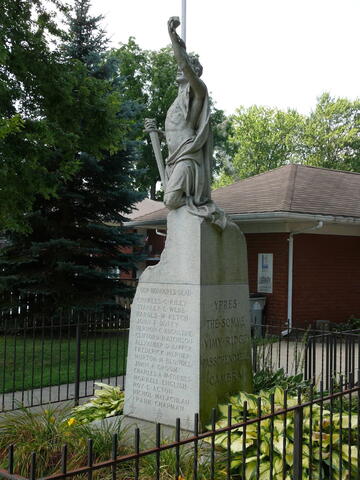
YPRES
THE SOMME
VIMY RIDGE
PASSCHANDAELE
CAMBRAI
MONS

[back/arrière]
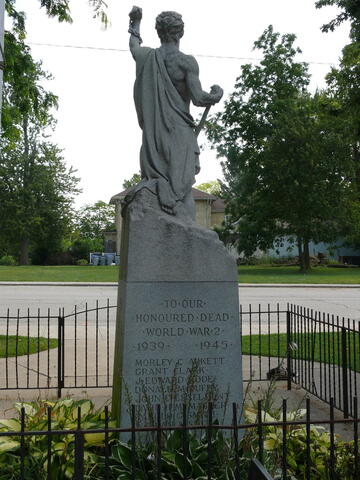
TO OUR
HONOURED DEAD
WORLD WAR 2
1939 1945
MORLEY C. AUKETT
GRANT CLARK
J. EDWARD CODE
DONALD M. DUFFY
JOHN C. ESSELMENT
DAVID H. MCMASTER
HAROLD G SMITH
WELLAN A. SMITH

[left side/côté gauche]
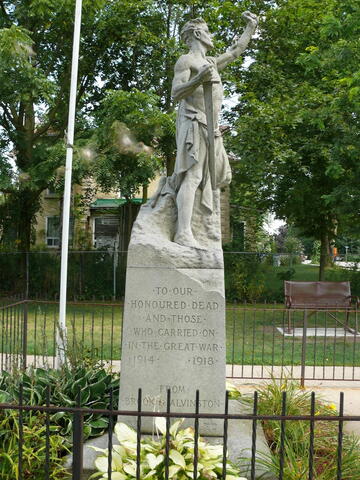
TO OUR
HONOURED DEAD
AND THOSE
WHO CARRIED ON
IN THE GREAT WAR
1914 - 1918

FROM
BROOK & ALVINSTON

Image
Caption
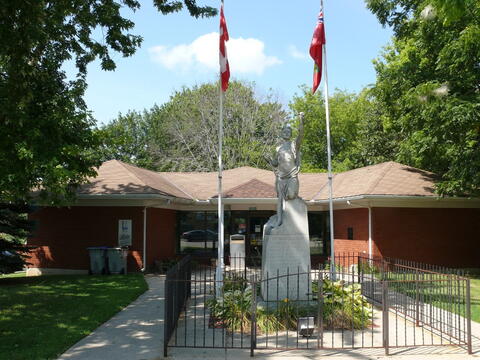
Alvinston Cenotaph
1 of 6 images
Image
Caption
surroundings
1 of 6 images
Image
Caption
right side
1 of 6 images
Image
Caption
back
1 of 6 images
Image
Caption
left side
1 of 6 images
Image
Caption
statue
1 of 6 images
War or Conflict Term
Province
!4v1622729210977!6m8!1m7!1sZmMTeow5oDLBqkCjKUCkzw!2m2!1d42.82100087749683!2d-81.86224580802998!3f286.10309444185157!4f2.1441456509351298!5f2.299968626952992
Body Content

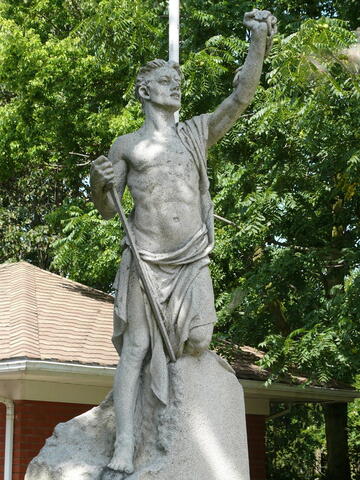
On June 29, 1921, the Alvinston Cenotaph was unveiled, with great ceremony, to honour the local men killed in the First World War. The statue was sculpted by Emanuel Hahn for the Thomson Monument Company of Toronto. Toronto’s own Ned Hanlon modelled for the statue, which depicts a soldier draped in cloth, holding a down turned sword in one hand, symbolic of the end of conflict, and holding up broken chains in the other - symbolic of freedom. Names of the men lost in the Second World War were inscribed after 1945.

The statue has a twin located in Toronto (Malvern), Ontario. In 2011, the sword on the Alvinston statue was used as a reference to create a copy of the missing sword on the Malvern statue. 

Emanuel Hahn moved to Toronto at the age of seven with his family of artists and musicians from Germany, in 1888. He studied commercial design and model-making at Toronto Technical School and Ontario College of Art and Industrial Design. At 25 years old Hahn began a nearly lifelong contract with Thomson Monument Company of Toronto. Two years later, he also started work as a studio assistant to sculptor Walter Seymour Allward. Part of his duties included assisting on Allward’s significant works such as the South African War Memorial in Toronto.

In 1912 Hahn began an association with the Thomson Monument Company of Toronto. It was there, along with several assistants, he made the many war memorials that are found across Canada: Fernie, British Columbia; Killarney and Russell, Manitoba; Alvinston, Bolton, Cornwall, Hanover, Lindsay,  Malvern, Milton, Petrolia and Port Dalhousie, Ontario; Gaspe, Quebec; Moncton, New Brunswick; Springhill and Westville Nova Scotia; Summerside, Prince Edward Island.

Hahn is probably most famous as the designer of the Bluenose on the back of the Canadian dime and the Caribou on the back of the Canadian quarter. He was a victim of anti-German sentiment in the years following the Great War, when his design for the Winnipeg Cenotaph was rejected in 1925. 

City
Alvinston
Country
Type Description
Shaft, statue - granite
Photo Credit
Tim Laye, Ontario War Memorials
Memorial CF Legacy ID
5279
City/Municipality
Waterloo
Memorial Number
35038-009
Type
Address
27 King Street N
Location
Canadian Imperial Bank of Commerce
in Canada
Yes
GPS Coordinates
43.4658116, -80.5225826
Inscription

IN MEMORY OF 1701 MEN OF THE CANADIAN
BANK OF COMMERCE WHO SERVED IN
THE GREAT WAR 1914-1918

LT H.G. HAZELTON
SGT C.R. KRANZ
SPR W.R. DIERLAMM

WATERLOO ONT
BRANCH

War or Conflict Term
Province
!4v1680187699723!6m8!1m7!1sQEf_dwyULZbIxTAr3UiCAw!2m2!1d43.46581157732391!2d-80.52258257316187!3f264.5028504387693!4f2.546378940394206!5f0.7820865974627469
Body Content

In addition to the monument at its head office in Toronto, the Canadian Bank of Commerce honoured employees from each branch who served in the First World War. This plaque was commissioned shortly after the war and dedicated to the bank's 1701 employees who served in the war, 321 laid down their lives. The names of three employees of the Waterloo Canadian Bank of Commerce who served in the war are listed on the plaque.

The plaque features the caduceus logo of the bank - two snakes winding around a winged staff at the upper left, and two poppies intertwined with a symbolic olive branch at the lower right. The Canadian Bank of Commerce went to great lengths to commemorate its staff that served in the war including a two-volume book of staff profiles and accounts of their war experiences.

City
Waterloo
Country
Type Description
Plaque
Memorial CF Legacy ID
11629
City/Municipality
Waterloo
Memorial Number
35038-008
Type
Address
315 Weber Street North
Location
Facing the Kitchener Waterloo Naval Association
in Canada
Yes
GPS Coordinates
43.4807147, -80.522901
Image
Photo Credit
Victoria Edwards
Caption
Mural
1 of 4 images
Image
Caption
Mural
1 of 4 images
Image
Caption
Mural
1 of 4 images
Image
Caption
Mural
1 of 4 images
Province
!4v1622741153363!6m8!1m7!1sFIaQwGauzGpLBk2xFGFdcQ!2m2!1d43.48071469496352!2d-80.52290102213456!3f174.88229288539463!4f-1.4908914795943815!5f0.7820865974627469"
Body Content

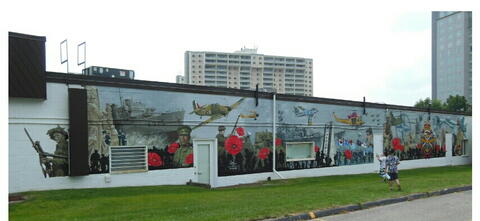
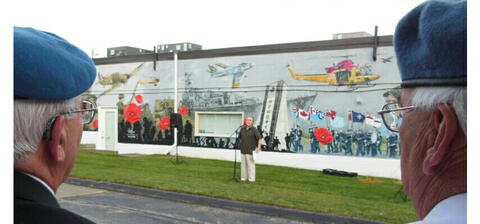
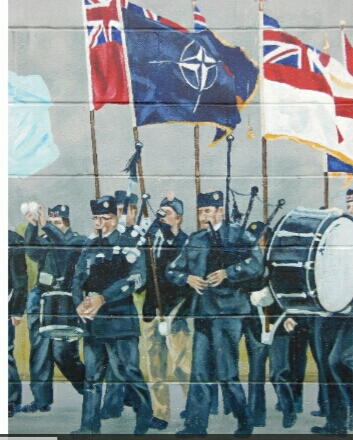
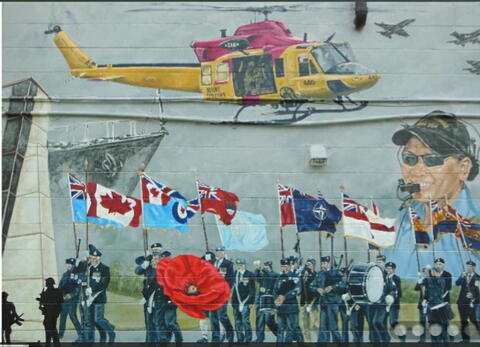
Military Memorial featuring aircraft, ships, vehicles and personnel from the Great War to the War in Afghanistan. The mural was painted by Cliff Smith.

City
Waterloo
Country
Type Description
Mural
Memorial CF Legacy ID
9744
City/Municipality
Woolwich Township
Memorial Number
35038-007
Type
Address
Memorial Avenue and Arthur Street S
Location
Memorial Avenue meets Arthur Street - It is front and centre, the main gateway when you are coming into Elmira (from the south).
in Canada
Yes
GPS Coordinates
43.5942934, -80.5607804
Inscription

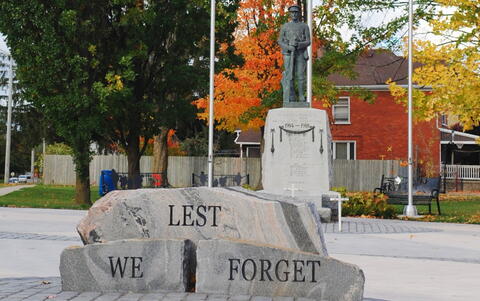
Elmira Cenotaph - Lest we forget

Image
Photo Credit
Victoria Edwards
Caption
Elmira Cenotaph
Province
!4v1622566558976!6m8!1m7!1sBD-MrMhoYHas9invevrGTw!2m2!1d43.59429339940367!2d-80.560780413064!3f40.321377068303065!4f-4.899774030779298!5f0.7820865974627469"
Body Content

Originally erected nearly 100 years ago with a marble statue, the soldier standing to attention at Memorial was replaced in 2010 with the current bronze figure, in 2016 the surrounding area that has been upgraded in time for the Legion’s Nov. 6 Remembrance Day ceremonies, and members incorporated a rededication ceremony into their usual schedule. Elmira Legion past-president Kirk Genereux and others campaigned for an update at the site, which previously was home to a rectangular planter, surrounded by grass. Now, there is an elaborate stonescape carpeting the spot, with a new stone monument bearing words repeated every year around Remembrance Day: Lest we forget. Benches were also installed on the north end of the plot, giving visitors a spot to sit and reflect. The project cost around $96,000 with some coming from the Legion, some coming from a Canada 150 grant, and the remainder from the capital projects budget from Woolwich Township. In the stone work, they stamped the maple leaf, tying in the Canada 150 celebrations. Now, it is more accessible to those that require assistance moving, such as those in wheelchairs. 

City
Woolwich Township
Country
Type Description
Sculpture
Memorial CF Legacy ID
9479
City/Municipality
Waterloo
Memorial Number
35038-006
Type
Address
20 Regina Street South
Location
At the Waterloo Cenotaph between Laurel Creek and the CNR Railway Tracks
in Canada
Yes
GPS Coordinates
43.4642339, -80.5201661
Inscription

In recognition and memory of the efforts of approximately 40,000 Canadian Armed Forces personnel who served and the 162 Canadians who died in the cause of bringing peace and freedom to the people of Afghanistan.

Canada Company

Image
Photo Credit
John Griffin, Ron Ormson
Caption
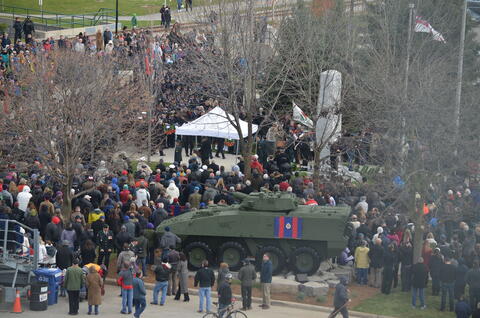
LAVIII during dedication ceremony at the Waterloo Cenotaph on 11 November 2016.
1 of 3 images
Image
Caption
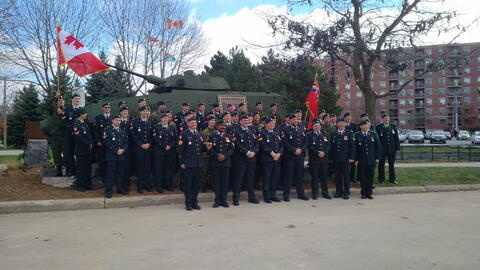
48 Engineer Squadron of 31 Combat Engineer Regiment (The Elgins) pose in front of the LAV III monument on 11 Nov 2016.
1 of 3 images
Image
Caption
Waterloo's LAVIII Monument Hull # APC (CDN) 411-00
1 of 3 images
Province
!4v1622741406907!6m8!1m7!1sBsYHEKyEhXgfm9zLZ7GiHA!2m2!1d43.46423388747073!2d-80.52016614477715!3f52.73906494556048!4f-1.5922063569220626!5f1.0689607382621438"
Body Content

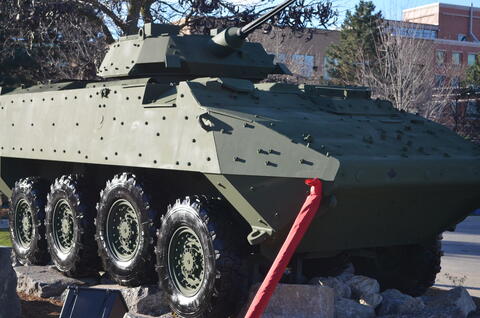
This LAV III Monument honours the members of our Canadian Armed Forces who served to protect our way of life and freedoms during the post 9/11 war on terror in Afghanistan from 2001 to 2014.

During their 12+ years in Afghanistan our troops were regularly confronted with enemy fire, suicide bombers and Improvised Explosive Devices (IEDs). The Canadian made LAV IIIs’ superior technology offered a great defense and soon became relied upon to protect our troops and preserve lives during the conduct of a variety of missions to help restore peace and government to the people of Afghanistan.

The LAV III became a "home away from home" for many soldiers and now it has returned to our hometown in the form of a memorial to say “thank you” to these very troops for their efforts and sacrifices. This monument - located next to the municipal cenotaph - will provide our citizens a place to pay tribute to our modern-day veterans of Afghanistan and to ensure that our local Fallen Heroes of that conflict will be forever remembered. It also serves as a lasting tribute to the families of all of those members of the Canadian Forces, both Regular and Reserve, who’s lives were forever impacted by the deployment of their loved ones.

The LAVIII is the modern-day equivalent of a RAM Tank Kangaroo Carrier developed by Canadian Troops during the invasion of Normany in World War II and used by Allied Forces. It was developed by General Dynamics Land Systems, formerly GM Defense, of London, Ontario.

City
Waterloo
Country
Type Description
Canada Company LAV III Monument
Memorial CF Legacy ID
9449
City/Municipality
Waterloo
Memorial Number
35038-005
Type
Address
154 King Street N
Location
St Sophia Ukrainian Orthodox Church
in Canada
Yes
GPS Coordinates
43.4713211, -80.5238927
Inscription

[front/devant]

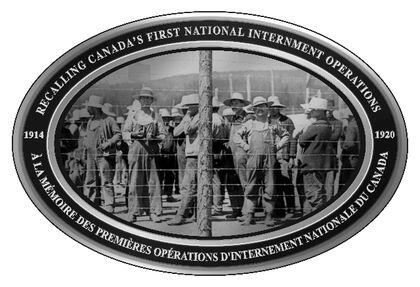
Recalling Canada's First National Internment Operations 1914-1920

A la mémoire des premières opérations d’internement nationale du Canada 1914-1920

Image
Province
!4v1622741685641!6m8!1m7!1sNldI0OaWh8okfF5RwQMaMg!2m2!1d43.47132112359403!2d-80.52389270321547!3f39.03925122966657!4f10.632660836729883!5f1.6161055052433104"
Body Content

This memorial recalls a historic injustice Canadians should pause to remember, as we recall the First World War and the valour of all those Canadian men, and some women, who served. It is a tribute to mark the memory of the thousands of "enemy aliens" who had their civil rights stripped, and were subsequently imprisoned during Canada's first national internment operations of 1914-1920, following the implementation of the War Measures Act. 2014 marks the 100th anniversary of the War Measures Act - adopted on August 22, 1914 during the First World War. It was used to imprison Ukrainian-Canadians, and other ethnic groups, including German, Hungarian, Serbian, Croatian, and Armenian communities, into one of Canada's 24 internment camps.

Dr. Lubomyr Luciuk, a professor at the Royal Military College of Canada and former chair of the Ukrainian Canadian Civil Liberties Association (UCCLA), had taken it upon himself to lead the way and organize the memorial. In the CTO ("One Hundred") project, 100 aluminum plaques were simultaneously unveiled at 100 different locations across the country at 11:00am local time on August 22, 2014. The first plaque was unveiled in Amherst, Nova Scotia, followed by a wave of plaque unveilings moved west, from province to province, culminating in Nanaimo, British Columbia. The plaques, which cost $1,000 to make, were funded by the generosity of the Endowment Council of the Canadian First World War Interment Recognition Fund.

Each plaque features a photo of internment prisoners confined behind a wire fence at the Castle Mountain Internment Camp in Banff, Alberta. The Castle Camp, which was built in 1915 at the base of Castle Mountain, was a Canadian internment camp which held immigrant prisoners of Ukrainian, Austrian, Hungarian, and German descent.

City
Waterloo
Country
Type Description
Plaque, aluminum
Memorial CF Legacy ID
8748
City/Municipality
Waterloo
Memorial Number
35038-004
Type
Address
50 University Avenue West
Location
Veterans' Green
in Canada
Yes
GPS Coordinates
43.4756739, -80.5284602
Inscription

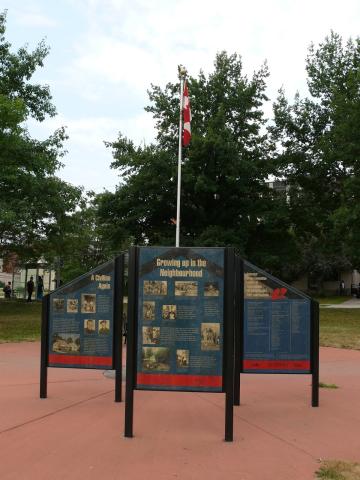
[storyboard/scénarimage]

(front/devant)

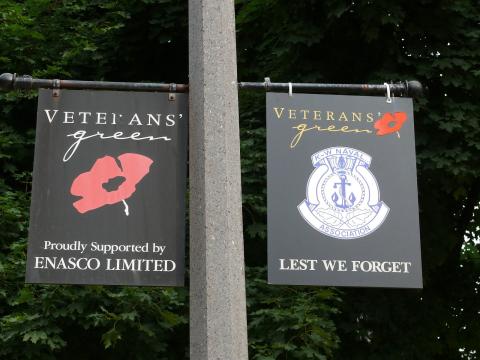
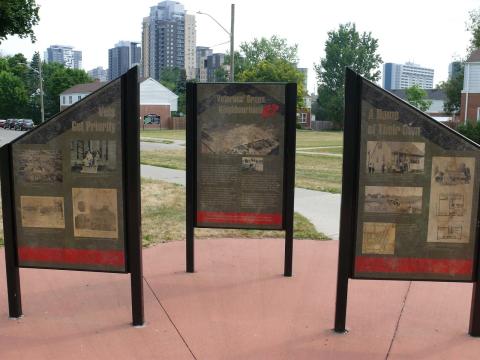
Veterans' Green
Neighbourhood

Over one million Canadians enlisted for
military service during the Second World
War. For those who returned home, housing
shortages were widespread. Recognizing the
need for housing local, the Town of
Waterloo and Housing Enterprises Canada
Limited announced in September 1946, one
of Ontario's first housing projects for
returning Veterans.

In the rural north end of Waterloo, fifty
terrace units were built for rent as part of
the "Hillcrest Development" between
Dearborn (now University Avenue) and Hill
(now Hickory) Streets. A second phase of
construction in 1948 produced 83 1 1/2
storey houses that Veterans could purchase
along Hazel, Beech, Fir and Hickory
Streets.

As families settled in this neighbourhood, a
sense of community produced a yearly skating
rink in this location, a horseshoe pit in the
back of Maple Court and community garden
plots on Albert Street. Local children attended
school at Northdale, MacGregor, St. Michel,
St. David or Waterloo Collegiate Institute.

Family block parties were celebrated in the
1970s and neighbourhood reunions rekindle
the memories of growing up in this area.
Gradually, over the years this community
would become home to many university
students attending Wilfrid Laurier University
and the University of Waterloo.

The redevelopment of this parkette in 2005, the "Year of the Veteran",
commemorates and honours this area's first residents and their families.

(back/arrière)

needs further research/recherche incomplète

[storyboard/scénarimage]

needs further research/recherche incomplète

[storyboard/scénarimage]

needs further research/recherche incomplète

Image
Caption
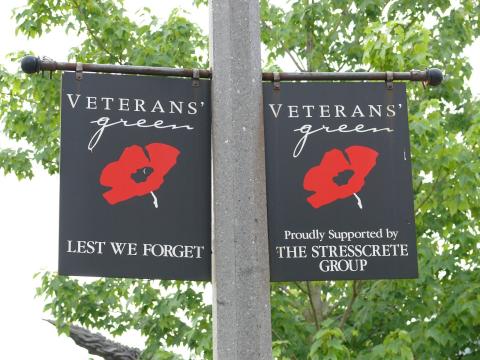
Veterans' Green banners
1 of 4 images
Image
Caption
Veterans' Green storyboards
1 of 4 images
Image
Caption
Veterans' Green storyboards
1 of 4 images
Image
Caption
Veterans' Green banners
1 of 4 images
War or Conflict Term
Province
!4v1709907620117!6m8!1m7!1shHeZxMd3ExREOBMhSCb-Rg!2m2!1d43.47567393226571!2d-80.52846016039715!3f57.40916426631655!4f1.1365079673782361!5f2.1270700180686197
Body Content

Over one million Canadians enlisted for military service during the Second World War. For those who returned home, housing shortages were widespread. Recognizing the need for housing local, the Town of Waterloo and Housing Enterprises Canada Limited announced in September 1946, one of Ontario's first housing projects for returning Veterans.

In the rural north end of Waterloo, 50 terrace units were built for rent as part of the "Hillcrest Development" between Dearborn (now University Avenue) and Hill (now Hickory) Streets. A second phase of construction in 1948 produced 83 1 1/2 storey houses that Veterans could purchase along Hazel, Beech, Fir and Hickory Streets.

As families settled in this neighbourhood, a sense of community produced a yearly skating rink in this location, a horseshoe pit in the back of Maple Court and community garden plots on Albert Street. Local children attended school at Northdale, MacGregor, St. Michel, St. David or Waterloo Collegiate Institute.

Family block parties were celebrated in the 1970s and neighbourhood reunions rekindle the memories of growing up in this area. Gradually, over the years this community would become home to many university students attending Wilfrid Laurier University and the University of Waterloo.

The redevelopment of this parkette in 2005, the "Year of the Veteran", commemorates and honours this area's first residents and their families.

City
Waterloo
Country
Type Description
Park, storyboards
Photo Credit
Tim Laye, Ontario War Memorials
Memorial CF Legacy ID
7154
City/Municipality
Waterloo
Memorial Number
35038-003
Type
Address
50 University Avenue West
Location
Veterans' Green
in Canada
Yes
GPS Coordinates
43.4751848, -80.5274727
Inscription

[front/devant]

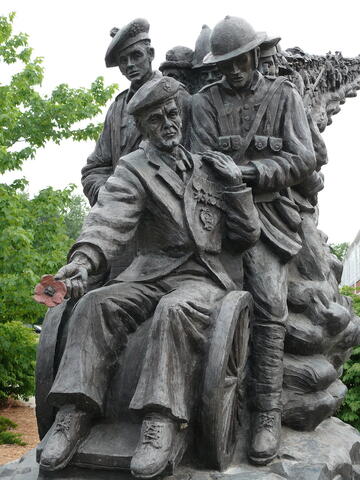
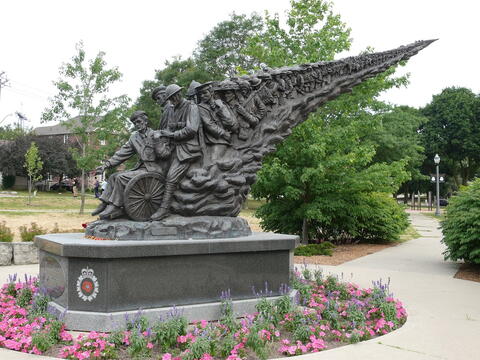
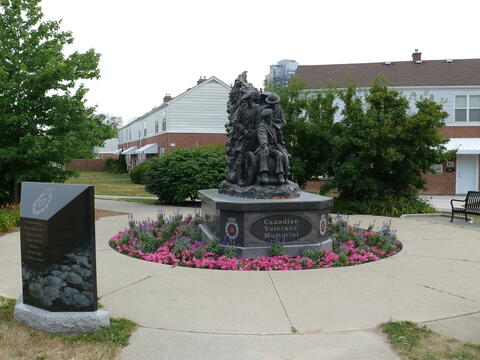
Canadian
Veterans'
Memorial


[stone/pierre]

(front/devant)

From distant eternity
They come back from wars
Fought in each century
To present their brother
The survivor
Who holds a poppy
A challenge to remember.

Timothy P. Schmaltz.

Image
Caption
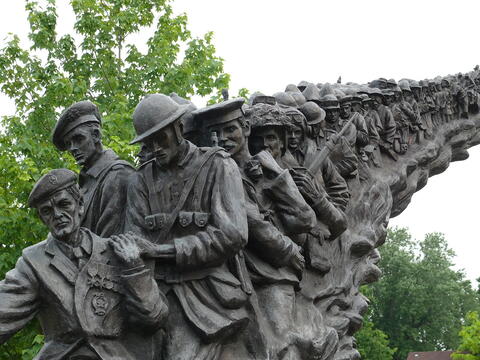
sculpture of soldiers
1 of 6 images
Image
Caption
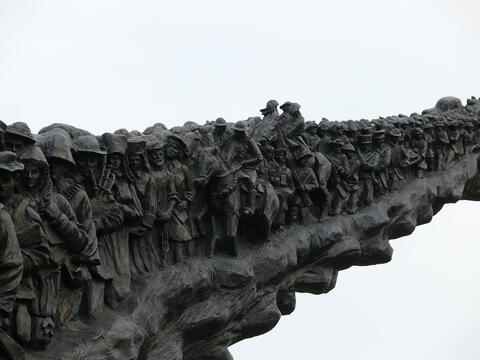
sculpture of soldiers
1 of 6 images
Image
Caption
sculpture of soldiers
1 of 6 images
Image
Caption
Canadian Veterans' Memorial
1 of 6 images
Image
Caption
sculpture of soldiers
1 of 6 images
Image
Caption
Canadian Veterans' Memorial
1 of 6 images
Province
!4v1622742186353!6m8!1m7!1sq8sFcNX1CSI5xfYnGY593w!2m2!1d43.47526991076458!2d-80.5276027122351!3f332.69236796400617!4f-2.187008373669343!5f2.6358776081772204"
Body Content

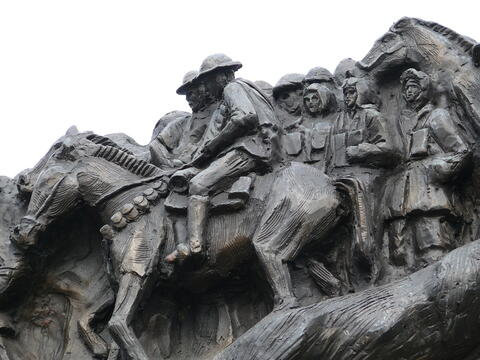
This memorial is dedicated to veterans of all wars and peacekeeping missions that Canada has participated in to date. It was erected by the K-W Naval Association Charitable Trust Fund and unveiled on 5 November 2006. The sculptor Timothy R. Schmalz used historical dress and military gear to represent every war the Canadians have participated in. It depicts the men and women who were lost in these wars as they return to console and present their surviving brother to future generations. It represents both the living and the deceased equally. The veteran at the front of the statue acts as a literal and physical bridge from those who died to those viewing the statue.

City
Waterloo
Country
Type Description
Sculpture
Photo Credit
Tim Laye, Ontario War Memorials
Memorial CF Legacy ID
7152
City/Municipality
Waterloo
Memorial Number
35038-002
Type
Address
Regina Street
Location
Waterloo Peace Grove
in Canada
Yes
GPS Coordinates
43.4646088, -80.5199823
Inscription

needs further research/recherche incomplète

Image
Photo Credit
StemNet
Caption
dedication of new memorial on November 3, 1957
1 of 3 images
Image
Caption
front view of original memorial
1 of 3 images
Image
Caption
original memorial's surroundings
1 of 3 images
Province
!4v1622742561520!6m8!1m7!1sHfIx6g9-DFJ6fBP7fS4McA!2m2!1d43.46460875706229!2d-80.51998228746821!3f154.66714555540432!4f1.0786987656441624!5f3.325193203789971"
Body Content

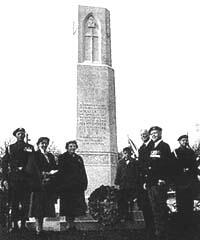
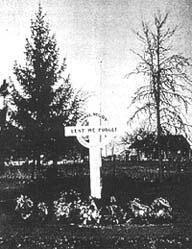
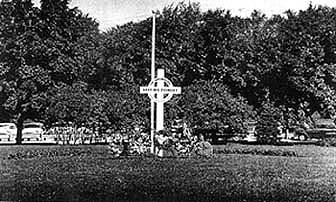
This memorial was constructed in honour of fourteen men of Waterloo who died in the First World War. It was re-commissioned on May 26, 1993, after it was moved from Memorial Park beside Knox Presbyterian Church on Erb Street West. After the First World War, on the Sunday closest to November 11, the citizens of the town of Waterloo remembered their 14 fallen soldiers in various church services. In 1922, it was decided to build a War Memorial in Mount Hope Cemetery, where a soldiers' burial plot had been set aside. On June 18, 1922, the contract was given to Casper Braun, a local mason and monument maker. The granite block bearing a bronze plaque was dedicated by Lieutenant Governor H. Cockshutt with 4,000 citizens in attendance. This memorial was deteriorating in the 1970s and in 1975, Waterloo Royal Canadian Legion members erected an angel stone marker, about three feet high with a plaque bearing the inscription "Our Glorious Dead" on the site. On November 12, 1922, a Twin Cities service of remembrance was held in Lyric Theatre, Kitchener, Ontario. On the previous day, businesses observed a two-minute silence. Work stopped, telephones and telegraph were silent, and no whistles or bells were sounded. The term "Armistice Day" was used after that first Armistice on November 11, 1918, at 11:00 a.m. Between 1923 and 1931, Remembrance Day was merged with the Thanksgiving holiday. After this, the remembrance reverted to November 11, and after the Second World War, Remembrance Day was the term used in this connection. The custom of observing a two-minute silence was initiated with a recommendation to the British Parliament by Sir James Fitzpatrick a South African statesman, gold miner and farmer and author of Jock of the Bushveldt. The first Poppy Day was held in 1928 in the Twin Cities. During the 1930s, official Armistice Day ceremonies for Waterloo were still held in Kitchener at its Cenotaph. It is recorded that S.C. Tweed, MLA, sent a wreath to the town to be placed by the mayor of Waterloo at Kitchener's Cenotaph on November 11, 1933. This procedure continued for several years, although Waterloo churches held their own Remembrance Day services on the appropriate Sunday. Older citizens also recall that services involving the children were held at the Central School memorial. The Civic Park West of the Town Hall, along Erb Street, was created in 1924. About the same time, the Waterloo Horticultural Society proposed the idea of a Memorial Park. The Society suggested planting maple trees, a Canadian symbol, as a remembrance of fallen soldiers. The planting of memorial trees in the park would not only beautify it but would provide a living memorial of the brave Waterloo men who fell in the First World War. In 1925, the beautification of the Civic Park was begun with the financial assistance of the town council. In May 1927, fourteen maple trees were planted as a reminder of the number fallen Waterloo soldiers. But some people were pushing for a more visible war memorial. The Waterloo Council wanted to dedicate Civic Park as a Memorial Park but no action was taken. The citizens of Waterloo felt differently and a move was made to find a plot of land to dedicate a fitting memorial. On June 15, 1933, Mizpah Lodge #820 of the Salvation Army, and a number of interested citizens marched to a triangular park on the Central School grounds. Central School, circa 1939, shows Erza Street buildings in the background (see 35038-002b). A six-foot-high Wooden Cross was dedicated to the Waterloo boys who gave their lives in the First World War. Three Ministers from St. Andrew's Presbyterian Church (Kitchener), Knox Presbyterian Church (Waterloo), and the Evangelical Church (Waterloo) assisted in the ceremonies. In 1957, the Waterloo Centennial Year Committee was formed, headed by Royal Canadian Legion member, Ronald Hines and Mr. Ford S. Kumpf. A fund-raising target of $15,000 was set and the amount was soon raised, enabling work to proceed on the purchase and erection of a 18-foot granite Cenotaph which would replace the wooden cross. The dedication ceremonies were held in the Memorial Park on November 3, 1957. In 1992, some veterans and others were disturbed when Waterloo City Council was asked if the Waterloo Cenotaph could be moved to allow a parking garage to be built for Marsland Centre. Council agreed to the request. After much debate, the site near the city hall on Regina Street was finally chosen although the old Mueller chimney, erected in 1903, had to be sacrificed. Stu Henderson, president of the 404 Wing, K-W Royal Canadian Air Force Association, said it all for the Legion members when he ended his remarks on Dedication Day with the comment, "May it stay there in perpetuity." The granite Cenotaph was moved to the new site near the Waterloo City Hall in 1993. Source: Waterloo Historical Society, Vol. 81, 1993

City
Waterloo
Country
Type Description
shaft
Memorial CF Legacy ID
5509
City/Municipality
Woolwich Township
Memorial Number
35038-001
Type
Address
Memorial Avenue
in Canada
Yes
GPS Coordinates
43.5942657, -80.5606329
Image
Caption
street sign
Province
!4v1634135223881!6m8!1m7!1sXKX0oMbBjQfEGgsZY_5R9w!2m2!1d43.59426571812103!2d-80.56063290199825!3f350.41910803571807!4f-13.644259337206009!5f0.7820865974627469
Body Content

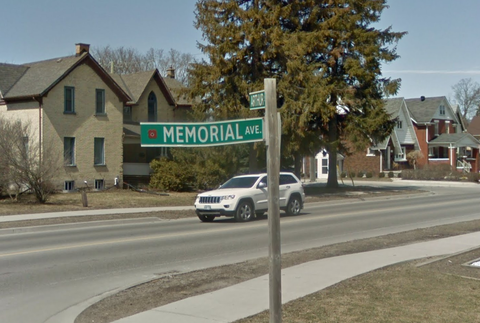
In 1999, it was determined to rectify duplication of street names within the Waterloo Region. There was a duplication of King Street across the Region and King Street in Elmira needed to be changed. With the location of the cenotaph at the corner of King and Arthur Streets, the name Memorial Avenue was suggested to commemorate Veterans. The Legion assisted the Township to have a poppy placed on the road sign.

City
Woolwich Township
Country
Type Description
Street
Memorial CF Legacy ID
10613